
Market pulse: MarketsandMarkets projects the CDP market reaches USD 37.11 BN market size, 2030 as enterprises chase usable customer context across systems. At TechTide Solutions, we treat that growth as a symptom, not the story. The story is fragmentation, consent pressure, and the rising cost of guessing. In this guide, we map what CDPs are, how they work, and which platforms we see win in the real world.
What are customer data platforms? Definitions and scope
Market pulse: the same MarketsandMarkets analysis frames CDPs as core infrastructure for unified profiles and cross-channel activation. That framing matches what we observe in delivery teams. A CDP is less a tool than a discipline, with software as the enabler. Done well, it becomes the “memory layer” for customer experiences.
1. Customer data platforms create a single source of truth by unifying data into real-time customer profiles
A customer data platform centralizes customer context into profiles that teams can actually use. The keyword is “unify,” not “store,” because storage alone rarely changes behavior. In our builds, the profile is a contract between business questions and raw events. Without that contract, a CDP turns into another data lake with a friendlier UI.
Practically, the “single source of truth” is a negotiated truth. Marketing wants household views, while product wants device fidelity. Sales wants account rollups, while support wants case history. Our stance is simple: define “truth” per use case, then back into the model.
2. How customer data platforms work collect harmonize activate and derive insights across channels
Most CDPs follow a loop: collect signals, normalize them, resolve identity, then push audiences out. The loop repeats as new data arrives and consent states change. When the loop is tight, personalization feels natural. When it is loose, campaigns lag behind behavior.
Collection usually starts with web and app events, but it cannot stop there. Offline receipts, call-center notes, and subscription billing often hold the highest intent. From our perspective, ingestion is the easy part. The hard part is preserving meaning across every hop.
3. The data that makes up a CDP emphasizes first-party data with identity resolution and consent
First-party data is the core asset, because it is both durable and defensible. That includes behavioral events, transactions, preferences, service interactions, and product usage. We also see second-party partnerships, but only when contracts are explicit. Third-party enrichment has become less reliable and harder to justify.
Identity resolution is what turns raw signals into a usable customer story. Consent is what makes that story permissible to use. We like to treat consent as a first-class attribute on every profile. That approach prevents “activation surprises” later.
4. Customer data platforms vs CRM vs DMP key differences in data types identity and activation
CRMs are operational systems of record for sales and service workflows. They are great at pipeline stages, tickets, and tasks. They are weaker at high-volume behavioral event capture. A CDP complements CRM by attaching behavioral context to operational records.
DMPs historically focused on audience buying and third-party identifiers. Their data is often short-lived and campaign-shaped. CDPs focus on first-party identity and longer-lived customer history. In modern stacks, we see DMP-like activation features move into CDPs.
5. Who needs a CDP organizations with fragmented tools data silos and cross-team use cases
We recommend CDPs when a business has many channels but no shared customer language. Retailers with loyalty programs feel this pain quickly. Subscription services hit it when onboarding and churn programs diverge. Financial services see it when digital and branch experiences disagree.
A CDP also helps when “reporting truth” and “activation truth” diverge. Analytics may show one segment, while ads target another. That mismatch is common when identity logic lives in spreadsheets. A CDP is justified when coordination becomes expensive.
Quick Comparison of customer data platforms
Market pulse: Gartner forecasts public cloud spending hits $675.4 billion, and CDPs increasingly follow cloud gravity toward faster activation. Our quick comparison favors platforms we see survive real constraints. Those constraints include data contracts, identity ambiguity, and consent propagation. We also weigh how a vendor behaves during implementation, not just on demos.
| Tool | Best for | From price | Trial/Free | Key limits |
|---|---|---|---|---|
| Adobe Real-Time CDP | Enterprises standardizing on Adobe Experience Platform | Custom quote | Demo-led | Complex governance work for clean identity inputs |
| Salesforce Data Cloud | Sales, service, and marketing unification inside Salesforce | Custom quote | Demo-led | Value depends on Salesforce-native activation paths |
| Treasure Data | Large-scale event data and cross-team profile sharing | Custom quote | Demo-led | Requires strong taxonomy to avoid noisy profiles |
| Tealium AudienceStream | Tag-driven collection with fast audience creation | Custom quote | Demo-led | Event semantics can drift without strict governance |
| Twilio Segment | Developer-first collection and broad downstream routing | Free tier | Free tier | Profiles need careful modeling beyond basic traits |
| mParticle | Mobile-heavy products with strict event governance needs | Custom quote | Demo-led | Activation may require extra tooling per channel |
| Amperity | Retail identity resolution and loyalty-grade profiling | Custom quote | Demo-led | Best outcomes require curated offline identifiers |
| ActionIQ | Enterprise audience operations across marketing teams | Custom quote | Demo-led | Depends on upstream data readiness and hygiene |
| Hightouch | Warehouse-native activation and reverse ETL workflows | Free tier | Free tier | Identity needs a separate strategy, not magic syncs |
| Census | Operationalizing modeled warehouse data into SaaS tools | Free tier | Free tier | Audience quality mirrors your warehouse modeling maturity |
We keep this table compact on purpose. A CDP selection is rarely about “best platform” in the abstract. Fit depends on where truth already lives. It also depends on who owns change management.
Top 30 customer data platforms to evaluate
We picked these 30 CDPs to cover three realities: classic “packaged” CDPs, warehouse-first composable stacks, and engagement-led platforms that behave like CDPs in practice. We evaluate each tool on jobs-to-be-done first. That means identity resolution that stops duplicate outreach, audience activation that actually ships, and governance that prevents bad data from becoming expensive data.
Each mini-review uses the same weighted score on a 0–5 scale: Value-for-money (20%), Feature depth (20%), Ease of setup & learning (15%), Integrations & ecosystem (15%), UX & performance (10%), Security & trust (10%), and Support & community (10%). We favor tools that shorten the path from raw events to usable audiences, with fewer handoffs. We also penalize “enterprise tax” friction, like opaque limits, slow onboarding, or locked-in activation routes.
1. Twilio Segment
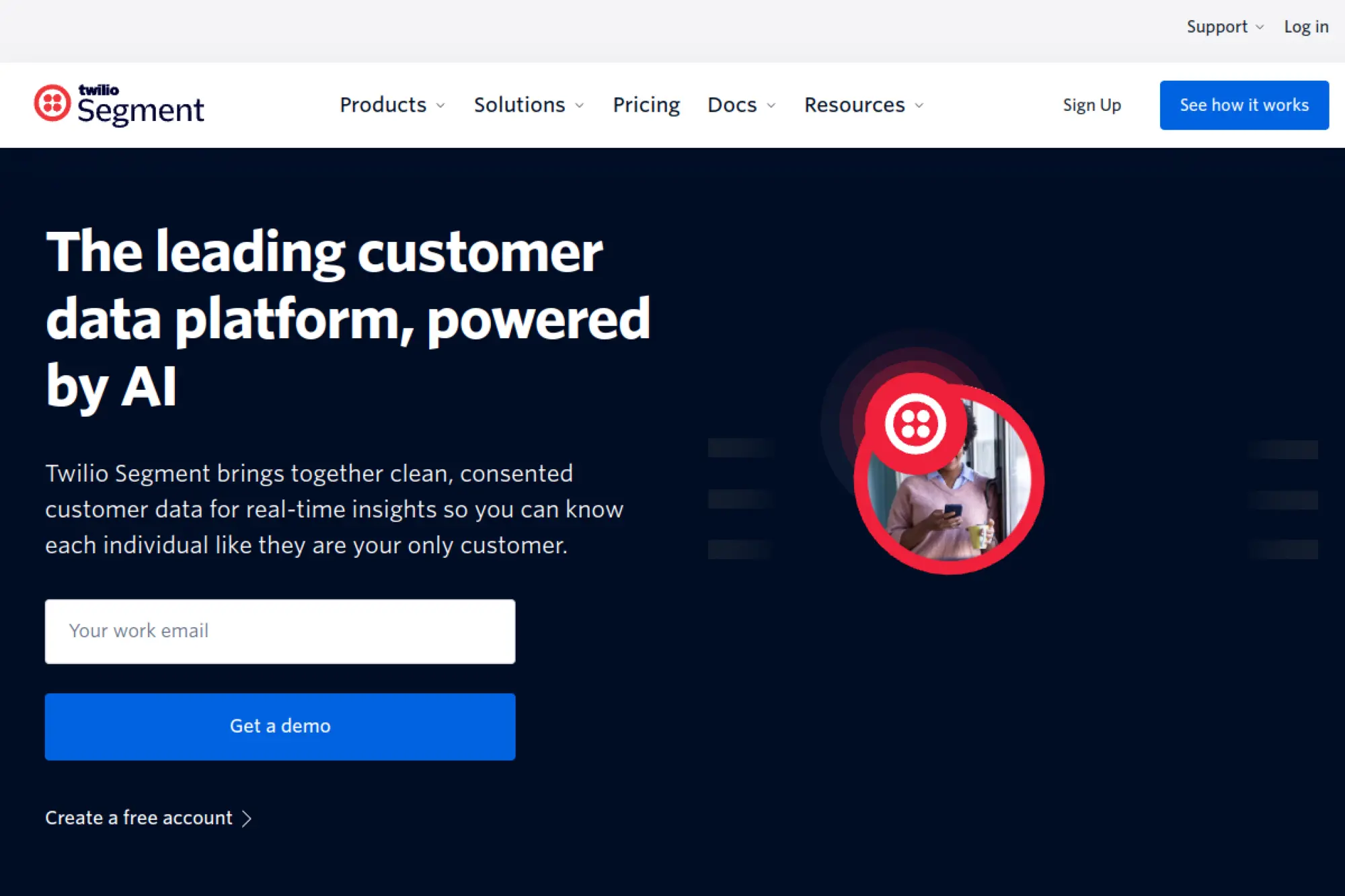
Twilio Segment is built inside Twilio, with a deeply product-led data infrastructure team. The platform still feels like it was designed by engineers for engineers. That bias is a feature when your tracking plan is messy.
Tagline: Standardize events once, then send clean data everywhere.
Best for: product-led companies with analytics teams; SMB data teams that need quick routing.
- Connections pipeline and schema discipline → fewer broken dashboards and cleaner attribution.
- Prebuilt destinations and reverse ETL records → skip 1–2 export/import loops per week.
- Self-serve setup with SDKs → time-to-first-value is often under 1 day.
Pricing & limits: From $0/mo; Team starts at $120/mo with a 14-day free trial. Free includes 1,000 visitors/mo, 2 sources, and 1 warehouse destination. Team includes 10,000 visitors/mo, plus usage-based tracked user scaling.
Honest drawbacks: Costs can jump fast with event growth and tracked users. Advanced profile unification and governance live behind higher-tier CDP plans. Beats many suites at data plumbing; trails audience-led CDPs on built-in journey execution.
Verdict: If you need reliable collection and routing, this helps you ship cleaner data flows in days, not quarters.
Score: 4.2/5
2. Salesforce Data Cloud
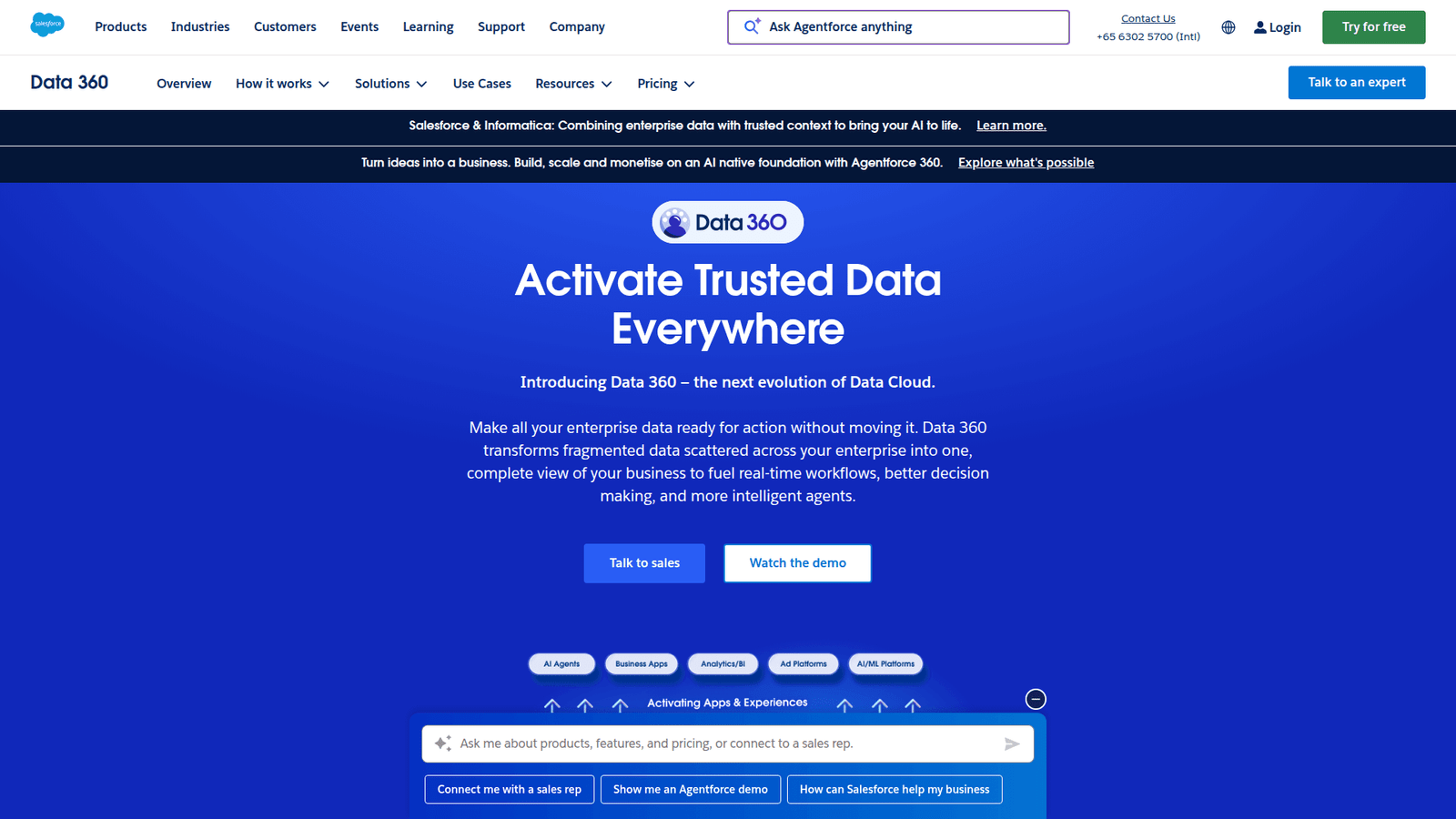
Salesforce Data Cloud is built by Salesforce’s platform and data teams, and it shows. The product is designed to sit close to CRM, service, and marketing execution. It is at its best when Salesforce is already your operating system.
Tagline: Turn enterprise CRM data into real-time profiles for activation.
Best for: Salesforce-first enterprises; revenue ops teams who want fewer data silos.
- Real-time profiles and segmentation → faster personalization without waiting on batch syncs.
- Native Salesforce connectors → saves weeks of custom connector work for CRM data.
- Provisioning inside Salesforce → first use cases can land in 2–4 weeks.
Pricing & limits: From $750/mo for 10k real-time profiles (as listed). Add-ons include items like Data Spaces at $60,000/year (about $5,000/mo). Usage also consumes credits, and storage is billed per TB per month. Trial: Salesforce customers can provision Data Cloud with limited credits and storage.
Honest drawbacks: Credit economics can be hard to forecast across teams. Non-Salesforce ecosystems may face integration drag and higher services reliance. Beats standalone CDPs at Salesforce-native activation; trails warehouse-first tools on cross-cloud neutrality.
Verdict: If you live in Salesforce, this helps you operationalize unified profiles in a few weeks and keep them close to execution.
Score: 4.0/5
3. Adobe Real-Time CDP
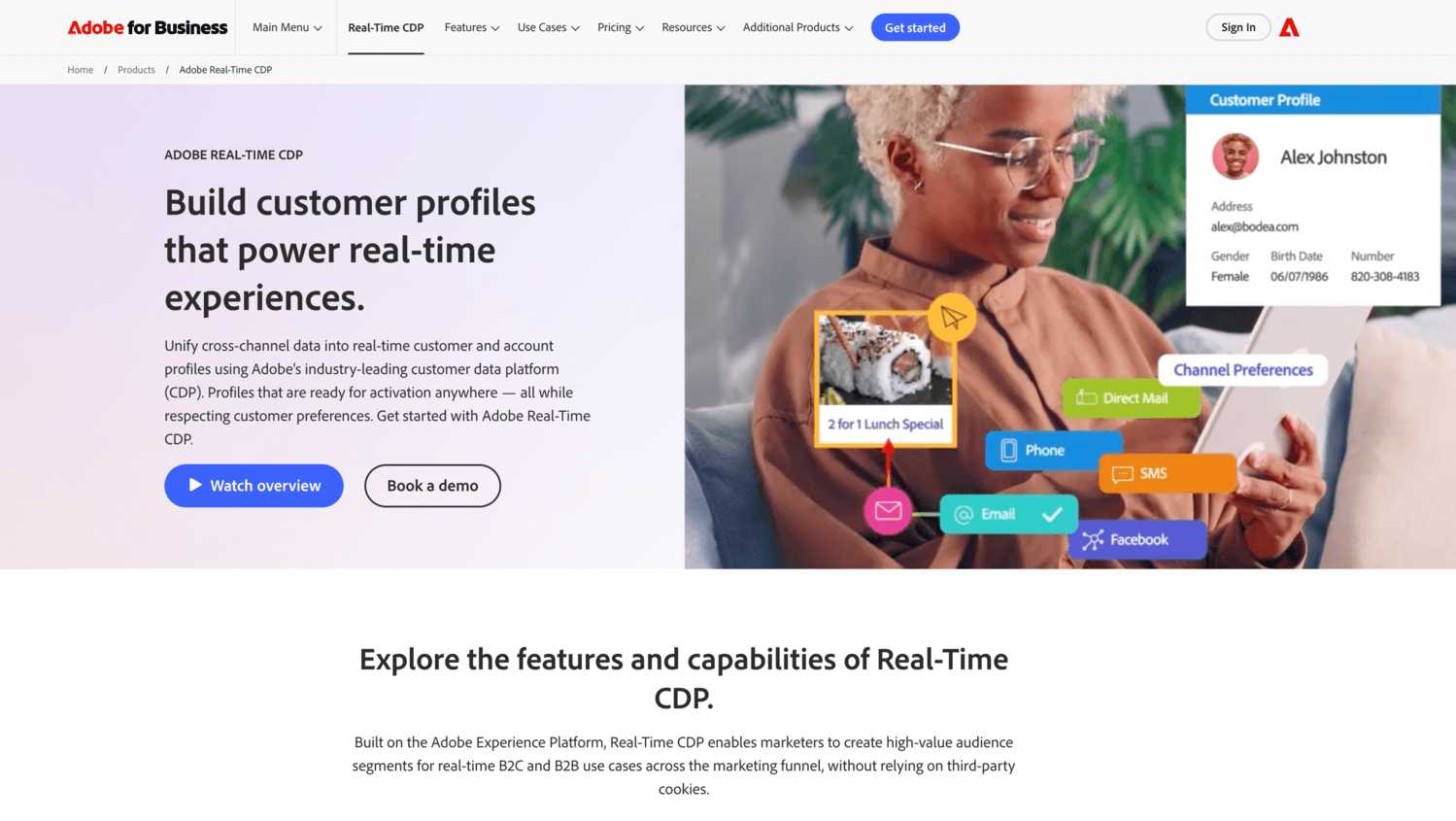
Adobe Real-Time CDP is shaped by Adobe’s Experience Platform teams. It is built for large-scale identity, governance, and omnichannel activation. The product feels like enterprise infrastructure, not a lightweight CDP.
Tagline: Build governed, real-time profiles that power personalization at scale.
Best for: enterprise marketing ops teams; brands already using Adobe Experience Cloud.
- Identity graph and real-time profiles → reduce duplicate messaging across channels.
- Experience Cloud connectors and activation paths → saves weeks of custom wiring in Adobe stacks.
- Structured packaging and entitlements → time-to-first-value is often 4–8 weeks with services.
Pricing & limits: From $Custom/mo (pricing is packaged and quote-based). Trial: an initial implementation/testing access period is granted at no additional cost before the license term. Limits are entitlement-driven, such as per-1,000 profile licensing and caps on outgoing calls per profile.
Honest drawbacks: Cost and implementation effort can be heavy for mid-market teams. Some advanced capabilities depend on licensed add-ons and strict entitlement rules. Beats many rivals on governance depth; trails composable CDPs on DIY speed.
Verdict: If you need enterprise-grade consent and profile activation, this helps you run governed personalization in months, with less risk later.
Score: 3.9/5
4. Tealium AudienceStream CDP
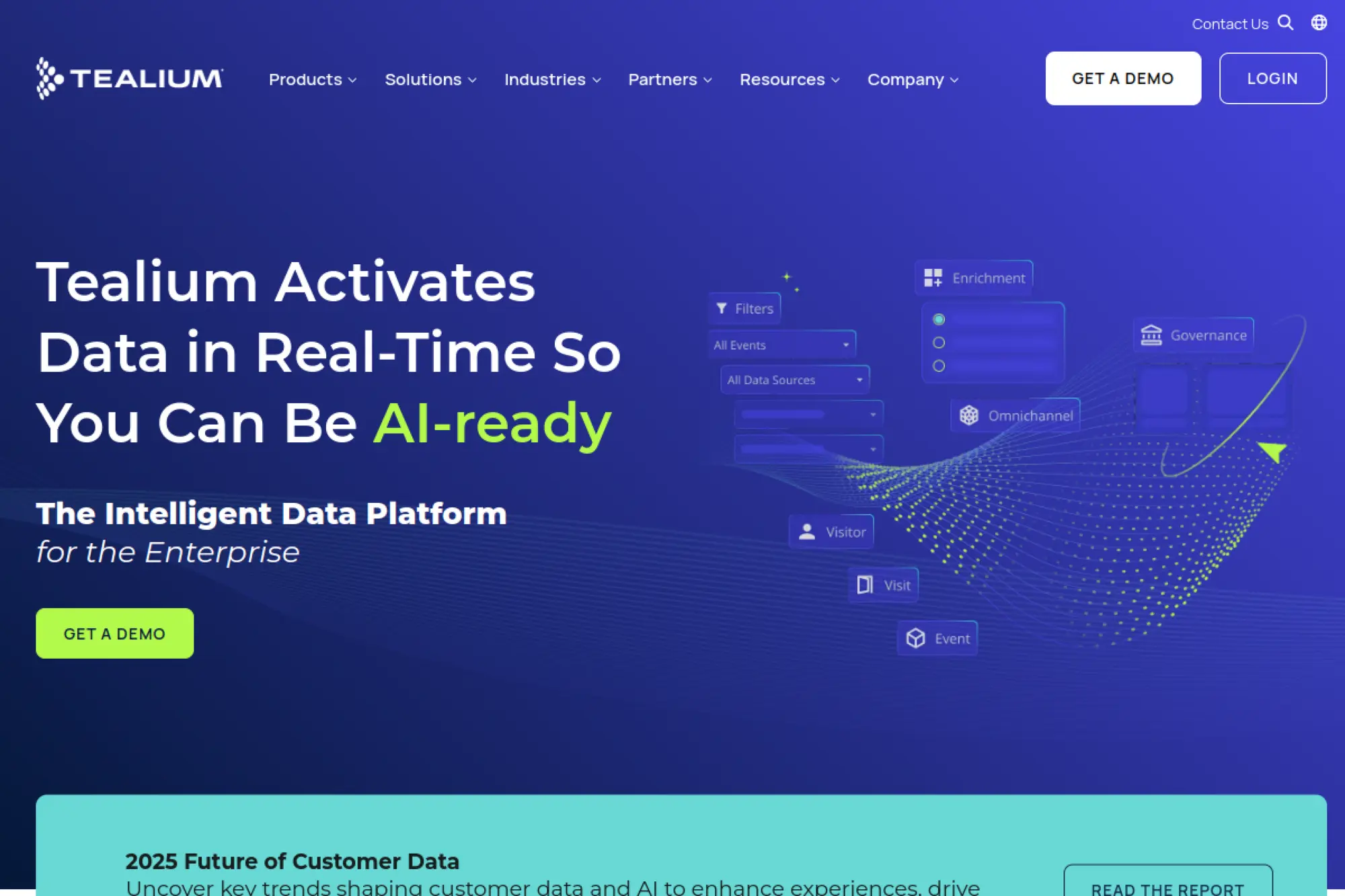
Tealium’s CDP comes from a long-running customer data and tag-management lineage. The team has strong roots in enterprise data collection and governance. AudienceStream is often chosen when “real-time audiences” must be operational, not theoretical.
Tagline: Build real-time audiences and activate them across tools without duct tape.
Best for: enterprise digital teams; privacy-conscious orgs with complex tracking needs.
- Real-time visitor profiles and audience rules → faster suppression and smarter targeting.
- Marketplace destinations plus cloud partners → saves days of manual audience exports.
- Template-heavy configuration → time-to-first-value is often 2–6 weeks.
Pricing & limits: From about $4,167/mo (based on a $50,000/12-month AWS Marketplace listing supporting up to 25M events/year). Trial: no standard self-serve trial is listed on that channel. Caps: event volume and contract entitlements drive limits.
Honest drawbacks: UI and rule complexity can slow new teams. Some implementations need strong governance discipline to avoid “audience sprawl.” Beats many suites at real-time segmentation; trails developer-first pipelines on flexibility.
Verdict: If you need real-time audiences with control, this helps you activate segments reliably within one to two quarters.
Score: 3.8/5
5. Treasure Data CDP
Treasure Data is built by an enterprise data platform team with deep roots in large-scale ingestion. The product aims to bridge IT governance and marketer usability. It is strongest when you need flexibility across warehouse and CDP processing.
Tagline: Unify profiles and run enterprise activation without compute bill anxiety.
Best for: data-rich enterprises; teams balancing marketing agility with IT controls.
- Hybrid CDP approach → keep governance while still enabling fast audience activation.
- Profile and event-based economics → reduces surprise warehouse compute steps and rework.
- POC-style onboarding support → time-to-first-value can be about 2 weeks for a scoped pilot.
Pricing & limits: From $39,000 for a one-month test drive (publicly described in industry coverage). Trial: Treasure Data promotes POC and trial-style programs, often scoped around weeks. Limits: pricing is based primarily on unified profiles and behavioral events, with contract entitlements.
Honest drawbacks: This is not a low-touch SMB tool. Many wins depend on strong data modeling and stakeholder alignment. Beats warehouse-only builds at activation speed; trails lighter tools on self-serve simplicity.
Verdict: If you need enterprise unification without runaway compute, this helps you prove value in weeks and scale in a quarter or two.
Score: 3.8/5
6. BlueConic
BlueConic comes from a product team focused on “data you can use,” not just store. The platform is oriented around first-party data capture, identity, and activation. It often lands with marketing teams that want a CDP they can actually operate.
Tagline: Capture first-party data and turn it into audiences you can ship.
Best for: mid-market marketing teams; digital teams rebuilding identity after cookie loss.
- Profile-first data model → faster segmentation for personalization and suppression.
- Connectors and activation workflows → saves 3–5 manual audience pushes per campaign cycle.
- Marketer-friendly UI patterns → time-to-first-value is often 2–4 weeks with onboarding.
Pricing & limits: From $Custom/mo (public pricing is not consistently listed). Trial: no standard self-serve trial is broadly advertised. Caps typically follow contracted profile volume, events, and enabled connectors.
Honest drawbacks: Enterprise governance features may feel lighter than heavyweight suites. Some teams will want deeper warehouse-native tooling for advanced modeling. Beats many enterprise CDPs on usability; trails Segment-style tools on developer workflow depth.
Verdict: If you want first-party activation without a data engineering project, this helps you launch usable audiences in weeks.
Score: 3.7/5
7. Amperity Customer Data Cloud
Amperity is built by a team obsessed with identity resolution quality. The product is positioned as an enterprise-grade customer 360, with strong modeling and segmentation. It tends to win when “matching” is the real pain.
Tagline: Fix identity, then trust every downstream campaign decision.
Best for: retail and consumer brands; data leaders fighting duplicate records at scale.
- Stitch-style identity resolution → reduces wasted spend from duplicate outreach and miscounts.
- Activation and orchestration paths → saves days of rebuilding segments across tools.
- Diagnostic-led evaluation → first value can show up within 48 hours for a data snapshot.
Pricing & limits: From $Custom/mo using a usage-based “Amps” model. Trial: Amperity offers a free data diagnostic that can surface issues in hours. Limits depend on contracted usage, data volumes, and enabled capabilities.
Honest drawbacks: Implementation still requires clean inputs and stakeholder agreement on “golden record” rules. Smaller teams may find it overpowered and over-budget. Beats many CDPs on identity accuracy; trails composable stacks on warehouse-native flexibility.
Verdict: If identity is costing you revenue, this helps you validate fixes fast and operationalize them within a quarter.
Score: 3.8/5
8. Hightouch
Hightouch is built by a modern data tooling team with a warehouse-first mindset. The product feels like Reverse ETL that grew into a broader composable CDP. It fits teams who trust their warehouse as source of truth.
Tagline: Activate warehouse data into every tool, without brittle pipelines.
Best for: data teams supporting marketing; growth teams with strong Snowflake or BigQuery foundations.
- Sync-based activation model → turn warehouse tables into always-fresh audiences.
- Destination breadth and automation → saves 5–10 manual list uploads per month.
- Free tier onboarding → time-to-first-value is often under 2 hours for one destination.
Pricing & limits: From $0/mo on the Free plan, capped at 2 active syncs per month. Trial: the free tier functions as an always-on trial. Caps include active sync limits, hourly sync frequency on self-serve, and an operations cap of 100,000,000 operations per month.
Honest drawbacks: You need a well-modeled warehouse, or you will export chaos faster. Advanced enterprise features and higher frequencies may require sales-led plans. Beats classic CDPs at warehouse activation; trails identity-heavy suites on turnkey profile unification.
Verdict: If your goal is faster activation, this helps you ship warehouse-powered audiences in days, not sprints.
Score: 4.2/5
9. Bloomreach Engagement
Bloomreach Engagement is built by a team focused on speed and personalization outcomes. It behaves like a CDP wrapped around marketing automation. Many teams adopt it to execute, not to admire dashboards.
Tagline: Unify customer data and trigger revenue-driving journeys from one platform.
Best for: ecommerce lifecycle teams; retention marketers who need fast omnichannel execution.
- Customer data engine with orchestration → launch targeted flows without exporting segments.
- Integration ecosystem and agencies → saves weeks of custom channel setup.
- Implementation playbooks → time-to-first-value is often 3 months for full Engagement adoption.
Pricing & limits: From $Custom/mo; Bloomreach pricing is customized and billed annually. Trial: no standard self-serve trial is advertised on the main pricing flow. Caps are driven by customers served, catalog size, and executed events like emails and SMS.
Honest drawbacks: Annual billing and custom quotes make budgeting slower. Teams wanting a pure “data plumbing” CDP may find the suite heavier than needed. Beats many CDPs at journey execution; trails Segment at developer-first instrumentation control.
Verdict: If you need lifecycle automation with strong data underneath, this helps you ship personalized journeys within a quarter.
Score: 3.9/5
10. Blueshift
Blueshift is built around the idea that CDP data should immediately drive engagement. The team positions the product as a CDP plus cross-channel execution. That makes it appealing when you want “one place to act.”
Tagline: Activate unified profiles into 1:1 journeys without extra tooling.
Best for: lean lifecycle teams; ecommerce marketers who want CDP plus execution.
- Free CDP starter pack → build profiles and audiences without a procurement cycle.
- Prebuilt destinations and recipes → saves hours per campaign build and QA pass.
- Self-serve onboarding → time-to-first-value can be about 15 minutes for basic activation.
Pricing & limits: From $0/mo on Free Starter, including up to 100k events/mo and 10,000 profiles. Growth starts at $750/mo (billed annually), with 2M events/mo and up to 100,000 profiles. Trial: a 90-day free platform tour is offered.
Honest drawbacks: The “all-in-one” approach can be too much for teams that only want data routing. Some advanced enterprise controls sit behind higher tiers. Beats many CDPs on free-to-start value; trails Salesforce on native CRM depth.
Verdict: If you want activation fast, this helps you stand up audiences and journeys in days, then scale with paid tiers.
Score: 4.1/5
11. ActionIQ

ActionIQ is built by a New York-based CDP team with strong enterprise roots. The platform is known for audience building and activation over many channels. It is typically deployed where marketing needs power without losing governance.
Tagline: Build enterprise audiences once, then activate everywhere with control.
Best for: enterprise marketing ops teams; teams coordinating audiences across many business units.
- Audience-centric workflows → reduce duplicate segment definitions across teams and tools.
- Activation connectors and orchestration → saves repeated CSV and API glue work each week.
- Guided enterprise onboarding → time-to-first-value is often 4–8 weeks for a first channel.
Pricing & limits: From $Custom/mo (public list pricing is not commonly posted). Trial: demo and pilot-style evaluations are typical for the category. Caps usually follow contracted profile volumes, activation destinations, and compute usage.
Honest drawbacks: Procurement and onboarding can be slow compared with self-serve CDPs. Smaller teams may struggle to justify the platform without multi-channel scale. Beats many suites at audience governance; trails warehouse-first stacks on developer control.
Verdict: If your goal is enterprise audience coordination, this helps you operationalize consistent segments within a quarter.
Score: 3.8/5
12. Convertlab Digital Marketing Hub
Convertlab is built for data-driven digital marketing workflows, with a strong footprint in China. The team positions DM Hub as a unified marketing and data platform. It is usually evaluated when brands need orchestration at high user volume.
Tagline: Turn fragmented touchpoints into automated, data-led marketing actions.
Best for: enterprise marketers in APAC; teams needing a localized ecosystem fit.
- Integrated marketing hub workflows → reduce manual campaign coordination across teams.
- Platform-style orchestration → saves repeated “pull data, build list, push list” cycles.
- Trial by application → time-to-first-value is often 2–6 weeks depending on access and scope.
Pricing & limits: From $Custom/mo (public monthly pricing is not listed on the primary site). Trial: Convertlab promotes applying for a DM Hub trial. Caps are typically contract-based, tied to active users, events, and enabled modules.
Honest drawbacks: English-language documentation and global integrations may feel lighter than US-first vendors. International compliance needs may require extra diligence across regions. Beats many global CDPs on localized execution; trails Segment on broad developer ecosystem.
Verdict: If you need a marketing hub with CDP behavior, this helps you operationalize automation in a quarter, with the right regional fit.
Score: 3.6/5
13. Redpoint CDP
Redpoint CDP is built by Redpoint Global’s enterprise data management team. The platform leans into data quality, orchestration, and enterprise support motions. It often appears on shortlists where IT and marketing must co-own outcomes.
Tagline: Operationalize a trusted customer record for enterprise activation.
Best for: enterprises with complex data sources; teams needing strong services support.
- Data preparation and identity foundations → fewer “segment looked right, campaign failed” moments.
- Activation across channels → saves repeated audience rebuilds between email, ads, and onsite.
- Vendor-led implementation → time-to-first-value is often 6–12 weeks for a first use case.
Pricing & limits: From $Custom/mo (pricing is generally quote-based). Trial: demo-led evaluation is common. Caps tend to be set by customer records, event throughput, and enabled activation endpoints.
Honest drawbacks: Not built for self-serve experimentation. Some teams will need training to avoid building brittle, overly complex flows. Beats lighter tools on enterprise services depth; trails Hightouch on warehouse-native activation simplicity.
Verdict: If you need enterprise-grade data readiness and activation, this helps you get a dependable customer view running within a quarter.
Score: 3.7/5
14. SAP Customer Data Platform
SAP’s CDP is built for SAP-centric enterprises that need customer data surfaced across the business. The team leans into enterprise integration and governance. This tool is most compelling when SAP data is central to operations.
Tagline: Bring customer data to the enterprise edge, governed and ready.
Best for: SAP enterprises; regulated orgs that prioritize permissions and controls.
- Enterprise data alignment → reduce duplicate definitions across commerce, service, and marketing.
- SAP ecosystem fit → saves weeks of integration work in SAP-heavy stacks.
- Services-led rollout → time-to-first-value is often 2–4 months for real activation.
Pricing & limits: From $Custom/mo (pricing is provided via demo and quote). Trial: no public self-serve free tier is broadly posted for the CDP. Caps are typically contract-based and tied to records, storage, and activation volumes.
Honest drawbacks: Best value depends on existing SAP footprint. Teams outside SAP may find integrations slower and costlier. Beats many tools on enterprise governance alignment; trails smaller CDPs on quick setup.
Verdict: If your goal is SAP-aligned customer data activation, this helps you deliver governed insights across teams within a quarter or two.
Score: 3.7/5
15. Oracle Unity Customer Data Platform
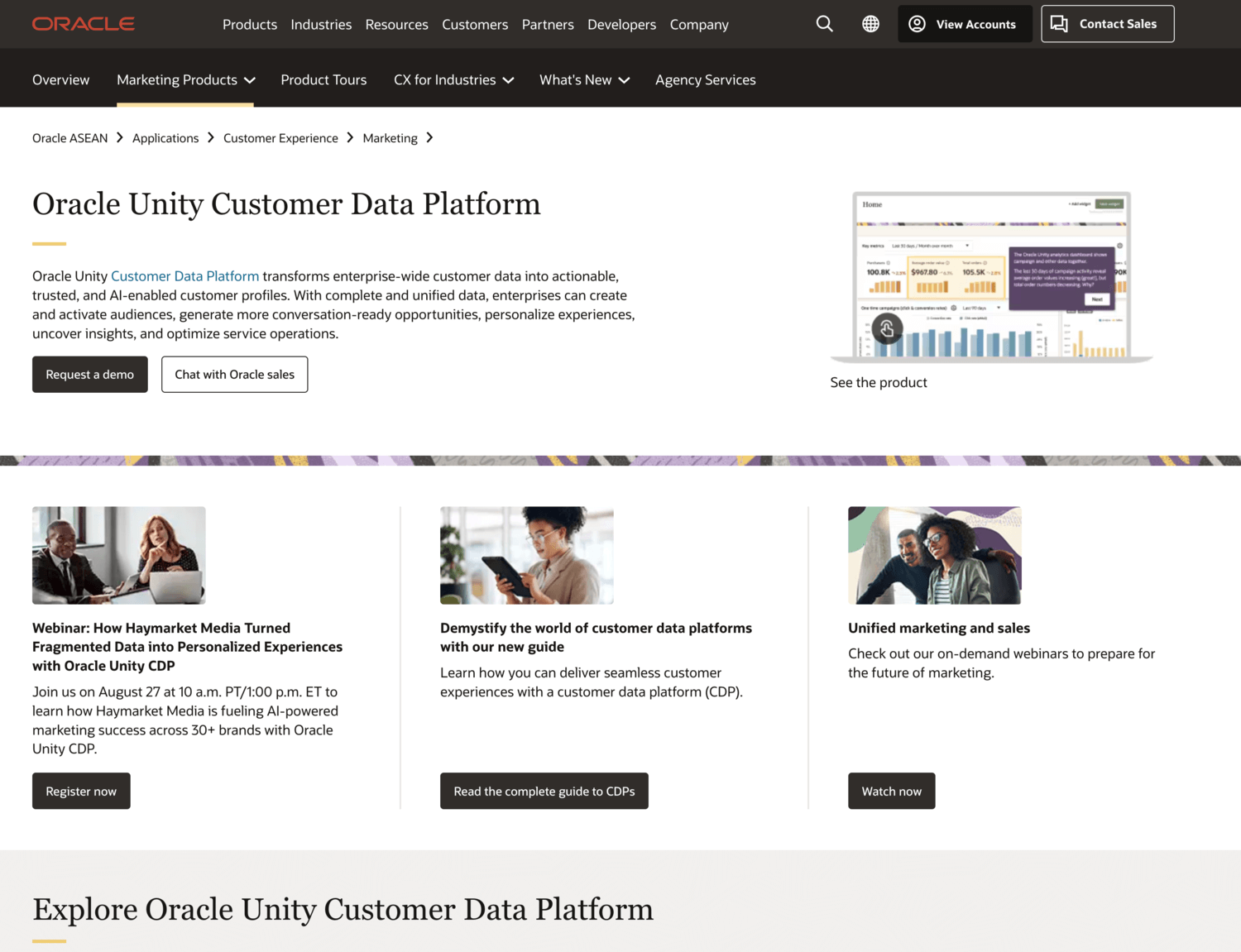
Oracle Unity CDP is built by Oracle’s CX and data platform teams. The product is designed to unify enterprise customer data, then feed Oracle CX execution. It fits best when you want a CDP tightly paired with Oracle applications.
Tagline: Unify customer data across the enterprise, then activate it across CX.
Best for: Oracle CX customers; enterprises needing a single vendor for CX data and activation.
- Unified data and cleansing model → fewer “same customer, five IDs” problems downstream.
- Oracle ecosystem integrations → saves weeks of connector and identity mapping effort.
- Prebuilt operational models → time-to-first-value is often 6–12 weeks with services.
Pricing & limits: From $Custom/mo (pricing is typically quote-based). Trial: demo-led evaluation is the norm. Caps are usually set by profiles, data volume, and enabled activation features.
Honest drawbacks: Total cost can rise if you need broad non-Oracle connectivity. Implementation often requires enterprise-grade project ownership. Beats many CDPs inside Oracle stacks; trails Segment on neutral, best-of-breed routing.
Verdict: If you need a CDP aligned to Oracle CX, this helps you operationalize unified data in a quarter and keep activation close to execution.
Score: 3.6/5
16. Zeta Marketing Platform
Zeta’s platform is built for enterprise-scale marketing execution, with CDP capabilities as a core layer. The team positions it as an omnichannel growth engine. It is usually evaluated by large brands with serious media and lifecycle volume.
Tagline: Unify audiences and orchestrate omnichannel marketing at enterprise scale.
Best for: enterprise lifecycle teams; brands managing large paid and owned orchestration.
- All-in-one execution plus CDP layer → fewer handoffs between data and journey teams.
- Enterprise contract entitlements → reduces repeated procurement for add-on channel expansions.
- Platform rollout support → time-to-first-value is often 2–4 months for full orchestration.
Pricing & limits: From about $48,333/mo (based on a $580,000/12-month AWS Marketplace contract listing). Trial: typically demo-led, with pilots by agreement. Caps follow contracted entitlements and usage-based overages.
Honest drawbacks: Entry cost is high, and scope creep is real. Teams wanting a pure CDP may pay for execution they do not use. Beats point CDPs at integrated orchestration; trails composable stacks on modular cost control.
Verdict: If you need enterprise omnichannel execution tied to unified audiences, this helps you scale coordinated marketing within a quarter or two.
Score: 3.6/5
17. WebEngage
WebEngage is built for lifecycle engagement, with a strong CDP-like data layer underneath. The team emphasizes cross-channel engagement and personalization. It often wins with mobile-first and product-led businesses.
Tagline: Turn user events into journeys that lift retention and conversion.
Best for: consumer apps and fintech; lean CRM teams shipping multi-channel journeys.
- Event-driven segmentation and journeys → trigger retention flows without manual list refreshes.
- Channel orchestration and automation → saves hours per week in campaign assembly and QA.
- Template-led onboarding → time-to-first-value is often 2–4 weeks for first journeys.
Pricing & limits: From $Custom/mo (plans are commonly “talk to us”). Trial: no public universal trial term is consistently listed by the vendor. Caps are typically tiered by monthly active users and plan entitlements, such as journey counts and integrations.
Honest drawbacks: Pricing transparency can slow buying decisions. Deep data modeling may be less flexible than warehouse-native CDPs. Beats many CDPs at lifecycle execution; trails Salesforce Data Cloud on CRM-native unification.
Verdict: If you want event-driven engagement without a heavy stack, this helps you launch practical journeys in weeks.
Score: 3.9/5
18. BlueVenn by Upland
BlueVenn sits within Upland Software, following Upland’s acquisition. The product is positioned as a CDP plus omnichannel marketing automation. It is typically evaluated by teams wanting “one vendor” simplicity.
Tagline: Unify customer interactions, then automate engagement across channels.
Best for: mid-market marketing teams; orgs standardizing on Upland CX tooling.
- Unified customer view and segmentation → reduce scattered lists and inconsistent targeting.
- Automation workflows across channels → saves repeated campaign rebuilds in email and SMS tools.
- Drag-and-drop operations → time-to-first-value is often 3–6 weeks with onboarding support.
Pricing & limits: From $Custom/mo (public pricing varies by deal and region). Trial: demo-led evaluations are typical. Caps usually follow contracted customer records, messaging volume, and enabled channels.
Honest drawbacks: Ecosystem depth is strongest when you commit to Upland’s suite. Teams wanting a neutral CDP layer may feel boxed in. Beats fragmented stacks on suite cohesion; trails Segment on best-of-breed integration neutrality.
Verdict: If you want a CDP tied to execution without stitching vendors, this helps you consolidate data and campaigns within a quarter.
Score: 3.6/5
19. Leadspace Drive
Leadspace is built for B2B customer and account intelligence. The team focuses on account data, enrichment, and go-to-market readiness. Drive is typically evaluated when you need smarter ICP and routing, not just a consumer CDP.
Tagline: Turn account data into better targeting, routing, and revenue decisions.
Best for: B2B demand gen teams; revenue ops leaders cleaning account and lead data.
- Account-centric identity and enrichment → fewer misrouted leads and wasted SDR cycles.
- CRM and MAP alignment workflows → saves hours per week on list hygiene and re-scoring.
- Services-backed rollout → time-to-first-value is often 4–8 weeks for scoring use cases.
Pricing & limits: From $Custom/mo (contracts are typically annual and quote-based). Trial: vendor-led demos and pilots are standard. Caps are often tied to enriched records, API usage, and enabled data products.
Honest drawbacks: Not designed for consumer lifecycle orchestration. Budget can be hard to justify without clear revenue ops ownership. Beats consumer CDPs at account intelligence; trails Simon Data on marketing journey orchestration focus.
Verdict: If you need cleaner B2B data and sharper targeting, this helps you improve routing and segmentation within one quarter.
Score: 3.6/5
20. mParticle
mParticle is built by a team focused on real-time customer data infrastructure, especially for mobile and product analytics stacks. Since 2025, it has been part of a merger with Rokt, which signals continued investment in “moment-based” relevance. The platform is often selected when event quality and governance matter.
Tagline: Control event data once, then power every downstream customer moment.
Best for: mobile-first product teams; enterprises needing governance over SDK chaos.
- Event collection and governance tooling → fewer duplicate events and broken analytics pipelines.
- Broad partner ecosystem → saves weeks replacing hand-built SDK integrations.
- Implementation patterns for apps → time-to-first-value is often 1–3 weeks for core events.
Pricing & limits: From $400/mo (as listed by some software directories), though many teams buy via quote. Trial: vendor-led trials and pilots vary by contract. Caps commonly follow monthly events, sources, and enabled destinations.
Honest drawbacks: Pricing and packaging can be opaque without a strong internal estimate of event volume. Non-mobile teams may find parts of the stack heavier than needed. Beats many CDPs at mobile data control; trails RudderStack on self-serve simplicity.
Verdict: If you need reliable event governance across apps, this helps you stabilize tracking and activation within a month.
Score: 3.9/5
21. RudderStack
RudderStack is built by a data infrastructure team that favors practical shipping over vendor mystique. The product feels like a toolkit: pipelines, reverse ETL, and optional profiles. It is a strong Segment alternative for many stacks.
Tagline: Stream events to your warehouse and tools, with predictable self-serve tiers.
Best for: startups and modern data teams; teams migrating off Segment.
- Event streaming and routing → keep warehouse and tools in sync without custom glue.
- 200+ cloud destinations plus reverse ETL → saves repeated manual audience pushes per week.
- Free-to-paid ladder → time-to-first-value is often under 1 day.
Pricing & limits: From $0/mo for 250,000 monthly events. Starter starts at $220/mo for 1M monthly events, with higher event tiers available. Trial: the Free plan functions as an ongoing trial. Caps are explicit by monthly event volume, with overage rules by plan.
Honest drawbacks: Costs can step up at tier thresholds. Self-hosting shifts burden to your infra and engineers. Beats many tools on transparent event tiers; trails enterprise suites on turnkey identity resolution.
Verdict: If you want a modern data pipeline with CDP-adjacent activation, this helps you ship reliable routing in days.
Score: 4.0/5
22. Simon Data
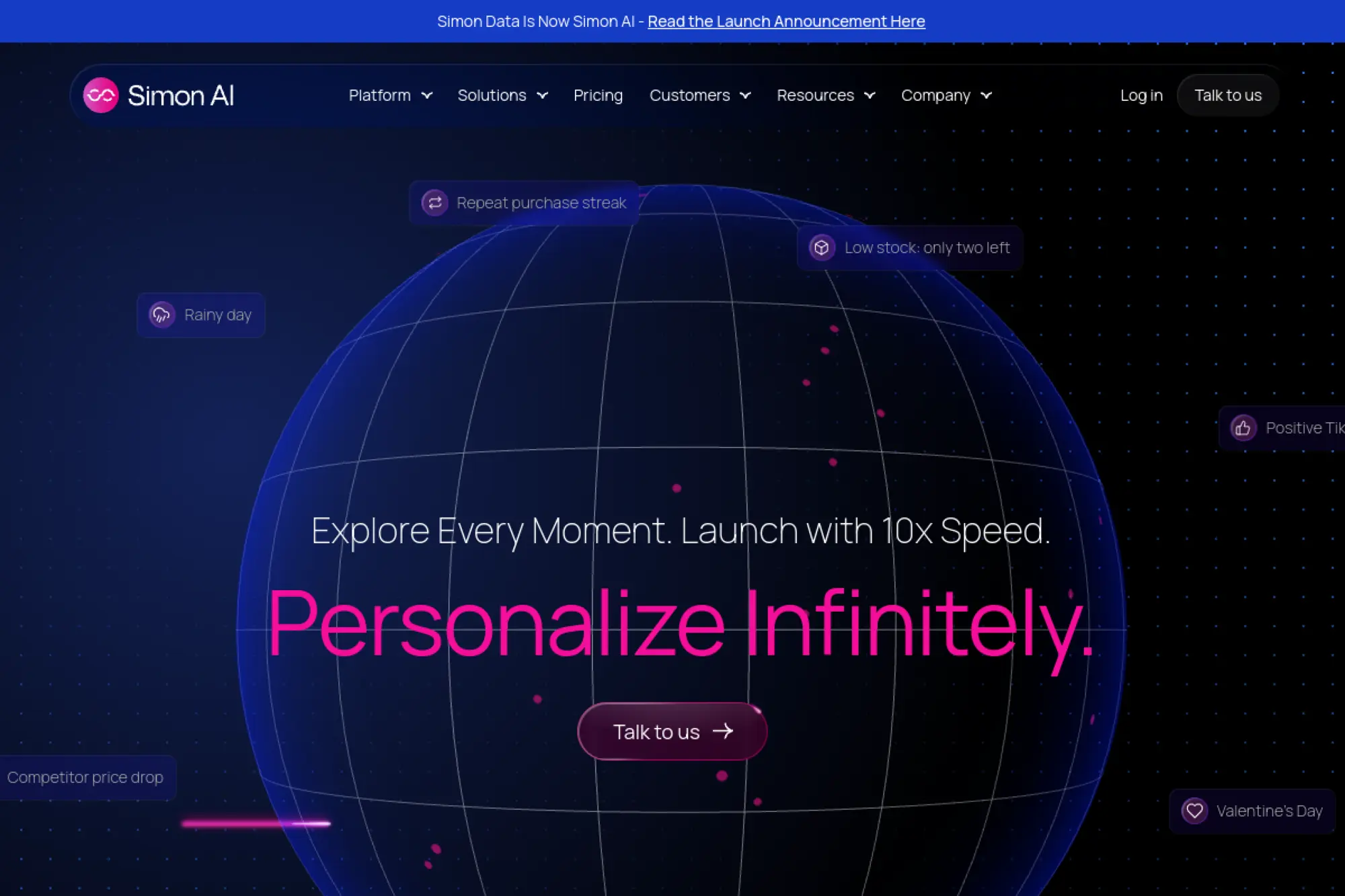
Simon Data is built by a team that treats the CDP as an activation layer, not a data museum. The platform is designed to sit close to warehouse and messaging systems. It is often chosen by sophisticated lifecycle teams with strong data partners.
Tagline: Turn first-party data into high-leverage lifecycle orchestration.
Best for: enterprise lifecycle marketers; data teams supporting high-volume messaging.
- Composable deployment options → match your current architecture without a full rebuild.
- Outcome-oriented orchestration → saves weeks of “build segments in five tools” repetition.
- Pilot program structure → time-to-first-value can be about 90 days for enterprise pilots.
Pricing & limits: From $Custom/mo (pricing is provided by quote). Trial: Simon Data advertises 90-day pilots for enterprises at reduced scope and cost. Limits are tied to contact volumes read by the platform, plus add-on usage pricing.
Honest drawbacks: Not a casual, self-serve purchase. Success depends on clean upstream data and strong channel ownership. Beats heavy suites at composable flexibility; trails all-in-one tools on “single login does everything” simplicity.
Verdict: If you want serious lifecycle activation on first-party data, this helps you prove impact in one quarter, then scale.
Score: 3.7/5
23. Lytics
Lytics is built around a pragmatic promise: personalization and profiles without an enterprise-only price tag. The team leans into marketer-friendly activation and lightweight governance. Its credit model is unusual, but refreshingly explicit.
Tagline: Build usable profiles and personalization without buying a whole suite.
Best for: mid-market teams; web-focused brands that need identity and activation fast.
- Free Developer tier → start profile building before procurement slows you down.
- Credit-based metering → reduces wasted spend and saves budget forecasting time.
- In-app upgrades → time-to-first-value is often same-day for a first web segment.
Pricing & limits: From $0/mo on Developer, including 2M monthly credits and up to 10 domains, with 30-day retention. Growth starts at $500/mo via in-app upgrade, with 5M credits and longer retention. Trial: the free tier is free forever, acting as an ongoing trial.
Honest drawbacks: Credits add a mental model your team must learn. Some identity stitching is web-only in lower tiers. Beats many CDPs on transparent entry pricing; trails enterprise platforms on deep multi-channel governance.
Verdict: If you want web-first personalization quickly, this helps you launch segments and experiences in days, then scale via credits.
Score: 3.9/5
24. Acquia CDP
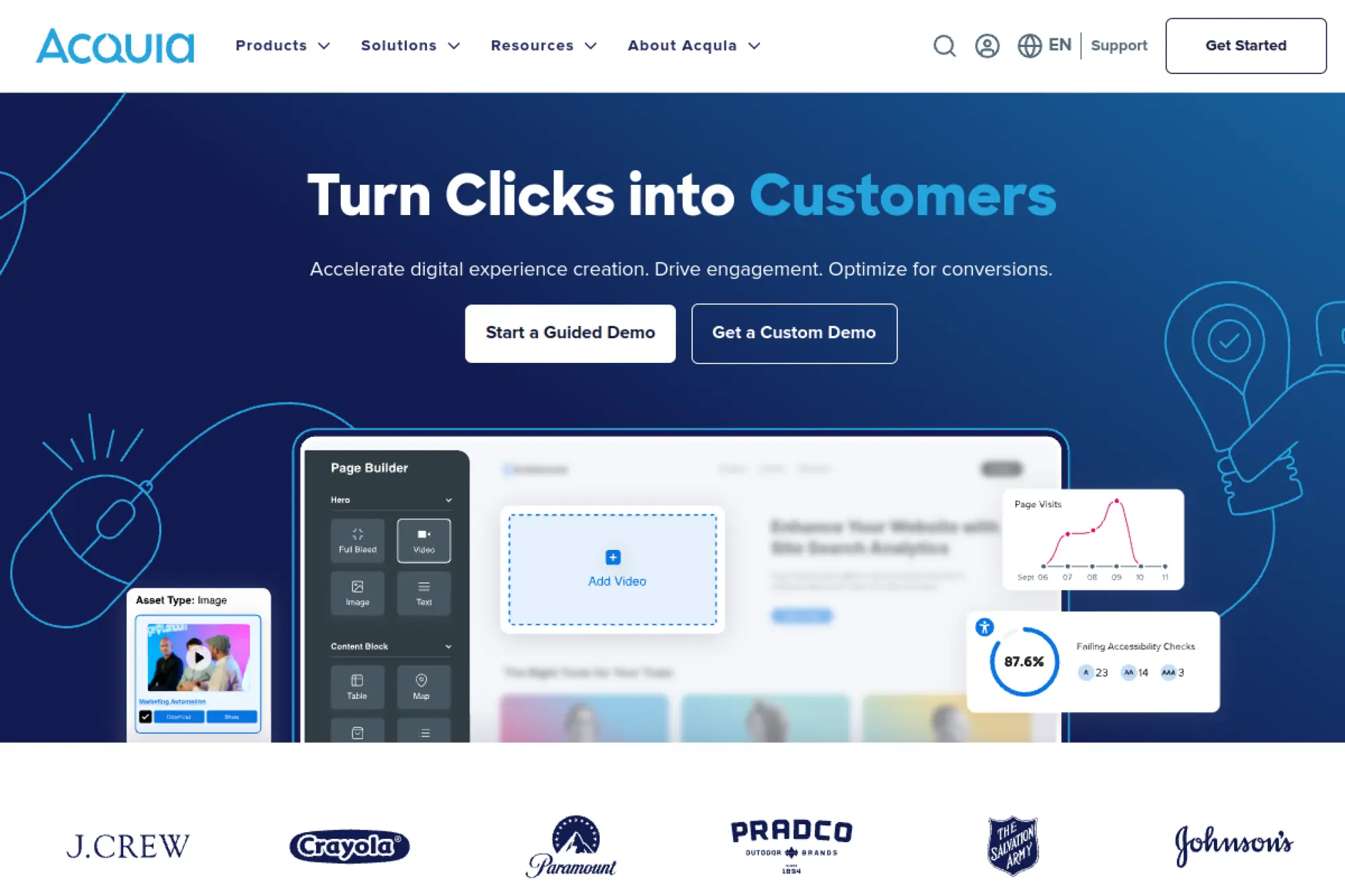
Acquia CDP is built for organizations that want enterprise-grade identity and reporting, often alongside digital experience stacks. The team leans into services, enablement, and enterprise support. It fits well when you want structure and help, not only software.
Tagline: Unify customer identity and reporting, then activate with confidence.
Best for: enterprises with complex web ecosystems; teams needing ML-powered identity resolution.
- Machine learning identity resolution → reduces duplicates and improves segmentation confidence.
- Data and reporting focus → saves hours per week on manual performance stitching.
- Professional services options → time-to-first-value is often 6–12 weeks for first use cases.
Pricing & limits: From $Custom/mo (pricing tiers exist, but amounts are not publicly listed). Trial: a guided demo is the primary entry point. Caps are based on data volume, user access, and advanced feature needs, plus add-ons like Snowflake data sharing.
Honest drawbacks: Budgeting is slower without published numbers. Teams seeking a pure composable activation tool may find it heavier than needed. Beats lighter CDPs on services depth; trails Hightouch on warehouse-native activation speed.
Verdict: If you need identity resolution plus reporting structure, this helps you get a dependable customer view live within a quarter.
Score: 3.6/5
25. Zeotap CDP
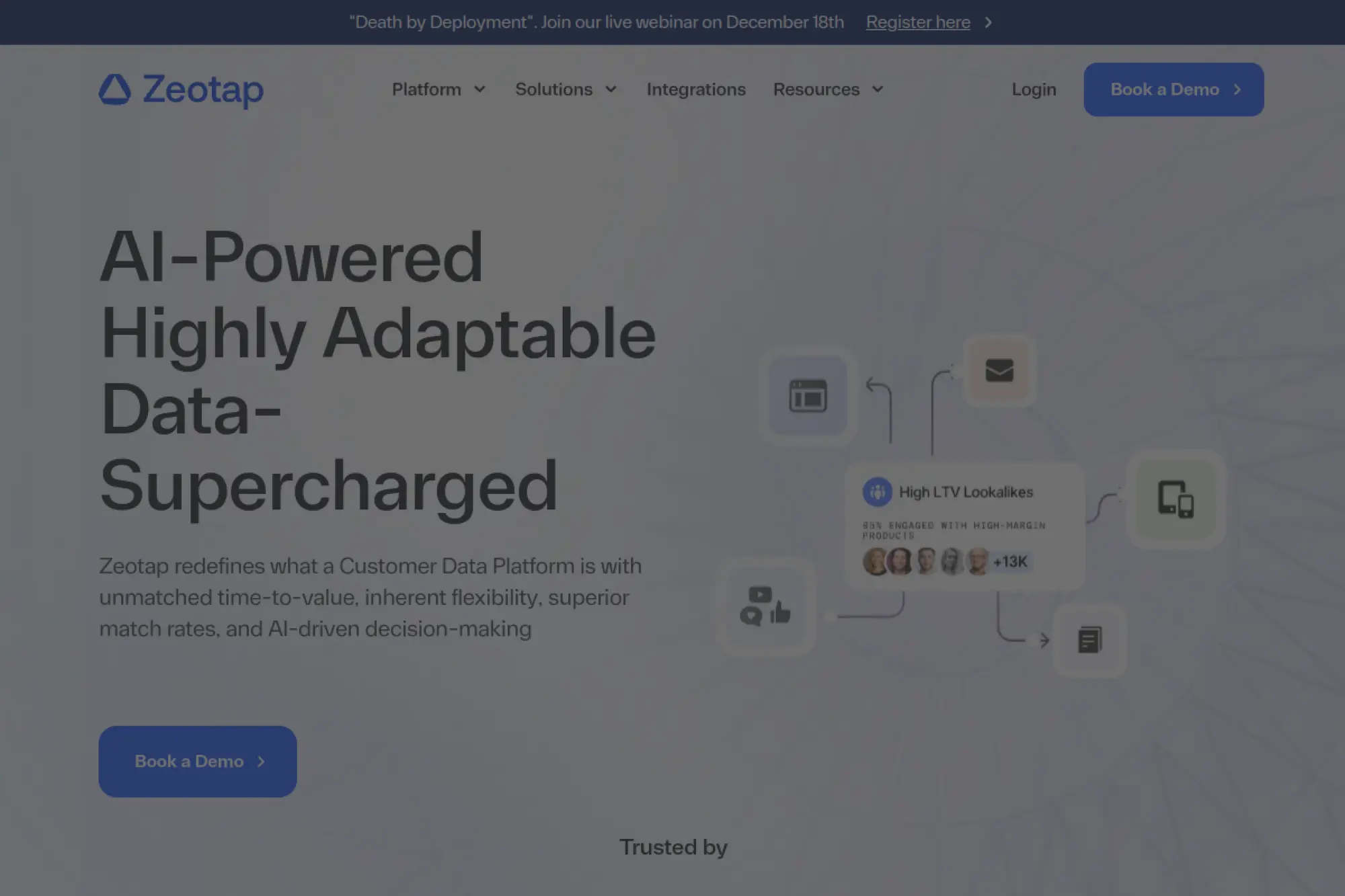
Zeotap is built by a team that blends identity, privacy, and activation into one story. The product emphasizes faster deployment and match rates, especially in privacy-conscious markets. It is often evaluated by brands needing better identity coverage.
Tagline: Improve match rates and activation readiness with privacy-forward identity.
Best for: brands in regulated markets; teams needing identity enrichment for activation.
- Identity enrichment and unified profiles → improve targeting accuracy and reduce wasted impressions.
- AI-assisted setup claims → can cut onboarding steps when mappings are repetitive.
- Deployment flexibility → time-to-first-value is often 4–8 weeks for real activation.
Pricing & limits: From $Custom/mo (pricing is generally quote-based). Trial: demo-led evaluations are typical. Caps commonly follow profiles, events, and destination activations, set by contract.
Honest drawbacks: Outcomes depend on your available identifiers and consent posture. Some organizations will prefer warehouse-first ownership over vendor-managed identity. Beats many CDPs at identity enrichment narrative; trails Segment at pure data routing neutrality.
Verdict: If you need stronger identity for activation, this helps you improve match and segmentation quality within a quarter.
Score: 3.6/5
26. Lexer CDP
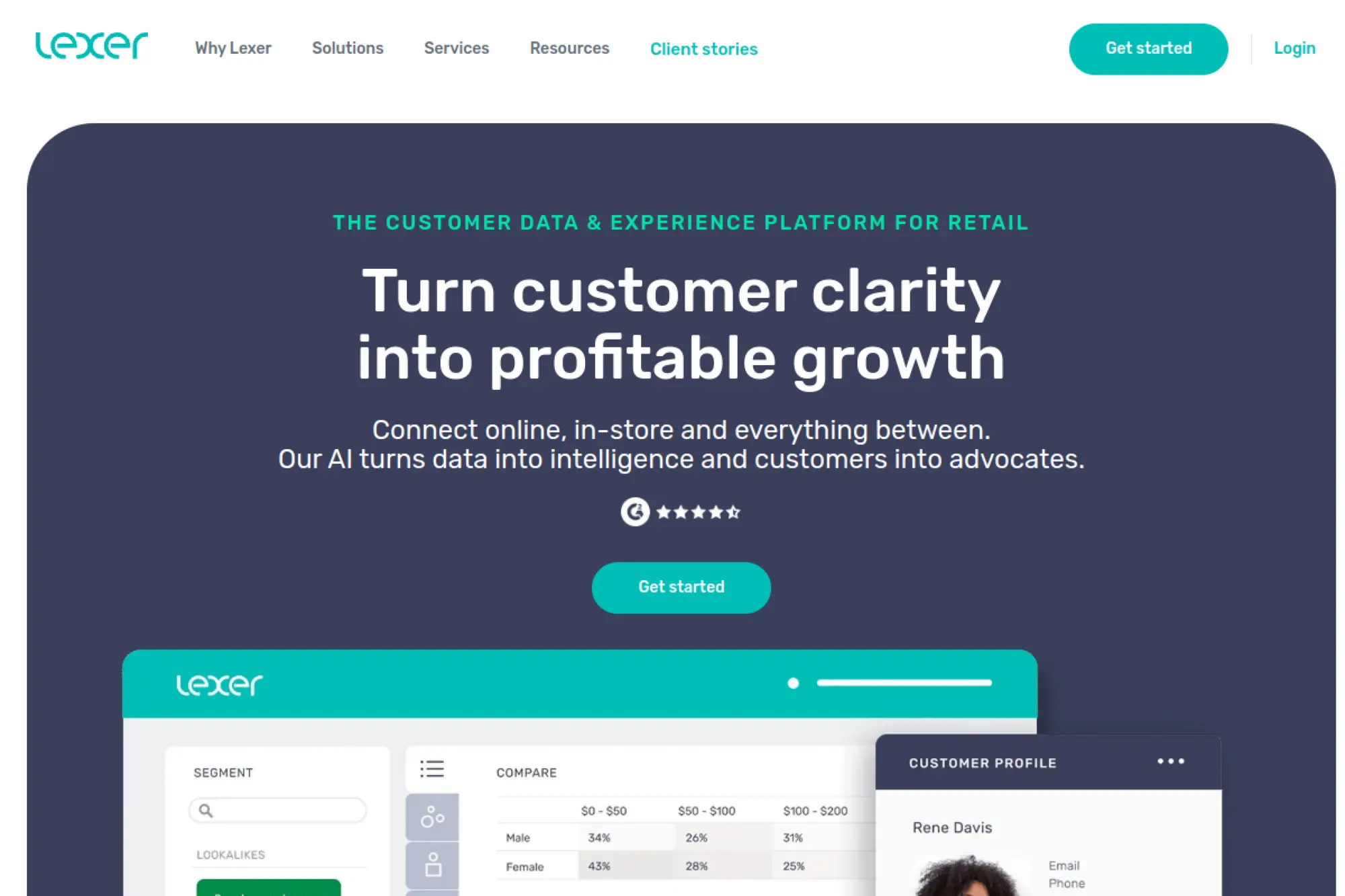
Lexer is built for retail-focused customer analytics and activation. The team positions the platform as a “customer data and experience” layer, with many out-of-the-box attributes. It is a strong fit when retail use cases matter more than generic CDP checklists.
Tagline: Turn retail customer data into ready-to-use segments and insights.
Best for: omnichannel retailers; CRM teams needing faster segmentation without heavy BI work.
- Retail-ready profile enrichment → faster RFM and loyalty targeting without custom modeling.
- Partner enrichment options → saves weeks sourcing lifestyle and propensity data separately.
- Packaged segments and workflows → time-to-first-value can be a few days for initial insights.
Pricing & limits: From about $3,750/mo (based on a $45,000/12-month AWS Marketplace listing for up to 100,000 unique enriched customer records). Trial: Lexer promotes live demo experiences that can surface insights in days. Caps: record-based pricing, with add-on costs per extra 10,000 records.
Honest drawbacks: Retail focus can be limiting for non-retail industries. Some advanced integrations may require services and fees beyond the subscription. Beats generic CDPs on retail specificity; trails enterprise suites on cross-industry breadth.
Verdict: If you want retail segments that ship, this helps you get actionable audiences and insights in days, then scale by records.
Score: 3.8/5
27. Optimove
Optimove is built for AI-driven retention and lifecycle orchestration, with embedded CDP functionality. The team markets a “positionless” approach that removes handoffs between analysts and marketers. It is usually evaluated as an engagement platform first.
Tagline: Use unified profiles to trigger retention campaigns that actually compound.
Best for: retention and CRM teams; brands with high messaging volume across channels.
- Embedded CDP layer → unify profiles without buying a separate data product.
- AI decisioning and orchestration → saves repeated manual targeting decisions each week.
- Marketer-first workflows → time-to-first-value is often 4–8 weeks for first journeys.
Pricing & limits: From $Custom/mo (Optimove states pricing is based on message volume and channel usage). Trial: demo-led evaluation is standard. Caps depend on communication scale, channels used, and contracted entitlements, with no user limits stated.
Honest drawbacks: It can feel “platform-heavy” if you only need a CDP layer. Data teams wanting deep warehouse control may prefer composable stacks. Beats point CDPs on journey execution; trails Hightouch on warehouse-native activation simplicity.
Verdict: If you want retention orchestration powered by unified data, this helps you launch AI-assisted campaigns within a quarter.
Score: 3.7/5
28. Ometria
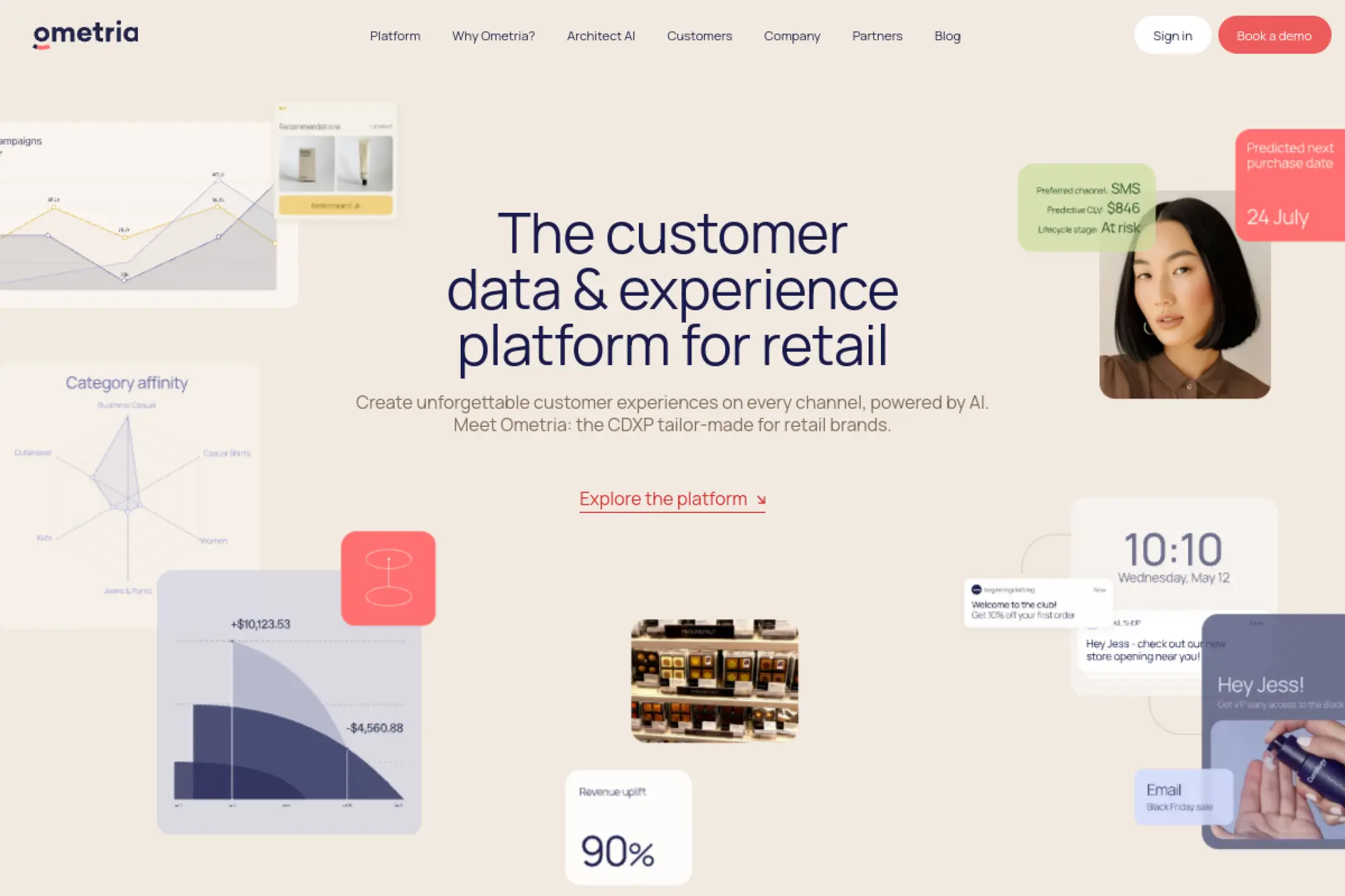
Ometria is built for ecommerce CRM and lifecycle marketing, with a strong customer data layer beneath. The team focuses on outcomes like repeat purchase and LTV, not generic segmentation. It is often shortlisted as a “CDP plus CRM brain” for retail.
Tagline: Turn ecommerce customer data into lifecycle campaigns that lift revenue.
Best for: ecommerce retention teams; brands wanting a retail-first lifecycle platform.
- Ecommerce-ready customer model → faster segmentation for replenishment, churn, and VIP flows.
- Automation and channel coordination → saves hours per week on campaign assembly and syncing.
- Guided onboarding → time-to-first-value is often 3–6 weeks for core lifecycle journeys.
Pricing & limits: From $Custom/mo (pricing is commonly quote-based). Trial: no universal self-serve trial is prominently posted. Caps typically follow customer profiles, message volumes, and enabled channel features.
Honest drawbacks: It is not built for non-retail industries. Deep custom analytics may still require warehouse tooling beside it. Beats general CDPs on ecommerce lifecycle focus; trails Bloomreach on broader suite modularity.
Verdict: If you want retail lifecycle outcomes, this helps you launch revenue-focused journeys in weeks and iterate fast.
Score: 3.8/5
29. Insider One
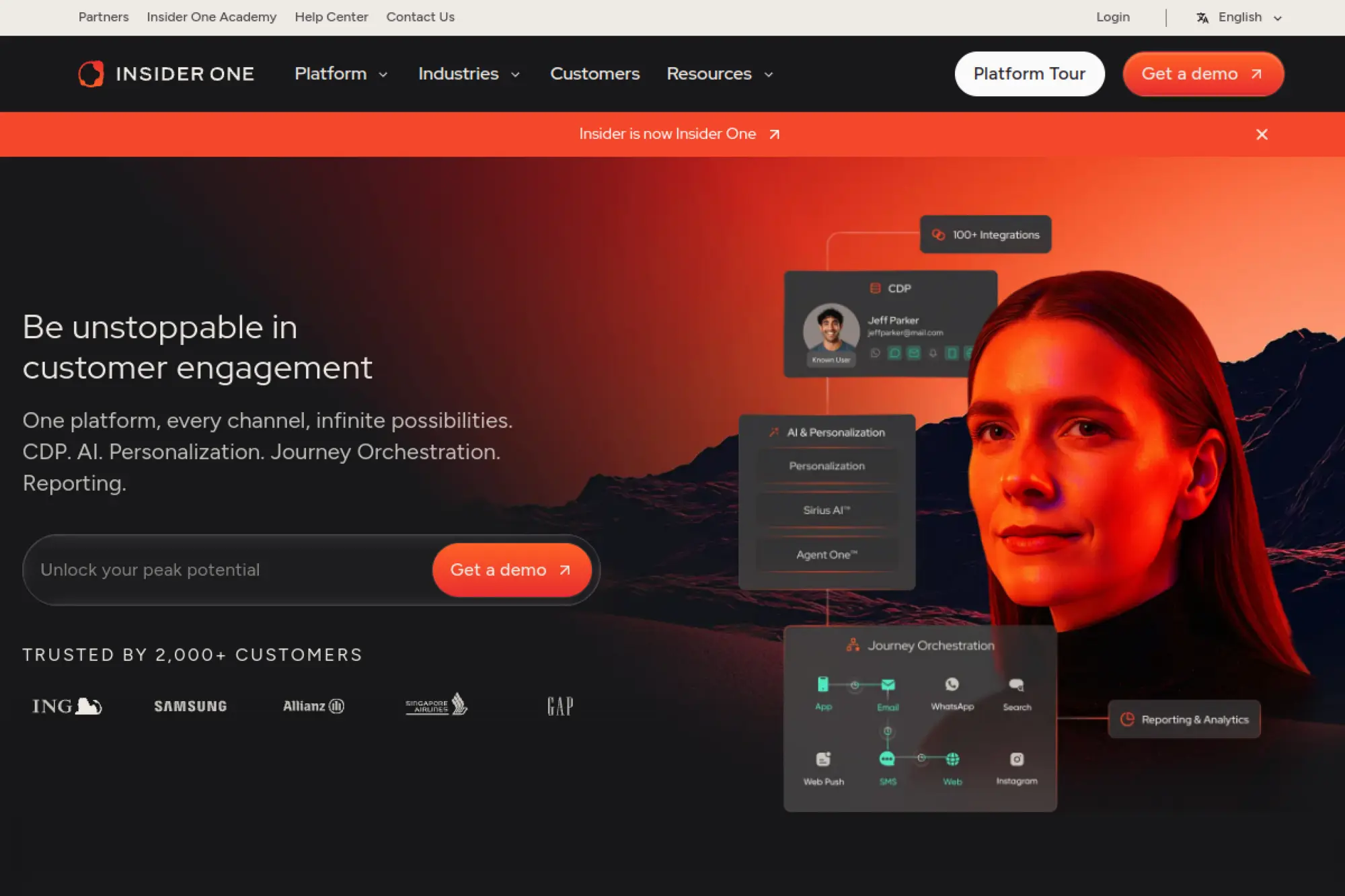
Insider One is positioned as an AI-native customer engagement platform with CDP capabilities baked in. The team sells a unified platform story: data, personalization, journeys, and reporting together. It is usually evaluated by teams tired of stitching point solutions.
Tagline: Run every channel from one platform powered by a unified customer view.
Best for: enterprise growth teams; lifecycle teams needing personalization plus orchestration.
- Platform-wide CDP layer → fewer tools to maintain and fewer audience sync failures.
- 100+ integrations claim → saves weeks connecting common channels and data sources.
- Self-guided tour availability → time-to-first-value can start same-day for product exploration.
Pricing & limits: From $Custom/mo (pricing is not publicly listed on the main product site). Trial: a self-guided tour is offered, with sales-led onboarding for production. Caps are contract-driven, typically tied to profiles, events, and enabled channels.
Honest drawbacks: “Everything platform” scope can make implementations sprawl. Teams that only need data activation may overbuy. Beats many CDPs at unified engagement scope; trails Segment on neutral data routing depth.
Verdict: If you want a single engagement platform with CDP behavior, this helps you consolidate journeys and personalization within a quarter.
Score: 3.8/5
30. GrowthLoop
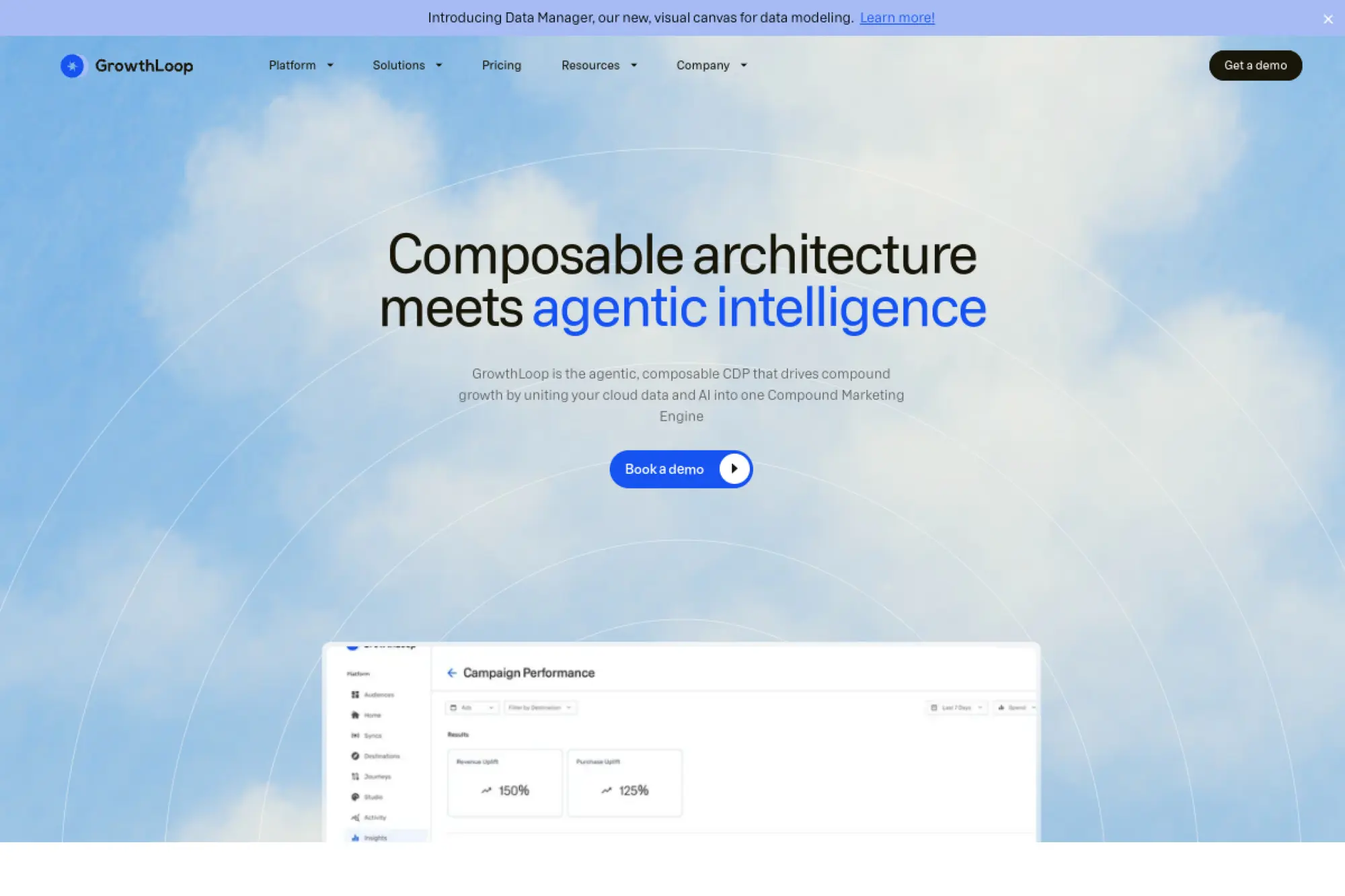
GrowthLoop is built as a composable marketing layer for data-cloud-centric teams. The product is designed to make audience building and activation faster on top of modern warehouses. It tends to land where marketers need autonomy, with governance intact.
Tagline: Build warehouse-powered campaigns in minutes, not tickets.
Best for: modern data-cloud enterprises; marketing ops teams wanting faster audience workflows.
- Composable audience building → reduce dependency on engineering for everyday segments.
- Activation to paid and owned channels → saves repeated SQL-to-CSV-to-upload steps weekly.
- Clear record-based packaging → time-to-first-value is often 2–4 weeks after data access.
Pricing & limits: From $Custom/mo (pricing is “contact us” across tiers). Limits are explicit by plan packaging, such as up to 1,000,000 customer records on Basic and up to 10,000,000 on Growth. Trial: demo-led evaluation is standard.
Honest drawbacks: You still need strong warehouse hygiene, or audiences will be wrong faster. Some teams will want deeper identity tooling than a composable layer provides. Beats heavier suites at warehouse-native agility; trails all-in-one CDPs on built-in execution.
Verdict: If you want marketers to self-serve on the warehouse, this helps you ship campaigns in weeks and keep scaling by records.
Score: 3.9/5
Core components and required capabilities of customer data platforms
Market pulse: Gartner’s Magic Quadrant for Customer Data Platforms reflects how CDPs now sit between martech and enterprise data platforms. That shift changes what “required capabilities” means. Buyers must evaluate data engineering realities, not just marketing features. We prioritize capabilities that reduce long-term entropy.
1. Data collection and ingestion from web mobile offline and IoT sources
Collection is the front door, so it shapes everything downstream. Web and app SDKs are common, but offline ingestion often decides outcomes. Point-of-sale, call-center, and returns data drive the most valuable segments. If those feeds arrive late or messy, activation becomes guesswork.
At TechTide Solutions, we push for event contracts early. A contract defines names, properties, and ownership. It also specifies what must never be collected. That is where privacy becomes practical.
2. Identity resolution and profile unification at person or account level
Identity resolution is usually a mix of deterministic and probabilistic logic. Deterministic matches use stable keys, like login identifiers or loyalty IDs. Probabilistic matches infer links from weaker signals, like device patterns. We prefer transparent matching rules, even when they are conservative.
Account-level unification matters in complex buying journeys. Business sales often involve teams, not individuals. In those cases, we model a relationship graph, not a single “golden record.” That choice prevents brittle rollups later.
3. Harmonization modeling and schema alignment for a single customer view
Harmonization is where CDPs either mature or fail quietly. Naming conflicts look small at first, then sabotage segmentation. “Plan,” “tier,” and “subscription_status” can mean different things across systems. A CDP must reconcile those meanings with a canonical model.
We use schema alignment to keep everyone honest. The canonical model should be versioned and reviewed. When it changes, downstream audiences must be revalidated. That discipline keeps personalization from becoming accidental.
4. Activation audience segmentation and cross-channel orchestration
Activation is the payoff, so latency and governance both matter. Audiences must be reproducible, not handcrafted. We like segmentation that can be expressed as logic, then tested. That makes audits and debugging possible.
Orchestration is more than pushing lists to channels. It also means handling conflicts, like suppression rules and frequency policies. A CDP that ignores those constraints can amplify customer fatigue. Great activation feels restrained, not noisy.
5. Analytic reporting at attribute profile and segment levels
Reporting in a CDP should answer “why did this person land in this audience.” Without explainability, teams lose trust. Attribute-level lineage helps debug joins and identity merges. Segment-level reporting helps compare audience health over time.
In our experience, the best CDP reporting is humble. It points you back to the source data. It also highlights missingness and drift. Those signals prevent quiet degradation.
6. Privacy governance and compliance including GDPR and CCPA
Privacy governance is no longer a legal afterthought. It is an engineering requirement that shapes data flows. Consent, purpose limitation, and deletion must propagate across the stack. If a CDP cannot enforce those rules, it becomes a liability.
We advise teams to implement “consent-aware activation.” That means audiences inherit consent constraints automatically. It also means exports are logged and reviewable. Customers notice when you get this right.
7. Real-time processing for low-latency insights and experiences
Real-time is not a checkbox. It is a system design choice with cost and complexity. Some use cases need instant decisions, like in-session recommendations. Other use cases tolerate batch, like weekly churn outreach.
We encourage teams to separate “real-time ingestion” from “real-time decisioning.” Ingesting fast is useful, even if decisions remain staged. That split keeps architectures sane. It also avoids overbuilding early.
8. Pre-built integrations and open APIs across warehouses and apps
Integrations determine how quickly value shows up. Pre-built connectors speed up early wins. Open APIs matter when the weird edge case arrives, which it always does. A CDP without extensibility forces brittle workarounds.
Our rule is to treat every integration as a product. It needs ownership, monitoring, and change control. Vendor connectors can break quietly after upstream changes. Strong teams plan for that reality.
Business benefits and common use cases of customer data platforms
Market pulse: McKinsey reports leaders drive 40 percent more of their revenue from personalization, which makes unified data a business mandate. We agree with the direction, but we add a caveat. Personalization fails when data meaning is unclear. CDPs pay off when they make meaning shared.
1. Single customer view for personalization at scale
A single customer view reduces duplicate messaging and missed intent. It helps teams tailor offers, content, and service based on real behavior. That sounds obvious, yet most stacks still personalize with partial context. CDPs address that gap by joining journeys end-to-end.
We often see the biggest lift in “boring” personalization. Examples include better onboarding sequences and smarter product education. Those moments compound over time. They also build trust, which is hard to buy.
2. Omnichannel consistency and real-time journey orchestration
Omnichannel consistency means the left hand knows what the right hand just did. A customer who just filed a support ticket should not receive a tone-deaf upsell. Journey orchestration uses rules and signals to coordinate those touchpoints. CDPs make orchestration feasible by standardizing identity and events.
In our projects, orchestration succeeds when ownership is clear. Someone must own decision policies and conflict rules. Otherwise, every channel team optimizes locally. The customer experiences that as chaos.
3. Audience suppression retention and improved customer lifetime value
Suppression is an underrated CDP use case. It prevents wasted spend by excluding ineligible audiences. It also protects customers from irrelevant outreach. Retention improves when messaging respects lifecycle stage and recent outcomes.
We also like “negative audiences” built from risk signals. That includes high-return buyers or recent complaint patterns. Those audiences inform gentler tactics, not punishment. Better retention often starts with restraint.
4. Insights measurement and marketing ROI uplift
CDPs improve measurement by aligning identity across impressions, clicks, and purchases. They reduce the “multiple users” problem that breaks attribution. Better identity makes experiments more trustworthy. That is how ROI conversations become less political.
From our viewpoint, the most useful CDP insight is directional. It highlights what changed and why it changed. Perfect attribution remains elusive. Still, consistent measurement beats confident guessing.
5. Data protection compliance and customer trust
Trust is a business benefit, not just a moral stance. Customers respond to transparency and control. CDPs can operationalize that by honoring preferences across channels. They also support deletion workflows when customers ask.
We treat privacy features as product features. Preference centers, audit logs, and export controls matter. When teams build those capabilities early, activation becomes safer. That safety encourages innovation.
Types of customer data platforms and architectures
Market pulse: analyst coverage in the same Gartner research highlights CDPs splitting into packaged suites, warehouse-native activation, and developer-first infrastructure. We see that split every week in architecture reviews. The right type depends on where your data gravity already is. It also depends on who can operate the system.
1. Traditional CDP packaged platform that stores and manages its own data
Traditional CDPs store customer data inside the platform. They provide identity resolution, segmentation, and governance in one place. That can accelerate time-to-value for teams without a strong warehouse culture. It can also create duplication if your enterprise already models data elsewhere.
What we include in this category
- Adobe Real-Time CDP
- Salesforce Data Cloud
- Oracle Unity Customer Data Platform
- SAP Customer Data Platform
- Microsoft Customer Insights
- Treasure Data
- Tealium AudienceStream
- Amperity
- BlueConic
- Redpoint Global
Packaged CDPs shine when governance and activation must be standardized quickly. They struggle when teams need unusual modeling. They also require disciplined integration design. Otherwise, you build a parallel stack accidentally.
2. Composable CDP runs on your warehouse for flexible activation without storing data
Composable CDPs treat the warehouse as the system of record. Activation tools then sync modeled data into downstream systems. This approach works well when data engineering is mature. It also reduces duplication, because transformation logic stays centralized.
What we include in this category
- Hightouch
- Census
- GrowthLoop
- Imagino
Composable approaches demand strong modeling discipline. They also require identity logic that is explicit. Without that, teams “activate garbage faster.” We prefer composable stacks when analytics and activation already share definitions.
3. Infrastructure CDP developer-first data collection pipelines and governance
Infrastructure CDPs focus on data collection, routing, and governance. They often excel at event instrumentation workflows. They also fit teams that prefer code, versioning, and change control. In product-led companies, this type is often the natural starting point.
What we include in this category
- Twilio Segment
- mParticle
- RudderStack
- Snowplow
- Lytics
Infrastructure CDPs rarely solve activation alone. They power the pipes, then rely on destinations for orchestration. We like them when data contracts must be enforced. They also work well for mobile-heavy instrumentation needs.
4. Hybrid CDP combines packaged and warehouse-native approaches
Hybrid CDPs mix warehouse-native activation with packaged identity and UI. Some integrate deeply with data clouds, while still maintaining their own profile services. Others offer “bring your own warehouse” options alongside internal storage. We see hybrid models win when organizations are mid-transition.
What we include in this category
- ActionIQ
- Zeta Global
- Zeotap
- NGData
- Acquia CDP
- Sitecore CDP
- Bloomreach Engagement
- Insider
- Optimove
- Braze
- Klaviyo
Hybrid platforms can reduce friction between IT and marketing. They can also become ambiguous about “source of truth.” Our advice is to choose one primary truth layer. Then design everything else as derived views.
How TechTide Solutions helps you build custom customer data platforms
Market pulse: Deloitte found Seventy-nine percent of our respondents agreed that they would be willing to share their data if there was a clear benefit for them, which makes value exchange central to CDP strategy. We build CDPs with that reality in mind. Data collection must be justified, not habitual. Activation must feel helpful, not invasive.
1. CDP readiness and architecture blueprint aligned to your use cases and data landscape
Readiness starts with use cases, not vendors. We run workshops that convert business goals into data requirements. That includes identity rules, consent requirements, and activation targets. The output is an architecture blueprint and an operating model draft.
In our assessments, the biggest gap is usually taxonomy. Teams collect events, yet disagree on meaning. We help define event schemas and ownership. That work prevents months of rework later.
2. Composable and warehouse-native implementations with identity resolution and activation
We implement warehouse-native CDP patterns when a company has data gravity in its warehouse. That often includes transformation pipelines, identity graphs, and audience materializations. We also design reverse ETL and activation flows with monitoring. Those details determine reliability.
Identity resolution is treated as an evolving system. Rules change as products and channels change. We design for iteration with versioned logic. That allows safe learning without breaking downstream programs.
3. End-to-end integrations journey orchestration and governance enablement
Integration work is where CDP projects either harden or crumble. We connect collection, warehouse modeling, activation, and orchestration into a coherent flow. Along the way, we set up audit trails and access controls. That keeps teams confident during activation.
Governance enablement is not a policy document alone. It includes playbooks, approval flows, and incident routines. We help teams practice those routines. That practice turns “compliance” into muscle memory.
Conclusion choosing and succeeding with customer data platforms
Market pulse: IBM reports the global average breach cost reached $4.88 million, which makes CDP governance a board-level concern. A CDP concentrates valuable data by design. That concentration increases both value and risk. The best programs balance activation speed with careful controls.
1. Define a use-case roadmap and measurable KPIs before vendor selection
Start with a roadmap that names the moments you want to improve. Examples include onboarding, churn prevention, and service deflection. Then define KPIs tied to those moments. Without KPIs, vendor demos become the decision engine.
We recommend choosing a small set of high-leverage journeys. Those journeys should touch multiple channels. They should also expose identity and consent requirements early. That is where the CDP earns its keep.
2. Map mandatory capabilities and integrations to your current and future stack
Capabilities matter only in context. A strong identity engine is wasted if upstream identifiers are unreliable. Great orchestration tools fail if destination integrations are weak. We map mandatory integrations first, then evaluate capability fit.
Future-proofing is about interfaces, not promises. Look for open APIs and clear data models. Also inspect export controls and auditability. Those features decide whether the CDP can evolve safely.
3. Pilot in phases to validate data quality time-to-value and activation impact
Pilots should validate data quality before they validate personalization. In early phases, focus on correct identity merges and clean attributes. Then test a small set of audiences end-to-end. That sequence reduces false confidence.
We also like to pilot operational workflows. That includes who approves schema changes and who owns incident response. A CDP is a living system, not a launch event. Operational readiness is part of value.
4. Scale with strong governance privacy controls and cross-team operating models
Scaling requires an operating model that matches your organization. Marketing, product, and data teams must share definitions and responsibilities. Governance should support speed, not block it. The trick is making safe defaults easy.
At TechTide Solutions, we see the most successful CDPs become “shared infrastructure.” Teams treat it like a core platform, with stewardship and roadmaps. If you are selecting a CDP now, which customer moments are you willing to operationalize first?