

At TechTide Solutions, we’ve learned that “web app development services” is an umbrella term that hides a very real fork in the road: either you’re buying pixels and pages, or you’re investing in a living system that will touch revenue, operations, compliance, and customer trust. Market forces keep raising the stakes; Gartner projected worldwide public cloud end-user spending to total $675.4 billion in 2024, and that kind of gravity pulls nearly every business process into software over time, whether leadership planned for it or not.
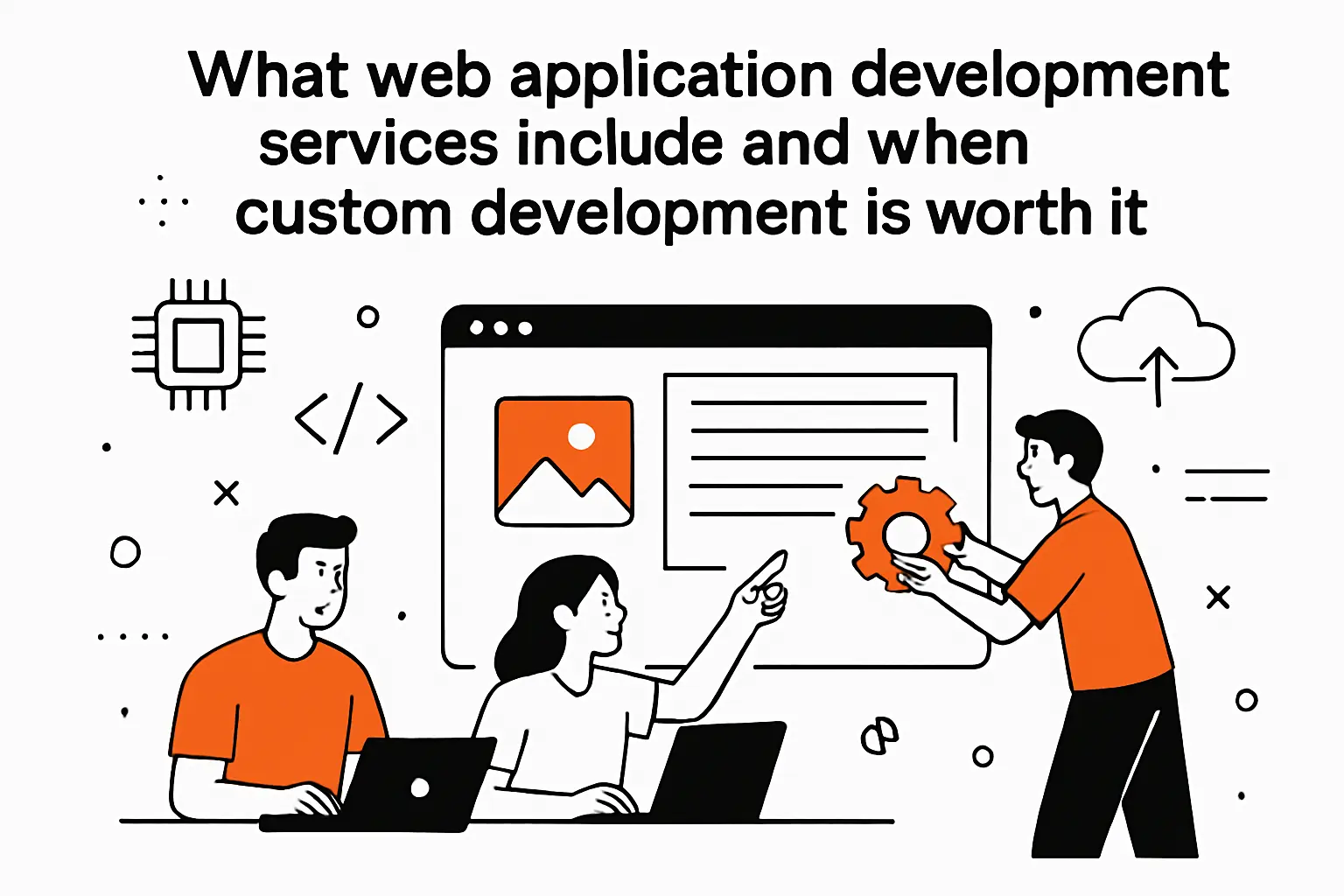
What web application development services include and when custom development is worth it
1. What a web application is: interactive, browser-based software (not just a static website)
A web application is software delivered through the browser that maintains state, enforces business rules, and typically sits on top of data you care about. In other words, it behaves less like a brochure and more like a product: users authenticate, permissions matter, workflows branch, and records change over time.
From our side of the table, this distinction shows up immediately in architecture decisions. Static sites can be “deploy-and-forget” for long stretches, while web apps need identity, session handling, data validation, audit trails, and observability. Even a seemingly simple customer portal quickly becomes a small ecosystem: account management, support ticket submissions, file uploads, notifications, and integrations with CRM or billing systems.
Real-world examples make this concrete. The Shopify admin is a web app because it’s an operational cockpit; Figma runs in the browser but behaves like desktop software; banking dashboards, insurer claim portals, and internal approval tools all fit the same mold. When the browser becomes the workplace, development services stop being “web design” and start being “systems engineering with a user interface.”
2. Common types of web apps: static, dynamic, single-page, multi-page, portal, e-commerce, and progressive web apps
Web apps span a spectrum, and choosing the wrong type often creates hidden costs later. Static sites (even when generated with modern tooling) shine when content is mostly read-only and changes are editorial. Dynamic apps handle personalized content, role-based actions, and “write” operations like purchases, submissions, or approvals.
Single-page applications emphasize app-like interactions: fast transitions, rich UI state, and fewer full-page refreshes. Multi-page applications can be better when SEO, content-heavy navigation, and simpler caching strategies matter. Portals usually introduce identity, entitlements, and multiple “mini-products” behind a single login, which elevates navigation, governance, and support needs.
E-commerce apps add a different kind of pressure: inventory accuracy, transactional integrity, payments, fraud considerations, and performance sensitivity at peak demand. Progressive web apps can bridge the gap between web and mobile expectations—offline tolerance, background sync patterns, and install-like behavior—when you’re trying to reduce friction without committing to a full native rebuild.
In our experience, the best partner isn’t the one who declares a preference; it’s the one who can explain tradeoffs, including how those tradeoffs affect marketing, operations, and long-term maintainability.
3. Business outcomes to expect: accessibility, automation, analytics, integrations, scalability, and better UX
Custom web apps are worth it when business outcomes require more than templated workflows. Accessibility is one of the most underestimated outcomes; the World Health Organization notes that 1.3 billion people experience significant disability, so inclusive UX is not a “nice-to-have” feature—it’s market reach, dignity, and risk reduction wrapped together.
Automation is usually the headline value: fewer spreadsheets, less manual reconciliation, fewer handoffs, fewer copy-paste errors. Analytics is the quieter win: once the workflow lives in software, you can measure drop-off points, cycle time, and customer friction without running an organization-wide archaeology project.
Integrations often become the decisive value driver. A web app can stitch together CRM, ERP, payment providers, shipping platforms, data warehouses, and internal systems so teams stop living in swivel-chair mode. Scalability is the long game: not just “more users,” but more products, more geographies, and more change without rewriting everything.
Better UX is the multiplier. When a web app reduces time-to-task and removes confusion, teams behave differently: adoption rises, support tickets drop, and leadership gains confidence to push more processes into the system.
Choosing web app development services starts with clear requirements and standards

1. Define goals, target users, and “must-have” vs “nice-to-have” functionality
Before evaluating vendors, we like to define what “done” means in business terms. Revenue goals, retention goals, operational throughput, compliance needs, and customer experience priorities all shape the technical plan. Without that framing, vendor comparisons collapse into aesthetics and hourly rates, which is how organizations buy the wrong thing with a very convincing slide deck.
Target users deserve equal attention. An internal operations team needs clarity, speed, and guardrails; external customers need trust, guidance, and low-friction flows. Those are different UX problems, and they imply different information architecture, security posture, and support models.
From there, we separate “must-have” from “nice-to-have” using a ruthless lens: what is necessary to deliver value and validate adoption, and what can wait until learning arrives? A surprising amount of scope creep is actually uncertainty pretending to be requirements.
Practically speaking, we often draft lightweight user journeys: what users are trying to accomplish, what data they touch, what approvals exist, and what happens when things go wrong. Error paths are requirements too, and partners who treat them seriously tend to deliver calmer launches.
2. Create a structured brief or RFP: scope, deliverables, assumptions, and evaluation criteria
A structured brief is not bureaucracy; it’s a risk-control device. When teams skip it, “misalignment” shows up later as change requests, timeline blowups, and quality compromises that nobody wants to own. A good brief clarifies scope boundaries, dependencies, and what each party is responsible for supplying.
In our engagements, we’ve found that the most useful briefs are specific about deliverables. Instead of “build a dashboard,” describe who sees it, what decisions it supports, what data sources feed it, and what actions it triggers. Similarly, instead of “integrate with our CRM,” list the objects, sync direction, failure handling, and audit expectations.
What We Like to See in a Brief
- Business context that explains why the project exists and what pain it removes
- User roles and permission expectations, including admin and support personas
- Data sources, data ownership, and any compliance constraints that shape storage choices
- Acceptance criteria framed as observable behaviors, not vague adjectives
- Evaluation criteria that clarifies how you’ll choose a partner beyond price
Strong RFPs also declare assumptions explicitly. If access to subject-matter experts is limited, say so. If the organization expects vendor-led discovery, say that too. Clarity up front keeps every proposal honest.
3. Set initial constraints early: timeline expectations, budget range, and success metrics
Constraints are not pessimism; they are how we keep decisions grounded. A timeline expectation forces tradeoffs to surface. A budget range prevents vendors from pitching a Ferrari when you needed a pickup truck. Success metrics stop the project from drifting into “it feels better” territory without proof.
In practice, we propose framing constraints as negotiable levers rather than fixed demands. If the timeline is tight, scope must become sharper. If scope is non-negotiable, budget and staffing must flex. When leadership insists all levers stay locked, the vendor selection process becomes theater.
Success metrics can be operational (cycle time reductions), customer-facing (reduced abandonment, higher completion), or financial (faster invoicing, fewer write-offs). What matters is that the metrics are measurable in the system you’re building, not in a separate spreadsheet that nobody maintains.
During vendor evaluation, we look for partners who ask questions about constraints rather than blindly accepting them. Curiosity is often the earliest indicator of delivery maturity.
Pick the right partner model: in-house team, outsourced company, freelancer, or hybrid

1. In-house development: control and context, but higher cost and lower flexibility
In-house teams can be excellent when the product is core to competitive advantage and the organization can sustain a long-term engineering culture. Context is the superpower here: internal developers absorb domain knowledge, navigate stakeholders faster, and build relationships that reduce miscommunication.
Cost and flexibility are the counterweights. Hiring is slow, onboarding takes time, and turnover can become an existential risk when systems are poorly documented. Even well-run internal teams can struggle to staff specialized needs like performance engineering, security testing, or complex UI architecture without over-hiring.
From our perspective, in-house can work best when paired with clear engineering leadership and product ownership. Without that, internal teams may become a ticket factory where priorities shift weekly and technical debt accumulates quietly.
A pragmatic approach we often recommend is to keep product ownership and architecture governance in-house, while augmenting implementation capacity with a partner who can surge during critical periods. That blend preserves control without forcing permanent headcount decisions.
2. Outsourced teams and agencies: scalable expertise and established process expectations
Outsourced teams can deliver real leverage when you need speed, breadth, and repeatable delivery patterns. Agencies often bring multidisciplinary roles—engineering, UX, QA, DevOps, and project management—already trained to collaborate, which reduces the “forming and storming” tax that new teams usually pay.
Scale is not only about more hands; it’s about depth in the right moments. A mature partner can pull in an architect during discovery, a security specialist during threat modeling, and a performance engineer during hardening, without you hiring for each niche.
Operationally, the best outsourced engagements behave like a product team, not a vendor queue. That means shared backlog grooming, transparent tradeoffs, and active participation from business stakeholders. When outsourcing is treated as “throw it over the wall,” the result is often a technically correct system that doesn’t match real workflows.
We also watch for process clarity. A partner should be able to explain how they plan, build, test, deploy, and support—without hiding behind buzzwords.
3. Freelancers and boutique studios: flexibility and price advantages with delivery and support risks
Freelancers and boutique studios can be the right fit when scope is narrow, budgets are constrained, or you need a specialist for a well-defined slice of work. The upside is speed of contracting, direct communication, and often a more flexible working arrangement than a larger firm can offer.
Delivery risk is the price of that flexibility. A single individual can become the bottleneck for architecture decisions, QA, and production support. If illness, competing commitments, or burnout hits, the project can stall abruptly, and continuity becomes difficult.
Support risk matters even more post-launch. A web app is not “done” when it goes live; users will find edge cases, browsers will change, dependencies will update, and security posture will need ongoing attention. If your business depends on the system daily, continuity should be treated as a first-order requirement.
When we advise clients considering freelancers, we usually recommend planning explicit redundancy: documentation standards, repository access, deployment automation, and a clear handoff strategy so the business isn’t held hostage by a knowledge silo.
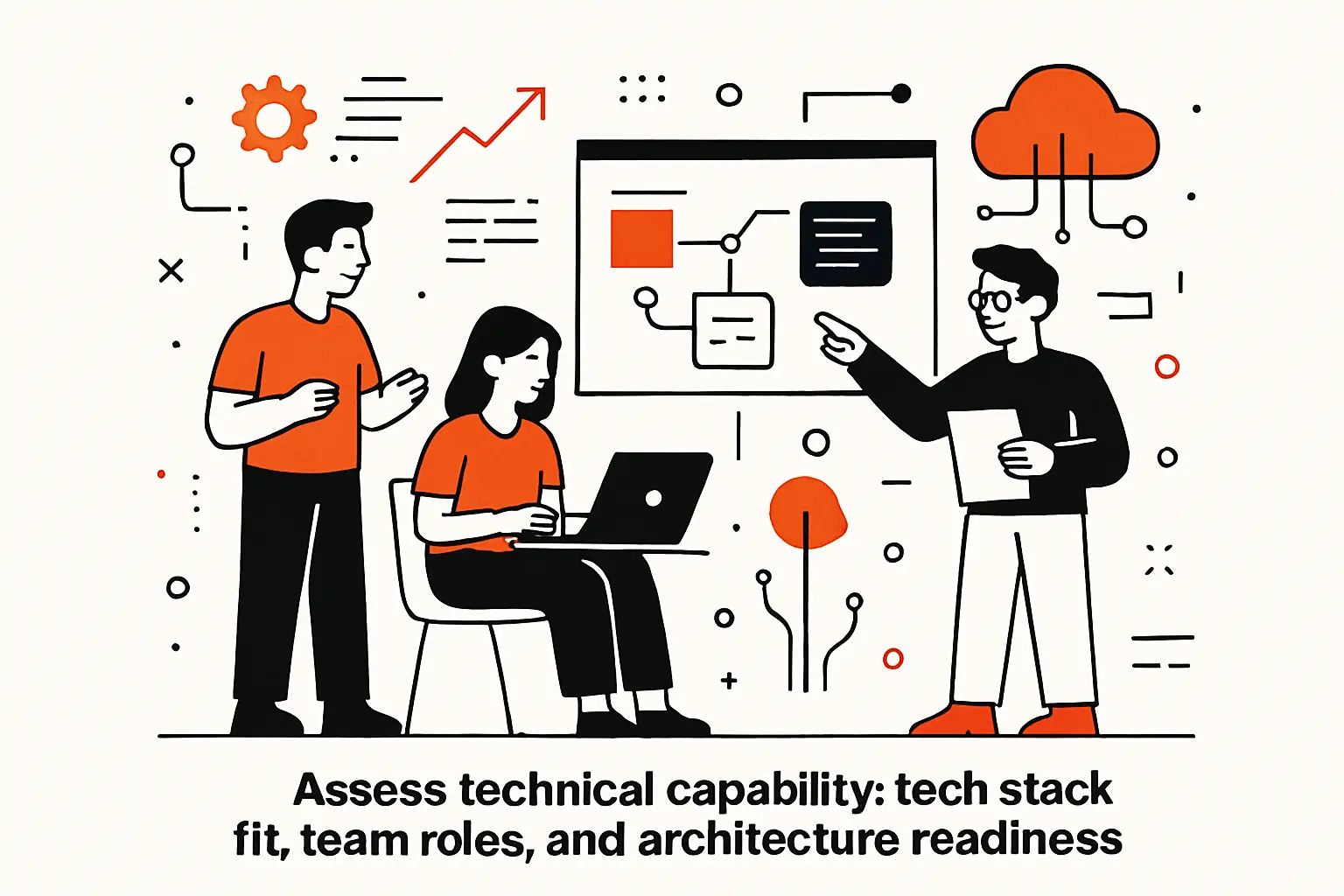
Assess technical capability: tech stack fit, team roles, and architecture readiness
1. Core competencies to validate: front end, back end, databases, APIs, and cloud deployment
Technical capability is not about a logo wall of tools; it’s about whether the partner can design and operate a coherent system. On the front end, that means state management discipline, accessibility competence, and performance awareness. On the back end, it means clear domain boundaries, reliable data validation, and predictable error handling.
Databases are often where web apps either become resilient or become fragile. A strong partner can discuss indexing strategy, migration safety, transactional boundaries, and how they avoid “mystery meat” schemas that only one developer understands. APIs deserve equal scrutiny: versioning strategy, idempotency, authentication, authorization, and observability are not optional details.
Cloud deployment is where many vendors overpromise. We like to hear specifics about infrastructure-as-code, environment separation, secure secret handling, log aggregation, and incident response playbooks. If a partner can’t explain how they ship safely, they probably can’t ship predictably.
During evaluation, we also confirm team roles. Great outcomes usually require more than coders: product thinking, design, QA, and DevOps must be present, whether in-house or via the partner.
2. Multi-device strategy: responsive web, mobile-first UX, and progressive web apps
Multi-device is no longer a design preference; it’s a business reality. Customers may browse on a phone, purchase on a laptop, and track orders from a tablet. Internal teams may approve requests in transit, then complete details at a desk. If a web app breaks that continuity, users invent workarounds, and the system slowly loses authority.
Performance is the sharp edge of multi-device strategy. Google’s research warns that 53% of visits are likely to be abandoned if pages take longer than three seconds to load, and we’ve watched that reality play out across industries: even “loyal” users will bail when the interface feels heavy or confusing.
Responsiveness alone is not enough; mobile-first UX requires rethinking information hierarchy, touch targets, and form design. Progressive web apps can add resilience—especially in field environments—by handling flaky connectivity more gracefully and enabling smoother repeat usage.
When selecting a partner, we recommend asking for mobile performance evidence, not promises: Lighthouse reports, real-user monitoring plans, and a clear strategy for keeping features from bloating the experience.
3. Scalability planning: how the partner handles performance, growth, and change over time
Scalability is a deceptively broad word. It includes user growth, data growth, feature growth, organizational growth, and even regulatory growth. In our experience, the hardest scaling problem is change: requirements evolve, integrations shift, and teams rotate, yet the system must remain understandable and safe to modify.
Architecture readiness shows up in how a partner talks about boundaries and failure modes. Do they isolate external dependencies so an outage doesn’t cascade? Can they describe caching strategy without hand-waving? Do they plan for background processing, rate limiting, and graceful degradation when “something downstream” misbehaves?
Cloud strategy matters here as well. Gartner has projected that 90% of Organizations Will Adopt Hybrid Cloud Through 2027, and that aligns with what we see in the field: many businesses operate across multiple environments for cost, latency, compliance, or vendor strategy reasons.
A capable partner plans for that complexity without turning it into chaos. Good scalability work is less about “bigger servers” and more about disciplined design, observability, and operational habits.
Validate proof of work: portfolio depth, case studies, and reputation signals
1. Portfolio review that goes beyond visuals: similar complexity, industry context, and outcomes
A portfolio should answer tougher questions than “does it look modern?” We recommend evaluating whether the partner has handled similar complexity: authentication flows, multi-role permissions, complex forms, approvals, data imports, integrations, and admin tooling. If their examples are mostly marketing sites, their instincts may not translate well to product-grade systems.
Industry context matters because domain constraints shape architecture. Healthcare products carry privacy and audit expectations. Fintech products wrestle with reconciliation and risk controls. Logistics products must tolerate partial data and operational messiness. A partner who has seen your kind of mess will design for it instead of being surprised by it.
Outcomes are the most credible part of a case study. We like stories that include the starting condition, the tradeoffs made, and what changed after launch—adoption behavior, support load, operational efficiency, or revenue workflow improvements. When a vendor can’t articulate outcomes, the work may have been superficial, or the measurement discipline may be missing.
During reviews, we also ask to see the unglamorous parts: admin screens, empty states, error handling, and permission boundaries. Those details are where real web apps either shine or crumble.
2. Client feedback and references: what to confirm before you trust testimonials
Testimonials are marketing; references are due diligence. We encourage buyers to ask references about predictability: did the partner communicate early about risks, or did surprises arrive late? How did the team respond when requirements shifted? Were there strong product instincts, or did every decision require client micromanagement?
Support behavior is another critical check. A partner can deliver a beautiful launch and still fail you if they disappear when production issues arise. References can tell you whether the vendor handled incidents calmly, documented fixes, and improved processes instead of blaming users or third parties.
From the technical side, we like to validate codebase handoff quality: was the repository organized, were deployments repeatable, did documentation exist, and could internal teams onboard without heroic effort? A good vendor leaves behind an asset; a weak one leaves behind a dependency.
When possible, we also confirm whether the reference project is still healthy. Long-term satisfaction is harder to fake than launch-day excitement, and it signals that the partner built something maintainable.
3. Common red flags during evaluation: vague timelines, unclear pricing, weak communication, no support plan
Red flags often appear as ambiguity disguised as confidence. If timelines are promised without a clear discovery phase, risk register, or dependency map, the vendor is betting that uncertainty will be paid for later. If pricing lacks structure—no explanation of what’s included, how change requests work, or what assumptions the estimate depends on—budget control will be painful.
Weak communication shows up early: slow responses, evasive answers, or a tendency to over-talk and under-clarify. In complex projects, communication is not a soft skill; it’s a delivery mechanism. If you can’t align during sales, alignment will not magically improve when deadlines hit.
No support plan is a major warning sign. A web app touches users every day, and production is where reality lives. Partners should be explicit about post-launch monitoring, incident response, patch cadence, and how enhancements are handled.
Another subtle red flag is a vendor who refuses to discuss tradeoffs. Mature teams can explain why they would not choose certain technologies or patterns for your context. When everything is “easy,” something is being ignored.
Evaluate delivery management and collaboration workflows before you commit
1. Discovery and planning practices: business analysis, architecture mapping, and risk planning
Discovery is where expensive misunderstandings are prevented. Strong partners don’t treat discovery as a formality; they treat it as engineering reconnaissance. That includes business analysis (how work really gets done), architecture mapping (systems, data flows, trust boundaries), and risk planning (what could derail delivery and how to mitigate it).
In our work, we also push for early alignment on “definitions.” What does “customer” mean across systems? What is the source of truth for billing status? Which events require audit logging? Seemingly small semantic mismatches can cause large integration failures later.
Risk planning should be explicit. We like to see a vendor identify integration uncertainty, data quality risk, stakeholder availability constraints, and security considerations. When those risks are named, they can be managed. When they’re ignored, they become surprise invoices and emergency redesigns.
Architecture mapping is not about drawing pretty diagrams. The point is to make decisions visible: where data lives, how permissions work, and what happens when dependencies fail. A partner who does this well tends to build calmer systems.
2. Agile execution expectations: sprint planning, progress demos, and change request handling
Agile, done well, is a transparency engine. You should expect regular planning sessions, frequent demos tied to real acceptance criteria, and a backlog that stays prioritized. Progress should be observable in working software, not only in slide updates or time tracking exports.
Change request handling is where many projects either remain healthy or spiral. Mature partners separate “new learning” from “scope drift” and have a clear workflow: what changes, why it changes, what it impacts, and who approves it. Without that discipline, teams quietly accumulate half-finished features and unresolved decisions.
At TechTide Solutions, we’ve found that demos are most valuable when they include edge cases: error states, permission boundaries, and what happens when integrations are unavailable. Those moments reveal whether the system is being built with operational realism.
Agile also requires client participation. If stakeholders never show up, the process devolves into guesswork. A good partner will push you—respectfully but firmly—to stay engaged, because silence is rarely agreement in software.
3. Communication model: project tools, availability, stakeholder alignment, and escalation paths
Communication is the scaffolding of delivery. We recommend agreeing early on project tools (ticketing, documentation, chat), meeting cadence, and who owns decisions. When stakeholders are unclear, projects stall in polite limbo where nobody wants to say “no,” so nothing moves forward.
Availability matters on both sides. If your subject-matter experts are stretched thin, name it and plan around it. If the partner cannot commit to consistent overlap time for collaboration, expect delays in feedback loops and slower resolution of blockers.
Escalation paths should be explicit, not improvised. When disagreements happen—on scope, timeline, quality, or risk—you need a known route to resolution that avoids passive-aggressive churn. The best teams normalize escalation as a healthy mechanism rather than a sign of failure.
We also like to see documentation habits embedded into communication. Decisions made in meetings should become durable artifacts: architecture notes, acceptance criteria, integration contracts, and operational runbooks. When knowledge stays in conversation only, future maintenance becomes a scavenger hunt.
Protect outcomes: pricing clarity, contracts, QA testing, security, and long-term maintenance

1. Cost and pricing models: fixed price vs hourly, what drives estimates, and how to avoid hidden costs
Pricing models should reflect uncertainty honestly. Fixed price can work when requirements are stable and scope is well-defined. Hourly (or time-and-materials) can be healthier when discovery is still revealing unknowns. The danger is not the model; it’s pretending the project has certainty it doesn’t.
Estimates are driven by complexity hotspots: integrations, data migration, permission models, offline tolerance, admin tooling, and quality expectations. UX design depth and QA rigor also change cost materially, even when the feature list looks similar on paper.
Hidden costs often come from “not in scope” assumptions: content entry, analytics setup, security reviews, legal approvals, and internal stakeholder time. A strong partner will surface these costs early and help you plan for them rather than letting them ambush the budget.
To avoid surprises, we advise buyers to require a written scope boundary list and a change-control workflow that defines how new requirements are priced. Clarity beats optimism every time.
2. Contracts and ownership: milestones, code/IP rights, NDAs, and access control to repos and infrastructure
Contracts are where outcomes are protected—or quietly forfeited. Milestones should map to measurable deliverables, not vague phases. Ownership language must be explicit about code, designs, documentation, and any reusable components. If your organization pays for the build, access should not be negotiable.
Repository access is non-negotiable in our view. Clients should have visibility into source control, issue tracking, and deployment pipelines so the project can survive vendor changes. Infrastructure access matters too: cloud accounts, DNS, monitoring, and secrets management must be structured to avoid lock-in and reduce operational fragility.
NDAs and confidentiality are common, but access control is more nuanced. Least-privilege permissions, auditable access, and clear offboarding procedures protect both sides. When vendors request broad access with little justification, it signals immature security habits.
We also recommend defining “handoff readiness” as a contractual expectation: documentation, runbooks, and a maintainable deployment process. A launch that cannot be safely operated is not a finished deliverable, even if the UI looks complete.
3. Quality and reliability: QA approach, testing types, acceptance criteria, and post-launch support
Quality is not a phase; it’s a posture. A serious QA approach includes automated checks, thoughtful manual testing, regression discipline, and acceptance criteria that can be verified without argument. If a vendor cannot explain how they prevent defects from reappearing, you should assume defects will become your ongoing tax.
Security is inseparable from reliability. IBM reported that the global average cost of a data breach reached $4.88 million in 2024, and we treat that as a reminder that “good enough security” is rarely good enough when a web app becomes a critical workflow.
In practical terms, we look for partners who incorporate threat modeling, secure coding practices, dependency management, and vulnerability remediation into normal delivery. Post-launch support should include monitoring, alerting, incident response, and a maintenance plan for updates and enhancements.
Finally, acceptance criteria must be realistic. It should cover not only happy paths, but also permissions, failure handling, and performance expectations. Launch day is a beginning; the real test is whether the system remains stable when users behave unpredictably.
TechTide Solutions: custom software tailored to your customers and business needs

1. Building custom web and mobile applications that match real workflows and user expectations
At TechTide Solutions, we build web apps by starting with the work, not the wireframes. Our bias is toward understanding the messy reality: how teams currently operate, where “tribal knowledge” hides, what approvals happen informally, and which edge cases cause the most frustration. That context informs design decisions that templates simply cannot capture.
In practice, we’ve built customer-facing portals that reduce inbound support load by clarifying status and next actions, and we’ve built internal tooling that replaces spreadsheet pipelines with auditable workflows. Those outcomes happen when UX and architecture reinforce each other: the interface guides users, while the system enforces the rules quietly in the background.
We also take integrations seriously because they’re often the real product. Whether we’re connecting to billing, CRM, inventory, or data platforms, we focus on operational safety: retries, idempotency, reconciliation strategies, and visibility when something fails.
Above all, we aim to deliver software that feels inevitable—like it matches the way people already think—while still nudging the business toward cleaner, more scalable processes.
2. End-to-end delivery from discovery through deployment, plus ongoing enhancement and maintenance
End-to-end delivery means we don’t stop at “it works on our laptops.” Our teams handle discovery, UX, architecture, implementation, QA, deployment, and post-launch enhancement so clients aren’t forced to stitch together a delivery chain from mismatched vendors. That continuity reduces handoff loss and increases accountability.
Operational readiness is a core deliverable. We plan environments, CI/CD pipelines, monitoring, logging, and alerting so teams can respond to issues with evidence rather than panic. In our view, observability is part of product quality because it determines how quickly you can diagnose and fix real-user problems.
Maintenance is not a reluctant add-on; it’s how web apps stay safe and useful. Dependencies evolve, browsers change, security expectations tighten, and business priorities shift. We design systems to accommodate change through modular architecture, clear boundaries, and documentation that remains legible to new engineers.
When clients want to scale, we help them scale responsibly: governance, release strategy, and iterative enhancement that preserves stability while allowing the product to grow.
3. Transparent collaboration: clear communication, milestone-based planning, and scalable development teams
Transparency is our default posture because it lowers risk for everyone. We collaborate in shared tools, keep backlogs visible, document decisions, and run demos that show working behavior rather than abstract status. Clients should never wonder what’s happening or why a decision was made.
Milestone-based planning, in our experience, works best when milestones represent meaningful business capability. Instead of celebrating “backend complete,” we prefer “users can submit requests end-to-end” or “admins can reconcile records safely.” Those milestones make progress understandable to non-technical stakeholders and keep delivery oriented around outcomes.
Team scalability is also a design problem. We structure work so additional engineers can contribute without creating coordination chaos. That includes clear coding standards, consistent architecture patterns, and a QA process that doesn’t become the bottleneck.
If you’re evaluating us alongside others, we encourage direct questions about how we handle change, how we manage risk, and how we support production systems. The best partnerships are built on shared clarity, not sales comfort.
Conclusion: a final checklist for choosing web app development services

1. Decision questions to ask every vendor before signing
Vendor selection becomes simpler when the questions are concrete. We recommend asking questions that reveal delivery behavior, not just technical vocabulary, because execution is where most partnerships succeed or fail.
Questions We Believe Every Buyer Should Ask
- How will you validate requirements and reduce ambiguity before committing to a plan?
- Which roles will be on the team, and who is accountable for architecture and quality?
- What does “done” mean for a feature, including testing and acceptance criteria?
- How do you handle changes in scope without damaging trust or momentum?
- What happens after launch: monitoring, incident response, and ongoing enhancements?
Answers should be specific and operational. If a vendor responds with only generic assurances, it suggests they have not built a repeatable delivery engine.
2. How to shortlist confidently: proposals, trials, and milestone-based commitments
Shortlisting is a risk-management exercise. Instead of picking a vendor solely from a proposal, we suggest validating fit through small, bounded commitments: a discovery engagement, an architecture spike, or a UX prototype that can be evaluated quickly. Those activities reveal how the team thinks, communicates, and documents.
Proposals should be judged on clarity and honesty. A strong proposal states assumptions, names risks, defines scope boundaries, and explains how delivery will be managed. A weak proposal is heavy on buzzwords and light on operational detail.
Milestone-based commitments can protect both parties. For buyers, it reduces exposure if collaboration is poor. For vendors, it creates a framework to make progress without constant renegotiation. From our perspective, the healthiest partnerships treat milestones as learning checkpoints, not as “finish lines” where reality is ignored until the last moment.
When you do a trial, pay attention to how the team handles feedback. Responsiveness, curiosity, and precision are strong predictors of long-term success.
3. What to verify one last time: scope, timeline, testing, security, ownership, and support
Before signing, we recommend a final verification pass that is brutally practical. Scope should be written in a way that prevents interpretation battles. Timelines should reflect dependencies and stakeholder availability. Testing expectations should be explicit, including who signs off and how acceptance is measured.
Security and privacy expectations should be documented early, not discovered late. Ownership language must ensure you can access and operate your system without friction. Support expectations should be concrete: monitoring, response times, and how enhancements are scheduled.
At TechTide Solutions, our closing advice is simple: choose the partner you can work with when the project is stressful, not the partner who is most charming when everything is hypothetical. If you’re about to select a web app development vendor, what is the one risk you most want to eliminate before the first line of code is written?