
As product engineers at Techtide Solutions, we track the AI market obsessively because macro signals often explain day-to-day model behavior. Two numbers frame this piece: worldwide AI spending is forecast to total $1.5 trillion in 2025, and the worldwide Generative AI market itself is projected to reach US$66.89bn in 2025. Against that backdrop, GPT‑5 isn’t merely “the next model”—it’s a strategic reset of how routing, reasoning, safety, and customization work together in production. In this article we’ll cut past the hype and share what changed under the hood, where GPT‑5 clearly leads, where GPT‑4o still charms, and—most importantly—how we integrate both in client workflows.
Chat GPT 5 vs 4: What Changed Under the Hood
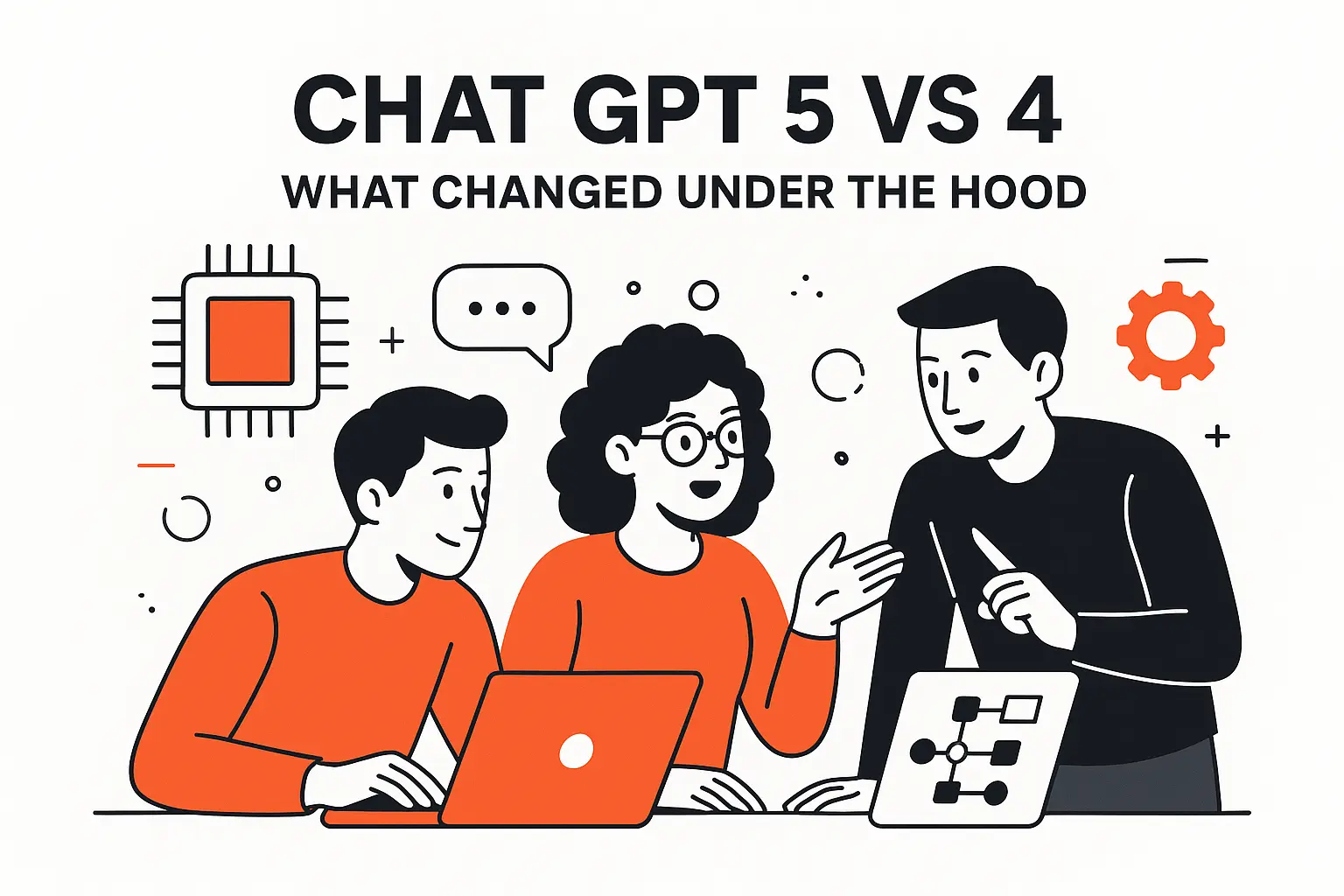
The model layer is evolving in lockstep with adoption: enterprise GenAI spend is expected to reach $644 billion in 2025, even as leaders gravitate toward predictable, off‑the‑shelf capabilities. GPT‑5’s core architectural choices—unified routing, a built‑in “thinking” mode, long context, improved safety, and steerable personalities—reflect that market pressure for reliability over raw novelty.
1. Unified Routing and Thinking Mode Replace Manual Model Picking
GPT‑5 is designed as a unified system with a real-time router that decides, per message, when to respond fast and when to deploy deeper “thinking,” rather than forcing us to hand‑pick a different model for each task. OpenAI describes a smart default model (“main”), a deeper reasoning variant (“GPT‑5 thinking”), and mini fallbacks, all mediated by a router that learns from signals like measured correctness and user preferences. This is not a cosmetic change; it reduces choice paralysis and prevents over‑spending on heavyweight reasoning when it’s unnecessary, while still letting power users force extended reasoning by saying “think hard about this.” The mechanism is documented in the launch blog and system card, which emphasize automatic selection and clear availability across tiers for routing and manual overrides in ChatGPT and API access.
In our practice, this means fewer brittle prompt “trees” and less orchestration glue. When teams used GPT‑4o alongside o‑series reasoning models, we often maintained separate toolchains and telemetry per model. With GPT‑5, we route through one surface and promote only the exceptional cases to “thinking.” That simplified our production agents and reduced the odds of accidentally leaving a complex job on a fast-but-shallow model. The official documentation confirms unified routing and the family layout, including named variants like gpt‑5‑thinking and gpt‑5‑thinking‑mini, with the router continuously retrained on real usage signals.
2. Larger Context Window and Multimodal Tool Use for Long, Complex Work
GPT‑5 raises the stakes on long context and multimodal tool use. In the API, GPT‑5 accepts up to 272,000 input tokens and can generate up to 128,000 reasoning & output tokens, for a combined context length of 400,000 tokens. OpenAI’s own long‑context evals (OpenAI‑MRCR and the BrowseComp Long Context benchmark) show robust retrieval accuracy even at 128K–256K‑token inputs, a range where we previously had to stitch together search, chunking, and retrieval pipelines. Crucially, GPT‑5 brings this length into the same surface as parallel tool calling, web/file search, image analysis, and Structured Outputs, which keeps agents composable as we scale.
Practically, that means we can drop an RFP packet, two architectural PDFs, a code excerpt, and a compliance appendix into a single conversation and still keep a tight chain of references. On a recent diligence project, we replaced a custom vector index and did end‑to‑end analysis inside one reasoning‑enabled thread, then emitted a rigid JSON schema using Structured Outputs. That shift wasn’t just “speed”—it removed a whole class of desynchronization bugs we’d been patching since the GPT‑4 era.
3. Safety, Hallucination Reduction, and Safe Completions
GPT‑5’s system card and launch post detail a stronger safety posture. With web search enabled on real‑world anonymized prompts, GPT‑5’s responses were ~45% less likely to contain a factual error than GPT‑4o, and GPT‑5’s reasoning variant produced ~80% fewer factual errors than OpenAI o3. OpenAI also treated “GPT‑5 thinking” as “High capability” in biological and chemical domains and reports 5,000 hours of red‑teaming with government‑backed institutes, coupled with a “safe completions” paradigm that pairs classifiers and reasoning monitors with enforcement pipelines, as documented in the model’s system card.
In our audits, GPT‑5 makes fewer confident misreads of medical abstracts and fewer “invented citations,” especially when forced to reason slowly. It also de‑sycophantizes politely: the model is better at saying “I can’t do X with the tools provided” instead of fabricating authority. That matters in compliance workflows. Where we used to slap a second pass validator (which often caught “too helpful” hallucinations), we now get fewer false alarms and can reserve heavyweight validators for final outputs only.
4. Personality Controls and a Shift Toward a More Formal Tone
GPT-4o sometimes felt like a genial coworker, occasionally ingratiating. GPT-5 trends more formal by default, with less sycophancy and clearer refusals. OpenAI rolled out four preset personalities: Cynic, Robot, Listener, and Nerd. They offer steerability without complex prompt engineering. Users can escalate to deeper reasoning when needed. This responded to earlier 4o experiments and user pushback. OpenAI reversed a GPT-4o update many described as sycophantic. A single default personality can’t satisfy hundreds of millions of users. OpenAI committed to broader customization controls, as reported then.
We like GPT‑5’s defaults for enterprise work because formality reduces accidental tone violations in regulated comms and aligns with structured outputs. But we also empathize with creative teams who miss 4o’s warmth for brainstorming; below we share when we still toggle back to 4o for voice and creative ideation.
Benchmarks and Hands-On Tests: Where GPT-5 Pulls Ahead
Benchmarks aren’t the whole story, but they do predict value in aggregate—especially as businesses look for ROI windows. Gartner expects end‑user spending specifically on GenAI models to reach $14.2 billion in 2025, a small slice of AI spend but an outsized lever in knowledge‑work automation. In our lab and client projects, GPT‑5 consistently translates its benchmark gains into fewer retries, tighter citations, and safer handoffs to tools.
1. Reasoning and Science Benchmarks Improve Over GPT-4o
On public reasoning and science tasks, GPT‑5 posts strong jumps. OpenAI reports 88.4% on GPQA without tools when using GPT‑5 Pro’s extended reasoning, setting a new state of the art in their internal comparisons, and 94.6% on AIME 2025 (no tools). In our trial prompts across organic chemistry, optics, and statistical inference, GPT‑5’s novel tendency is to announce uncertainty early, ask for missing variables, and then opt into slow thinking—behavior we didn’t see as reliably with 4o.
Crucially, GPT‑5’s “thinking” traces are tighter: fewer redundant steps and more explicit verification before final answers. In science report writing, that translates into fewer “reasonable but wrong” paragraphs that require manual fixes. We still wrap consequential analyses with external calculators and literature searches, but we’re catching fewer logic errors in peer review.
2. Coding Performance Jumps on Real-World Tasks
We pay special attention to SWE‑bench Verified because it’s closer to production reality than toy coding tasks. GPT‑5 registers 74.9% on SWE‑bench Verified on OpenAI’s fixed subset and 88% on Aider Polyglot code‑editing, while using fewer tool calls and output tokens than prior reasoning models. Even more pointedly, OpenAI has begun rolling out GPT‑5‑Codex—a coding‑focused variant in the Codex surfaces—meant for agentic code workflows and interactive edits at developer cadence, alongside model‑aware refactoring support. For us, that shows up as fewer “semantic mismatches” between the model’s reading of a diff and the repository’s build constraints.
Hands-on, GPT-5 is less likely to forget config files and more likely to audit scaffolding. It checks pytest fixtures and proposes safe feature flags by default. In a mission-critical web refactor, GPT-5 captured screenshots as context for reasoning. That capability matters for front-end modernization. Pixel fidelity and layout intent are notoriously hard to prompt. We can now ask an agent to read TypeScript, CSS-in-JS, and design tokens across a repo. It produces a consolidated ADR without hours lost to scaffolding or lint wars.
3. Math and Competition-Style Problem Solving Show Significant Gains
Beyond AIME’s 94.6% without tools, GPT‑5 shows materially higher scores on newly emphasized math benchmarks in OpenAI’s developer post, including HMMT 2025 and long‑context graph reasoning, while preserving retrieval accuracy. These aren’t just leader‑board numbers; in our experience they mean fewer dead‑ends when debugging NaN‑plagued training runs or balancing cost curves in FinOps models. We’ve long used ensembles—fast model for setup, slow model for the tricky algebra—for cost control. With GPT‑5, we can keep more of that work inside one “thinking” tier and hit SLAs without a lot of orchestration.
4. Speed and Concision Noted by Multiple Testers
OpenAI’s claim that GPT‑5 outperforms o3 while using 50–80% fewer output tokens in evaluations holds up anecdotally: we see shorter, denser answers with fewer filler sentences. That efficiency pairs with newly adjustable “thinking time” in ChatGPT, which now offers user‑visible modes to trade off speed vs. depth, addressing a common complaint about long pauses in deep reasoning. On top of that, rate limits for the “Thinking” tier were recently raised in ChatGPT to 3,000 messages/week for paid users, alleviating throughput bottlenecks in extended workflows.
In plain English: GPT‑5 spends its “slow tokens” where they matter (proof steps, code audits, risk analysis), and stays terse elsewhere. That’s a quality‑of‑life upgrade for engineers and analysts who want reliable rigor without default verbosity.
Where GPT-4o Still Shines Against GPT-5
As adoption broadens, the modalities matter. Gartner estimates GenAI smartphone end‑user spending will reach $298.2 billion by the end of 2025, and GPT‑4o’s “omni” DNA—native voice and vision with low latency—still feels like the friendliest front door for many human‑in‑the‑loop tasks. Even as GPT‑5 assumes the default slot, we intentionally keep GPT‑4o in our toolkit for scenarios where warmth, rhythm, and pacing trump raw IQ.
1. Creative Writing Style and Conversational Warmth
We still reach for GPT‑4o when a client wants lyrical ideation or brand‑voice exploration in early drafting. Some of that preference is cultural—writers and marketers often prefer a slightly more emotive collaborator. OpenAI’s earlier 4o personality experiments, later reversed after feedback about sycophancy, are a reminder that “vibe” is a product surface, not a side effect. In contrast, GPT‑5 defaults toward formal clarity and safety‑driven restraint. For mature copy pipelines with strong style guides, GPT‑5 is fantastic at adherence. For greenfield voice, 4o often plays the better muse.
2. Emotional Support and Empathy in Sensitive Tasks
Even though OpenAI has updated GPT‑5 Instant to better detect distress and de‑escalate, we’ve found that 4o’s tone can still feel more “human” in moments that call for empathy without diagnosis—think customer escalations, support for frustrated users, or first‑pass onboarding during organizational change. That’s partially because the 4o era baked “omni” cues into its conversational cadence. We won’t ship any sensitive flow without explicit escalation paths and safety controls, and for anything health‑adjacent we keep GPT‑5’s safer defaults. But when a product manager asks, “Which one will make a novice user feel at ease?”—4o often wins in listening posture.
3. Step-by-Step How-To Guidance in Everyday Scenarios
For recipe tweaks, DIY repairs, or hobbyist “how‑to”s, 4o’s chatty stepwise style reduces perceived friction. GPT-5’s precision excels at professional instruction. For example: “Write the Terraform policy diff and explain the IAM blast radius.” In casual settings, a more conversational path—shorter steps and more encouragement—drives better adherence. We frequently A/B test these flows with target users. The “right” model gets users across the finish line. It’s not necessarily the one using the fewest tokens.
4. Low-Latency, Chatty Responses for Casual Use
GPT‑4o remains our default for real‑time voice demos and “talk it out” ideation because it was built for native audio interactions and sub‑second turn‑taking. OpenAI’s 4o launch materials emphasized this low‑latency, multimodal core, and in our usage that characteristic persisted through the 4o snapshots. The practical upshot: if your end‑user experience is essentially a conversation—on mobile, in a car, or via a wearable—4o’s liveliness can increase engagement enough to outweigh GPT‑5’s analytical edge.
Chat GPT 5 vs 4 in Daily Workflows
Agentic automation is moving from lab to line‑of‑business. Deloitte predicts that 25% of enterprises using GenAI will deploy AI agents by 2025, with adoption accelerating thereafter. Our guidance below is unapologetically pragmatic: start where GPT‑5’s deltas are obvious, keep 4o where user experience is king, and build observability from day one so routing remains a choice, not a guess.
1. Software Development and Debugging
Where GPT‑4o helped write functions and fix small bugs, GPT‑5 safely expands the blast radius. We now ask GPT‑5 to:
- Digest multi‑file diffs and surface cross‑cutting risks (e.g., a subtle breaking change in a shared utility) before proposing a patch, reflecting its strong performance on real repo tasks like 74.9% on SWE‑bench Verified.
- Translate design intent into code and tests for front‑ends, leaning on GPT‑5’s improved design sensibility and higher Aider Polyglot accuracy of 88%.
- Run longer “agentic” loops safely with tool‑aware constraints. GPT‑5’s router spares the heavy thinker for trickier steps while using faster pathways for glue work, and Structured Outputs lets us bind results to a schema so CI steps can fail deterministically if the model deviates.
Our house style now forces pre‑merge summarization (“what changed and why, as a diff‑aware ADR”) and automated risk labeling. With GPT‑5 in the loop, the ADRs get specific—pointing to exact files, likely regressions, and test coverage gaps—and we see fewer back‑and‑forths in review.
2. Research, Analysis, and Structured Summaries
We’ve leaned into GPT‑5’s long context and Structured Outputs for primary/secondary research. In one customer project, we fed scanned contracts, vendor SOC reports, and a backlog of security tickets into a single thread and asked for a risk register mapped to our JSON schema. GPT‑5 handled the citations cleanly, and the schema guarantee spared us a lot of brittle post‑parsing logic. Where GPT‑4o excelled at quick briefs, GPT‑5 treats the same problem as a mini‑ETL job—more work up front, less cleanup down the line.
Key capabilities include schema-true JSON responses and parallel tool calling. These keep the model honest and the pipeline fast. Use Structured Outputs by default for data that hits databases or dashboards. Enforce structure at the model boundary to improve monitoring and cost control.
3. Agentic Automation with Tools, Browsing, and Apps
Apps inside ChatGPT and AgentKit in the API ecosystem are the missing mid‑layer between raw models and finished products. Apps let ChatGPT call partner services in conversational flow, like Zillow, Spotify, Canva, and Expedia. The Apps SDK, built on Model Context Protocol, gives developers composable UI and logic patterns. AgentKit adds an Agent Builder, ChatKit UI components, and a Connector Registry. It includes integrated evals to design, embed, and measure agents without weeks of glue code. Together, these reduce the cognitive load of orchestrating tools and data, and they meet enterprise governance needs without hobbling velocity.
Our pattern: let ChatGPT apps handle the near‑term “learn in the chat” experiences for business users; in parallel, build API‑level agents with AgentKit for embedded workflows where you need brand‑consistent UI, custom guardrails, and enterprise auth. GPT‑5’s unified router means both experiences benefit from the same core judgment about when to think longer or answer quickly.
4. Personalized Memory and Task Adaptation
Memory graduated from novelty to necessity. ChatGPT now supports personal and project‑only memory, letting workstreams maintain tone, glossary, and context isolation by project. For product teams, that means a design system glossary, preferred copy rules, and “do not use” lists can follow a thread without bleeding into unrelated chats. For analysts, project‑only memory guarantees that an M&A due‑diligence lexicon won’t contaminate a retail pricing exploration. We still recommend explicit, human-readable profiles alongside memory for smoother onboarding. New teammates shouldn’t depend on spelunking past chats. GPT-5’s “remember just enough” is finally useful and reliable at scale.
Chat GPT 5 vs 4: Costs, Access, and Picking the Right Model
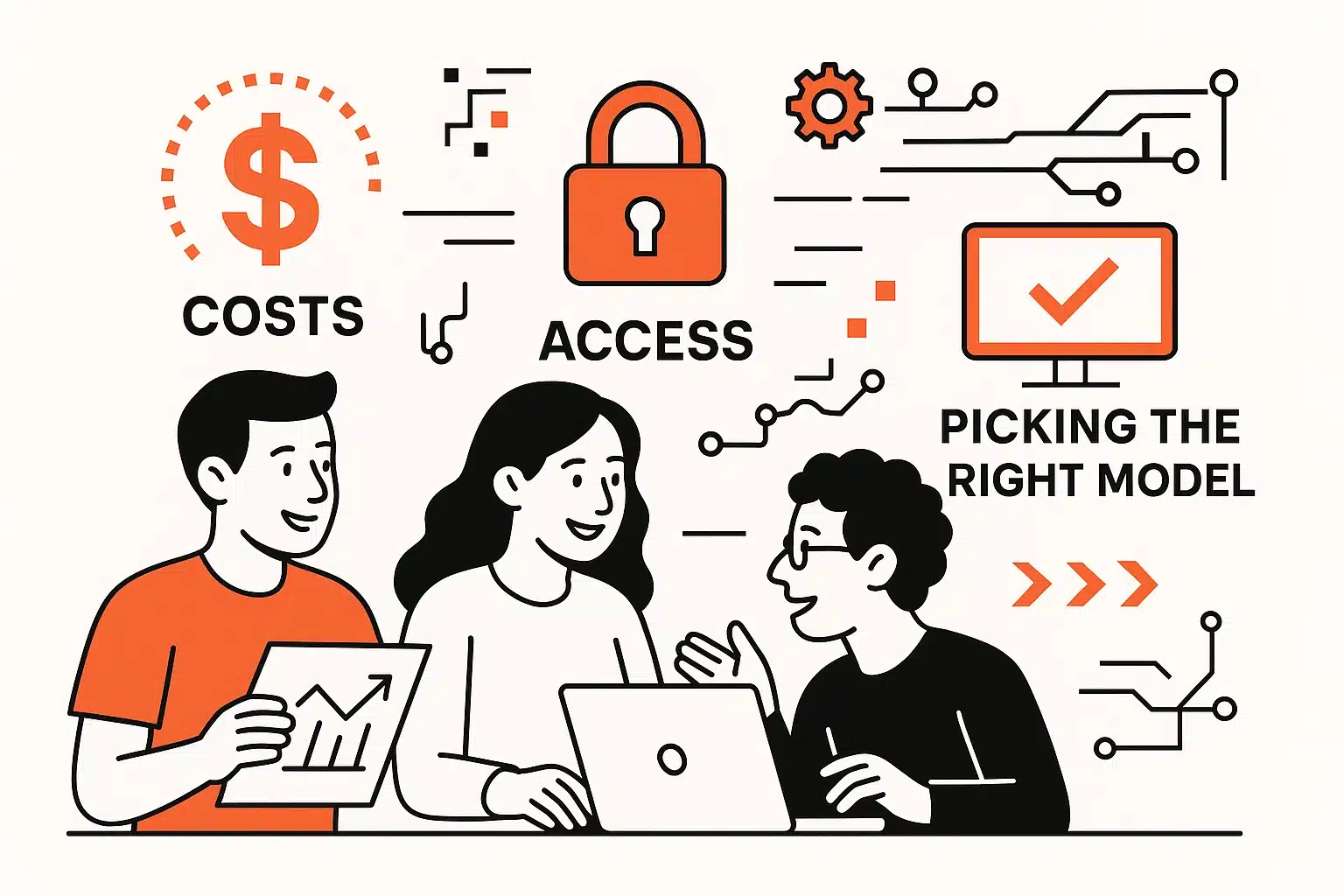
Money is strategy. The GenAI market will total US$66.89bn in 2025, but your TCO depends on plan limits, token prices, caching, and how aggressively you route to “thinking.” The good news: GPT‑5’s pricing tiers and Batch/caching economics make sensible architectures affordable when you pick the right surface for each task.
1. Availability in ChatGPT and API, with Legacy GPT-4o Option for Paid Users
GPT‑5 is now the default in ChatGPT, with selectable modes (Auto, Fast, Thinking) and increased “Thinking” capacity. After rollout pushback, OpenAI restored 4o in the model picker for paying users by default. They also added a “Show additional models” toggle to enable options like 4.1 and o3. For planning and procurement, that stability matters. Product teams can keep 4o-based experiences alive while migrating critical paths to GPT-5 gradually, not in one sprint.
Plan math also helps set expectations: Plus is $20 per month, Pro is $200 per month, and Business (Team) starts at $25 per user per month billed annually, each with differing limits and access to reasoning tiers. For high‑volume or high‑control work, we usually add the API and route token‑heavy jobs there, keeping ChatGPT for interactive tasks and apps.
2. Pricing and Caching Tips When Migrating to GPT-5
On the API, GPT-5 input lists at 1,250 US$ per million tokens. GPT-5 output lists at 10,000 US$ per million tokens. Cached GPT-5 inputs cost 0,125 US$ per million tokens. GPT-5 mini sets input at 0,250 US$ per million tokens. Its output is 2,000 US$ per million tokens. GPT-5 nano reaches 0,050 US$ input per million tokens. Nano output is 0,400 US$ per million tokens. Batch API halves input and output costs for batched, non-interactive workloads. The tradeoff is 24-hour latency on batch jobs. In migrations, we inventory “prompt constants”: system prompts, schemas, and tool specs. We push those constants into cache to realize immediate savings.
Finally, treat “thinking” time as a budget lever. In the API you can set `reasoning_effort` from minimal to high; in ChatGPT you can toggle modes explicitly. We default to minimal or low on retrieval‑heavy long‑context jobs (where long “thoughts” add little), and reserve high for proof‑like math, code safety audits, or adversarial analysis. This achieves the quality of deep reasoning while keeping costs and latency bounded.
3. Route Easy Tasks to GPT-5 Mini and Use GPT-5 Thinking for Hard Ones
GPT-5 has a purposeful family. gpt-5-mini handles high-QPS and lightweight transformations. gpt-5 handles everyday “smart fast” tasks. gpt-5-thinking tackles problems benefiting from extended chains of thought. The system card and launch post explain automatic router decisions. Power users can still force a tier when necessary. Default rules send classification, extraction, and templated summarization to mini. Send knowledge work with modest ambiguity to main. Reserve thinking for proofs, multi-hop coding, or high-stakes analysis. Add telemetry so you can spot when the router is spending “thinking” tokens where they aren’t helping.
4. Simple Rules of Thumb for Choosing GPT-5 or GPT-4o
- Pick GPT‑5 when correctness and structure dominate—regulatory summaries, code diffs, risk memos, or anything destined for a schema. Benchmarks indicate advantages on GPQA (88.4%) and AIME (94.6%) and strong coding performance (SWE‑bench Verified 74.9%), which show up in fewer retries.
- Pick GPT‑4o when experience is the product—low‑latency voice, warm ideation, or casual how‑to flows. It remains available in the model picker for paid users and still excels at real‑time multimodal conversations, where responsiveness beats meticulousness.
- If you need both, route by intent: start chats and voice in 4o, escalate to GPT‑5 for drafting, validation, and structured output. With Apps and AgentKit, you can keep the handoff inside the same experience.
How TechTide Solutions Helps You Build Custom AI Solutions Tailored to Your Needs

Adoption is now mainstream, which raises the bar for reliability and governance. Deloitte recently reported that 86% of corporate and private‑equity leaders are already using GenAI in deal workflows, and many plan to increase spending in the next 12 months. Our role is to convert that spend into outcomes by combining product craft, safety engineering, and credible model choices. Our method is simple but rigorous:
1. Discovery with evidence.
We map jobs-to-be-done to user journeys and compliance constraints. Then we run spike tests that mirror real artifacts. Examples include repo snapshots, vendor security docs, and voice transcripts. Early, we decide where GPT-5’s long context and thinking reduce system complexity. We also choose where GPT-4o’s conversational front door will boost adoption.
2. Guardrails at the edges.
We front-load safety with schema-enforced outputs and tool permissioning. We add project-only memory where needed. Agents remember the right things and forget the rest. When embedding ChatGPT apps, we align data-sharing prompts with your privacy posture. We align app permissions with that same privacy posture. For API agents, we wire guardrails and evals before any end user sees them.
4. Agentic architecture without the drag
With AgentKit, we compose and version workflows visually, use ChatKit to ship a polished agent UI quickly, and attach evals that measure task‑level success rather than token‑level trivia. That way, when a CFO asks “What’s it actually doing?” we can show traces and graders, not just cherry‑picked demos.
5. Cost designed in
We plan for caching and batching, separate prompt constants from variables, and set conservative `reasoning_effort` defaults. Where unavoidable, we isolate long “thinking” turns to async jobs and surface progress to users so perceived latency stays low.
Finally, we train teams to use personality controls responsibly. For customer support, a warmer “Listener” preset can reduce escalations; for legal and finance, a drier “Robot” preset reduces tone risk. The outcome isn’t a monolithic copilot; it’s a portfolio of assistants matched to each job and accountable to measurable standards.
Conclusion: Choosing Between GPT-5 and GPT-4 in 2026

The big‑picture direction is clear: as spending surges, leaders will privilege reliability and governance. Gartner forecasts worldwide GenAI spending of $644 billion in 2025, and GPT‑5’s unified design, safer defaults, and long‑context competence align with that center of gravity. But there’s still room—indeed, a need—for GPT‑4o’s conversational warmth and latency in human‑facing surfaces.
1. Prefer GPT-5 for Accuracy, Reasoning, Math, and Coding
Pick GPT‑5 (and escalate to “Thinking”) whenever you need verifiable reasoning, strong math/coding performance, or reliable structure. The model’s scores on GPQA (88.4%), AIME (94.6%), and SWE-bench Verified (74.9%) are impressive. They reflect qualitative gains: fewer retries and cleaner handoffs to tools. For long‑context research, its 400,000‑token ceiling and schema‑true outputs make it the safer production default.
2. Prefer GPT-4o for Personality-Driven, Creative, and Low-Latency Chats
Reach for GPT‑4o when your product is a conversation: real‑time voice, brainstorming, and casual step‑by‑step guidance. Keep it in the model picker for paid users. Design escalation to GPT-5 for drafting and validation to feel seamless. Let usage data guide routing decisions over time. As we tell clients: use GPT‑5 to be right, and 4o to be received. If you want help piloting both under one roof—with observability, guardrails, and cost control baked in—shall we scope a two‑week discovery to chart the fastest path to ROI?