
We’re Techtide Solutions, and when we evaluate the best web design companies for our clients, we start with the market reality: online commerce is the demand engine behind most website initiatives. Globally, retail e‑commerce sales reached six trillion U.S. dollars in 2024, a reminder that design and development decisions are business decisions made in the bright light of customer behavior and competitive pressure. In that context, choosing the right partner is the difference between a site that simply exists and a site that compounds growth.
In our practice, we look at contenders the way a product team looks at a roadmap—evidence first, narrative second. We examine what the agency has shipped, the outcomes it has achieved, and the systems it put in place to sustain results. And we ask whether a firm will bring fresh eyes to a problem or simply repackage a trend. We check how they learn from failure. And we never forget the deceptively simple truth: websites are living systems. A portfolio screenshot tells only a fraction of the story; how an agency evolves a system tells the rest.
How to Evaluate the Best Web Design Companies
Before we engage any firm, we calibrate how design excellence correlates with business results; top performers in design achieved 32 percentage points higher revenue growth in a well‑known longitudinal study, which is why our due diligence emphasizes outcomes, not aesthetics. We then translate that insight into a practical checklist that mixes qualitative judgment with verifiable signals.
1. Verified Client Reviews and Ratings
Ratings without context are mirages. When we read reviews, we look past the star count and focus on what was hard. Did the client describe a thorny integration, a chaotic migration, or a leadership change? How did the partner respond? We weigh patterns across feedback: recurring praise for discovery, consistency of communication, and the courage to push back when a decision would compromise UX or reliability.
What to look for
Read for details that only insiders would know: specific design critiques that led to measurable UX improvements, or process interventions that kept a timeline from slipping. Seek evidence that the agency tempered ambition with feasibility—successful teams translate blue‑sky ideas into buildable interfaces without draining the creative well.
Pro tip from our shop
We often call reference clients and ask one question: what surprised you? The best partners create positive surprises—proactive risk logs, early prototypes that change the conversation, and concise memos that capture decisions and their trade‑offs.
2. Leaders Matrices, Service Focus, and Ability to Deliver
Leaders matrices are useful heuristics, not verdicts. We triangulate them with independent signals: the mix of disciplines on the team, the depth of discovery artifacts, and the clarity of scoping documents. “Ability to deliver” shows up in boring places—release notes, QA checklists, and change‑management hygiene. Great agencies celebrate this “boring excellence” because they know it’s what keeps launches smooth and stakeholders calm.
How we read matrices
We treat a top‑right placement as an invitation to investigate, not a reason to stop. We examine the agency’s focus areas and ask whether their tooling ecosystem aligns with our client’s stack. If an agency advertises end‑to‑end capability, we probe for depth in the critical few, not breadth in the trivial many.
3. Portfolio and Case Studies Relevance to Your Industry
Industry fluency shortens the path to insight. A case study that shows how a commerce brand addressed returns anxiety tells us more than a carousel of hero images. We look for evidence of domain thinking: how a B2B manufacturer simplified complex catalogs, how a nonprofit increased recurring donations by clarifying the value proposition, how a healthcare provider balanced empathy, privacy, and clarity in appointment flows.
Patterns we look for
We map a partner’s past work to your future state. If your roadmap includes product bundling, we want to see how they modeled bundles; if you’ll localize content, we look for their experience with translation workflows and governance. We treat portfolio pieces as hypotheses: promising signs that still need to be validated against your constraints.
4. Industry Expertise and Market Presence
Market presence is more than social proof; it’s a proxy for sustained practice. We assess whether a firm publishes thoughtful research, contributes to open source, or speaks credibly at conferences. We prize teams that change their minds in public when the evidence changes—that intellectual honesty is the mark of a learning organization.
Beyond the usual suspects
We also pay attention to quiet operators that do the heavy lifting in regulated spaces. Agencies that thrive in compliance‑heavy environments learn to design with constraints as creative inputs. That skill travels well.
5. UX, Accessibility, and Quality Assurance Standards
Accessibility is table stakes and a source of competitive advantage. The best agencies build accessibility into discovery, IA, and component design—not as a late compliance pass. We ask whether they run assistive‑technology testing, whether semantic HTML comes first, and whether design tokens encode contrast and motion preferences. We also check if QA automation is integrated with design systems, so that regressions in components are caught at source.
Signals of maturity
We look for accessibility statements that are understandable by non‑specialists, defect triage that names the user harm, and a culture that treats accessibility as product quality. For QA, we value pragmatic automation: test what matters most to the business and the user, not what’s easiest to script.
6. Technical SEO and Site Performance Benchmarks
Search and speed are dual aspects of the same problem: relevance. We probe whether a partner aligns content architecture with crawlability and designs components that render progressively. We look for an ethic of performance at the component level—images optimized by default, critical styles inlined thoughtfully, and third‑party scripts managed as carefully as any dependency in your application.
How we validate
In early workshops, we ask agencies to bring annotated audits: not just a list of issues, but a diagnosis of root causes and a pragmatic path to remediation. We also check that performance budgets are enforced in CI and that teams know how to interpret real‑user monitoring, not just lab scores.
7. CMS and E‑Commerce Expertise WordPress Shopify Webflow Sitecore
Tool choice is strategy in disguise. We examine whether a partner’s CMS recommendation matches your governance, editorial cadence, and integration profile. If you run a complex catalog, we want to know how they model variants and inventory states. If your editors move fast, we want to see how preview, rollback, and content workflows protect them from accidental chaos.
Case‑driven evaluation
We ask agencies to trace a typical content change—from an editor’s idea to a published component—and to show us where errors get prevented, not just detected. For commerce, we look for discipline around promotions engines, tax and compliance integrations, and the choreography of checkout steps that mitigate anxiety and abandonment.
8. Pricing Transparency Minimum Budget Hourly Rate Average Project Cost
We prefer partners who publish their assumptions rather than guardrails that obscure risk. A transparent estimate breaks down phases, spells out what success means, and articulates what is included—and, crucially, what is not. In time‑and‑materials models, we ask for controls that prevent scope drift; in fixed models, we ask for a change‑budget strategy that avoids adversarial negotiations.
What clarity looks like
Clear rate cards attached to clear roles, change requests that map to business outcomes, and invoicing that reflects real delivery milestones. We also appreciate candid “not a fit” conversations when the budget and the ambition are misaligned; that honesty saves everyone time.
9. Team Size, Location, and Time‑Zone Fit
Distributed delivery is a skill, not a default. We check for overlap strategies, documented handovers, and mechanisms that keep the client decision‑maker close to the work. The best partners design communication like they design interfaces: intentionally, with guardrails and clear expectations.
Why this matters
Misaligned schedules kill momentum; misaligned expectations kill trust. A reliable partner treats meeting hygiene, asynchronous artifacts, and decision logs as part of the product.
10. Awards and Recognition Awwwards and Design Awards
Awards can be a signal of craft, but we treat them as a by‑product, not a goal. We ask what the team did after the award: did they systematize the insight into a component or pattern, or did the learning stay stuck in a single project? We prefer agencies that convert moments of excellence into reusable assets.
How to interpret
Look for a thread from accolade to capability: a navigation pattern that shows up consistently in future work, a motion language that survives new branding, or a content model that scales. That through‑line is the signature of a mature practice.
11. Post‑Launch Support, Maintenance, and Retainers
A launch is a beginning. We assess whether partners instrument the site to learn from real users, whether they maintain a backlog that evolves with the business, and whether support commitments include both response and resolution promises. We also ask how they sunset legacy components and retire debt without derailing roadmaps.
What good looks like
Operational runbooks that non‑engineers can follow, escalation paths that are understood by everyone, and regular “tech health” reviews that translate platform risks into business language. We value partners who schedule routine opportunity scans—small experiments that keep the site fresh and the team curious.
12. Vendor Verification Legal Entity and Risk Checks
Diligence beats drama. We verify legal entities, confirm beneficial ownership via official registries, and review insurance and contractual protections. We also examine data handling practices, especially around analytics, forms, and integrations. An agency that treats your data with the care it reserves for its own is an ally worth keeping.
Trust, but verify
We ask for security questionnaires that a non‑security person can still understand, and we look for repeat audits in regulated industries. The strongest partners welcome these checks; they know that transparency is part of their value proposition.
The Top 20 Best Web Design Companies and Services in 2026
When we evaluate web design partners, we look beyond surface polish. We ask how an agency thinks, ships, and sustains outcomes after launch. In 2025, strategy-led web programs are where brand, product, SEO, and analytics converge, and we’ve seen winning teams operationalize this convergence with design systems, performance budgets, and content operations that scale. Why the rigor? Because missed details compound: an extra field in a form, an unlabeled button, or a LCP spike can quietly drain pipeline. Consider that 70.19% of online carts are abandoned on average, a stark reminder that UX friction is expensive. Likewise, reliability matters to buyers choosing long-term partners; it’s no accident a major list in 2025 recognized 300 companies for consistency and dependability, reinforcing how trust translates to revenue.
From our vantage point at Techtide Solutions, the best web teams combine craft with operating discipline: user research that informs IA, accessibility baked into components, CI/CD that respects editorial velocity, and analytics that close the loop from design hypothesis to business impact. We also watch for culture signals that predict delivery quality—things like transparent backlog hygiene, reusable blocks in component libraries, and an honest stance on scope and trade-offs.
The firms below—ranging from boutique B2B specialists to Silicon Valley studios and globally distributed product shops—impress us not just with aesthetics, but with a pragmatic understanding of how websites actually perform in the wild. We’ve included our field notes on fit so you can match their strengths to your context, whether you’re a venture-backed SaaS firm, a complex B2B enterprise, or a nonprofit modernizing the donor journey. If one description resonates, start a short discovery call; a 30-minute conversation often reveals, quickly, whether there’s a shared working rhythm worth pursuing.
1. Bop Design
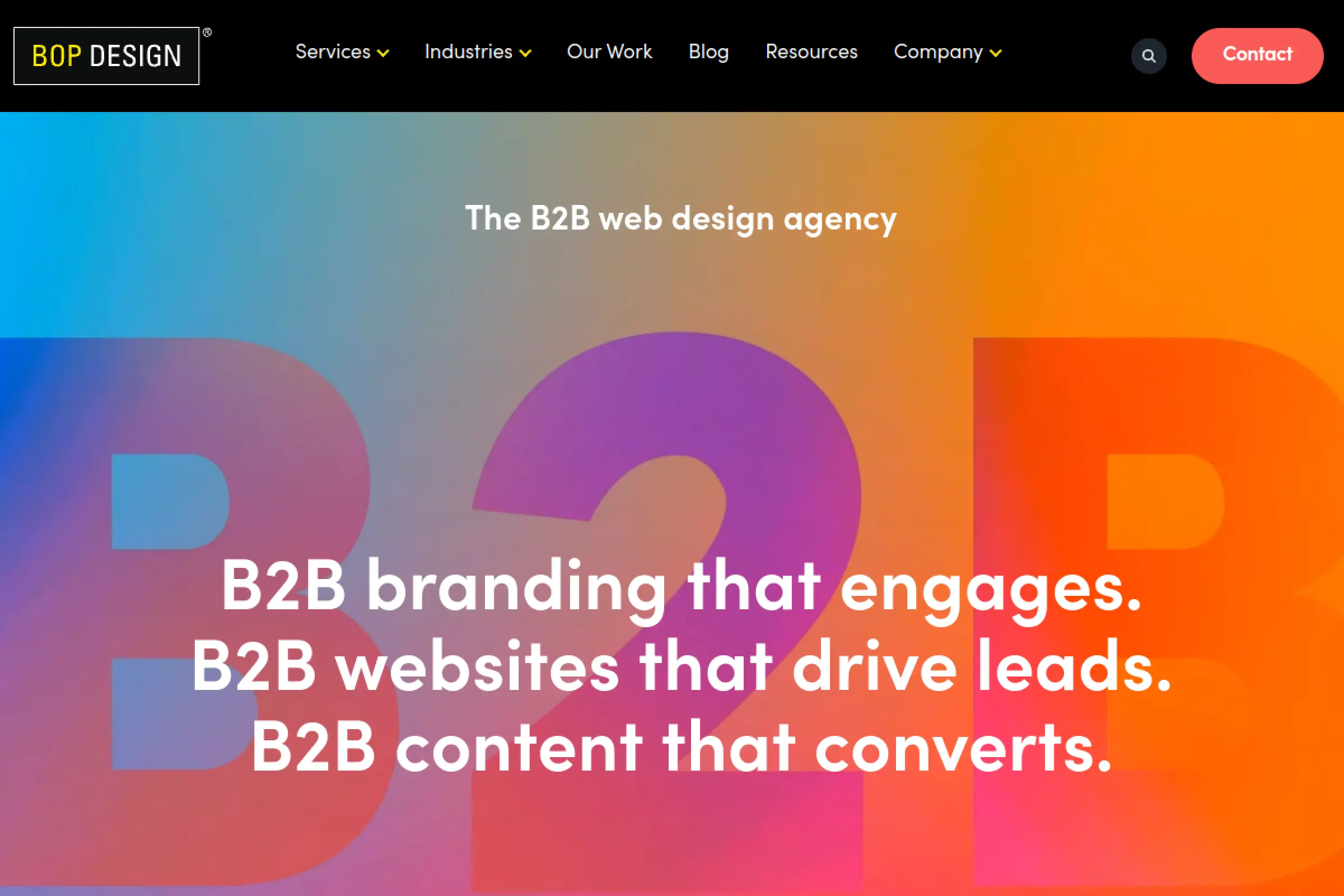
As a B2B-first agency, Bop Design focuses on industrials, professional services, and tech, with an estimated team of 10–49 and ~17 years in operation (founded 2008). Headquartered in San Diego with additional U.S. presence, they’re known for crisp positioning, conversion-forward WordPress builds, and content programs that support long-cycle sales motions.
Among recent recognitions, Bop appeared on a national reliability ranking for business-to-business firms in America’s Most Reliable Companies 2025, an indicator that their processes and client experience are consistent over time.
On the services front, we’ve seen Bop run tight website redesigns that bundle narrative, IA, and CRO with brand updates—useful in category repositioning. Their public case stories reference outcomes for clients like Perr&Knight and LRE that blend faster time-to-value with organic visibility gains, reflecting a repeatable playbook for B2B growth sites.
Best for mid-market B2B organizations (Series A–D or PE-owned) that need a clear value proposition, authoritative content, and a scalable WordPress foundation. If you prize deadlines, senior account attention, and lead-gen metrics over motion-heavy showpieces, their operating style will feel like a match.
2. Lounge Lizard
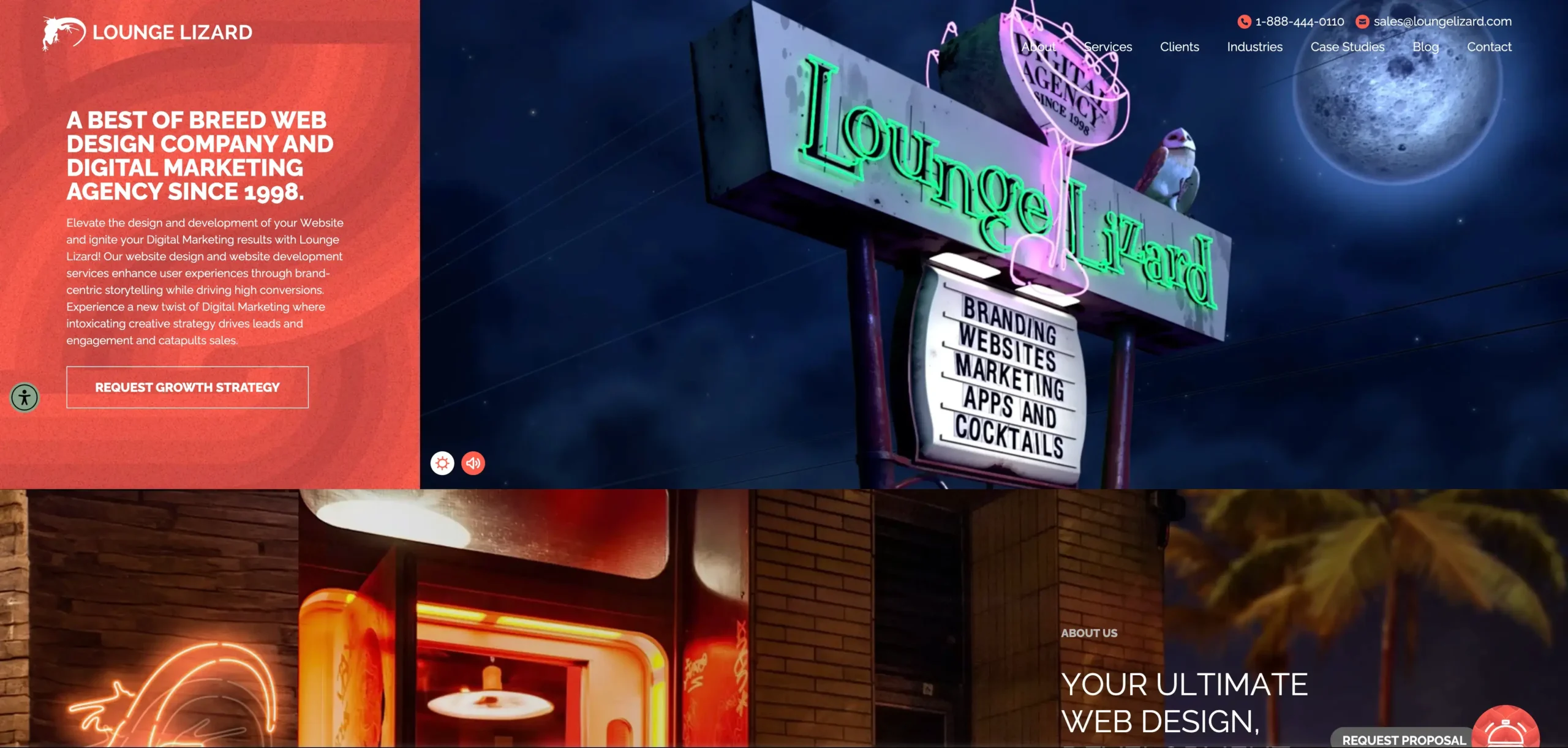
Founded in 1998 and headquartered in New York City with a national footprint, Lounge Lizard blends brand, web, and performance marketing for mid-market and enterprise clients. With an estimated 50–100 professionals and decades of institutional memory, they’ve grown up alongside the commercial web and still ship with energy.
A long-standing presence in New York’s agency ecosystem, Lounge Lizard was named among 2019 Leading NYC B2B Companies in Clutch’s citywide report, signaling consistent client-reported delivery in a crowded market.
We’ve seen them deliver full-funnel programs—brand refresh, site rebuild, and the campaign muscle to capitalize on it—particularly in finance, consumer, and SaaS. Their public portfolio spans engagements like Renaissance Capital and LOOP‑LOC, pairing bold creative with conversion stewardship and ongoing optimization.
Great fit if you’re a CMO or Head of Growth who wants one accountable partner for brand + web + media, appreciates structured creative processes, and plans to push content and campaigns through the same team that built the site.
3. TechTide Solutions
We’re a software development company that delivers conversion-minded web experiences alongside custom apps and integrations. Our core team operates from Ho Chi Minh City with distributed collaborators, and we’ve been building under the TechTide banner since ~2023. We focus on growth-stage startups and B2B firms that need product velocity and an editorially friendly site.
We prioritize measurable impact over trophies, so we won’t list awards here. Our view is simple: craft the right system, instrument it, and iterate until the data confirms the design instincts. That culture tends to resonate with product-first teams.
In practice, our engagements pair component-driven UX, TypeScript/Next.js, and headless CMS patterns with analytics, SEO, and CRO. We’ve helped clients consolidate brand sites and product marketing into flexible design systems that reduce time-to-launch for pages from weeks to hours, while keeping performance budgets and accessibility intact.
Choose us if you’re operating in SaaS, fintech, health, or eCommerce with a lean internal team and need senior builders who think in systems. We’re a fit when you want a collaborative cadence (weekly demos, CI/CD, shared dashboards) and a partner who will push back when it protects outcomes.
4. Baunfire
San Jose–based Baunfire is a Silicon Valley-native digital agency focused on high-polish brand sites for tech and enterprise. With roughly 11–50 employees and ~15+ years of operation, they’ve built a reputation for portfolio-grade aesthetics coupled with sturdy engineering and editorial ease.
Their craft routinely shows up in design juries, including Site of the Day – Mar 18, 2019 and the later Site of the Day – 2022 mentions on Awwwards, a proxy for visual excellence and attention to UX detail.
We’ve seen Baunfire’s work shine on product marketing sites for robotics, AI, and enterprise software; their public roster includes firms like Ambi Robotics and Karat, and they’re comfortable shaping narratives for complex innovations while keeping performance sharp.
Ideal for growth-stage or enterprise tech brand teams that want a flagship web presence—the kind investors, recruits, and customers feel—delivered by a group that understands stakeholder alignment across product, design, and comms.
5. Digital Silk
Digital Silk is a full-service web and marketing agency with U.S. hubs in Miami, New York, Chicago, and California. In operation for ~6 years and an estimated team in the dozens, they’re built to handle brand strategy, UX, custom dev, and performance marketing under one roof.
We won’t cite awards here; what stands out is their breadth across industries and their willingness to be accountable for KPIs beyond launch. That operational maturity is valuable when the website is a growth engine, not a one-off project.
Public case narratives highlight launches for names like Bang & Olufsen, Puma Energy, and IBM, where they marry high-end storytelling with conversion frameworks and technical SEO—useful for global organizations balancing brand and pipeline.
Well-suited to marketing leaders who want a multi-city team with enterprise process, a strong PMO, and hands-on specialists across design, engineering, and acquisition.
6. Vrrb
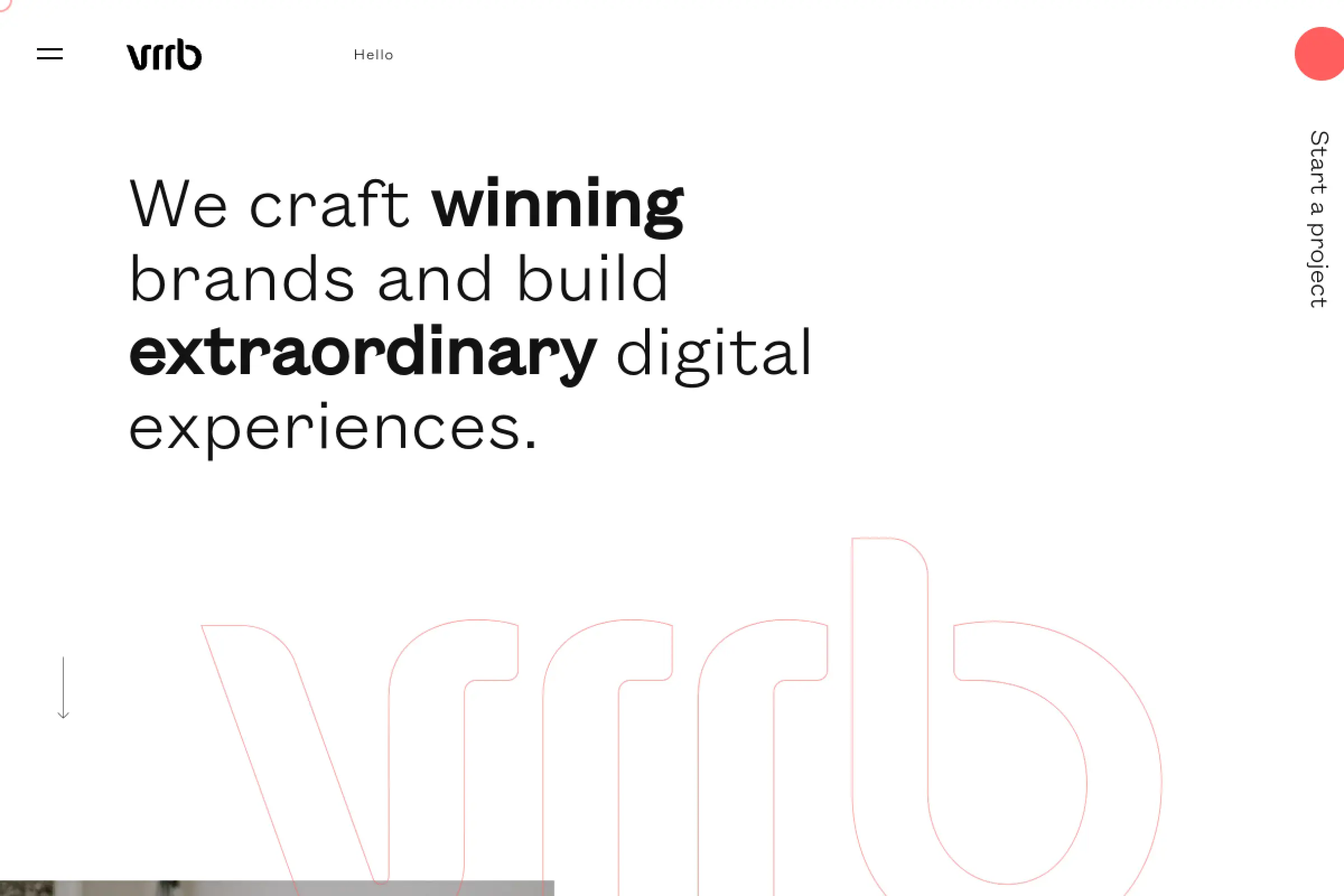
Los Angeles–based Vrrb is a product-forward web studio focusing on UI/UX, interactive experiences, and scalable CMS/eCommerce. With a compact, senior-heavy team operating for more than a decade, they’re known for balancing brand flourish with practical business outcomes.
No external awards to cite here; we tend to rate them on shipped work quality and how clearly their team connects design decisions to KPIs in stakeholder reviews—something stakeholders appreciate when negotiation meets timeline.
We’ve seen Vrrb’s site work and design systems support growth initiatives for B2B SaaS and consumer brands; their public materials reference collaborations spanning fintech to hardware, with an emphasis on robust prototypes and tidy handoff.
Best for founders and PMMs who want an embedded, collaborative build—from discovery to design system to front-end—that trades on clarity, speed, and polish rather than layers of overhead.
7. eDesign Interactive

Operating from New Jersey and Sofia, eDesign is a digital experience shop with ~40+ team members and two decades in the field. Their split U.S.–EU footprint helps them balance creative experimentation with cost-effective delivery across time zones.
In 2025, their Sour Jacks work was highlighted with an AIVA Team’s Picks 2025 mention that also notes a 2025 w3 Gold Award – Websites: Food & Beverage, pointing to both industry recognition and category fit.
eDesign’s portfolio spans nonprofit, healthcare, CPG, and B2B; we’ve observed solid UX narratives (e.g., for OINJ and TDF) with a knack for motion that adds clarity rather than distraction. Their content and SEO handling is pragmatic, which helps sustain wins after launch.
Great fit for marketing and communications teams that want a creative partner able to deliver award-caliber visuals while adhering to accessibility, governance, and editorial workflows.
8. Dotlogics
New York–based Dotlogics is a seasoned digital consultancy (~20 years operating) serving mid-market and enterprise. With a team likely in the 10–49 range and roots in UX, commerce, and integration projects, they’re comfortable translating business constraints into workable digital systems.
Their design work has appeared on juried platforms such as an Awwwards listing for PLANiT Measuring, marked as Nominee – Feb 15, 2016, echoing their long tenure in interface craft.
Dotlogics’ public stories include efforts for McDonald’s, Brown University, and Unilever—evidence of comfort across consumer and institutional stakeholders—and we’ve seen them pull complex integrations (ERP/CRM/CMS) into cohesive experiences.
Strong choice for organizations with multifaceted requirements (compliance, legacy platforms, global audiences) that need a pragmatic, cross-disciplinary digital partner rather than a pure-play design boutique.
9. PopArt Studio
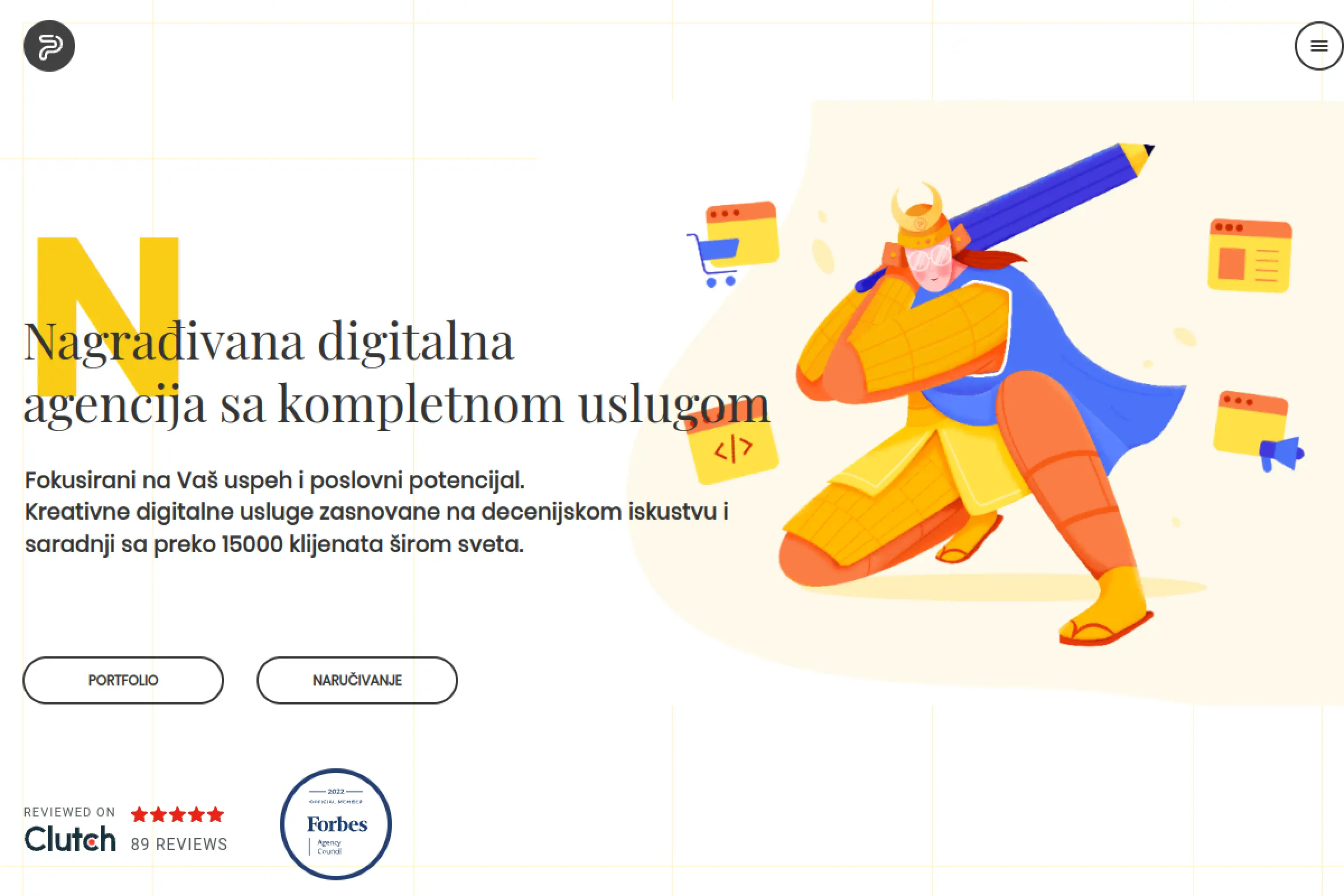
Headquartered in Novi Sad with international reach, PopArt Studio is a full-service Serbian agency covering design, development, and marketing. Operating since ~2010 with a staff that’s scaled into the dozens, they offer an attractive value-to-craft ratio for global clients.
Recognition from design competitions includes Special Kudos on CSS Design Awards, a signal of consistent interface quality and attention to interaction detail.
Public-facing client rosters feature Nike, Visa, Schneider Electric, and regional enterprises, and we’ve seen them deliver multilingual sites, custom WordPress/Laravel builds, and SEO programs that serve both export-facing and domestic markets.
Ideal for cost-conscious brand and product teams seeking European craft with English-friendly delivery, particularly for multilingual B2C sites, catalogs, and content-heavy B2B experiences.
10. ControlF5
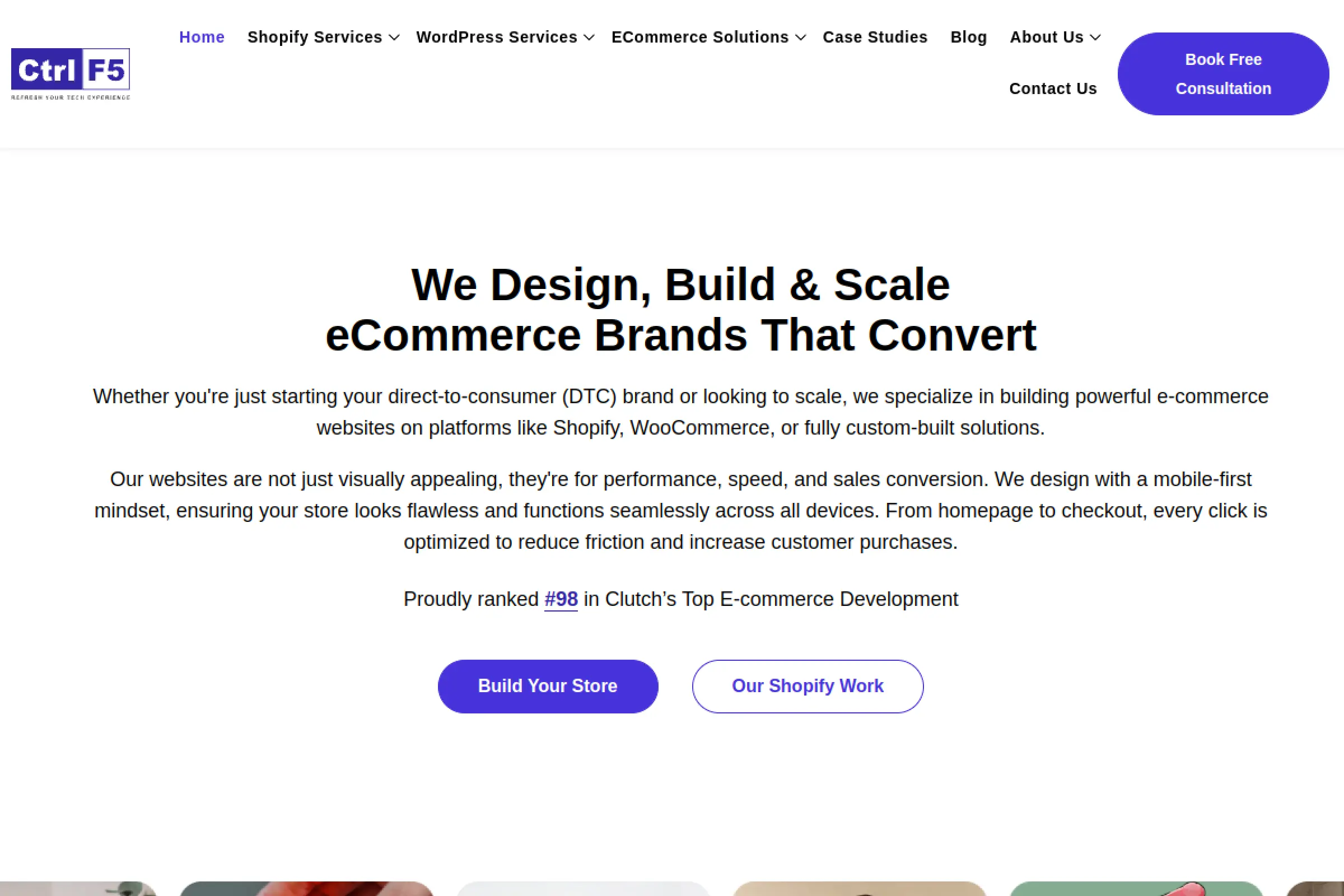
ControlF5, based in Indore, India, is a web and mobile development studio with a tilt toward Shopify and WordPress. After more than a decade in market and a team size likely in the dozens, they’ve carved a niche in eCommerce builds and AI-enabled operational tooling.
We didn’t find third-party award listings we trust for 2025 and won’t invent them. Instead, we’ll note their growing eCommerce specialization and repeat work across storefronts and conversions.
We’ve seen their team handle design-to-code pipelines, from Figma to Shopify. They also execute multi-store implementations and post-launch iteration that lifts add-to-cart and checkout completion. That’s useful for brands modernizing on Shopify without overengineering.
Best for SMB and mid-market merchants who need a practical, responsive dev partner to stand up or replatform stores, tune CRO, and layer automation to reduce operational drag.
11. GLIDE
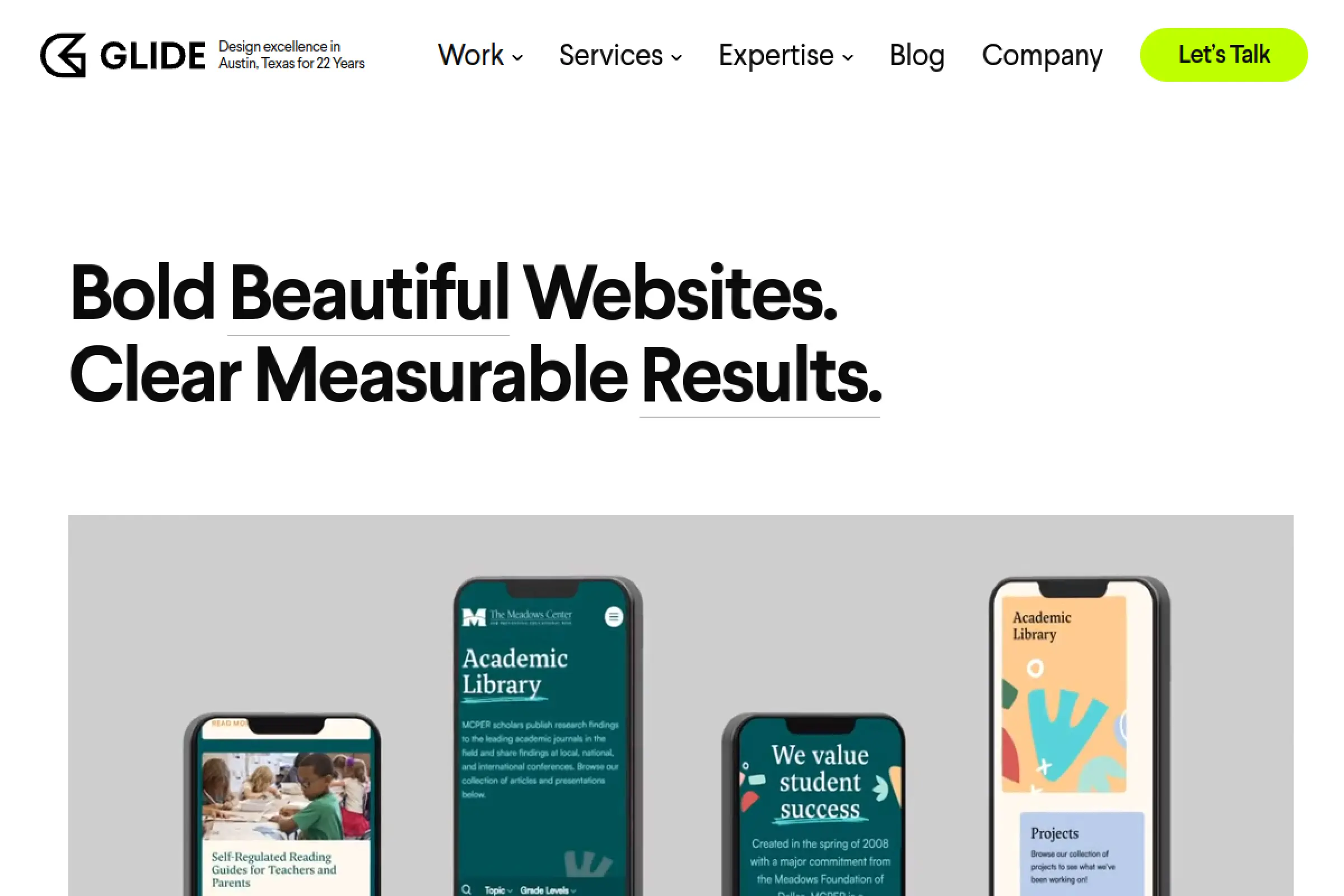
Austin-headquartered GLIDE (founded 2003) builds brand-forward WordPress sites for purpose-led organizations and growing companies. With an estimated 20–50 team members and a values-first culture, they combine strong PM with reliable post-launch support programs.
We’ll skip awards and focus on their operating rigor. Their public materials highlight quality reviews and a cadence of continuous improvement programs—traits we value when a site must deliver month after month.
Case narratives reference engagements with National Breast Cancer Foundation, Westlake Dermatology, and Baylor College of Medicine—each showing how GLIDE pairs UX, SEO, and content governance to move concrete metrics like goal completions and organic footprint.
Choose GLIDE if you want a steady, long-term partner: marketing teams that care about accessibility, editorial velocity, and measurable growth will appreciate their process and transparency.
12. Azuro Digital
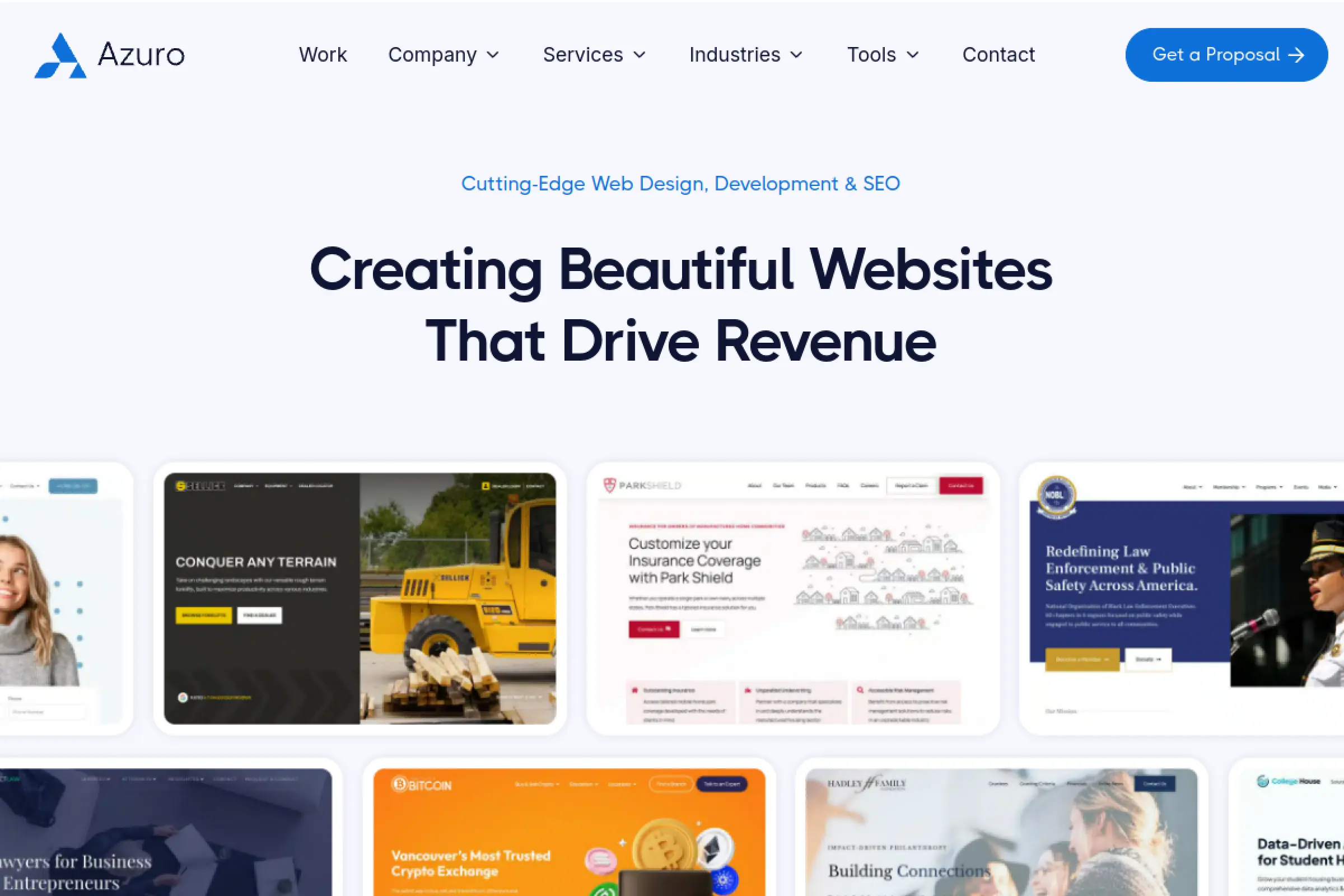
Azuro Digital is a Canadian web design, development, and SEO firm with offices in Ottawa, Toronto, and Calgary. Operating since 2018 with a compact team, they specialize in performance-first WordPress builds supplemented by accessibility and compliance expertise.
Awards aside, what’s notable is their emphasis on WCAG conformance and inclusive publishing workflows—something many teams underinvest in until legal risk rises. Their positioning on accessible design is unusually pragmatic.
Public case notes mention results for Sellick Equipment and Staten Island Oral & Maxillofacial Surgery—sites that saw visibility and conversion gains via speed budgets, content restructuring, and SEO/“AI search” readiness.
Well-suited to North American SMBs and mid-market firms—legal, industrials, healthcare, and services—that want a dependable WordPress partner with real SEO chops and a bias for measurable outcomes.
13. League Design Agency
With roots in Kyiv and U.S. representation, League Design Agency unites brand identity, UI/UX, and web development in a systemized, research-driven approach. The team (dozens strong) has operated for ~8 years, and their process emphasizes scalable design logic over trend-chasing.
No independent award entries we can responsibly cite here. What stands out is their documented process and emphasis on design systems that survive real-world scaling—critical when multiple teams will extend the work.
We’ve observed League shepherd brand and product design for startups and scale-ups across eCommerce, medtech, and platform software, delivering tidy handoffs, component libraries, and CRO‑informed landing frameworks.
Ideal for founders and marketing leaders who want a partner that can codify identity, ship a high-conversion site, and leave behind the design operations (guidelines, component logic) to scale internal teams.
14. Creative Brand Design
London‑based Creative Brand Design is a boutique web agency with a decade‑plus track record, serving U.K. and international clients from a compact, senior team. They focus on bespoke WordPress builds with high attention to UI detail and SEO‑readiness.
On Awwwards, they show 7 Honorable Mentions, a useful external signal of design craft across multiple submissions over time.
Public client lists reference government and enterprise work (e.g., Department for International Trade, NATO Innovation Fund) alongside high-growth companies, reflecting comfort with compliance and stakeholder choreography.
Pick them if you’re U.K.-based (or servicing the U.K.) and want a hands-on team that can own both the brand website and its technical SEO posture, with the responsiveness of a boutique.
15. Solid Digital
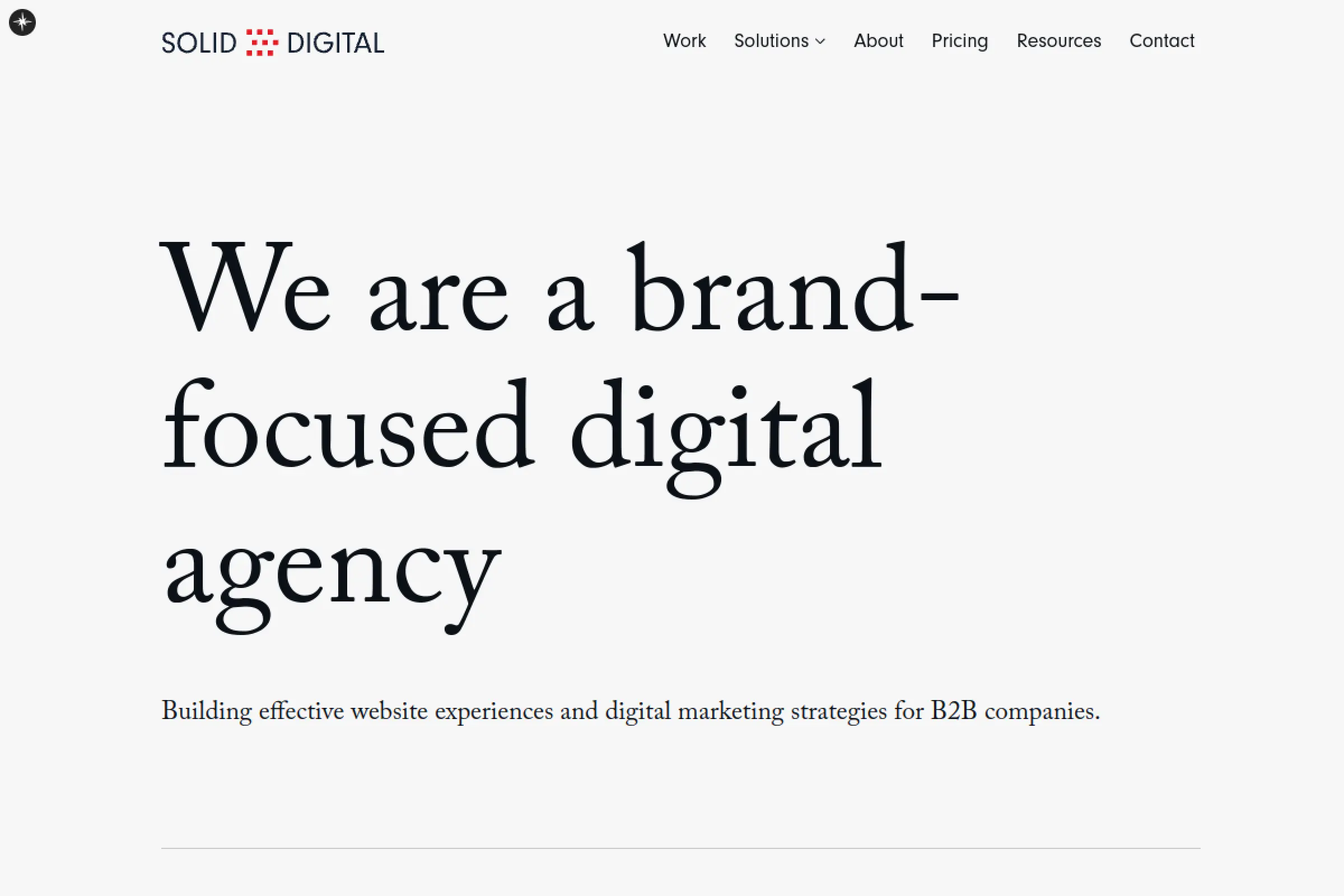
Solid Digital is a brand-focused web and digital marketing agency with roots in Chicago, Portland, and Austin. Operating for ~15+ years with a team likely in the 40–80 range, they combine web builds with ongoing growth engagements calibrated to B2B goals.
We’re not listing awards; their strength is steady execution for B2B brands where sales enablement, content marketing, and conversion pathways must live as one system—not as separate teams’ outputs.
Public narratives cover multi-year relationships with companies like 6sense, Baker Hill, and Hireology, aligning redesigns with content and technical SEO to raise qualified demand and governance maturity.
Best for B2B marketing leaders who want a partner to rebuild the website and then stay engaged—maturing content ops, analytics, and CRO month over month rather than treating launch as a finish line.
16. Usman Group
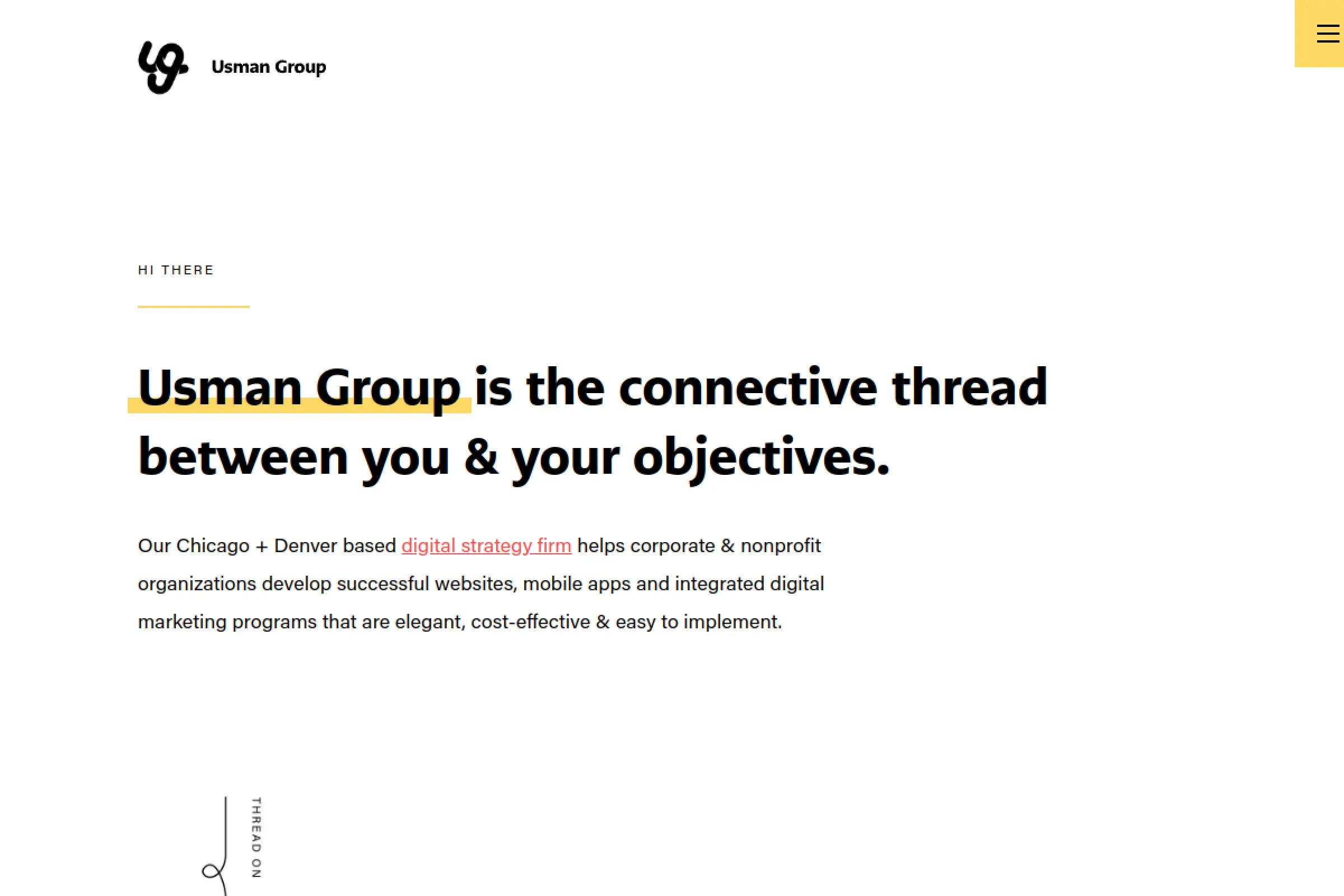
Usman Group is a Chicago- and Denver‑based digital strategy consultancy. With a lean, senior team and nearly two decades of operation, they advise on research‑driven web projects, vendor selection, and orchestration of the right tools for the job.
Skipping awards here; their value proposition is the clarity that comes from rigorous discovery and stakeholder alignment, which can avert expensive detours later in a build.
We’ve seen them guide organizations through discovery, usability research, and RFPs, then act as accountable advisors throughout implementation—especially valuable for nonprofits and complex enterprises navigating internal politics and technical constraints.
Choose Usman Group if you need a neutral partner to de-risk an upcoming redesign, build a credible roadmap, and ensure execution aligns with strategy across internal and external teams.
17. Huemor
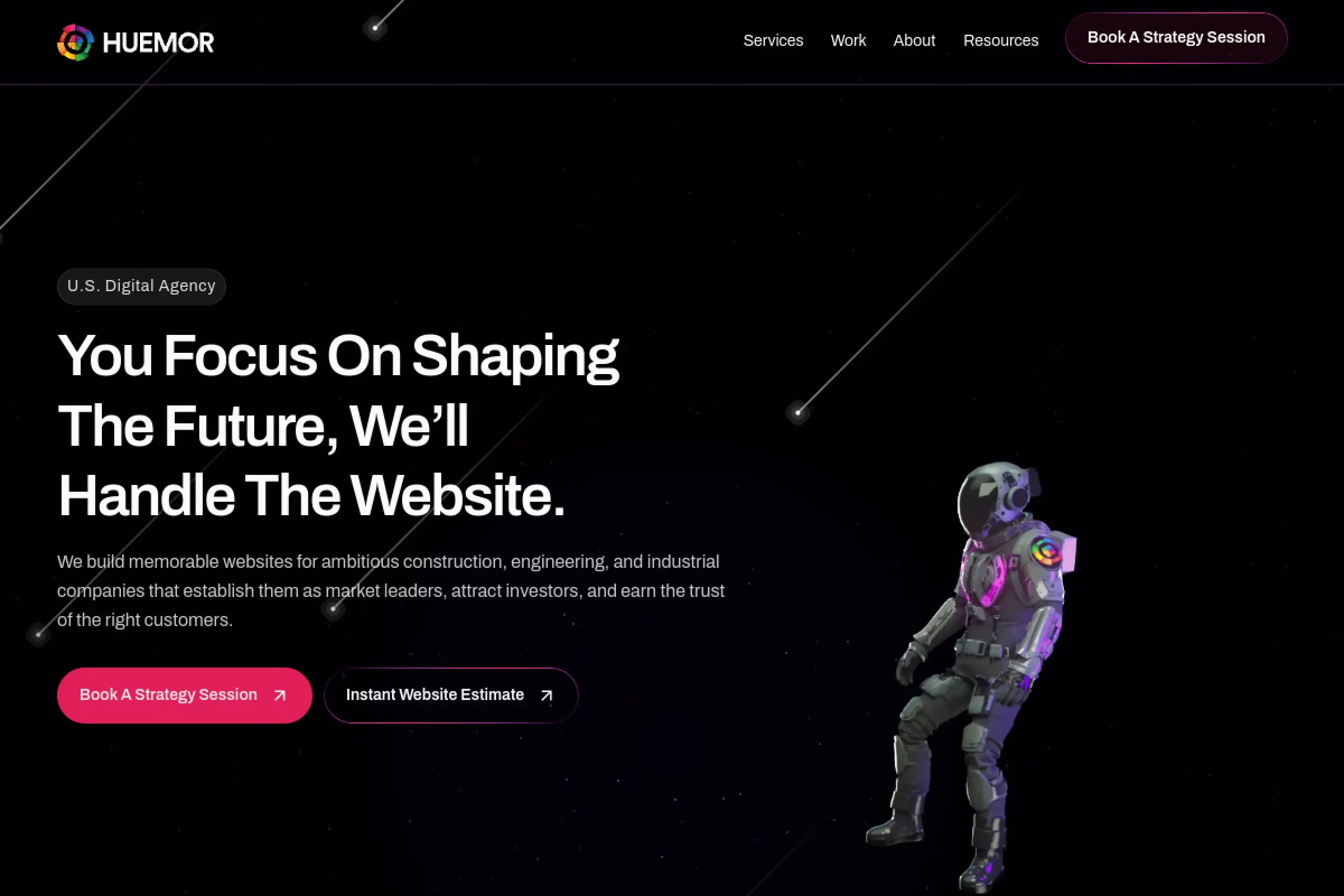
Pittsburgh‑born with national reach, Huemor builds conversion‑minded websites for industrials, construction, and tech. With ~14 years on the board and a team size that’s grown into the dozens, they’re known for pairing bold creative with disciplined CRO.
On Awwwards, Huemor’s profile lists 6 Honorable Mentions, an indicator that peer juries have repeatedly recognized their interface and visual craft across multiple submissions.
Public case stories include Boston Dynamics and HITT Contracting, with quantified lifts in organic traffic and qualified leads after design‑system‑driven rebuilds and performance-focused engineering.
Best for B2B operators who want an expressive site that still respects funnel math—executed by a team comfortable owning design, engineering, and the post-launch optimization runway.
18. Pixelmatters

Porto‑based Pixelmatters is a digital product studio blending product strategy, design, and engineering. In market since 2014 with ~50–80 people, they’re strong in complex UI, design systems, and long‑running product partnerships that include the marketing site.
No external awards cited here. What we value is their product‑grade rigor—discovery, prioritization, and engineering depth—that translates well to “web as product,” not just brochure sites.
Public case material includes Amigo (telecom) and other scaling ventures, illustrating how product sensibilities (reliability, instrumentation, roadmap) uplift marketing sites and brand experiences.
Great fit for product‑led companies that want the marketing site and the app experience to feel like one continuous, measurable journey—designed and built by an integrated team.
19. Fable&Co
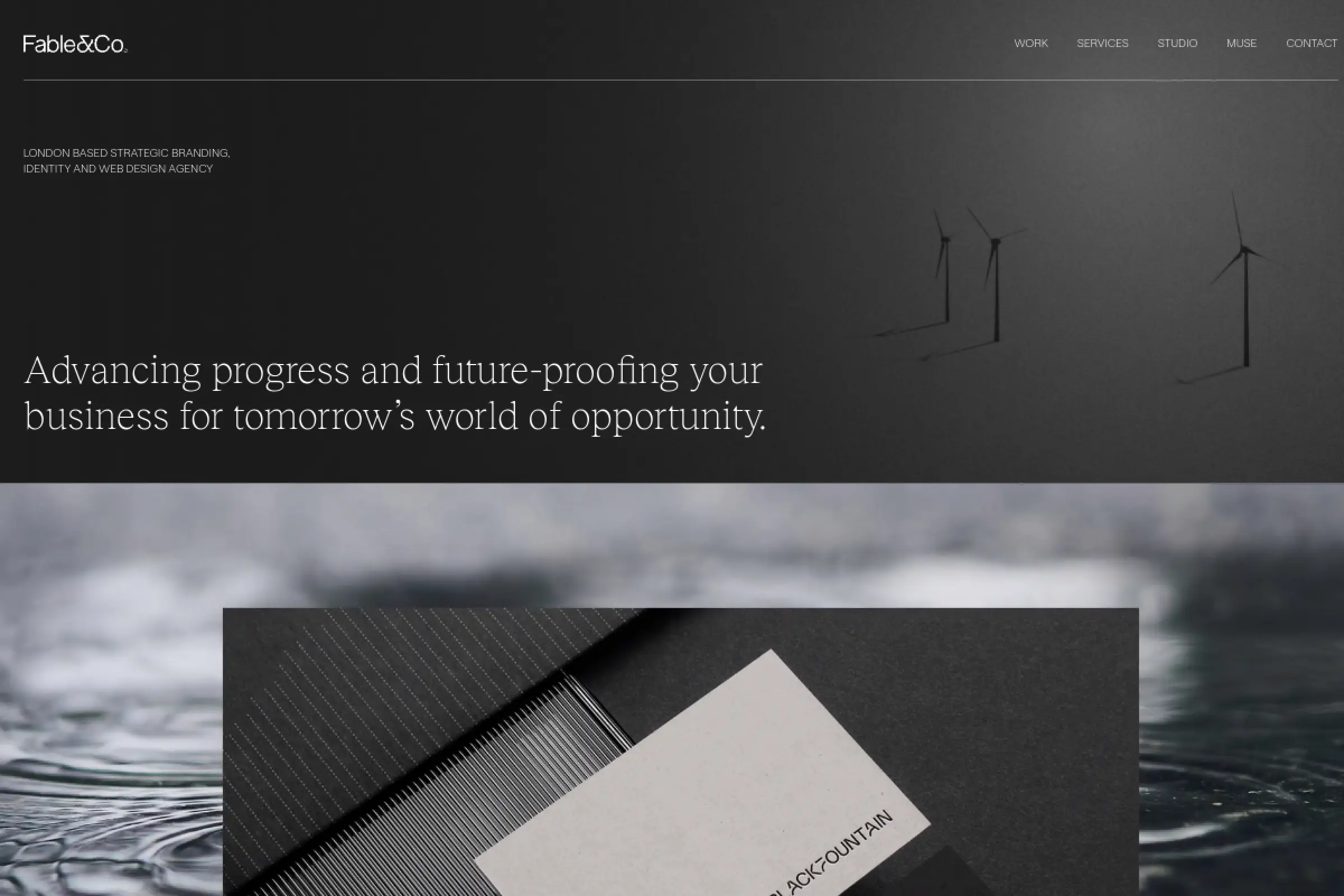
Fable&Co is a U.K. brand and web studio working at the intersection of identity and digital. Incorporated in 2014 and based in the greater London area, their small senior team focuses on strategic brand systems that express elegantly across web.
We’re not listing awards here; our interest is in their disciplined brand work and how consistently it translates into restrained, high‑legibility web experiences that age well and minimize maintenance overhead.
Public-facing work spans corporate and venture-backed firms where clarity, typography, and hierarchy do the heavy lifting. Their stance favors longevity and a calm, timeless brand web presence over fleeting trends.
Best for leadership teams seeking a thoughtful rebrand paired with a measured, scalable website—particularly effective for professional services and investment firms.
20. Groove Digital

Groove Digital is a European no‑code/low‑code agency specializing in Webflow and Shopify. With a compact team and sprint‑based delivery model, they emphasize speed‑to‑value, pragmatic integrations, and meticulous front‑end craft.
No third‑party awards to cite; what’s attractive is their “sprints & recipes” cadence, which gives stakeholders frequent checkpoints, fixed outcomes per sprint, and momentum without bloated overhead.
Public case materials point to B2B, SaaS, and eCommerce brands seeking rapid MVP‑to‑V1 journeys, CRO programs, and ongoing enhancements—especially where time to launch and iteration speed trump heavy custom stacks.
Ideal for marketing and product leads who want to move fast on Webflow/Shopify, keep ownership inside the business post‑handoff, and invest in continuous, data‑driven improvements after launch.
If you want help matching your goals, constraints, and internal capabilities to the right partner, tell us your deadline, tech stack, and the two KPIs you must move this quarter—shall we co‑create a shortlist and an evaluation matrix to make the choice obvious?
Regional and Niche Insights on the Best Web Design Companies
Budget realities and buyer expectations vary by geography and sector; technology spending itself is expanding, with worldwide IT expenditures projected at $5.43 trillion in 2025, which influences capacity, pricing, and talent availability across regions. We synthesize these differences so that your shortlist reflects local constraints and global opportunity.
1. United States Landscape Services, Filters, and Rankings Updated October 21, 2025
In the U.S., the web design landscape combines household‑name consultancies, boutique studios, and specialist shops tied to platforms and verticals. Rankings can be useful for discovery, but we recommend filters that align with your strategy: regulated‑industry experience, depth in conversion research, or proficiency with modern architectures. We’ve found that buyers get better outcomes when they start with capability filters, then use rankings as a second pass.
Where to look
Consider regional hubs that pair creative talent with engineering density. We advise clients to explore providers beyond their immediate metro if the firm can demonstrate reliable distributed delivery. The best partners show fluency in governance as much as in design; they know that procurement, privacy, and security are design constraints, not post‑launch chores.
2. United Kingdom Cost Ranges and Sector Specializations
The U.K. blends public‑sector expertise, commerce craft, and product‑design heritage. Buyers benefit from agencies comfortable with service design and content operations, especially when projects intersect with editorial teams and multiple stakeholders. When cost is complex, we encourage value‑based scoping tied to clear outcomes, with contingencies that protect both sides.
Sector nuance
Public‑facing services prioritize clarity and accessibility; direct‑to‑consumer brands emphasize pace and polish. The best U.K. partners borrow strengths across these contexts—bringing the rigor of government service design to retail, and the storytelling of brand work to civic digital services.
3. Canada E‑Commerce Strength and Shopify Ecosystem
Canada’s ecosystem is a strong choice for merchants who want a partner steeped in platform‑native commerce and practical integrations. We evaluate agencies on their ability to build themes that age gracefully, architect data models that power merchandising, and connect storefronts with operations. For international sellers, we also assess experience in cross‑border logistics and content localization.
What differentiates
Depth in product information management, comfort with experimentation platforms, and an instinct for balancing performance with brand expression. Canadian specialists who can thread these together often scale well with growth‑stage brands.
4. Verification and Awards What to Look for Across Regions
Award culture varies; so do verification norms. We advise clients to calibrate expectations: some regions emphasize craft‑award circuits, others emphasize enterprise credentials. Use awards to spot potential, then verify with case studies and references. For buyers in regulated sectors, we put extra weight on past audits and standard‑operating procedures.
Why this reduces risk
When you combine awards with verifiable delivery signals, you turn subjective praise into objective confidence. That balance helps teams make decisions quickly without surrendering due diligence.
5. Niche Specialists B2B Healthcare SaaS Finance
Specialists shine when stakes are high and complexity is layered. In healthcare, patient flows and privacy must harmonize; in finance, the choreography of consent and clarity of disclosures shapes trust; in B2B, long buying cycles and complex catalogs demand content architectures that can nurture without overwhelming. We prioritize partners who translate regulation into patterns and words users understand.
Integration is everything
Vertical expertise matters most at the seams: connecting forms to back‑office systems, unifying identity across properties, and designing dashboards that speak each stakeholder’s language. The best specialists think in systems, not screens.
6. Freelancers vs Agencies Guidance for Minimal Budgets
Smaller budgets don’t eliminate the need for rigor. Solo specialists and micro‑studios can deliver exceptional work when scope is tight, governance is light, and decision‑makers are reachable. We recommend a discovery‑first approach: agree on a minimal viable experience, cut non‑essentials, and reserve a small buffer for the unknowns that always appear once real users interact with your content.
How to make it work
Define a single KPI and focus on the pages and flows that drive it. Postpone anything that doesn’t move the needle. Strong freelance partners are transparent about what they don’t do. They refer reliable collaborators when you need depth they don’t offer.
7. Timeline‑Budget‑Quality Trade‑Offs
The iron triangle isn’t a cliché; it’s a governance tool. We ask buyers to pick two priorities and accept tradeoffs on the third. We then design the engagement to protect that choice. On time-critical initiatives, scope is simplified and proven patterns take precedence; on quality-critical efforts, research and prototypes are sequenced to de-risk decisions; on cost-critical deliveries, components are reused and the feature set is intentionally narrower.
Our playbook
We use design sprints to answer the riskiest question early, then iterate in careful increments. When trade‑offs get murky, we bring stakeholders into a structured decision workshop so that priorities are re‑affirmed in the open rather than assumed in silence.
8. Leaders to Watch Clutch’s Top Web Design Agencies in 2025
Rankings surface patterns more than destinies. On Clutch’s leaders pages, we look for a through‑line: agencies that show consistent storytelling across reviews and case studies, a bias toward research‑informed design, and a habit of building design systems rather than one‑off flourishes. Leaders to watch are often those whose work feels obvious in retrospect—the kind of clarity that hides deep craft.
How we shortlist from rankings
We cross‑reference leaders lists with platform ecosystems, award circuits that value usability, and open‑source contributions. Then we interview for chemistry. Even the most credentialed firm must still fit your culture and cadence.
How TechTide Solutions Helps You Build Custom Web Solutions
Our approach blends research, craft, and engineering pragmatism, anchored in the reality that tiny technical gains can produce meaningful commercial impact; an independent study documented that a mobile site speed improvement of 0.1s correlated with stronger conversion behavior, which is why our process bakes performance into discovery, design, and development—not just QA.
1. Discovery and Requirements Workshops Aligned to Your KPIs
We begin with facilitated workshops that illuminate user goals, stakeholder incentives, and technical constraints. Our discovery artifacts are decision tools. Journey maps name friction, content inventories surface governance risks, and service blueprints show where integrations make or break the experience. We exit discovery with a shared language across the team. Clear problem statements and success criteria guide later trade-offs.
Deliverables you can use
We produce concise briefs, prioritized roadmaps, and risk registers that speak plainly about uncertainty. This is not ceremony for its own sake; it’s how we ensure momentum survives the surprises every project encounters.
2. UX Research and Information Architecture
Our research is practical and layered. We start with the questions that matter to your users, test language and structure before color and motion, and validate navigation against the tasks customers actually perform. Where possible, we integrate analytics and field observations so that what users say is cross‑checked with what users do.
IA that earns its keep
We design content models that reflect business rules and editorial habits. Good IA reduces cognitive load and accelerates changes; it also makes future migrations less painful because the structure mirrors the reality of your products and services.
3. Conversion‑Focused UI Design and Prototyping
We treat UI as a hypothesis generator. Clickable prototypes let us test messaging, trust markers, and interaction pacing before any code ships. Our component libraries enforce consistency while giving room for brand expression. We pay attention to microcopy because it’s often where users make choices; the right label or hint can rescue a faltering flow.
Design that scales
We encode tokens for color, type, spacing, and motion so that brand, accessibility, and performance stay in sync. As your site evolves, those tokens turn into a living contract between design and engineering.
4. Custom Front‑End and Back‑End Development
Our engineers prefer progressive enhancement and clean, semantic markup. On the back end, we design for resilience and clarity: straightforward APIs, maintainable schemas, and logging that helps teams see what’s happening in production. We choose frameworks with healthy ecosystems, not just fashionable ones, and we pressure‑test the stack against your team’s skills.
Shipping with confidence
We keep trunk‑based development, feature flags, and automated checks in the pipeline so that releases feel routine. When a launch feels boring, we’ve done it right.
5. CMS and E‑Commerce Implementations WordPress Shopify Webflow
We implement platforms as systems, not as themes. For content teams, we build editorial workflows that protect quality while maximizing speed; for merchants, we tie storefront behavior to merchandising strategy so that promotions, bundling, and inventory signals align. We optimize for maintainability, which often means resisting the temptation to over‑customize.
Right‑sized flexibility
We scope custom components where they deliver competitive advantage and stick to platform conventions where they don’t. That balance keeps your roadmap nimble.
6. Performance, SEO, Accessibility, and QA Automation
We plan for performance early: set budgets that reflect business goals, design components that stream efficiently, and trace each dependency’s cost. SEO is treated as information architecture plus intent, not just metadata. Accessibility is ever‑present: content, structure, and interaction all support users with diverse needs. QA automation focuses on the flows that matter most, with human testing layered where nuance requires it.
Guardrails that work
We wire real‑user monitoring into dashboards and institute regression checks on components so that slowdowns and breakages are caught before customers feel them. Our aim is simple: a site that stays fast, findable, and fair as it grows.
7. Integrations via APIs and Legacy System Modernization
Integrations are where projects succeed or stall. We map upstream and downstream dependencies, model error states as intentionally as happy paths, and choose adapters that reduce coupling. For legacy systems, we modernize incrementally: stabilizing critical endpoints, adding caching where safe, and carving out services as the architecture evolves.
Why it matters
Your website is the face of a supply chain of information. When integrations are clear and well‑instrumented, customer experiences feel seamless and teams sleep better.
8. Agile Delivery Sprints and Transparent Communication
We run delivery in steady cadence. Demos are honest, backlogs are prioritized with stakeholders, and decisions are documented in language everyone can follow. We share the messy middle so that surprises don’t turn into crises. This transparency makes it easier to re‑scope gracefully when an insight changes the plan.
Decision discipline
We favor small, reversible bets and reserve heavier investments for the ideas that earn them. That discipline keeps momentum high and morale higher.
9. Data Analytics, A/B Testing, and Continuous Optimization
We make analytics actionable by tying events to questions. Experiments are designed to be read by humans, not just machines, and results are translated into backlog items rather than slideware. Optimization is continuous and holistic: content, layout, and performance all get a turn, but always in service of business goals.
Learning loops
We establish rituals that keep teams curious. Regular reviews of search queries, support tickets, and behavior funnels generate insights for next week’s work, not next quarter’s strategy.
10. Post‑Launch Support, Maintenance, and Roadmapping
Support is a product. We define service commitments, create playbooks for incidents, and schedule health checks that reduce surprises. Roadmapping is collaborative and flexible; we keep a long‑view horizon for strategy and a near‑term horizon for action, and we revisit both as data and context evolve.
Partnering for the long run
Our best work happens when we become an extension of your team. We bring the candor to say “not yet” when an idea is right but the timing is wrong—and the initiative to propose better paths when constraints appear.
Conclusion Choosing Among the Best Web Design Companies for Your Goals
The web design partner you choose must operate in a world where AI‑driven tools, infrastructure, and customer expectations are accelerating; annual AI outlays are projected to reach nearly $1.5 trillion in 2025, which will reshape workflows, personalization, and content operations. Amid that change, the fundamentals still win: clarity of purpose, sound architecture, and teams that learn quickly.
1. Define Business Goals Scope Timeline and Success Metrics
Start with why. Write down the business outcome your site must influence and the non‑negotiables that constrain the work. Frame success in language that a CFO, a CMO, and a product manager can all nod at—this alignment prevents teams from optimizing for different goals without realizing it.
2. Shortlist Using Verified Reviews and Leaders Matrices
Use reviews to find signals of reliability and empathy, then use leaders matrices to refine by capability. Reach out to references and ask what they would change if they could do the project again. You’ll learn the questions to ask in your own engagement.
3. Compare Portfolios for UX Accessibility and Performance
Don’t be seduced by static visuals. Ask to see component libraries, content models, and examples of how accessibility concerns shaped design choices. If an agency can show how it reduced friction in a complex flow without resorting to gimmicks, you’re on the right path.
4. Align on Budget Hourly Rates and Average Costs
Clarity on money is clarity on trust. Discuss assumptions openly: what’s included, what requires a change, and how surprises will be handled. Prefer partners who are transparent about margins and constraints; they will be transparent about risks too.
5. Confirm Tech Stack CMS and SEO Plan
Match stack to strategy: editorial velocity, integration complexity, experimentation appetite, and internal capability. Ensure the SEO plan is more than a checklist—information architecture, performance, and content quality should be coherent with your goals and brand voice.
6. Validate Team Fit Location and Communication Cadence
Projects succeed when people talk well. Align on cadence, artifacts, and decision rights. Chemistry isn’t soft; it’s an operating condition. If you feel heard and challenged in equal measure during sales, you’ll likely be well served in delivery.
7. Plan Post‑Launch Support and Continuous Improvements
Make iteration part of the contract, not an afterthought. Budget for learning, schedule optimization rituals, and agree on how success will be measured and acted upon. Continuous improvement keeps your site relevant and your team curious.
If you’d like, we can help you turn these guidelines into a shortlist and a set of tailored RFP questions in a working session—shall we book time to map your goals to a practical selection plan?