
At TechTide Solutions, we’ve learned that “building an app” is rarely the hard part; building the right app, at a pace the business can stomach, with quality the brand can stand behind, is where most teams feel the strain. Delivery becomes a contact sport: product wants speed, engineering wants safety, stakeholders want certainty, and users want simplicity. Somewhere in the middle sits project management—often misunderstood as paperwork, yet indispensable as the connective tissue that keeps decisions coherent from kickoff to post-release.
Market context matters because it explains why expectations are rising. In Gartner’s latest outlook, worldwide IT spending is forecast to reach $6.08 trillion in 2026, and that kind of macro investment reliably increases scrutiny over what software teams ship and how predictably they ship it. Under that level of executive attention, “we’ll figure it out as we go” stops sounding nimble and starts sounding negligent.
Our practical stance is simple: app development project management is the discipline of making trade-offs explicit—scope, time, cost, quality, and risk—so the business can choose intentionally instead of discovering consequences accidentally. This guide is how we run projects when we care about long-term maintainability, stakeholder trust, and release confidence—not just the dopamine hit of “launch day.”
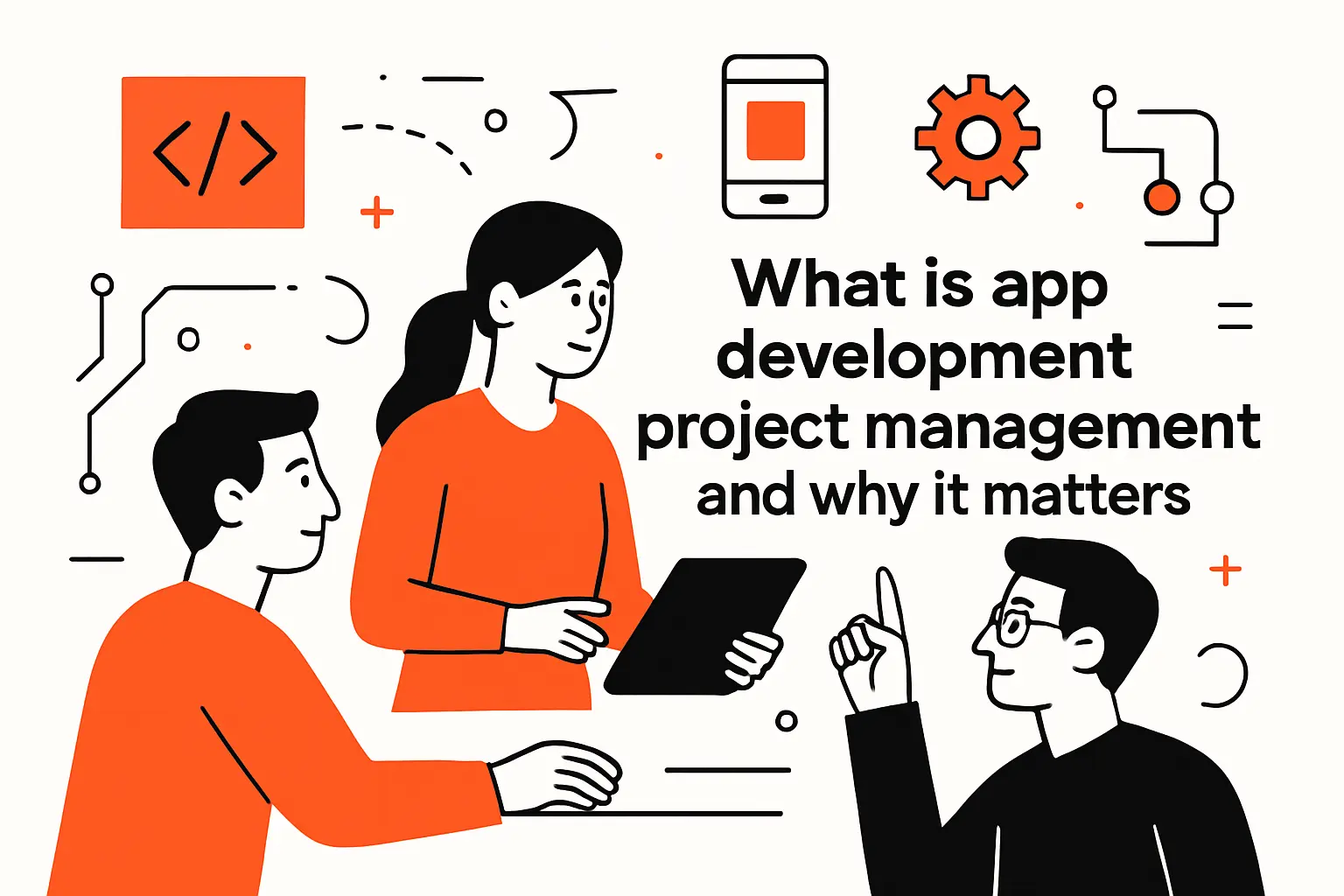
What is app development project management and why it matters
1. How app project management differs from traditional, rigid delivery models
Traditional delivery models often treat software like a construction project: finalize the blueprint, then execute the plan. App development punishes that illusion because the “blueprint” is frequently wrong in subtle ways—user behavior, edge cases, integration realities, and performance constraints all surface late unless the process is designed to discover them early.
In our field experience, the most decisive difference is that app project management must manage learning, not just tasks. Product discovery, usability validation, API boundary decisions, and security threat modeling are not “nice-to-haves”; they’re how teams avoid building a polished solution to the wrong problem.
Evidence for the risk is not theoretical. McKinsey’s research on large technology initiatives highlights that large IT projects, on average, run 45 percent over budget and 7 percent over time, a pattern we interpret as a warning label: when software is managed like a static plan, reality collects interest.
2. Core benefits: expectation-setting, communication clarity, and resource control
Expectation-setting is the most undervalued deliverable in app work. A project can be technically brilliant and still fail if executives expected a revenue engine while the team delivered an internal tool, or if marketing expected a consumer-grade UI while engineering optimized for back-office workflows.
Communication clarity is where we see compounding returns. A clear backlog narrative, a shared definition of “done,” and an agreed release policy prevent the classic anti-pattern where stakeholders only discover what’s happening through rumors, demos, or escalations.
Resource control is not just about headcount or burn. Capacity is also cognitive: a team that is constantly context-switching between new features, production incidents, and ambiguous stakeholder requests can appear “busy” while delivering surprisingly little. Good project management protects focus so engineering effort becomes cumulative rather than dissipated.
3. Key mindset: adaptability, customer collaboration, and continuous feedback loops
Adaptability is not a license for chaos; it’s a commitment to respond to evidence. When we say “adapt,” we mean that priorities change because user interviews contradicted an assumption, analytics revealed friction, or a compliance constraint changed—not because someone had a gut feeling in a hallway conversation.
Customer collaboration is also a technical strategy, not merely a relationship posture. A customer who can validate workflows, data fields, and operational constraints early will prevent costly re-architecture later, especially in apps that integrate with payment, logistics, identity, or regulated data.
Continuous feedback loops are the insurance policy. Build pipelines, automated tests, staged environments, and observability are not “DevOps extras”; they are the instrumentation that tells the team whether the app is trending toward stability or quietly accruing production risk.
Scoping the app: objectives, deliverables, and out-of-scope boundaries
1. Project objectives and measurable goals that define success
Objectives should be expressed in outcomes, not features. In practice, we try to phrase goals as: what user behavior must become easier, what operational cycle must become shorter, or what business risk must become smaller. An “inventory scanning feature” is not the goal; reducing inventory inaccuracies is the goal, and the feature is just one candidate solution.
Measurable goals do not need to be fancy, but they must be testable. A good objective can be validated by a stakeholder demo, a report, a user journey walkthrough, or a production telemetry dashboard—anything that makes “did it work?” answerable without debate.
2. Scope definition and stakeholder alignment to prevent scope creep
Scope creep is rarely malicious; it’s usually unmanaged discovery. Stakeholders learn what they truly want only after they see something real, and that is normal. The project manager’s job is to turn that learning into controlled change, not silent expansion.
Alignment works best when we name the decision-makers and define the escalation path. Product owners define priorities, engineering defines feasibility and risk, and the business sponsor approves trade-offs that affect cost or schedule. Without that structure, scope becomes whoever speaks last.
Practical artifact we rely on
A “scope narrative” is one of our most effective tools: a plain-language summary of who the app serves, which workflows it supports, which integrations it depends on, and which constraints are non-negotiable. Unlike a requirements spreadsheet, the narrative remains readable months later when the team is tired, new people join, and memory gets fuzzy.
3. Out-of-scope agreements that reduce surprises, rework, and budget overruns
Out-of-scope is not a rejection; it’s a boundary. When we document what is excluded—certain platforms, advanced analytics, complex role-based permissions, migrations, data cleansing, or third-party vendor negotiations—we’re not being difficult. We’re making space for honest planning.
Good out-of-scope agreements also reduce rework by preventing “implicit requirements.” For example, if accessibility compliance or multilingual support is not named early, teams might accidentally bake in assumptions that become expensive to undo later.
We’ve found that out-of-scope lists work best when paired with “how we will revisit this.” A simple mechanism—periodic scope checkpoints tied to demos—lets stakeholders propose changes in a controlled forum rather than through ad hoc requests that derail momentum.
Building the app development project management plan and timeline
1. Resource planning: people, responsibilities, capacity, and budget assumptions
Resource planning begins with role clarity. A developer can write code, but someone must own product decisions, someone must own design coherence, and someone must own quality strategy. If those responsibilities are vague, the project becomes a relay race where everyone drops the baton politely.
Capacity planning is where many timelines quietly fail. Vacation, on-call load, parallel initiatives, and onboarding time are real constraints, not excuses. In our delivery practice, we treat capacity as a variable to be observed and adjusted, not a fixed number to be wished into existence.
Budget assumptions deserve the same rigor as architecture assumptions. If the plan presumes fast stakeholder feedback, timely access to backend systems, or rapid legal review, we write that down. When assumptions are explicit, constraints become solvable problems instead of hidden traps.
2. Roadmaps, milestones, and sequencing work into an achievable development timeline
Roadmaps are not calendars; they are decision maps. We like to sequence work by risk: clarify the hardest unknowns first, such as data model constraints, integration contracts, and performance bottlenecks, before polishing UI details that may change anyway.
Milestones should represent verifiable capability, not internal effort. “API layer complete” is ambiguous, while “users can complete the end-to-end workflow in a staging environment with representative data” is demonstrably true or false.
Sequencing also benefits from technical empathy. Backend-first plans can unblock UI work with mock data, while UI-first prototypes can validate usability before heavy integration. The right ordering depends on what the business needs to learn next, and we treat that as a strategic choice.
3. Communication plans and documentation habits that keep stakeholders in sync
Communication is a system, not a vibe. Without a plan, updates become sporadic, demos become theatre, and stakeholders invent their own narrative. In contrast, a consistent cadence turns progress into a shared reality.
Documentation habits matter because app projects have long memory. Decisions about authentication, data retention, or permission modeling will be revisited, often under pressure. A lightweight decision log, a living backlog, and short architectural notes prevent teams from re-litigating the same debates repeatedly.
Our default stakeholder rhythm
For most engagements, we combine short written status notes, demo-based reviews, and clear escalation channels. That blend keeps the project grounded in evidence while still leaving room for nuance when trade-offs get tense.
Choosing the right methodology for app development project management
1. Agile project management for iterative delivery and stakeholder collaboration
Agile, at its best, is a promise to optimize for learning and value delivery. The core idea is not speed for its own sake; it’s the ability to course-correct without rewriting the entire plan. That is why we anchor our Agile approach in the ethos of Individuals and interactions over processes and tools, because apps succeed through collaboration that survives uncertainty.
Iteration gives stakeholders a way to decide with eyes open. Instead of approving a massive release based on documents, the business can react to working increments: real screens, real data flows, and real operational constraints.
In our view, Agile also encourages better technical behavior. Incremental delivery forces teams to automate quality checks, modularize architecture, and keep integration pathways healthy—because the project cannot hide behind a “big bang” launch date.
2. Scrum: sprints, prioritized backlogs, and structured ceremonies
Scrum is useful when teams need a steady cadence and clear roles. The backlog becomes the single source of truth for what matters next, and ceremonies create predictable moments for planning, review, and reflection.
Structure is not bureaucracy if it reduces friction. A well-run planning session surfaces dependencies, a review session turns progress into shared evidence, and a retrospective makes process improvement part of the work rather than an afterthought.
We ground our Scrum implementations in the idea that Scrum is a lightweight framework, which means teams should avoid cargo-cult rituals. When a ceremony stops producing insight, we adjust it rather than defending it.
3. Kanban: visual workflow, WIP limits, and continuous flow for bugs and enhancements
Kanban shines when work arrives unpredictably: production fixes, small enhancements, operational requests, and ongoing platform improvements. A visual workflow makes bottlenecks visible, and explicit work policies prevent the system from drowning in “urgent” tasks.
Flow thinking changes how teams behave. Instead of maximizing how much gets started, teams optimize how much gets finished, which is a subtle shift that tends to improve cycle time and reduce half-done work.
For teams blending approaches, we often point to the framing that Kanban is a strategy for optimizing flow. That single sentence clarifies why Kanban is compatible with many delivery styles: it focuses on how work moves, not on prescribing how teams must plan.
4. Waterfall: sequential execution when requirements and scope are stable
Waterfall is not inherently wrong; it’s simply brittle when assumptions shift. When requirements are stable—such as well-defined compliance implementations, straightforward data migrations with clear acceptance criteria, or tightly constrained integrations—sequential planning can be efficient.
Predictive approaches also help when the organization’s governance requires heavy upfront approvals. In those environments, the project manager’s craft becomes translating real engineering uncertainty into a plan that is honest enough to be credible and structured enough to pass scrutiny.
At TechTide Solutions, we treat Waterfall as a tool for specific contexts, not a default ideology. When a project’s success depends on user adoption and evolving workflows, we typically favor iterative delivery even if the contracts look “fixed.”
5. Extreme Programming XP: stages and values that emphasize high-quality software
Extreme Programming matters to project management because it takes quality seriously as a delivery constraint, not a cleanup phase. Practices like test-first thinking, refactoring discipline, and tight feedback loops reduce the hidden cost of change—especially when product discovery keeps evolving.
Values are the heart of XP, and we like the way Robert C. Martin frames communication, simplicity, feedback, and courage as stable foundations for software craftsmanship. Those are not abstract virtues; they are operational tools that make delivery more predictable under pressure.
From our perspective, XP complements Agile planning because it makes technical excellence legible to non-technical stakeholders. When automated testing and clean architecture are treated as first-class work, release confidence rises and “surprise regressions” become less frequent.
The project manager’s role across the app development lifecycle
1. Negotiation stage: clarifying constraints, shaping scope, and selecting an SDLC model
Negotiation is where projects either become healthy or inherit dysfunction. A project manager should clarify what constraints are real—budget ceilings, regulatory requirements, legacy system boundaries, and timeline drivers—so the scope can be shaped accordingly.
Selection of an SDLC model is also a negotiation, even when people pretend it is not. Stakeholders may want fixed dates, while engineering may need iterative discovery. The project manager’s job is to present options, consequences, and trade-offs in language that business leaders can actually decide on.
In our engagements, we push for a negotiation artifact that combines a scope narrative, an acceptance strategy, and a risk register. That trio turns “we agree” into something testable later, when pressure makes memories unreliable.
2. Discovery stage planning: task decomposition, iterations, and project governance setup
Discovery is where ambiguity gets converted into an actionable plan. Decomposition should reflect how software is actually built: by slices that include UI behavior, backend logic, data persistence, security constraints, and test coverage—not by isolated technical layers that only make sense to specialists.
Governance setup is equally important. Decision rights, review cadence, release approval expectations, and escalation pathways are governance—not the number of meetings. When governance is absent, teams improvise under stress, and improvisation tends to favor the loudest voice.
We often treat discovery as the phase where “definition of done” becomes real. If the project cannot clearly state what quality means—testing, performance expectations, accessibility expectations, logging, and monitoring—then execution becomes a series of arguments instead of a progression toward closure.
3. Execution and post-release: change control, risk mitigation, reporting cadence, and stabilization
Execution is where planning meets entropy. A strong project manager protects the team from thrash by enforcing change control: not by rejecting change, but by ensuring every change has an owner, a rationale, and a cost acknowledged by stakeholders.
Risk mitigation becomes practical during execution. Integration uncertainty, data quality surprises, third-party vendor delays, and security review findings should all live in a visible risk log so the project can respond early, not panic late.
Post-release stabilization is where many teams quietly fail to plan. Monitoring, incident response procedures, rollback strategies, and backlog triage should be part of the delivery definition, because “released” is not the same as “operationally safe.”
Assembling and leading a cross-functional app development team
1. Core roles and responsibilities: project manager, developers, UI UX designers, QA engineers
Cross-functional teams work when roles are complementary rather than competitive. Developers build and maintain the system, designers protect usability and coherence, QA engineers protect the user experience from regressions, and the project manager protects the delivery system itself—scope, timeline, decisions, and stakeholder alignment.
Responsibility boundaries should be explicit while collaboration stays fluid. Designers should not be reduced to “make it pretty,” and QA should not be treated as a gate at the end. Instead, design and quality disciplines should shape work from the earliest backlog conversations.
At TechTide Solutions, we also emphasize product ownership as a real role, even when clients do not use that title. Someone must be empowered to decide priorities, define acceptance, and resolve conflicting stakeholder requests, or the team will waste energy debating what “value” means.
2. Essential skills mix: technical depth, design thinking, and quality-first execution
Technical depth is necessary because apps fail at the seams: API contracts, data consistency, concurrency, caching, offline behavior, and authentication flows. A team without architectural competence may ship quickly at first, then slow dramatically when rework and reliability issues accumulate.
Design thinking matters because “correct” software can still be unusable. Workflow design, information architecture, and error-state handling determine whether users feel empowered or trapped, and those subtle moments often decide adoption.
Quality-first execution is the discipline that keeps velocity real rather than imagined. Automated tests, code review norms, incremental refactoring, and observability practices are not luxuries; they are how teams make change safe enough to repeat.
3. Collaboration patterns that balance speed, usability, and reliability
Healthy collaboration is about minimizing handoffs and maximizing shared understanding. When designers, developers, and QA collaborate on a slice of functionality, the team can catch ambiguity early: missing states, unclear error messaging, or fragile assumptions about backend data.
Speed improves when collaboration is intentional. A short “three-discipline” review—product, design, engineering—often prevents long debugging sessions caused by misaligned expectations.
Reliability is also a collaboration outcome. When QA is involved early, testability influences architecture. When engineering communicates constraints early, design stays grounded. And when product clarifies priorities, the team avoids gold-plating the wrong features.
App development project management tools and workflows that keep delivery moving
1. Task tracking and sprint planning: issues, cycles, triage, and progress insights
Task tracking tools are only as good as the workflow discipline behind them. The tool should make work visible, clarify ownership, and show progress toward outcomes rather than merely accumulating tickets like a digital junk drawer.
Triage is the habit that keeps the system sane. Bugs, enhancements, and stakeholder requests must be categorized, prioritized, and scheduled intentionally; otherwise, the backlog becomes a graveyard that no one trusts, and teams resort to side-channel requests.
Progress insights should be tied to milestones stakeholders can understand. Instead of reporting “tickets closed,” we prefer reporting “workflows completed,” “risks reduced,” and “release readiness improved,” because those statements reflect business impact rather than internal mechanics.
2. Communication and collaboration stack: structured client updates and internal coordination
Communication tooling should reduce ambiguity, not multiply channels. Chat is useful for coordination, but decisions should land in a durable place: a backlog, a decision log, or a project wiki, so the team does not depend on scrolling through history.
Client updates work best when they are structured. A short summary of accomplishments, upcoming work, current risks, and decisions needed keeps stakeholders engaged and reduces the likelihood of late-stage surprises.
Internal coordination benefits from predictable rituals. Planning, refinement, review, and retrospective moments create checkpoints where the team can course-correct without waiting for a crisis to justify a process change.
3. Operations tooling: issue and bug tracking, time tracking, estimates, and resource allocation planning
Operations tooling becomes critical when the app meets real users. Bug tracking must connect to release management so fixes do not disappear into a backlog without accountability, and so stakeholders can see when a reported issue becomes a planned change.
Time tracking is sensitive: it can build trust or destroy it. Our approach is to use time data as a planning feedback mechanism rather than a surveillance tool, focusing on where effort clusters and where estimation assumptions keep failing.
Resource allocation planning is where leadership decisions become visible. When too many initiatives compete for the same engineers, the result is not heroism; it is delay, context switching, and rising operational risk that shows up later as outages and rework.
Monitoring progress, metrics, and risk management
1. Status updates and reporting: visibility into project health, progress, and blockers
Status reporting should be about decision-making, not reassurance. A useful status update tells stakeholders what changed, what risk increased or decreased, and what decisions are needed to keep delivery healthy.
Visibility into blockers is where reporting becomes valuable. If the team is waiting on credentials, legal approval, third-party vendor access, or data exports, that is not “noise”—that is the actual constraint on delivery, and leadership can often unblock it faster than engineers can.
At TechTide Solutions, we prefer demo-driven reporting because it reduces interpretive ambiguity. When stakeholders can see the workflow in action, it becomes harder for anyone to confuse “activity” with “progress.”
2. Risk management and mitigation: logs, contingency plans, and proactive issue identification
Risk logs are only effective when they are living artifacts. A risk should have an owner, a mitigation strategy, and a trigger that signals when the risk has become an issue. Without that structure, teams collect risks like trivia and still get surprised later.
Contingency planning is a form of respect for reality. Integration failures, data inconsistencies, and performance surprises are common in app work, and planning for them early reduces the temptation to cut quality corners when deadlines loom.
Proactive identification is also cultural. Psychological safety matters because engineers and QA must feel safe to say “this is fragile” or “this isn’t testable” without being treated as obstacles, especially when stakeholders are eager for feature progress.
3. Change control and scope creep prevention: approvals, change logs, and priority discipline
Change control should be lightweight but explicit. A change log that records what changed, why it changed, and who approved it prevents the endless argument of “we never agreed to that,” which is one of the fastest ways to destroy stakeholder trust.
Approval paths need to match impact. Small UI text changes can be handled quickly, while changes that affect security, data models, or operational workflows should trigger deeper review, because their downstream cost can be substantial.
Priority discipline is the true defense against scope creep. When everything is urgent, nothing is; the system collapses into reactive work, and the team loses the ability to plan. In our experience, a calm backlog with firm priorities is one of the strongest predictors of predictable releases.
TechTide Solutions: building custom solutions that support successful delivery
1. Turning customer needs into clear requirements, scope, and a delivery-ready roadmap
At TechTide Solutions, we start by translating customer needs into operational narratives: who does what, in which system, with what data, under what constraints. That translation sounds obvious, yet it is where most projects either become crisp or remain perpetually vague.
Our requirements approach emphasizes decision points. Instead of treating requirements as a list, we model them as a set of choices: workflow variants, permission boundaries, integration contracts, and failure-mode handling. Those decisions become the backbone of scope, because they determine complexity far more than feature labels do.
Roadmaps become “delivery-ready” when they sequence risk reduction early. A roadmap that starts with the hardest unknowns—data access, identity, and integration stability—usually leads to calmer execution later, because the team is not discovering foundational constraints at the worst possible moment.
2. Implementing agile execution with quality gates, transparent reporting, and predictable releases
Agile execution works when quality gates are built into the workflow. Automated checks, code review standards, test coverage expectations, and release readiness criteria turn “quality” from an argument into a process.
Transparent reporting is how we earn stakeholder trust without theatrics. When progress is tied to demos, decision logs, and clearly stated risks, clients can participate as partners rather than as distant approvers who only hear from the team when something goes wrong.
Predictability is also a technical outcome. Release automation, staging discipline, and observability practices reduce the fear of deployment, which means the team can ship changes when they are ready instead of bundling everything into one stressful release event.
How we connect research to day-to-day delivery
When we look at industry research, we notice a consistent theme: teams that treat delivery as a measurable, improvable system tend to outperform teams that treat delivery as a heroic act. The DORA research effort, drawing on more than 39,000 professionals, reinforces our instinct that capability-building—testing discipline, platform investment, stable priorities, and user-centricity—matters as much as raw talent.
3. Delivering custom web apps, mobile apps, and internal tools tailored to your workflow and users
Custom web apps often succeed when they reflect real operational workflows rather than idealized ones. Internal tools, especially, must respect the messy truth of business operations: partial data, exception handling, role ambiguity, and the reality that users multitask across systems.
Mobile apps demand additional project management rigor because distribution channels, device variability, and privacy expectations are unforgiving. Security and privacy are also delivery requirements, not post-launch patches, and we often align mobile requirements with the Mobile Application Security Verification Standard to keep security work concrete rather than aspirational.
Workflow tailoring extends into reliability practices. In production, reliability is a product feature, and we like the operational framing that error budgets balance service reliability with the pace of innovation. That mindset helps stakeholders decide when to ship faster and when to invest in stability, without turning the conversation into a political contest.
Conclusion: a repeatable framework for app development project management success
App development project management succeeds when it turns ambiguity into decisions and decisions into delivery. Clear scope boundaries, outcome-oriented objectives, risk-first sequencing, and method selection based on context—not ideology—create the conditions for predictable work.
Over time, repeatable success also depends on the “boring” mechanics: disciplined backlogs, durable documentation, visible risk logs, and a cadence of demos that makes progress undeniable. In our practice at TechTide Solutions, the best projects feel calm not because they are easy, but because the team has a system that absorbs change without breaking.
As a next step, we recommend taking a single active app initiative and mapping it against the lifecycle roles and artifacts in this guide—scope narrative, decision log, risk register, roadmap sequencing, and release readiness criteria—then asking one honest question: what would your delivery feel like if every trade-off were explicit instead of implied?