

At Techtide Solutions, we treat “Android vs iPhone” less like a tribal debate and more like a set of operating constraints that quietly steer product outcomes. A platform choice changes who shows up, how they pay, how they discover you, and how forgiving they are when something feels “off.” In a market where Sensor Tower reports $150 billion in global in-app purchase revenue across iOS and Google Play, small differences in user behavior compound into meaningful dollars and lasting brand perception.
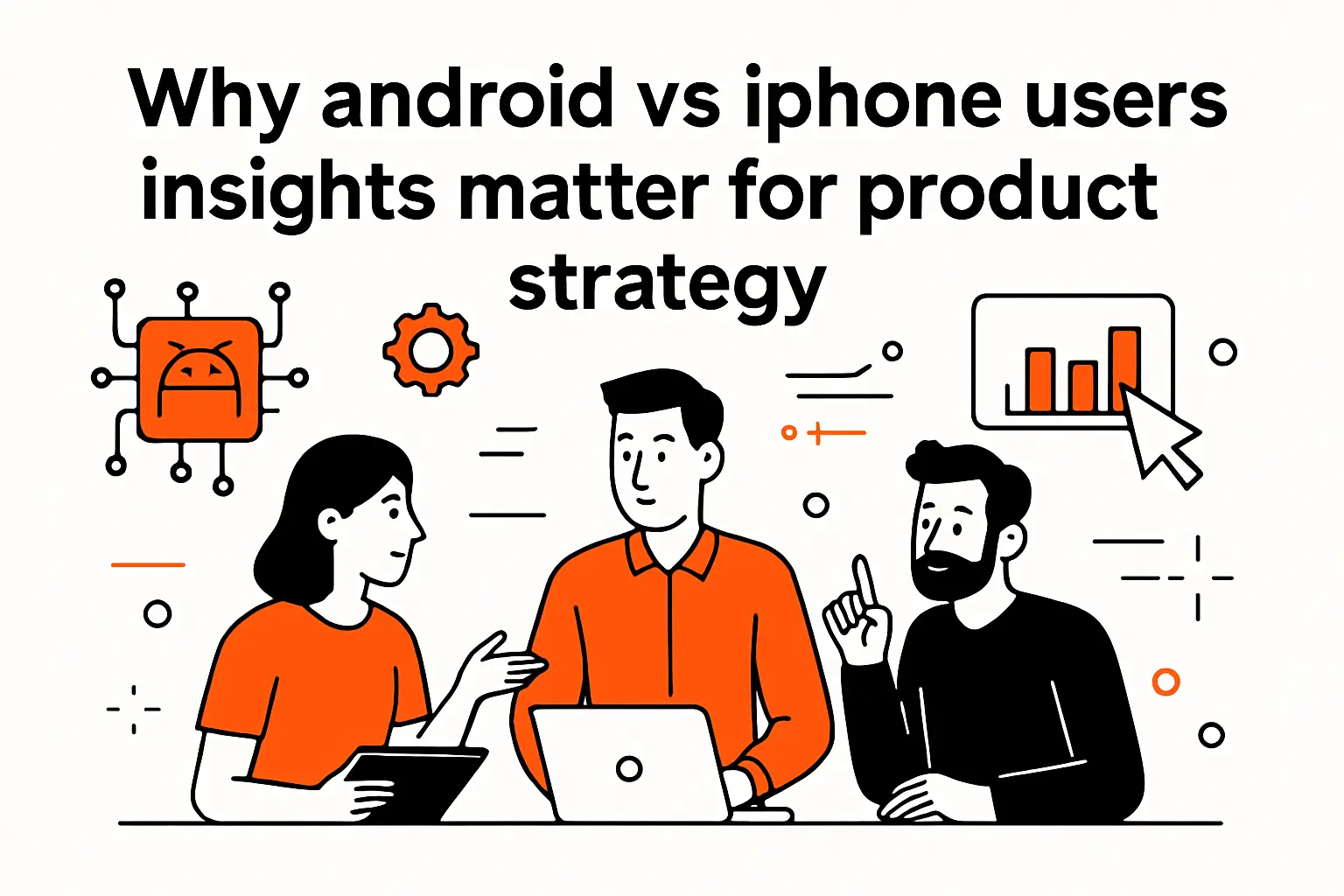
Why android vs iphone users insights matter for product strategy
1. Mobile micro-decisions shape engagement, revenue, and brand preference
Every mobile experience is a chain of micro decisions. Users face choices like allowing notifications, using Face ID, or continuing with Apple or Google. They also decide whether to trust the payment sheet and share location. These prompts are not cosmetic. They are conversion gates. When we audit funnels, we rarely find one big UX issue. More often, we find several small frictions. Together, they stack up until the user leaves.
On iOS, the first run experience often depends on trust and polish. Users expect cohesive typography, predictable system sheets, and restrained motion. Meanwhile, Android first run experience is judged more by speed and flexibility. People may accept more UI variety there. But they punish latency and confusing permission flows. In both cases, micro decisions test the brand promise. If the app claims security but asks for permissions without clear value, the brand loses the argument.
From our perspective, the practical takeaway is simple: we build funnels as if each prompt is a business negotiation. The platform determines which arguments will land.
2. Platform-specific UX and messaging outperform one-size-fits-all experiences
“Consistent” does not mean “identical.” A consistent product feels native in each ecosystem, and the fastest way to sabotage that is to force one platform’s idioms onto the other. Over time, we’ve learned to design around a platform’s default mental models rather than fighting them.
In iOS-first experiences, the user often expects crisp information hierarchy, predictable navigation patterns, and system-level conventions (like how modal sheets behave or how text selection feels). On Android-first experiences, the user often expects more configurability, clearer back navigation behavior across screens, and tolerance for a wider range of device ergonomics.
Messaging changes, too. An iOS paywall message that succeeds tends to emphasize quality and ease (“simple,” “private,” “works beautifully”). An Android paywall message that succeeds tends to emphasize value and control (“customize,” “choose,” “save time”). When we tailor UX and copy at the platform level, we see fewer support tickets and smoother upgrades—not because the user is “better,” but because the experience matches their expectations.
3. Platform choice affects audience reach, monetization, development effort, and long-term support
Platform strategy is never only about UX; it’s also about engineering economics. Android’s device diversity creates a larger test surface: chipsets vary, OEM skins vary, background process policies vary, and camera pipelines vary. Meanwhile, iOS tends to concentrate device behavior, but it concentrates policy constraints as well—especially around app review, permissions, and distribution.
Release management differs accordingly. With Android, we plan for gradual rollout, deeper crash segmentation, and “unknown unknowns” tied to specific devices. With iOS, we plan for sharper review cycles and faster adoption of OS updates, which can be a blessing and a curse (a new OS release can quickly surface edge cases in privacy prompts, background tasks, or entitlement usage).
In our own delivery playbooks, we budget differently by platform because the risk profile differs. The goal is not to pick the “best” platform; the goal is to pick the platform mix that matches your business model and your support tolerance.
Market share reality check: Android vs iPhone users worldwide, the U.S., and tablets
Market share isn’t destiny, but it is gravity. We use share data as a starting point for reach assumptions, then validate with first-party analytics because “Android users” in one region can behave nothing like “Android users” in another.
1. Worldwide smartphone OS market share and the scale of active device ecosystems
Globally, Android remains the volume platform. StatCounter reports Android 71.71% and iOS 27.91% for worldwide mobile OS market share in its latest view, which matches what most product teams feel intuitively: Android is where you get breadth.
Scale is not only about share; it’s also about the installed ecosystem you can reliably reach. Google has stated there are over three billion active monthly Android devices around the world, which helps explain why Android is frequently the default for emerging-market reach, hardware variety, and lower-cost device penetration. On the Apple side, Apple disclosed an active base of 2.35 billion active devices, reflecting a massive and sticky ecosystem where users often span phone, tablet, and desktop.
From our standpoint, the “ecosystem scale” question becomes: are you optimizing for a broad first acquisition wave, or for a tightly integrated user journey that spans devices and services? Android and iOS can both do both—but they make different things easier.
2. U.S. market share and installed base signals for iOS-first versus Android-first prioritization
The U.S. is a different battlefield than the global average, and product strategy should reflect that. StatCounter’s U.S. view shows iOS 59.31% and Android 40.41%, which aligns with what we see across many consumer categories: iOS often has a distribution advantage in the American market.
In practical terms, that can justify iOS-first for products where early revenue, subscriptions, and premium positioning matter more than raw reach. Fintech, wellness subscriptions, and professional creator tools frequently fit this pattern. Conversely, Android-first can still be defensible in the U.S. when your product grows through utility, field operations, or hardware adjacency (for example, enterprise fleets, scanning workflows, rugged devices, or budget-sensitive segments).
Our bias is not “iOS first” or “Android first.” Our bias is “U.S.-first products should at least confront iOS dominance honestly,” because otherwise you can build a great app that simply feels invisible to a large part of the paying audience.
3. Tablet market share differences and why large-screen optimization changes the roadmap
Tablet strategy is where many teams quietly lose time. They ship a phone UI scaled up, call it “responsive,” and then wonder why retention is soft. Tablet users behave differently: sessions run longer, layout expectations are higher, and split-screen multitasking exposes UI brittleness fast.
Hardware share matters here. StatCounter’s tablet vendor data shows Apple 54.76% and Samsung 22.71% worldwide, which implies a large portion of tablet experiences are shaped by iPad expectations. That expectation includes more robust keyboard support, better layout density, and a sense that the app can function as a “work surface,” not just a “feed.”
From the engineering side, large-screen optimization changes the roadmap because it forces decisions about navigation structure, information architecture, and component reusability. In our builds, tablet support is rarely a final polish step; it’s a design system commitment.
Demographics and socioeconomic patterns behind platform choice
Demographics are not a moral judgment; they are a planning tool. We use demographic signals to shape onboarding tone, monetization friction, accessibility defaults, and even customer support pathways.
1. Age trends: younger segments skew iPhone while older segments skew Android in key surveys
Younger American users often cluster around iPhone. That pattern is amplified by messaging norms, social groups, and accessory ecosystems. Piper Sandler reports 87% of teens own an iPhone. That number is more than a statistic. It signals peer influence and default communication channels.
In product work, a teen leaning product cannot ignore iOS polish, performance, and camera flows. When we build for youth heavy audiences, we invest early in iOS native affordances. This audience reads rough edges as proof the brand does not understand them.
Meanwhile, our analytics work often shows older cohorts leaning more Android heavy. That is especially true in value driven categories and promotion shaped regions. Those patterns affect font sizing defaults, permission explainers, and customer support UX. Older users often reward clarity more than cleverness.
2. Gender and income differences reported between iOS and Android audiences
Income is one of the most persistent correlates of platform choice in U.S. research, even if the shape of the curve evolves over time. Pew Research Center’s analysis notes 49% of cellphone owners with household incomes of $150,000 or more reported owning an iPhone in that snapshot, reinforcing a pattern we still see reflected in pricing tolerance and subscription conversion behavior.
On the ground, we translate “income differences” into concrete product bets. Subscription onboarding can be more direct on iOS, where a meaningful share of users are already comfortable paying for digital services. On Android, especially when targeting broad markets, we often emphasize free value first, then earn the upgrade through habit and trust.
Gender splits are trickier and more context-dependent; we prefer to avoid stereotypes and instead rely on your actual analytics. Still, when you see a platform skew in your own product, it’s usually a sign that your positioning, acquisition channels, or pricing are resonating unevenly—so the right move is not to guess, but to measure and adjust.
3. Regional concentration: iPhone strength in developed markets versus Android dominance across many developing regions
Regional OS concentration is where global product strategy gets real. In Japan, StatCounter reports iOS 61.38% and Android 38.41%, which makes iOS-first prioritization feel rational for many consumer apps that depend on local network effects. In India, the picture flips: StatCounter shows Android 95.17% and iOS 4.53%, which makes Android performance, APK size discipline, and device capability detection far more important than iOS flourish.
Localization isn’t only translation. Payments differ, network reliability differs, default app ecosystems differ, and hardware constraints differ. When we help clients expand cross-region, we focus on “capability tiers” rather than “countries,” because the same city can contain both premium iOS users and budget Android users with very different expectations.
From a roadmap lens, regional concentration suggests a phased plan: ship the platform that dominates your first target region, then expand once monetization and retention are stable enough to fund the second platform properly.
User mindset and identity: how people relate to iOS vs Android
User identity is not fluff. The way people talk about their phone choice influences referrals, reviews, and whether they blame your product or their device when something breaks.
1. Personality framing: extroversion, introversion, spending versus saving, and political preference splits
Popular culture loves to assign personalities to platforms: iPhone users are framed as status-driven, Android users as pragmatic; iPhone users as brand-loyal, Android users as tinkers. In our experience, those narratives are occasionally useful as marketing language, but they are dangerous as product assumptions.
What actually matters is the behavior those identities produce. Some users want the phone to disappear into the background so the app can do its job; others want the phone to be an extension of personal style and control. One cohort wants defaults and automation; another cohort wants explicit settings and transparency.
When a team leans too hard on personality framing, they build “persona theater” instead of measurable improvements. Our preference is to treat identity as a hypothesis generator, then validate via cohort analytics, onboarding completion, and retention curves by acquisition channel and device family.
2. Status object versus practical tool: how device perception shifts expectations for design and branding
Device perception changes what “good design” means. If the phone is a status object, users interpret UI quality as brand competence. That pushes iOS experiences toward high-fidelity motion discipline, typographic rhythm, and careful empty-state writing. If the phone is a practical tool, users interpret UI quality as “does it work fast and reliably,” which pushes Android experiences toward performance predictability, robust offline behavior, and fewer “cute” interactions that slow the workflow.
In a retail app, that difference can show up as how you present loyalty and discounts: iOS users may respond to “premium membership” framing, while Android users may respond better to “save more, control more” framing. In a B2B field app, the difference can show up as how you handle authentication: some teams over-optimize for elegance and under-optimize for resilience in low-connectivity environments, which can disproportionately hurt Android-heavy deployments.
At Techtide Solutions, we treat device perception as a design constraint: branding must harmonize with what the user believes their device represents.
3. Community observations: why personal networks can look iPhone-heavy even when broader share is mixed
Many founders swear “everyone has an iPhone,” then get surprised when Android usage dominates their sign-ups internationally. That mismatch is usually a network artifact: personal circles cluster by geography, profession, and income. If your team lives in an iOS-heavy bubble, your intuition will be skewed—and intuition is a poor substitute for instrumentation.
Platform-specific communication channels amplify the illusion. iMessage group dynamics, FaceTime habits, and Apple accessory ecosystems can make iPhone feel like the “default social phone” in certain U.S. communities. Meanwhile, in many countries and in many budget-sensitive segments, Android’s affordability and variety make it the actual default.
Our operational fix is unromantic: we require every product decision that depends on “who our users are” to cite analytics, not anecdotes. The moment you do that, platform myths become measurable segments.
Money and monetization: spending differences between android vs iphone users
Monetization is where platform differences stop being philosophical. The platform shapes payment trust, subscription tolerance, and even what users consider “worth paying for.”
1. In-app spending and purchase propensity differences reported across iOS and Android
Across the industry, iOS tends to over-index on revenue even when Android over-indexes on users. A TechCrunch summary of Appfigures data reports $91.6 billion came from the App Store while Google Play reached $35.7 billion in global consumer spending in the same snapshot, which captures the gap many teams feel when they compare conversion rates by platform.
Practically, that gap changes product decisions. Subscription-first businesses often need iOS to hit early revenue targets, while ad-supported businesses often need Android to hit early scale targets. Even within subscriptions, the “what” differs: iOS users often pay for convenience and polish; Android users often pay for utility and control once value is proven.
In our build plans, we typically map monetization mechanics to platform-specific trust triggers: payment sheet clarity, refund flows, and family-sharing expectations all land differently depending on what the user believes their platform “protects” them from.
2. Device pricing gaps and how price sensitivity shapes adoption and upgrade decisions
Price sensitivity shapes behavior long before the first in-app purchase. Android spans budget devices to premium flagships, which means the same app may run on radically different hardware. That reality affects everything from animation choices to image pipeline strategy to offline caching defaults.
On iPhone, users often pay for a cohesive ecosystem and longer perceived device life. That makes them more comfortable buying digital goods that match a premium device narrative. On Android, especially in emerging markets, the phone often serves broader household needs. It may be the primary internet device and a carefully managed purchase. As a result, users often lean toward freemium models that build trust gradually.
From our perspective, pricing gaps mean you cannot treat performance optimization as a “nice to have.” If your Android experience feels heavy on mid-range devices, you don’t just lose engagement; you lose credibility.
3. Revenue expectations: iPhone profitability signals versus Android volume and reach
Revenue expectations should be set per platform, not averaged across them. iPhone audiences often justify deeper investment in onboarding, retention, and premium support. Those users can sustain higher lifetime value. Android audiences often justify deeper investment in acquisition efficiency, virality, and device specific feature gating. Their reach can be enormous, and small conversion gains scale quickly.
In real-world product work, we often recommend dual monetization tracks: a subscription engine tuned to iOS sensibilities and a value-first engine tuned to Android reach. The mistake we see is forcing one monetization philosophy onto both platforms, then blaming “the audience” when results diverge.
Our viewpoint is blunt: if your business model needs both platforms, your monetization strategy needs two personalities—aligned to one product vision, but implemented with different levers.
App store ecosystems and distribution dynamics
Distribution is not neutral plumbing. App stores determine your discoverability, your pricing freedom, your update cadence, and the trust users extend before they even open your app.
1. App catalog scale: reported app counts and free-app share across Google Play and the App Store
Catalog scale matters because it shapes competition and discovery friction. Statista places Google Play at 1.68 million apps, which is enough volume to make search ranking, reviews, and category strategy existential rather than tactical. On Apple’s side, reporting around Apple’s catalog shifts suggests the App Store moved from 1.6 million to 1.64 million apps in the same discussion of store inventory changes, reinforcing that iOS discovery can still be crowded even if the raw count differs.
Free dominates both ecosystems. Statista reports 95.37 percent of iOS apps were free and the Google Play share was 96.99 percent in its distribution view, which is why freemium mechanics are not “a monetization strategy” so much as “the default economic language of mobile.”
From our perspective, this catalog reality means you win distribution through differentiation and retention, not by merely shipping. A crowded store punishes generic apps and rewards products with clear positioning and sharp onboarding.
2. Store economics: commission structures and alternative payment flexibility considerations
Store economics shape what business models are viable, especially at early scale. Apple’s Small Business Program announcement describes a reduced commission alongside the standard rate, referencing 15 percent and 30 percent as key anchors in how developers think about margin and pricing.
Those economics ripple into architecture. If margins are tight, teams may prefer server-side entitlement checks, careful SKU design, and pricing experiments that don’t require constant binary updates. Policy constraints also influence whether teams invest in web-based purchase flows, bundled subscriptions, or partnerships that move monetization outside the app without breaking platform rules.
At Techtide Solutions, we treat store economics as a design input, not a finance footnote. The earlier you model margins and compliance into the roadmap, the fewer “surprise rewrites” you face when growth arrives.
3. Discovery and demand signals: engagement growth and platform-specific download leaders
Discovery dynamics differ by platform, but the hidden truth is that neither store is a reliable growth engine by itself. Search is crowded, featuring is unpredictable, and “best new apps” lists are not a plan. As a result, modern distribution is usually hybrid: a mix of ASO, paid acquisition, influencer loops, partnerships, and product-led virality.
On iOS, we often see stronger returns from brand trust and polished listing assets—screenshots that feel like product design, not marketing collateral. On Android, we often see stronger returns from localized listings, flexible pricing narratives, and acquisition strategies that match diverse devices and carriers.
In our own launches, we favor a demand model that assumes the store will amplify traction, not create it. If your growth plan depends on being “found,” the roadmap needs to include a stronger retention loop and a clearer reason to share.
Engagement and communication: screen time, push notifications, and usage patterns
Engagement is where assumptions go to die. Many teams obsess over acquisition, then discover the real battle is keeping users active without exhausting them.
1. Daily screen time differences and what that implies for content cadence
Mobile is still where attention lives, which is both an opportunity and a liability. A Sensor Tower State of Mobile release notes 4.2 trillion total hours spent on mobile worldwide in its snapshot, underscoring that users will spend time—just not necessarily in your app.
Platform differences show up less as “iOS users use phones more” and more as “what kind of time they spend.” iOS-heavy audiences often concentrate time in high-retention, high-polish categories like subscriptions and creator tools. Android-heavy audiences often spread time across utility apps, messaging, commerce, and locally relevant services.
From a cadence standpoint, we recommend designing for “earned interruptions.” Notifications, emails, and in-app prompts should feel like timely assistance, not noise. When cadence is aligned to user intent, engagement feels respectful rather than desperate.
2. Push notification responsiveness benchmarks by platform
Push performance is one of the clearest “platform reality checks” we use. Airship’s benchmark press release cites that medium-performing Android apps saw 20 percent versus 8 percent notification engagement compared to iOS in its benchmark framing, suggesting that Android can offer more leverage when push is designed well.
That does not mean teams should spam Android users. Instead, it means segmentation and relevance pay off, and the shape of that payoff differs. On iOS, opt-in is explicit and users are quick to disable noisy apps, so the best strategy often prioritizes fewer, higher-intent messages. On Android, the channel can be more forgiving, which makes it tempting to overuse—until churn teaches the lesson the hard way.
In our builds, push is treated as a product surface: it gets UX design, QA, analytics, and lifecycle logic, not just copywriting.
3. How many apps people use: monthly breadth versus daily habits
App usage breadth is narrower than many teams assume. TechCrunch, citing comScore, reported 51% of users still don’t download any apps in a typical month in that discussion, which is a brutal reminder: distribution is hard, and switching costs are real.
That reality reframes product strategy. If most users aren’t downloading new apps, then winning means becoming one of the few apps they keep. Retention features—saved state, fast login, predictable performance, and meaningful personalization—stop being “nice UX” and become existential.
From our perspective, the most effective retention work is often unglamorous: fixing edge-case crashes, reducing cold-start time, improving offline behavior, and making the “come back” moment feel obvious. The platform matters, but habit matters more.
Security behavior differences: trust, risky shopping, and protection habits

Security is not only about OS hardening; it’s also about user behavior. A secure system can still be undermined by rushed decisions, confusing UI, and social-engineering pressure.
1. Risky buying behaviors: unknown sellers, discount-seeking via DMs, and QR-code purchase flows
Risky buying often looks similar across platforms. It usually starts with a deal that feels too good to be true. Sometimes it comes through an urgent message or a QR code that skips normal navigation. In other cases, the warning sign is a request to pay outside the app. What changes is the pathway into risk. Android’s openness can make sideloading and third-party stores more common in some regions. Meanwhile, iOS users may trust the walled garden too easily and lower their guard in social commerce contexts.
Malicious campaigns exploit distribution scale. TechRadar reported over 331 malicious Android apps tied to ad fraud and data theft that accumulated more than 60 million downloads before removal, illustrating how quickly “looks normal” can spread when users are moving fast.
In our product work, we assume risky purchase flows will be attempted and we design friction intentionally: clear merchant identity, transparent receipts, and warnings when users are leaving a safe context.
2. Protection gaps: security software usage, ad blockers, and password hygiene
Protection gaps are rarely about a single missing tool; they’re about inconsistent habits. Users reuse passwords, ignore permission prompts, and approve transactions without reading. Those gaps hit Android and iOS differently because the ecosystems train users differently: Android users may be more accustomed to configuration and third-party tools, while iOS users may be more accustomed to default protections and system-managed privacy cues.
From an app standpoint, we cannot “delegate security” to the OS. Secure sessions, rate limits, anomaly detection, and careful handling of device signals matter regardless of platform. On-device protections help, but they don’t replace secure backend design.
At Techtide Solutions, our rule is to build as if every client device will eventually be compromised. That sounds pessimistic, yet it produces calmer incident response and fewer catastrophic surprises.
3. Trust and consequences: perceived safety, scam victimization rates, and why OS alone is not enough
Perceived safety can be more dangerous than actual risk because it changes behavior. When users believe “my phone would never allow that,” they stop verifying sellers, links, and payment flows. Conversely, when users believe “my phone is risky,” they may avoid perfectly safe features that would improve their experience.
The real fix is shared responsibility: the OS enforces guardrails, the app enforces intent and clarity, and the backend enforces verification. In practice, that means building purchase flows that are hard to spoof, designing error states that don’t leak sensitive information, and instrumenting suspicious behavior so support teams can act before fraud spreads.
Our viewpoint is straightforward: platform choice influences the threat landscape, but security posture is a product decision. If you treat it as an afterthought, users will eventually pay the price—and then they’ll blame your brand, not the attacker.
TechTide Solutions: custom software that fits Android and iPhone audiences
Platform differences are only useful if they lead to better decisions. Our work is about turning OS signals into concrete UX, engineering, and monetization choices that fit your real customers.
1. Audience-led mobile strategy: align features, UX, and monetization to your real user mix
Audience-led strategy starts with instrumentation, not assumptions. At the start of an engagement, we map users by platform, region, acquisition channel, and revenue cohort. That segmentation becomes the backbone of prioritization. It shows which platform gets premium features first, where performance budgets stay strict, and which onboarding flows need most iteration.
Instead of arguing “Android users do X,” we ask “our Android users do what, exactly?” Then we compare cohorts: activation rate, retention, upgrade conversion, feature adoption, and support volume. Once those signals are visible, platform debates become solvable engineering tickets.
From our standpoint, the best strategy is the one that survives contact with analytics. If the data says your highest-value users cluster on one platform, the roadmap should admit that openly.
2. Custom app development across iOS, Android, and cross-platform stacks for consistent experiences
Implementation choices should match the product’s risk profile. For some products, native iOS and native Android are the right call. Performance, platform specific UI, or OS integrations may be central to the value. In other cases, a cross platform stack can speed delivery and reduce long term maintenance. That only works when the design system is strong and QA stays disciplined. Otherwise, the product drifts toward lowest common denominator UX.
In our delivery practice, consistency means “consistent intent,” not “pixel-identical screens.” We aim for parity in outcomes: the same core jobs-to-be-done, the same account integrity, and the same trust cues—implemented in a way that feels natural on each OS.
When clients ask us which path to pick, we answer with tradeoffs, not slogans. The right choice depends on your integrations, your performance needs, and your tolerance for platform-specific divergence.
3. End-to-end delivery: backend integration, analytics, QA, and security-by-design tailored to customer needs
Mobile apps fail in the seams: between app and backend, between analytics and decision-making, between QA and real devices, between security assumptions and real attackers. Our end-to-end approach treats those seams as first-class surfaces.
On the backend, we build for resilient sessions, well-defined entitlements, and observability that can answer “what changed?” quickly. In analytics, we implement event taxonomies that support real experimentation, not vanity dashboards. In QA, we test against representative device tiers, accessibility settings, and network conditions because that’s where platform differences become user pain.
Security-by-design is woven through all of it: careful data handling, secure storage patterns, least-privilege permissions, and threat modeling for the specific workflows your customers rely on. The goal is not to build a “secure app” in theory; it’s to build an app that stays trustworthy when the real world gets messy.
Conclusion: turning android vs iphone users differences into better product decisions
Platform differences are not a trivia contest. They are signals—about who your users are, how they behave, and what they will reward or punish. When we treat those signals with respect, we build products that feel obvious to the people they serve.
1. Use market share, demographics, and behavior signals to prioritize platforms and features
Market share shows where gravity pulls. Demographics hint at willingness to pay and preferred UX tone. Behavior benchmarks help predict which levers move engagement. Together, these inputs create a grounded platform strategy.
From our perspective, healthy teams hold two ideas at once. iOS and Android users differ in aggregate. Your own users are never the aggregate. The winning move is simple. Start with credible external signals, then validate quickly with your own data.
If your roadmap treats platform like a checkbox, rewrite it as customer segments. That is what it really is.
2. Plan for ecosystem realities: app store rules, device diversity, and update timelines
Ecosystem realities are where product strategy becomes operational. Store policies constrain monetization choices, device diversity constrains performance assumptions, and update dynamics constrain how fast you can rely on newer OS capabilities.
In practical delivery, that means planning for policy shifts and investing in observability. It also means resisting the urge to ship one build for everyone without platform aware QA. Support workflows should reflect different failure modes. Android often breaks through device specific quirks, while iOS more often fails through policy or entitlement mismatches.
At Techtide Solutions, we view ecosystem constraints as a way to reduce risk early. If you model them up front, you spend less time firefighting later.
3. Validate assumptions with your own analytics, then iterate with targeted experimentation
Validation is the bridge from research to results. With analytics in place, platform differences become measurable gaps. You can see where Android churns, where iOS converts, and where onboarding or notifications help or hurt.
Then targeted experiments close those gaps without rebuilding everything. A platform specific onboarding tweak or paywall message can outperform a major redesign when testing stays disciplined. This week, segment activation, retention, and revenue by OS, then ship one improvement based on what you find.