

At Techtide Solutions, we hear the phrase “AAA game” in planning meetings, pitch decks, postmortems, and player forums—and rarely with the same meaning twice. Sometimes it’s shorthand for “big-budget spectacle.” Other times it’s a warning label: “expect monetization,” “expect long installs,” “expect a day-one patch,” or “expect a years-long tail of updates.”
Across the industry, that ambiguity persists because “AAA” isn’t a certification, a standards body, or a consistent tier. Yet businesses still make decisions as if it were. Marketing teams position releases with the label, publishers benchmark spend against it, and players use it to predict polish, performance, and production values—often before a single trailer proves anything.
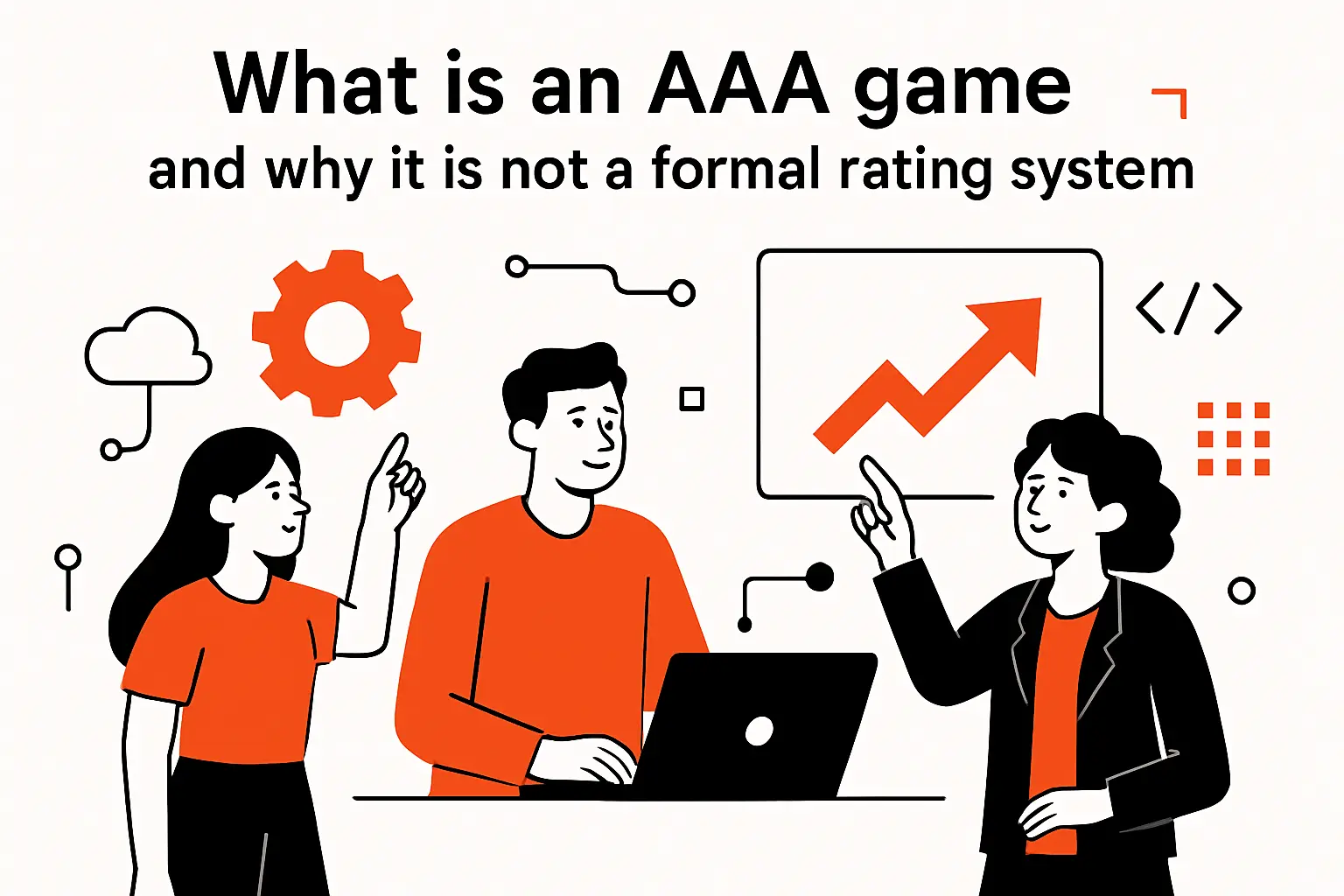
What is an AAA game and why it is not a formal rating system
Meanwhile, the stakes keep rising. In our market read, it’s not hard to see why the label became so loaded: Statista’s Market Insights projections put global gaming revenue at over $520 billion in 2025 inside a broader ecosystem that now includes hardware, digital storefronts, live-service operations, and creator-driven distribution. In the rest of this article, we’ll unpack what “AAA” tends to mean in practice, why it keeps shifting, and how the label shapes expectations in ways that can help—or quietly sabotage—teams trying to build software and experiences at modern blockbuster scale.
1. AAA as a high-budget, high-profile industry buzzword
In day-to-day industry conversation, “AAA” is less a definition than a vibe: high production value, broad market appeal, and enough investment behind it that failure would be headline-worthy. Because budgets, staffing, and marketing plans are often opaque, people infer “AAA-ness” from signals—publisher reputation, engine choice, cinematic trailers, celebrity voice talent, and the sheer volume of pre-launch hype.
From our view as an engineering partner, that label usually points more to real business needs than to creative ones. When clients ask us to build a player portal, a data-tracking system, or a sales-related service “for a AAA launch,” they usually mean the business is preparing for traffic spikes, many users at the same time around the world, frequent content releases, and a support burden that feels more like a major media event than a normal software launch.
Critically, none of that requires the game to be “good.” The label is about scale and intent, not a guarantee of fun, fairness, or longevity. That gap—between what “AAA” signals and what it actually promises—is where misunderstandings begin.
2. How players and publishers commonly use the AAA label in conversation
Players often use “AAA” as a shortcut for polish. In that sense, “AAA” suggests steady frame rates, consistent UI design, strong accessibility features, high-quality sound mixing, and fewer bugs that pull people out of the experience. At the same time, many players also connect “AAA” with trade-offs: safer design choices, familiar gameplay systems, and monetization that can feel added on rather than naturally built in.
Publishers use the label differently. Internally, “AAA” can mean a portfolio pillar: a release that anchors quarterly forecasts, negotiates prime storefront placement, and sustains a long-tail strategy through seasonal content. That business definition is why “AAA” conversations so often revolve around retention loops, content cadence, and platform relationships rather than the moment-to-moment feel of combat or traversal.
Between those two perspectives sits a communications problem. When one side hears “AAA,” they expect craftsmanship; when the other side says “AAA,” they often mean commercial durability. Neither side is wrong, but the mismatch is expensive.
3. Why there is no single definitive definition of “AAA”
No governing body certifies a game as “AAA.” Ratings boards evaluate content suitability, not production scale. Platform holders enforce technical requirements, but passing certification doesn’t reveal team size, budget, or marketing spend. Even awards and critical reception are downstream signals, arriving after the term has already shaped consumer expectations.
Because “AAA” is socially defined, it drifts with the market. A budget that looked enormous a decade ago may be routine today once you factor in global outsourcing, performance capture, compliance, localization, and ongoing live operations. Conversely, a visually stunning project might still be “AA” if it’s produced with a leaner structure or narrower distribution plan.
As a result, we treat “AAA” as a shorthand for risk profile: the higher the ambition, the more the project must behave like a resilient software platform—observable, secure, scalable, and designed for change.
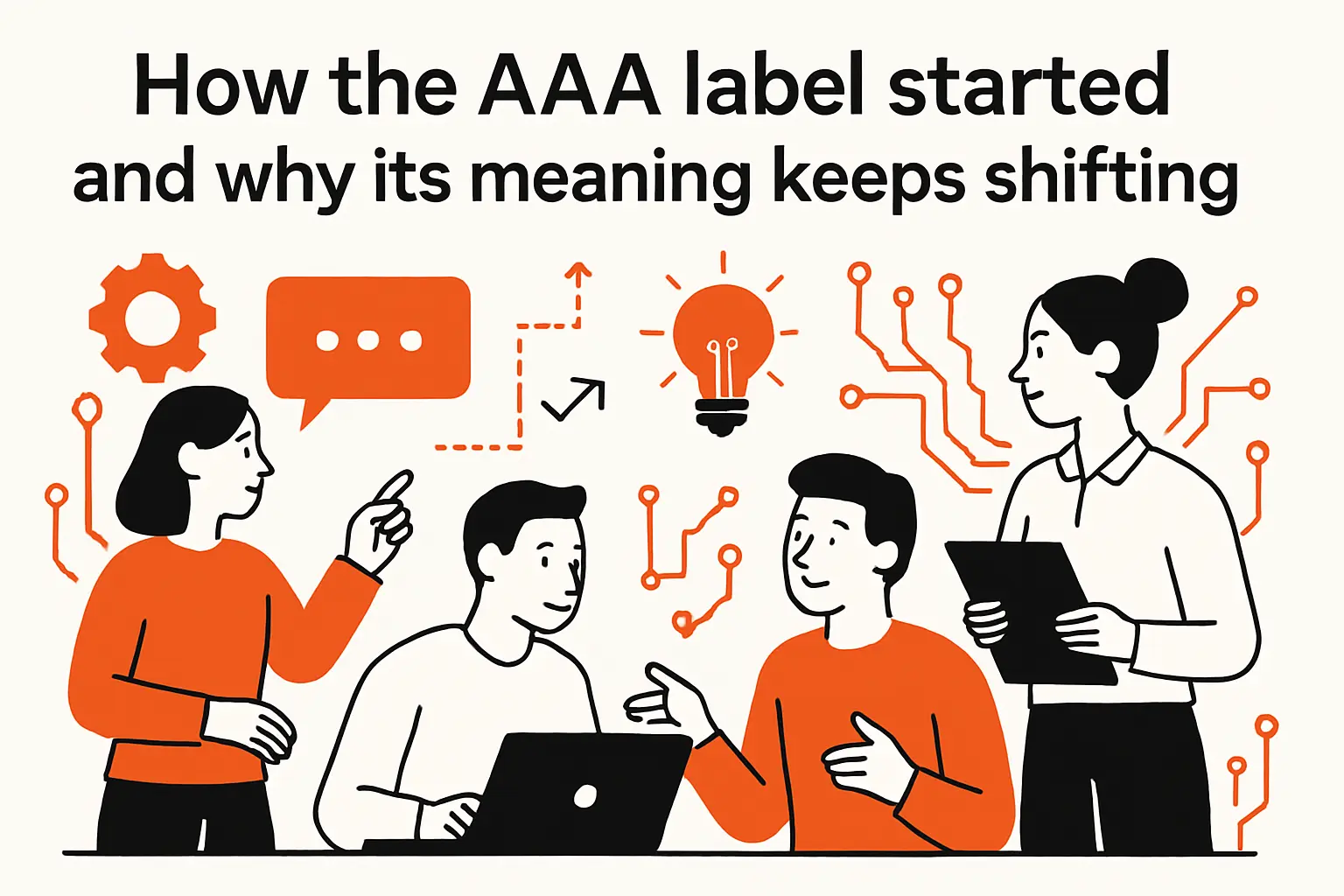
How the AAA label started and why its meaning keeps shifting
1. Late-1990s retailer shorthand and the bond-rating inspiration
Long before “AAA” became a marketing staple, it functioned as retail shorthand. Store buyers and merchandisers needed a quick way to describe upcoming releases likely to move hardware, justify end-cap placement, and reduce inventory risk. Borrowing the language of finance—where “AAA” implies perceived safety—fit the commercial mindset: a “AAA” release was supposed to be a reliable bet.
That origin matters because it frames the term as economic first, creative second. When the label spreads from retail to publishing, it carries the same implication: big bets deserve big visibility, and big visibility requires controlled messaging. Over time, that dynamic nudged the term toward a kind of prestige branding, even though no consistent criteria ever existed.
Today, the irony is hard to miss. Many so-called “AAA” projects are the riskiest things in entertainment precisely because the investments, timelines, and expectations have grown so large.
2. Early blockbuster milestones: Final Fantasy VII and Shenmue
Two early touchstones still shape how people talk about AAA: Final Fantasy VII and Shenmue. Both titles signaled a shift toward cinematic ambition and expansive world-building, and both became symbols of “games as blockbuster events,” even for audiences who never played them.
What makes them especially relevant is how often budget narratives get attached to them. Guinness World Records reports a combined development and marketing budget of $145,000,000 US dollar(s) for Final Fantasy VII, a claim that—regardless of the debates around estimation—captures the cultural point: the industry was already experimenting with film-like spend and film-like promotion.
On the other side of the spectrum, commentary around Shenmue frequently points to its famous cost. One mainstream retrospective frames it as a $70 million swing that pushed fidelity, simulation, and environmental detail far beyond typical expectations of its era.
3. From tens of millions to modern budgets that can reach into the hundreds of millions
Once blockbuster-scale spending becomes thinkable, it tends to become repeatable—and then, eventually, expected. Modern AAA budgets don’t just cover game code and art; they also fund global localization, accessibility work, external QA, licensing, compliance, security hardening, build infrastructure, and the operational staffing required to keep online systems healthy after launch.
One widely cited example of “blockbuster spend” in the mainstream business press is Rockstar’s Grand Theft Auto V, which CNBC framed as $260 million in the context of an entertainment-scale investment. For our purposes, that figure is less about one title and more about what it implies: once games are financed like tentpole films, they inherit tentpole expectations—predictable release windows, global attention, and a post-launch plan that keeps the asset earning.
At Techtide Solutions, we’ve learned to translate that reality into engineering terms. Bigger budgets often mean larger dependency graphs: more vendors, more integrations, more platform constraints, and more failure modes to design around.
Budget, team size, and publisher backing that typically define AAA
1. Major publishers and established studios behind AAA development and distribution
Publisher backing is one of the clearest “AAA signals,” because it influences everything downstream: distribution guarantees, marketing muscle, platform negotiations, and the ability to fund extended development. Large publishers also bring institutional process—greenlight gates, milestone-based funding, compliance teams, and legal review—that can make AAA production feel more like enterprise software delivery than the romantic myth of a small creative team “just making a game.”
Yet publisher support has a double edge. More stakeholders can mean clearer accountability, but it can also mean more constraints: creative risk is harder to defend when budgets balloon, and systemic change becomes difficult when many teams depend on shared pipelines and deadlines.
In our client work, the presence of a major publisher typically correlates with stricter requirements: identity management, fraud prevention, customer support tooling, privacy reviews, and audit-friendly operational reporting.
2. Large-scale development teams with hundreds of contributors
AAA games are often built by hundreds of people across disciplines: gameplay engineers, rendering specialists, tools teams, animators, writers, audio designers, performance capture crews, build engineers, QA, localization, and production. Even when the “core studio” remains modest, outsourcing and co-development expand the contributor count dramatically, especially for asset-heavy content like character models, environment art, and cinematic sequences.
A useful public data point comes from Guinness World Records, which lists the largest development team for a videogame as 2000 people for Red Dead Redemption II. We read that not as a bragging right, but as an architectural clue: when contributor counts rise, toolchains and workflows must absorb huge parallelism without collapsing under merge conflicts, broken builds, and inconsistent content standards.
Practically speaking, the “AAA” threshold is often crossed when coordination becomes as hard as creation. Once that happens, pipelines—not just talent—determine whether a project ships.
3. Blockbuster marketing reach and global launch expectations
Marketing is where the AAA label becomes visible to the public. A global launch implies more than ads; it implies synchronized storefront placement, preloads, influencer campaigns, review embargo orchestration, and community management that can handle rapid sentiment swings. Even the best-engineered backend can be kneecapped by unclear messaging, while a strong launch narrative can sometimes carry a technically imperfect release through its first critical days.
From an engineering standpoint, marketing reach creates unpredictable load. A trailer drop can trigger account creation spikes; a streamer moment can cause sudden concurrency bursts; a negative patch narrative can double support tickets overnight. In other words, “global launch expectations” are operational expectations as much as promotional ones.
When we build game-adjacent services, we treat “launch” as a sequence of stress events rather than a single date. That posture—anticipating waves, not a peak—often separates smooth rollouts from crisis response.
Production values that players expect from a modern AAA game
1. Cinematic presentation: cutscenes, voice acting, and movie-like storytelling
Cinematic presentation is one of the most visible reasons players apply the AAA label. High-quality facial animation, performance capture, and tightly directed cutscenes create a “premium” feel even before gameplay systems prove themselves. Voice direction matters too: players can forgive stylization, but they rarely forgive inconsistency—flat reads, mismatched lip-sync, or tonal shifts that feel like they came from different teams.
Behind the scenes, cinematic delivery is a pipeline problem. Narrative design must be integrated with level design, animation, lighting, audio, and localization in a way that survives iteration. Each cutscene is also a source of technical risk: branching logic, save-state compatibility, asset streaming, subtitle timing, and accessibility options all intersect there.
Our experience is that cinematic ambition tends to magnify integration complexity. The more “film-like” the presentation, the more the production needs software-like rigor to keep assets, versions, and dependencies coherent.
2. High-fidelity graphics and polish as core “premium” expectations
Players often equate AAA with visual fidelity, but fidelity alone is not the bar. Modern expectations include consistent art direction, stable performance, clean UI transitions, and “invisible” polish: tight collision, reliable quest triggers, readable combat feedback, and menus that remain responsive even when the game is streaming assets in the background.
Polish is also the hardest thing to market honestly. A trailer can showcase lighting and animation, but it rarely communicates input latency, pacing, or the feel of moment-to-moment navigation. That’s why “AAA disappointment” tends to arrive as a gut reaction: players sense when a product feels unfinished, even if they can’t name the technical root cause.
In business terms, polish is reputation protection. A single high-profile performance issue can dominate coverage, distort review narratives, and reduce conversion across the entire portfolio.
3. Massive production pipelines: large teams working across locations and studios
AAA pipelines are factories for assets, builds, and updates. They coordinate work across time zones, manage approvals, enforce naming standards, and keep thousands of files shippable across platforms. When pipelines are strong, teams iterate faster; when pipelines are fragile, teams slow down to avoid breaking the build, and creativity quietly narrows.
Tooling, therefore, becomes a creative enabler. Asset validation, automated testing, deterministic builds, and reliable CI systems are not glamorous, but they’re how large teams keep momentum without collapsing into integration chaos. A strong pipeline also improves security posture by reducing ad-hoc file sharing and lowering the temptation to bypass governance during crunch periods.
At Techtide Solutions, we tend to describe AAA pipelines as “human-scale concurrency systems.” The goal is not just to make builds compile, but to make collaboration resilient under constant change.
Technical ambition: engines, graphics, and performance targets
1. Advanced game engines and proprietary platforms pushing real-time interactivity
Under the hood, AAA ambition is often expressed through engine choices and engine customization. Studios may extend commercial engines with proprietary rendering features, bespoke animation systems, or specialized world-streaming tech. Other teams run fully proprietary engines to control performance, memory behavior, and toolchain integration—especially when targeting a particular “house style” of open-world simulation or systemic interaction.
Engine ambition isn’t just about visuals. Real-time interactivity demands deterministic gameplay behavior, predictable physics integration, and stable performance across diverse hardware. That typically requires careful thread management, disciplined asset budgets, and a tooling ecosystem that can profile bottlenecks quickly.
From our software perspective, engines behave like platforms: they accumulate technical debt, require roadmap governance, and benefit from product thinking. Treating engine work as “just tech” is a common mistake that AAA studios learn the hard way.
2. Demanding features like real-time physics, ray tracing, and immersive audio
Modern AAA features often sound like a shopping list—ray-traced lighting, advanced cloth, destructible environments, spatial audio, procedural animation—but the real challenge is composability. Each system wants CPU time, GPU budget, memory bandwidth, and predictable frame pacing. When systems compete without a clear priority model, “premium features” can turn into performance cliffs.
Immersive audio is a good example. High-quality mixes depend on runtime voice management, occlusion models, and reverb zones that match level geometry. Those features then intersect with streaming systems and scripting systems, which means the audio experience is only as stable as the wider content pipeline.
In practice, the most successful AAA teams design features as part of a performance contract. Instead of asking “can we add this,” they ask “what must we trade to add this and still ship a stable experience?”
3. System-level needs: CPU and GPU coordination plus efficient memory management
AAA engineering is often the art of making expensive systems appear effortless. Smooth traversal requires aggressive streaming and predictive asset loading. Large crowds require animation LOD strategies and smart simulation throttling. Open-world density requires culling, batching, and careful GPU submission patterns.
Memory management becomes a product feature. Players rarely say “great allocator,” yet they absolutely notice the symptoms of memory pressure: texture pop-in, stutter during traversal, unstable performance after long sessions, and crashes that appear “random.” Those issues are frequently systemic, not isolated bugs.
For businesses, system-level stability affects more than reviews. Stable performance reduces refund risk, improves retention, and lowers customer support volume—outcomes that translate directly into revenue protection and brand trust.
AAA games and the wider ecosystem: innovation, creativity, and risk

1. How AAA titles raise the bar for graphics, performance, and console capabilities
AAA games act as stress tests for the broader ecosystem. They push engines, GPU drivers, console SDKs, and middleware to their limits, often exposing edge cases that smaller projects never hit. When those problems are solved, the benefits trickle outward: better tooling, stronger performance baselines, and more mature workflows become available to the rest of the industry.
At the same time, “raising the bar” can narrow expectations. Once players get used to certain visual density or cinematic quality, stylized or minimalist games may be dismissed as “cheap,” even when the design is intentionally restrained. That cultural drift is one reason indie and mid-market studios often emphasize uniqueness rather than competing on raw fidelity.
From our standpoint, AAA also raises the bar for backends. Players now expect cross-progression, robust anti-cheat, reliable matchmaking, and seamless account recovery as table stakes—features that resemble mature SaaS products more than traditional boxed games.
2. Why rising costs can push studios toward sequels, reboots, and established IP
When a game becomes a nine-figure bet, marketing risk becomes existential. Familiar IP lowers uncertainty: brand recognition improves conversion, established lore supports merchandising, and sequels provide predictable retention hooks. That’s why AAA portfolios often cluster around franchises, spiritual successors, and recognizable genres.
Still, there’s a subtle trap here. Reusing an IP can reduce creative risk while increasing operational risk, because sequels often inherit legacy tech, legacy pipelines, and old assumptions about content cadence. In software terms, the product ships with dependencies that were never designed for the new scale.
Our advice to teams chasing franchise durability is to treat each sequel as a platform migration opportunity. Even incremental refactors—identity unification, telemetry modernization, or pipeline automation—compound over time and protect the studio from slow-motion collapse under inherited complexity.
3. Workforce realities: crunch time and other development pressures
AAA is frequently romanticized as “big teams making big art,” but the human cost can be severe. Scheduling pressure compounds when marketing commitments, platform deals, and fiscal calendars harden deadlines long before production realities stabilize.
Industry survey data illustrates how common the problem remains. In the IGDA’s Developer Satisfaction Survey press release, 28% said their job involved crunch time, a statistic that matters because it’s not describing a rare edge case; it’s describing normalized pressure across roles and studio types.
At Techtide Solutions, we view sustainability as an engineering requirement, not a morale perk. Reliable tooling, observable systems, and predictable release processes reduce firefighting—and firefighting is one of the fastest ways to turn a talented team into a burned-out one.
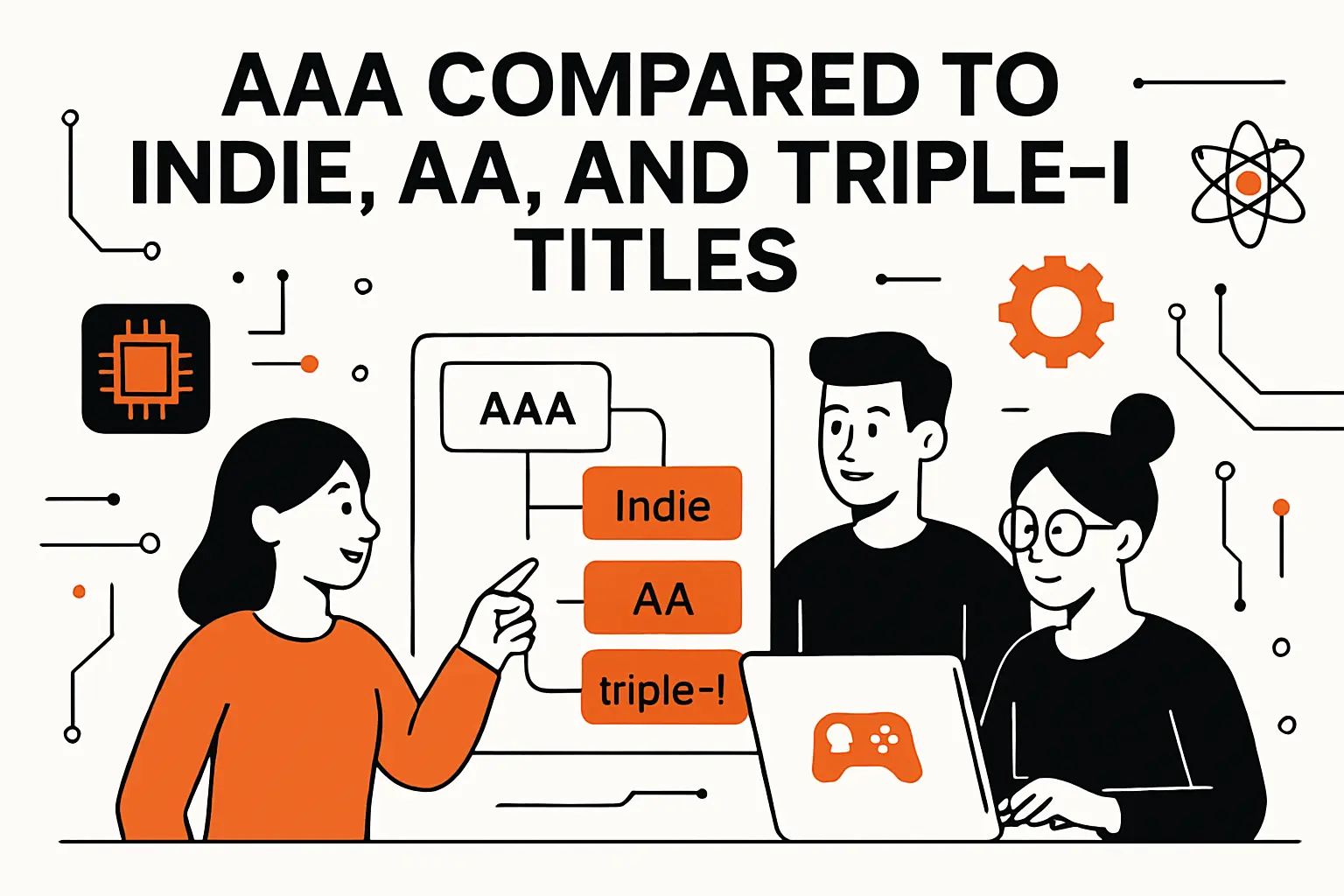
AAA compared to indie, AA, and triple-I titles
1. Indie games: very small teams, limited budgets, and passion-project roots
Indie games often begin with a different kind of capital: conviction. Small teams can move quickly, make bold design bets, and iterate without the coordination overhead that defines AAA production. Constraints can also sharpen creativity; when you can’t outspend competitors, you outthink them.
Yet the indie path has its own risks. Tooling and infrastructure can be underbuilt, analytics can be minimal, and live operations may be improvised late in the process. Success can be just as destabilizing as failure if a small team suddenly faces huge player demand without scalable services or support workflows.
In our client ecosystem, indie studios often ask for “AAA-level reliability without AAA-level process.” That’s a reasonable ask, but it requires intentional architecture: managed services, strong observability, and automation that substitutes for headcount.
2. AA double-A games: mid-market studios between indie and AAA scale
AA games sit in a productive middle ground. They can deliver meaningful scope—voiced narratives, rich combat systems, striking art direction—without the full overhead of blockbuster expectations. For many studios, AA is where experimentation and professionalism coexist most comfortably.
From a business standpoint, AA can also be a portfolio stabilizer. Mid-budget releases can diversify revenue, reduce dependency on a single annual tentpole, and create room for new IP to prove itself before receiving AAA funding.
Technically, AA teams often benefit from choosing battles. Rather than chasing maximum fidelity everywhere, they pick the experiences that matter most—combat feel, systemic depth, or aesthetic style—and design pipelines around those priorities.
3. Triple-I and AAAA terms: high production value independent projects and emerging marketing labels
As the industry evolved, language tried to keep up. “Triple-I” emerged to describe independent studios shipping games with surprisingly high production value—projects that look “big” but are structured more like indie companies. The term is a cultural signal: polish and ambition are no longer exclusive to publisher-backed behemoths.
Meanwhile, “AAAA” has appeared as a marketing escalation, usually met with skepticism. Public discussion around Ubisoft’s use of “quadruple-A” framing—particularly in the context of Skull and Bones—shows how quickly players interpret the extra letter as hype rather than meaningful classification, a dynamic captured in coverage describing Ubisoft’s “AAAA” labeling as something the public tends to mock rather than embrace in AAAA Quality.
Our take is blunt: adding letters doesn’t add clarity. Teams and publishers are better served by describing concrete expectations—scope, platform support, live-service intent—than by inventing new tiers that nobody can measure.
Monetization and live-service in AAA: from AAA+ to server shutdowns
1. AAA+ revenue models: DLC, subscriptions, and long-tail engagement strategies
Monetization in AAA has expanded from a one-time sale into a layered strategy: premium editions, downloadable expansions, cosmetic stores, seasonal passes, and subscription bundling. The label “AAA+” is sometimes used informally to signal not just a large game, but a long-tail business plan—one that expects ongoing revenue from ongoing engagement.
From a product standpoint, that shift changes how teams build. Content cadence becomes a core requirement. Data pipelines become decision engines. Player identity becomes a durable asset that must survive platform migration, account recovery, fraud attempts, and policy changes.
As engineers, we don’t moralize monetization by default. Instead, we ask whether the monetization model is technically honest: does it match the game’s update capacity, community management bandwidth, and customer support readiness, or is it a spreadsheet ambition that the pipeline cannot sustain?
2. Live-service direction: content-heavy updates and ongoing patches
Live-service operations resemble running a production SaaS platform with an entertainment front end. Patches must be deployed safely. Telemetry must be trusted. Incidents must be triaged with clear ownership. Security must be proactive because cheaters, fraudsters, and exploit hunters treat popular games as targets of opportunity.
Operational maturity also becomes player experience. Maintenance windows, matchmaking reliability, and rollback capability directly affect whether players recommend a game to friends. Even narrative-heavy titles increasingly ship with connected features—cloud saves, cross-play, creator tools—because the market has trained players to expect continuity across devices and communities.
In our practice, the most resilient live-service stacks are built around observability and change management. When teams can see what’s happening and ship fixes confidently, they buy themselves the most precious resource in AAA: time.
3. When an online-only AAA game disappears: Anthem’s shutdown after January 12, 2026
Online-only design changes the meaning of ownership. If a game requires servers to function, then the game is also a service contract—whether players think of it that way or not. When the service ends, access ends, and preservation becomes complicated fast.
EA’s official messaging around sunsetting Anthem makes the broader point explicit: when the servers go offline, the title becomes unplayable because it was designed that way. For players, the emotional impact is obvious—memories, mastery, and community disappear. For publishers, the lesson is operational: sunset planning is not just PR, but data retention policy, customer support playbooks, and reputational risk management.
In our view, this is where the “AAA” label becomes consequential beyond marketing. A blockbuster-scale game that cannot be played without infrastructure forces a new kind of accountability: if you sell access to a living system, you must plan for its full lifecycle, including its end.
TechTide Solutions: building custom, scalable software for AAA-level experiences

1. Custom solutions for game-adjacent products: live-service backends, player portals, and content pipelines
At Techtide Solutions, we don’t pretend every studio needs to build everything from scratch. Still, many teams hit a point where generic platforms fight the product’s reality: unique progression rules, bespoke entitlements, unusual moderation workflows, or a content pipeline that must integrate with proprietary tools.
Our sweet spot is game-adjacent software that must behave like an enterprise platform while serving an entertainment experience: live-service backends, account systems, player portals, support tooling, content publishing workflows, and internal dashboards that turn telemetry into action.
Because these systems sit close to revenue and trust, we design them with auditability, security, and operational clarity in mind. A portal that “usually works” is not enough when a launch event turns “usually” into “constantly under attack.”
2. Performance-focused architecture for demanding workloads and real-time user experiences
Performance isn’t a single metric; it’s a chain of promises. Authentication must be fast enough to feel invisible. Matchmaking must be consistent enough to feel fair. Inventory updates must be reliable enough to prevent support nightmares. Each promise depends on careful architecture: caching, idempotent APIs, resilient messaging, and well-modeled data that doesn’t collapse under contention.
For real-time experiences, we often favor event-driven designs that decouple game services from downstream analytics, moderation, and customer support workflows. That separation keeps the player-facing path lean while still feeding the organization the data it needs to operate responsibly.
Equally important, observability is not optional. Tracing, structured logs, and actionable alerting let teams respond to incidents before social media becomes the monitoring system.
3. End-to-end delivery tailored to customer needs: discovery, development, integration, and ongoing support
End-to-end delivery matters because AAA-level expectations punish weak handoffs. Discovery aligns success criteria with what the business actually needs. Development turns those criteria into software that can ship safely. Integration makes the system real in the messy ecosystem of platforms, stores, and identity providers. Ongoing support keeps it alive when traffic spikes, policies change, or new content introduces unexpected load patterns.
In our engagements, we emphasize pragmatic documentation, clear ownership boundaries, and release processes that reduce heroics. The goal is not to build a monument; it’s to build a machine that a client team can operate, extend, and trust.
Ultimately, “AAA-level” isn’t a finish line. It’s a commitment to resilience under scrutiny, and scrutiny is exactly what successful games attract.
Conclusion: using the AAA label to set expectations, not to judge quality
1. How to interpret “AAA” as a shorthand for scale, budget, and ambition
Used responsibly, “AAA” is a useful compression algorithm. It tells us to expect large teams, heavy pipelines, big marketing pressure, and a risk profile that demands operational maturity. For businesses, it also signals that reliability, security, and customer support are part of the product—not accessories added after launch.
At Techtide Solutions, we treat the label as a planning hint. If stakeholders say “AAA,” we probe for the real requirements hiding underneath: concurrency expectations, content cadence, cross-platform identity, data governance, and what “success” means after the initial release window.
Once those requirements are explicit, the work becomes less mystical. The label stops being a badge and starts being a checklist.
2. Why the label can’t guarantee innovation, longevity, or player satisfaction
AAA does not equal excellence. Big budgets can buy fidelity, but they can’t automatically buy coherence. Large teams can produce enormous worlds, but scale also multiplies misalignment and makes late course-correction painful. Live-service ambitions can extend longevity, yet they can also undermine trust if content cadence slips or monetization feels extractive.
Players, for their part, are increasingly sophisticated. Communities notice when a game launches “unfinished,” when patches feel reactive, or when the business model is driving design decisions. In that environment, the AAA label is less a shield than a spotlight.
So here’s the practical next step we encourage: before calling a project “AAA,” are we willing to define what that implies for our pipeline, our infrastructure, and our long-term obligations to players?