
At TechTide Solutions, we treat “Panda penalty” as a useful shorthand, even though it’s not usually a tidy, single on/off switch. In the real world, the “penalty” most teams feel is an ecosystem shift: Google gets better at identifying pages that don’t deserve attention, and entire sites that leaned on low-value scale suddenly lose the attention they were renting.
Across the marketing landscape, the stakes are not theoretical—visibility is budget. In a Gartner CMO spend survey, digital channels now account for 61.1% of total marketing spend, which is exactly why content quality “taxes” like Panda still matter years after their first splash: the web rewards what helps users, and punishes what wastes their time.
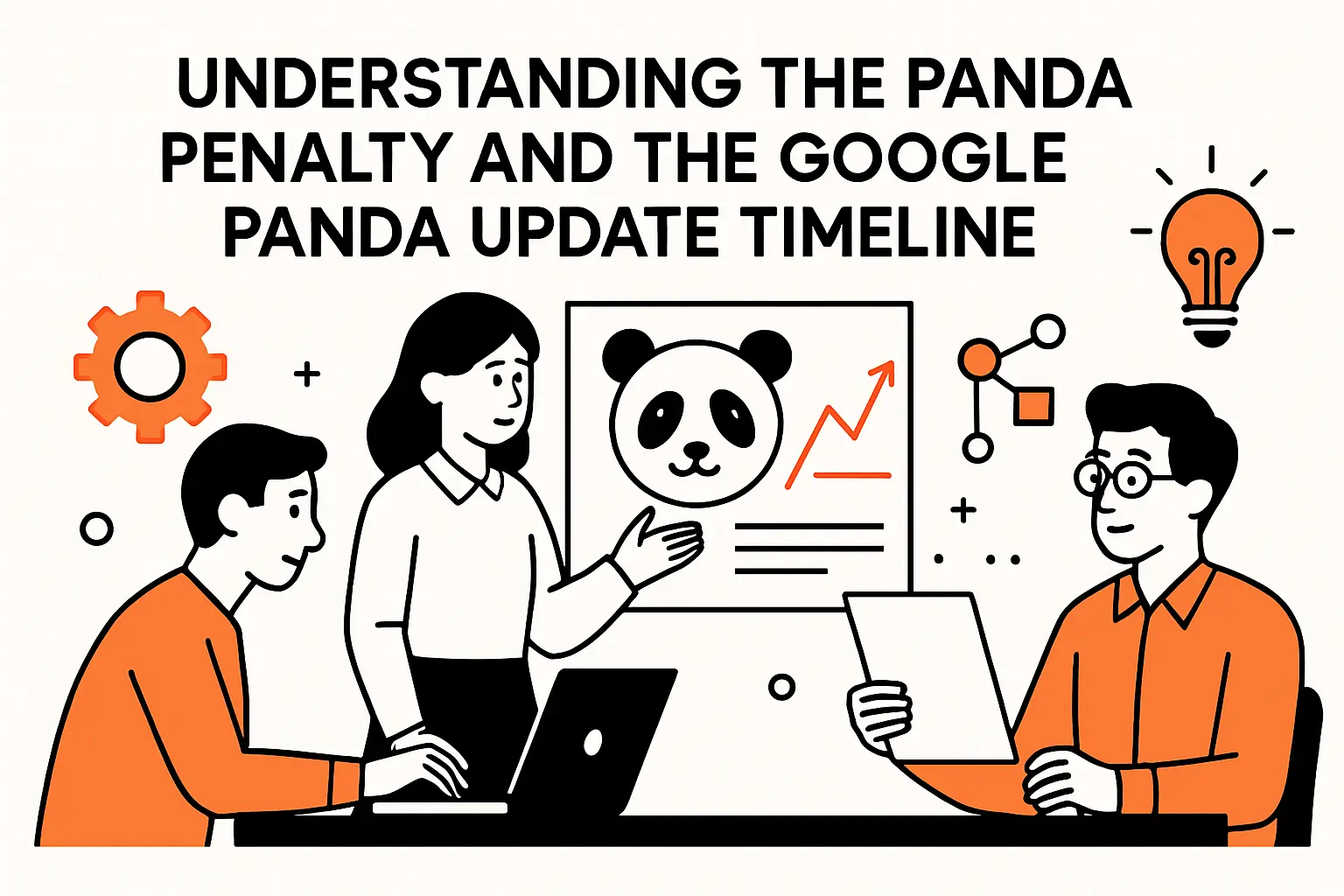
Understanding the panda penalty and the Google Panda update timeline
Our perspective is shaped by building and modernizing large content systems—publisher platforms, e-commerce catalogs, knowledge bases, and UGC-heavy communities—where quality isn’t a motivational poster; it’s an operational discipline. Panda-style hits tend to be the moment a business discovers whether its content program is a craft, or just a content factory with a logo.
1. What a panda penalty is and why it leads to major ranking drops
In practice, a “Panda penalty” describes an algorithmic demotion driven by perceived site quality. Rather than targeting a single spam trick, Panda-class quality systems tend to evaluate patterns: thin pages, near-duplicates, aggressive monetization layouts, weak editorial standards, and content that looks like it was created to rank rather than to help.
From our audits, the harsh part is rarely a single bad URL. Instead, the pain comes from aggregation: a large volume of low-value pages can pull down the perceived quality of a whole section—or, depending on architecture and internal linking, the whole domain. When that happens, even your best pages can lose their edge because they no longer sit inside a trusted neighborhood.
Under the hood, this kind of drop often looks like a classifier or scoring system changing how much “benefit of the doubt” Google grants. Content that once ranked because it was “good enough” can suddenly need to be clearly better than alternatives.
2. Google Panda’s launch in February 2011 and its role in reducing low-quality content
Panda’s origin story matters because it explains the philosophy behind the symptoms. The initial thrust was not “punish SEO,” but to reduce the visibility of pages that felt mass-produced, derivative, or unhelpful—especially the kind that users clicked, regretted, and immediately bounced from.
In our view, Panda changed the content economy by making “scale without craft” a liability. Before Panda, many teams could flood the index with templated pages and win simply by being present on enough long-tail queries. After Panda, quantity still mattered, but only when quantity carried its weight in usefulness, clarity, and trust.
Notably, Panda also pushed businesses to confront a difficult truth: search engines don’t just rank pages; they shape incentives. If your incentive system rewards publishing volume over outcomes, Panda tends to show up as an unexpected performance review.
3. How Panda became part of Google’s core algorithm rather than a standalone update
Over time, Panda stopped feeling like a periodic storm and started behaving more like climate. Google communicated that Panda became integrated into core ranking systems around January 2016, which, operationally, changes how we advise clients: waiting for a named “Panda refresh” becomes less relevant than continuously raising the baseline quality of the site.
From an engineering standpoint, core integration also implies a deeper coupling to other systems: crawling choices, index selection, query interpretation, and user-satisfaction modeling. That coupling is why Panda recovery is rarely “fix five pages and you’re done.” Sustainable recovery usually looks like product work—content design, governance, and UX remediation—more than a quick SEO patch.
In other words, Panda became less like a toggle and more like an always-on evaluator, which is exactly why we treat quality as a platform capability rather than a campaign task.
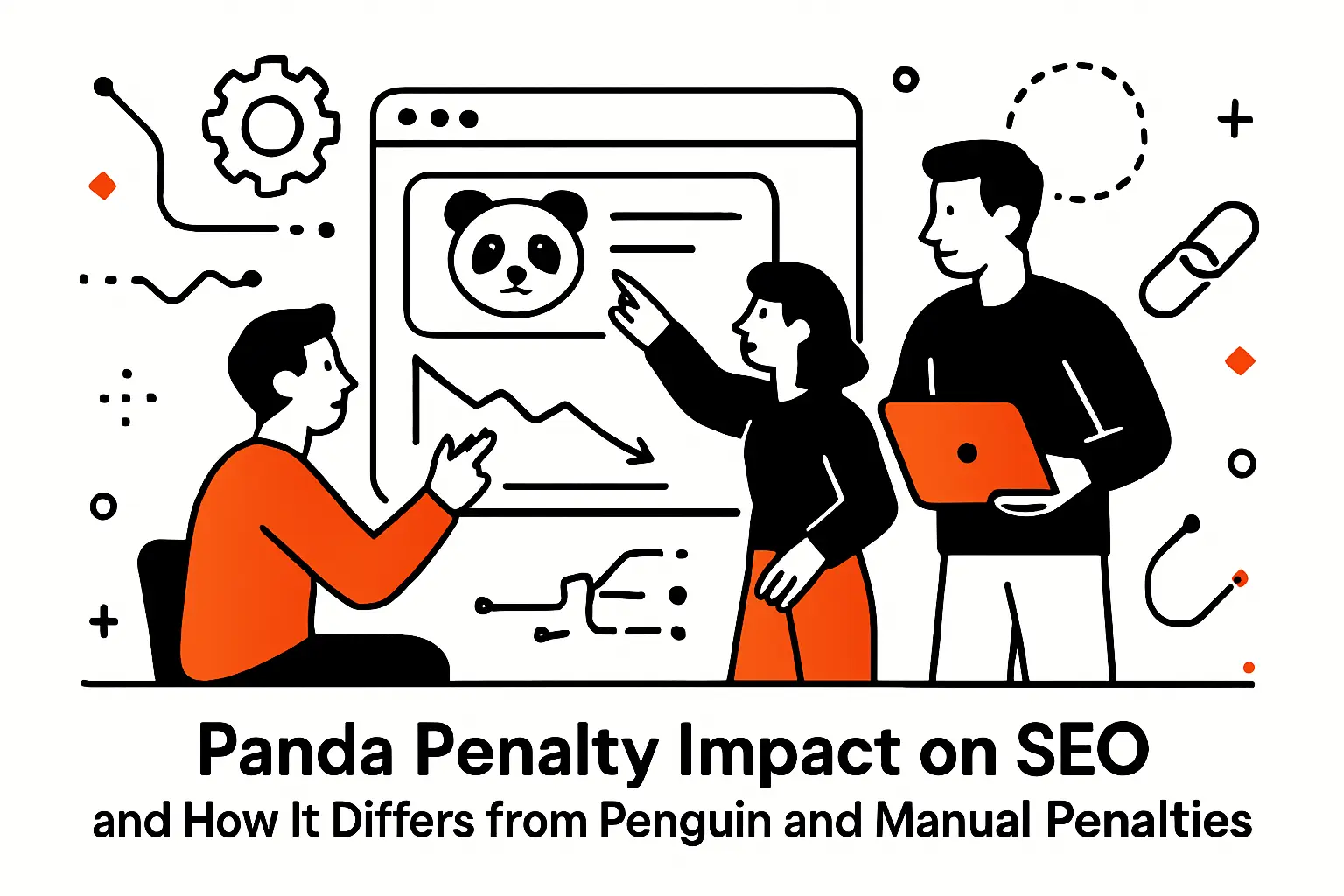
Panda penalty impact on SEO and how it differs from Penguin and manual penalties
1. What a panda penalty can do to organic visibility, traffic, and conversions
A Panda-style demotion usually hits where it hurts: discovery. Rankings slip across large keyword sets, impressions fall, and the pages that remain visible are often the ones least tied to revenue. That’s the cruel irony—teams assume “traffic down” will be evenly distributed, yet quality demotions can preferentially remove the pages that previously captured mid-funnel intent.
In client retrospectives, conversion damage often outlasts the ranking drop. Lower rankings change who arrives: more brand-biased users, fewer comparison shoppers, fewer “problem-aware” searchers. Because the mix shifts, onsite conversion rates can degrade even after some visibility returns.
From a business lens, Panda also increases customer acquisition cost indirectly. When organic loses efficiency, teams compensate with paid media, partnerships, or marketplaces, which can create margin pressure that lasts long after the SEO charts stabilize.
2. Penguin vs Panda: content quality signals compared with link-spam signals
Panda and Penguin get lumped together because both can be algorithmic, but they “feel” different because they measure different sins. Panda is a content-and-experience judge: originality, usefulness, editorial care, and whether pages seem designed to satisfy users. Penguin, historically, has been more of a link integrity enforcer: manipulative link patterns, unnatural anchor distributions, and the kind of offsite gamesmanship that tries to manufacture authority rather than earn it.
In implementation terms, Panda remediation tends to be labor-intensive and cross-functional. Content teams, product owners, designers, and engineers all have to agree on what “good” looks like. Link-spam remediation, by contrast, is often narrower—still complex, but usually concentrated in backlink auditing, outreach, and a rethinking of promotion strategy.
Our takeaway is simple: Panda asks whether you deserve to rank; Penguin asks whether your reputation was acquired honestly.
3. Algorithmic filters vs manual actions: what recovery looks like in each case
Algorithmic demotions are opaque by design. A team can improve the site dramatically and still feel uncertain because there is no “case number” or formal letter from Google. Manual actions are the opposite: they come with explicit messaging and a more procedural remediation loop.
From our side of the table, algorithmic recovery looks like building evidence rather than filing paperwork. We want to see quality lift across the content set: fewer thin URLs, stronger topical coverage, improved engagement, clearer authorship and editorial review, and better internal discovery. In a manual-action scenario, the work is still real, but the path is more linear: identify the violation, correct it, document the fix, request review.
Either way, the mindset that wins is the same: treat Google’s guidelines as constraints, but treat user satisfaction as the actual product requirement.
How Google Panda evaluates content quality and trust

1. Usefulness and uniqueness: whether the page adds real value beyond what already exists
At TechTide Solutions, we think about “usefulness” as an information delta. If a page merely repeats what is already on the SERP, it has to compete on brand strength alone—and most sites aren’t the brand users are searching for. A Panda-vulnerable page often answers a question, but not completely; it names a concept, but doesn’t operationalize it; it lists steps, but doesn’t show tradeoffs.
Uniqueness is not just plagiarism avoidance. In our audits, the more common issue is “procedural duplication”: the same article structure repeated with different keywords, producing a library that looks wide but reads shallow. Search engines can interpret that pattern as an attempt to capture many queries without doing the hard work of genuine coverage.
Practically, we aim to make each page “decision-complete”: a reader should be able to act, choose, or learn something specific without needing to open five other tabs to fill the gaps.
2. User experience quality: readability, ad placement, and whether content is buried by distractions
UX is where many Panda stories become uncomfortable, because the culprit is often revenue design. When ads, interstitials, autoplay media, and aggressive affiliate blocks push the main content below the fold, users don’t just get annoyed—they lose trust. That behavioral response can become a quality signal in aggregate, especially when paired with thin copy.
Readability is also a technical feature, not merely a writing virtue. Layout stability, font scaling, contrast, heading structure, table usability on mobile, and the predictability of navigation all influence whether users can consume content without friction. In large CMS deployments, tiny UX regressions multiply quickly because templates replicate the problem across thousands of URLs.
Our rule of thumb is blunt: if the user has to hunt for the answer, the page is already negotiating against itself.
3. Authority and trust signals: expertise, accuracy, and credibility expectations aligned with E-E-A-T
Panda-era quality thinking foreshadowed what many SEOs now shorthand as E-E-A-T: experience, expertise, authoritativeness, and trust. In our delivery work, that translates into visible accountability—clear authorship, update policies, references when appropriate, and correction mechanisms when information changes.
Accuracy is especially important in “high consequence” spaces: health, finance, legal, and safety-related content. Even outside those areas, factual sloppiness and vague claims create a “thinness” that no amount of keyword targeting can repair. Readers sense when content is written by someone who has done the work versus someone who summarized someone else who did the work.
From a systems perspective, trust is also infrastructural. Broken templates, outdated pages, and inconsistent metadata send the same message as sloppy writing: nobody is steering the ship.
Panda penalty triggers: the content and UX issues Google targets

1. Thin pages and low-value content that offers little information or overly general answers
Thinness is rarely about word count alone. Some short pages are excellent, and some long pages are empty calories. The real trigger is “insufficient utility”: pages that exist primarily to match a keyword pattern, without delivering the depth implied by the query intent.
Across SaaS sites, we often see thinness emerge from programmatic landing pages—dozens of near-identical “use case” URLs that never got real examples, screenshots, integration steps, or limitations. In e-commerce, thinness shows up as faceted category pages that pretend to be helpful but are functionally just filters with a paragraph of fluff.
When thin pages dominate crawl and index space, the site begins to look like it’s optimized for presence rather than service.
2. Duplicate or plagiarized content across a site or across domains
Duplicate content is a spectrum. On the obvious end, there’s scraping and plagiarism. On the more common end, there’s template duplication: the same boilerplate repeated across many locations, while the meaningful content varies only slightly.
From our engineering perspective, duplication is often an architecture problem disguised as a content problem. Session parameters, tracking variants, printer-friendly versions, paginated archives, and faceted navigation can generate a shadow web of near-identical URLs. Even when canonical tags exist, internal linking and sitemap choices can accidentally encourage crawlers to spend attention on the duplicates.
Because Panda-style systems care about overall quality patterns, a site can “feel” duplicative even if each page is technically distinct.
3. High ad-to-content ratio and ads above the fold that disrupt the main content
Ad-heavy layouts are tempting because they monetize attention directly. The catch is that search visibility is itself an attention supply chain, and Panda-like quality assessments can break that supply chain when monetization overwhelms the user’s goal.
In publishing ecosystems, we’ve seen the same failure mode repeat: revenue teams optimize for short-term yield, design gets crowded, engagement drops, and then search traffic declines, shrinking the very inventory the ads relied on. What looks like a “Google problem” is often an incentive problem inside the business.
UX remediation here is not anti-ads; it’s pro-clarity. If the primary content is immediately visible and easy to consume, monetization can coexist with quality.
4. Keyword stuffing, poor readability, and weak editorial quality control
Keyword stuffing is less common than it used to be, but its modern cousins are everywhere: repetitive phrasing, awkward headings written for bots, and intros that delay the answer to “warm up” the keyword. Readers feel that manipulation instantly, and they respond with impatience.
Weak editorial control is where this becomes systemic. Without governance, a large site drifts into inconsistency—tone changes, definitions conflict, internal links point to outdated pages, and the same concept is explained differently across articles. That inconsistency is both a user experience problem and a trust problem, especially when the content is supposed to guide decisions.
In our experience, the fix is less about banning SEO and more about insisting that SEO is subordinate to editorial standards.
5. Untrustworthy or irrelevant pages, low-quality external links, and poorly vetted user-generated content
Trust can be damaged by association. Pages that link out to dubious sources, affiliate networks with questionable quality, or irrelevant “resource lists” can make a site look like it participates in a low-quality web neighborhood. Even when outbound linking is not malicious, careless curation signals careless intent.
UGC adds another dimension: scale amplifies variance. A forum or comments section can be a goldmine of authentic experience, yet it can also become a landfill of thin posts, spammy profiles, and AI-generated noise. Moderation policies, anti-spam controls, and clear indexing rules are what separate “community” from “index bloat.”
When we design UGC systems, we treat vetting as a product feature—because it is.
How to diagnose a panda penalty on your site
1. Recognizing the typical pattern: steady traffic decline followed by stabilization
Panda-style drops often present as a slow bleed rather than a single cliff. Visibility declines across many pages, then levels off at a new baseline. That pattern makes teams second-guess themselves: “Is this seasonality?” “Is it competition?” “Did we change something?”
In our diagnosis playbook, we look for correlated signals across systems. Search analytics shows falling impressions and average positions. Crawl logs show Googlebot spending time on low-value sections. Index coverage shifts suggest more URLs being excluded or de-prioritized. Meanwhile, user behavior trends—shorter sessions, lower scroll depth, more pogo-sticking—hint that the content is failing the job it was hired to do.
When those signals align, “Panda” becomes less a label and more a likely explanation.
2. Site-wide signals: drops across many keywords rather than isolated pages
A single page dropping is usually not a Panda story; it’s typically competition, intent shift, or on-page relevance. Panda stories feel broader: multiple directories decline, long-tail queries evaporate, and even high-performing pages slip slightly because they’re attached to a weaker site-level narrative.
From an information architecture angle, internal linking can magnify the site-wide effect. If low-quality pages are heavily interlinked, they receive disproportionate crawl and perceived importance. If navigation or related-article modules promote thin pages, the site teaches Google (and users) that thinness is central rather than peripheral.
Our recommendation is to assess quality by sections, not just by URLs, because sections are often how risk clusters in real CMS ecosystems.
3. Google Search Console clues: decreases in indexed pages and Crawled currently not indexed pages
Search Console can reveal the “index selection” story behind the traffic chart. A rise in URLs that are crawled but not indexed often implies Google is evaluating pages and deciding they are not worth storing or serving. That is not a punishment in the moral sense; it is an economic choice by a crawler with finite resources.
How we interpret coverage signals
- First, we segment coverage by template type to see whether the issue is localized to a specific page generator.
- Next, we map excluded URLs back to internal linking pathways to understand why Google is encountering them so frequently.
- Then, we review canonicalization, parameter handling, and sitemap hygiene to ensure we’re not actively advertising low-value URLs.
Once the coverage patterns are visible, remediation becomes much more concrete: reduce index noise, elevate primary content, and make quality easier for Google to recognize.
4. Using engagement metrics to isolate low-performing pages that drag down overall quality
Engagement metrics are imperfect, yet they’re useful as a triage tool. Low time on page, short scroll depth, rapid back-to-SERP behavior, and poor internal click-through often cluster around the same types of pages: thin explainers, doorway-like location pages, duplicated tag archives, and outdated posts that no longer match intent.
In our workflow, we avoid blaming users for leaving. Instead, we treat exits as feedback: the page didn’t deliver what the search snippet promised, or it delivered it in a way that felt untrustworthy. Pairing engagement metrics with qualitative review—reading the page as if we were the target user—often reveals the real issue in minutes.
From there, we decide whether to improve, consolidate, or remove, because “fix everything” is not a strategy; it’s a wish.
Panda penalty recovery checklist: fix content, UX, and technical issues

1. Audit and triage content: remove, rewrite, or consolidate low-quality pages
Recovery begins with admitting that not all pages deserve to exist. That can feel radical to stakeholders who equate “more pages” with “more opportunities,” yet Panda-style systems flip that logic: low-value scale becomes a liability.
At TechTide Solutions, we run a triage process that resembles product backlog grooming. Some pages are “rewrite candidates” because the topic matters but execution is weak. Other pages are “merge candidates” because multiple thin URLs should become a single strong resource. A final group is “remove candidates” because the content never served a user need in the first place.
Crucially, we define success as improving the average quality of the indexable set, not preserving legacy vanity metrics like total published URLs.
2. Resolve duplication at scale: rewrite, 301 redirect, or block necessary duplicates appropriately
Duplication rarely yields to manual cleanup when a site is large. Engineering support is usually required: normalize URL patterns, enforce canonical rules at the platform level, and stop generating low-signal pages by default.
In consolidation projects, we often create a “primary page” policy for each topic cluster. Supporting pages either become distinct enough to justify their existence, or they collapse into the primary. When duplicates are necessary for user flows—print views, filtered views, internal search results—the goal is to keep them usable without letting them compete in the index.
Handled well, de-duplication does more than recover rankings; it reduces crawl waste, makes analytics cleaner, and improves the editorial team’s ability to maintain accuracy over time.
3. Improve on-page experience: reduce intrusive ads, streamline design, and fix broken links
UX work is often the fastest “quality win” because it changes the user’s felt experience immediately. Simplifying layouts, making the main content dominant, improving readability, and eliminating broken links all signal care. That care shows up in user behavior, and user behavior often shows up in performance.
What we prioritize in UX remediation
- Visually, we ensure the primary content is obvious and not visually competing with monetization modules.
- Structurally, we improve scannability with clear headings, concise intros, and predictable navigation.
- Operationally, we tighten template QA so fixes don’t regress during the next release cycle.
When teams treat UX as “cosmetic,” Panda recovery becomes slower. When teams treat UX as part of content quality, recovery becomes a system improvement rather than a patch.
4. Review outbound links and backlink profile: remove risky associations and clean up toxic links when needed
Panda is not primarily a link algorithm, yet link ecosystems still matter because they contribute to perceived trust. Outbound links tell Google what you endorse. Backlinks tell Google who endorses you. Both can become messy over time, especially on older content that accumulated questionable “resource” links or participated in low-quality syndication networks.
Our approach is pragmatic. For outbound links, we verify that citations still exist, still make sense, and still align with the page’s intent. For backlinks, we focus on patterns that look manipulative or irrelevant, and we document changes so the business understands what is being removed and why.
Most importantly, we pair link hygiene with content upgrades, because cleaning associations without improving substance often yields disappointing results.
5. Recovery expectations: why improvements can take time to be reflected after algorithm refreshes
Panda recovery rarely feels instantaneous, even when the improvements are real. Crawlers need to revisit URLs, indexing systems need to accept changes, and quality assessments need enough evidence to revise earlier conclusions. That timeline is frustrating for stakeholders, but it’s also predictable if you treat recovery as a pipeline rather than a moment.
In our post-recovery monitoring, we look for leading indicators: crawl distribution improving, low-value URLs being visited less often, stronger pages earning more internal links, and Search Console showing healthier indexing decisions. Rankings often follow after those foundations shift.
If a business needs quick wins, we aim them at high-intent pages and core templates first—because rebuilding trust at the margins is slower than reinforcing it at the center.
How to avoid a panda penalty in the future with ongoing quality control
1. Build for readers first: satisfy search intent instead of writing to manipulate rankings
Prevention starts with humility about intent. A query is not a keyword; it is a person trying to accomplish something. Content that exists to “capture traffic” usually reads like it, and Panda-like systems are increasingly good at detecting that mismatch.
In our own content engineering, we push for intent-first briefs: what problem is being solved, what decision is being supported, what objections the reader has, and what evidence would earn trust. SEO comes in afterward as packaging: structure, metadata, internal linking, and discoverability.
When teams reverse that order—SEO first, user second—the content tends to become formulaic, and formulaic libraries tend to become Panda risk.
2. Maintain editorial standards: originality checks, expert review, and consistent updates to aging content
Editorial standards are the anti-Panda engine. They keep the site coherent: consistent definitions, consistent tone, consistent claims, and consistent accuracy. In large organizations, the primary failure mode is not malice; it is entropy. Multiple authors publish similar pages, style drifts, and old content quietly becomes wrong.
We recommend building a living editorial system: review checkpoints, ownership assignment, and update workflows. Expert review matters most when content makes claims that affect decisions. Originality checks matter because accidental duplication is common in large teams, especially when multiple writers work from the same competitor set.
Ultimately, a site that updates itself responsibly signals a kind of maturity that both users and algorithms reward.
3. Protect performance and usability: monitor site speed, reduce bloat, and keep ad ratio in check
Performance is quality, because slow pages feel broken even when they are technically correct. Bloated scripts, heavy third-party tags, and over-engineered front-end frameworks can sabotage otherwise excellent content. If the page jitters, stalls, and fights the user, the words on the page don’t get a fair chance.
From our engineering side, we advocate for continuous performance budgets, template profiling, and periodic tag audits. Ad ratio discipline is part of that governance, because monetization sprawl is often the biggest contributor to both performance regressions and UX degradation.
Prevention, in short, is an operational habit: measure, fix, and keep the system from drifting back into clutter.
TechTide Solutions: custom software that supports quality-first SEO at scale

1. Custom web app development to manage content lifecycles, approvals, and governance tailored to customer needs
At TechTide Solutions, we’ve learned that quality is not a pep talk; it’s a workflow. The organizations that avoid Panda problems tend to have governance baked into their tooling: drafts don’t publish without review, outdated pages surface automatically, and content owners can see what’s decaying before it becomes an SEO incident.
In custom web app builds, we implement lifecycle states, editorial checklists, and accountability layers that match the business’s risk profile. A medical publisher needs different gates than a hobby blog. An enterprise knowledge base needs different controls than an e-commerce merchandising hub.
When governance becomes part of the platform, quality stops being optional—and Panda-style vulnerability drops sharply.
2. Automation and integrations for audits, duplicate detection, and structured content QA workflows
Scale demands automation, especially when a site has more URLs than any human can review. We build integrations that continuously inventory content, detect near-duplicates, flag thin templates, and surface sections where indexing decisions are deteriorating.
From a practical standpoint, that often means connecting analytics, Search Console exports, crawl data, and CMS metadata into a single QA pipeline. The output is not just a report; it’s a prioritized queue: which pages to merge, which to rewrite, which to remove, and which templates are generating most of the risk.
Automation also reduces organizational drama. Instead of arguing from anecdotes, teams can argue from a shared dashboard of evidence.
3. Performance-focused engineering to improve UX signals, site speed, and maintainability across large sites
Engineering quality is inseparable from content quality. A site with great writing but brittle templates, broken internal links, and slow rendering is still delivering a poor experience. Our performance work typically targets the fundamentals: reduce front-end bloat, improve caching strategy, streamline critical rendering paths, and harden templates so small mistakes don’t multiply across the site.
Maintainability is the quiet hero here. When releases are safe and reversible, teams can improve UX continuously without fear. When deployments are risky, even obvious fixes get delayed, and the site decays in public.
In Panda recovery and prevention projects, the best outcome is not merely “rankings returned,” but a platform that can sustain quality without heroics.
Conclusion: long-term SEO resilience after a panda penalty
1. Prioritize unique, trustworthy content and user experience as the foundation of sustainable rankings
Panda penalties are painful, yet they’re also clarifying. They reveal whether a business has been building a library worth keeping, or just expanding an index footprint. The recovery path that lasts is the path that improves the product: fewer low-value pages, stronger topical resources, clearer UX, and governance that prevents quality debt from compounding.
From where we sit at TechTide Solutions, the most resilient SEO programs treat content as an asset class with maintenance costs, not a campaign artifact. Trust is earned through accuracy, transparency, and consistency. Experience is earned through pages that load quickly, read cleanly, and answer real questions without making the user fight for the point.
If your site took a Panda-style hit, the next step is not to chase the algorithm—it’s to decide what “quality at scale” means for your business, then engineer your content and platform to deliver it; what would change if you treated every indexable page like a product you’re proud to ship?