


Market overview: Newzoo expects the global games market to hit $189 billion in 2025, which keeps multiplayer infrastructure firmly in the “core product” budget, not the “nice-to-have” bucket. At Techtide Solutions, we treat that reality as both a technical constraint and a business promise. Players forgive imperfect content. They rarely forgive unstable sessions.
From our side of the keyboard, “game server architecture” is not a single diagram. It is a set of trade-offs. Those trade-offs touch fairness, latency, hosting cost, and operational sleep. We build systems that survive real networks, real cheaters, and real launch days. This outline is how we explain the basics to teams who must ship.
Game server architecture basics: understanding the client-server loop
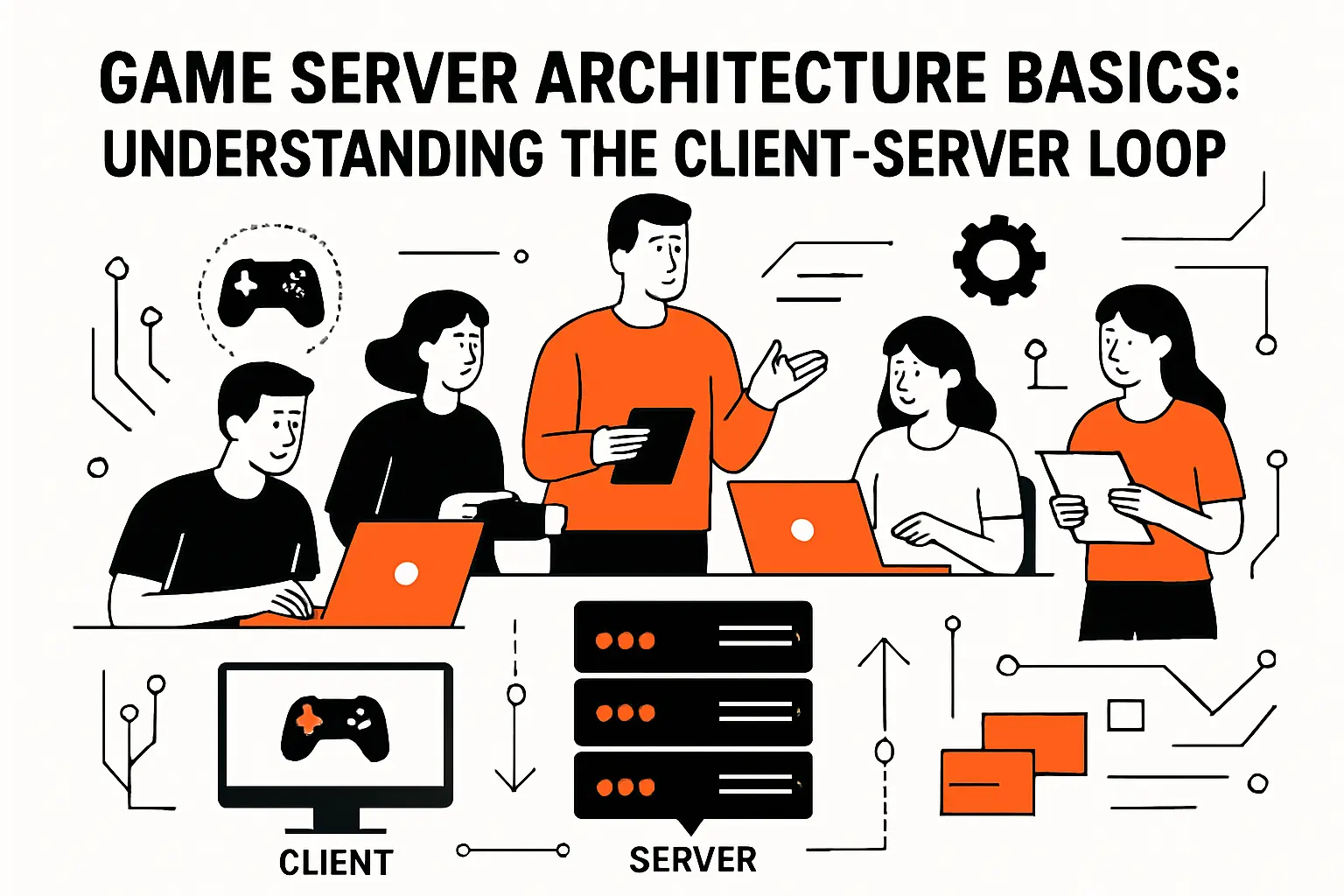
Market overview: Gartner forecasted worldwide public cloud end-user spending would total $675.4 billion in 2024, and that tide pulls game servers into the same cloud-native expectations as fintech and retail. In practice, that means disciplined loops, clean interfaces, and measurable performance. The “loop” is the first place we look when a prototype becomes a product.
1. Server owns the game state and updates it periodically
Server authority starts with a simple rule: the server is the source of truth. It moves the game forward in fixed steps. At each step, it accepts only checked player input. Then it creates a new world state.
Under the hood, we treat the server as a state machine that behaves the same way every time. That state includes positions, timers, inventories, and objectives. The machine handles commands in order. Each command is marked with a time and linked to a player. As a result, that record becomes extremely useful when teams need to resolve disputes.
Why regular updates matter
Regular updates make CPU use and network use easier to predict. They also give teams a clear way to compare and sync state. Without that discipline, random delay starts to affect game logic. Then bugs get blamed on “network issues,” and nobody benefits.
In our implementations, we also keep simulation separate from presentation. The server does not handle animation. Instead, it only runs the game logic and decides outcomes. Because of that separation, teams can build bots, replay systems, and moderation tools later.
2. Clients send player actions to the server and render returned game state
Clients should send intent, not outcomes. A client says “move forward” or “use ability.” The server decides whether that intent is legal. The client then renders what the server confirms.
In a shooter, that means the client may predict movement. It might even predict firing feedback. Yet the server still decides hits and damage. The client’s job is responsiveness. The server’s job is fairness.
A practical loop we use in reviews
- Client collects input and packages a compact command.
- Server validates command, applies it, and records the result.
- Client receives state and reconciles prediction against authority.
Business teams often ask why this feels “complicated.” Our answer stays blunt. Complexity here prevents chaos later. It also reduces support costs after launch.
3. Dedicated server vs hosted server running on a player machine
Dedicated servers buy trust. They also buy operational responsibility. Player-hosted servers save cash early. They pay back that savings with edge cases.
When the host is a player, that player owns the schedule. They can pause, alt-tab, or disconnect. They can also observe information they should not see. Even without malice, their home network becomes everyone’s bottleneck.
How we choose, in plain terms
For competitive games, we lean dedicated. For co-op and casual, hosted can work. The hinge is the damage of unfairness. If cheating ruins retention, hosting is a false economy. If social play matters more, hosting can be acceptable.
Recommended reading: AAA Game: What It Means, What Defines It, and Why the Label Matters
Network topology options for multiplayer games
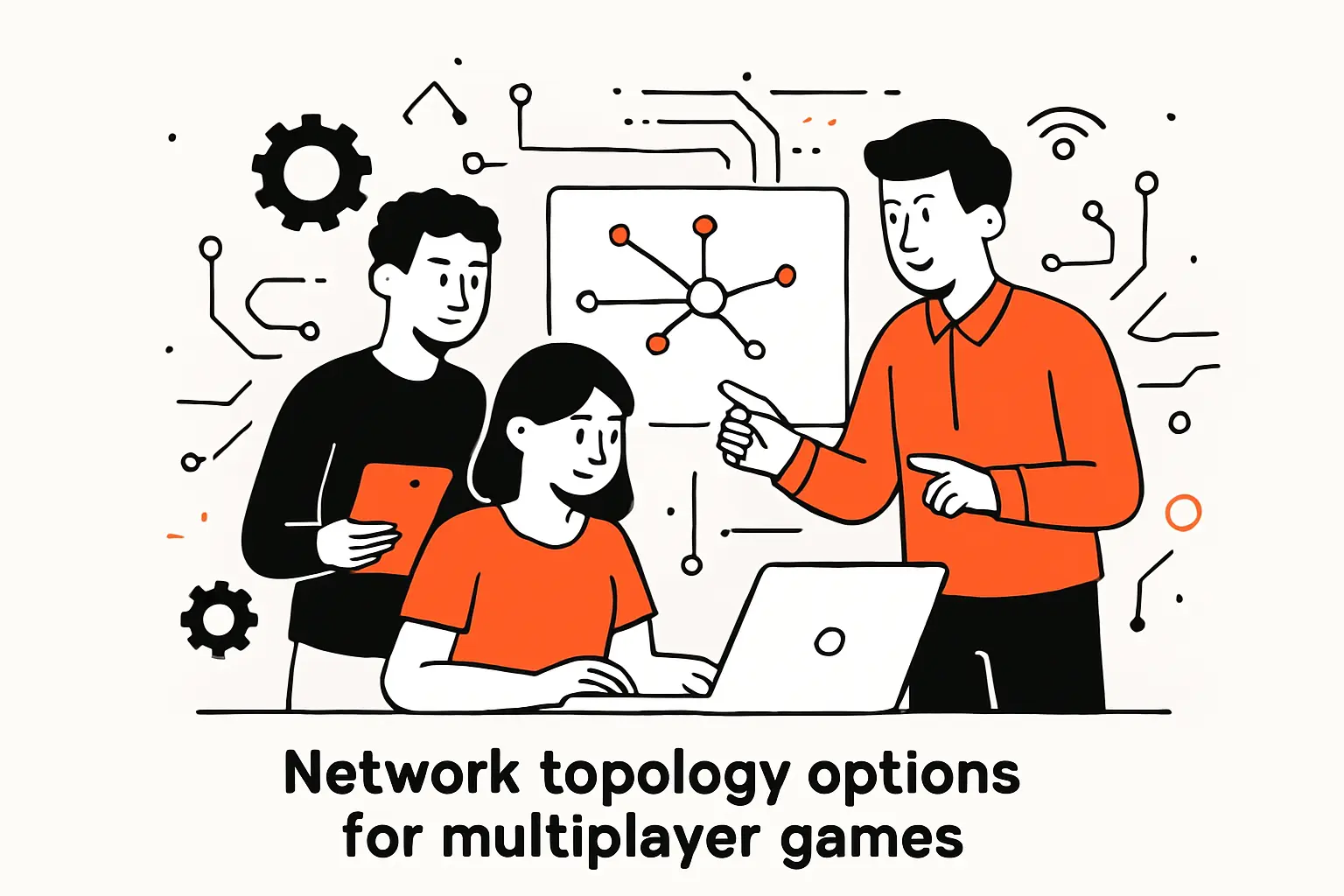
Market overview: Gartner predicts 90% of organizations will adopt a hybrid cloud approach through 2027, and multiplayer architecture increasingly mirrors that hybrid reality. Players sit behind home routers. Servers sit across regions. Relays sit between carriers. Topology is your first latency decision.
1. Client-server topology with all traffic flowing through the game server
Client-server is the default because it centralizes authority. Every client talks to the server. Clients do not talk to each other for gameplay-critical messages. That makes validation straightforward.
From an operational lens, it also makes observability easier. Logs are in one place. Metrics have one choke point. Abuse detection can correlate across players. That correlation is hard in distributed topologies.
Where it can hurt
Pure client-server can become bandwidth-heavy. It can also increase round-trip time for nearby players. Still, for competitive play, we accept those costs. Fairness beats elegance. Players notice inconsistency more than they notice topology.
2. Peer-to-peer topology with direct peer connections
Peer-to-peer pushes traffic to the edges. Each peer talks to other peers. That can reduce server spend. It can also reduce latency for nearby players.
Yet peer-to-peer creates two chronic problems. First, addressability is fragile behind NAT. Second, trust evaporates when every peer is also a server. Even “soft cheating” becomes hard to detect. Players can delay messages, drop updates, or rewrite outcomes.
When we still consider it
We consider peer-to-peer for small co-op sessions and consider it for games where outcomes are not adversarial. We also consider it for prototypes where speed matters. Even then, we design a migration path. Shipping is not the end. It is the beginning.
3. Relay topology where a central relay forwards messages between clients
Relays exist because direct connections often fail. A relay is not fully authoritative. It is a traffic middleman. Clients connect outbound to the relay. The relay forwards packets between them.
In practice, a relay can stabilize matchmaking success rates. It can also reduce DDoS exposure for player hosts. That matters when streamers attract attention. Relays also simplify NAT traversal. They make connectivity boring, which is the point.
Our caution
A relay does not solve cheating. It solves reachability. Teams sometimes confuse those. We keep the relay simple. We avoid putting game logic in it. Otherwise, it becomes a hard-to-debug half-server.
Recommended reading: How Do Game Servers Work? Understanding Multiplayer Game Servers End-to-End
Authority models and anti-cheat fundamentals
Market overview: Gartner projects worldwide end-user spending on information security will total $240 billion in 2026, and multiplayer games inherit the same adversarial mindset as any online service. Cheating is not a “community issue.” It is an architectural input. Authority models are how we express trust boundaries.
1. Do not trust the player: keep critical logic and validation server-authoritative
We do not trust the player device. Not because players are bad. Because devices are owned by the attacker. That includes memory, timing, and network behavior.
Server-authoritative validation means the server checks invariants. It checks movement limits and checks ability cooldowns and checks inventory transitions. Then checks that actions obey the rules of the world.
Invariant thinking, not rule sprawl
Teams often write huge rule sets. We prefer invariants. Invariants are stable even when content changes. For example, “health never increases without a healing source.” That holds across patches. That approach keeps anti-cheat durable.
When a player violates invariants, we log context. We keep raw inputs. We keep the derived outcome. That dataset later feeds heuristics and moderation workflows.
2. Client-authoritative components and when server oversight is still required
Some client authority is practical. Animation timing is client-owned. UI state is client-owned. Cosmetic particles are client-owned. Nobody wants the server deciding menu transitions.
Even gameplay-adjacent features can be client-owned when they are low risk. Audio cues can be local. Camera shake can be local. Accessibility filters should be local. Those do not change outcomes.
Oversight still matters
Oversight means the server constrains what the client can claim. For example, a client can claim it “started sprinting.” The server can accept or reject that. Clients can also predict. Still, prediction should be reversible. That is our litmus test.
3. Mixed authority by subsystem: movement, hits, health, and objective state
Real games rarely pick one authority style. They blend. Movement can be predicted locally and verified remotely. Hits can be client-reported and server-confirmed. Health is usually server-owned. Objective state should be server-owned.
When subsystems disagree, the server resolves conflict. That resolution must be explainable. Players feel “desync” as injustice. A good architecture lets you explain what happened. It also lets you reproduce it.
A pattern we reuse
- Let the client predict only what is reversible.
- Let the server validate only what affects outcomes.
- Let telemetry tell you where trust is failing.
From our experience, mixed authority is not a compromise. It is a control system. It is how you keep games responsive and fair.
Recommended reading: How to Make a AAA Game: A Roadmap from Concept to Launch and Live Operations
Discovery, matchmaking, and auxiliary services around the game server
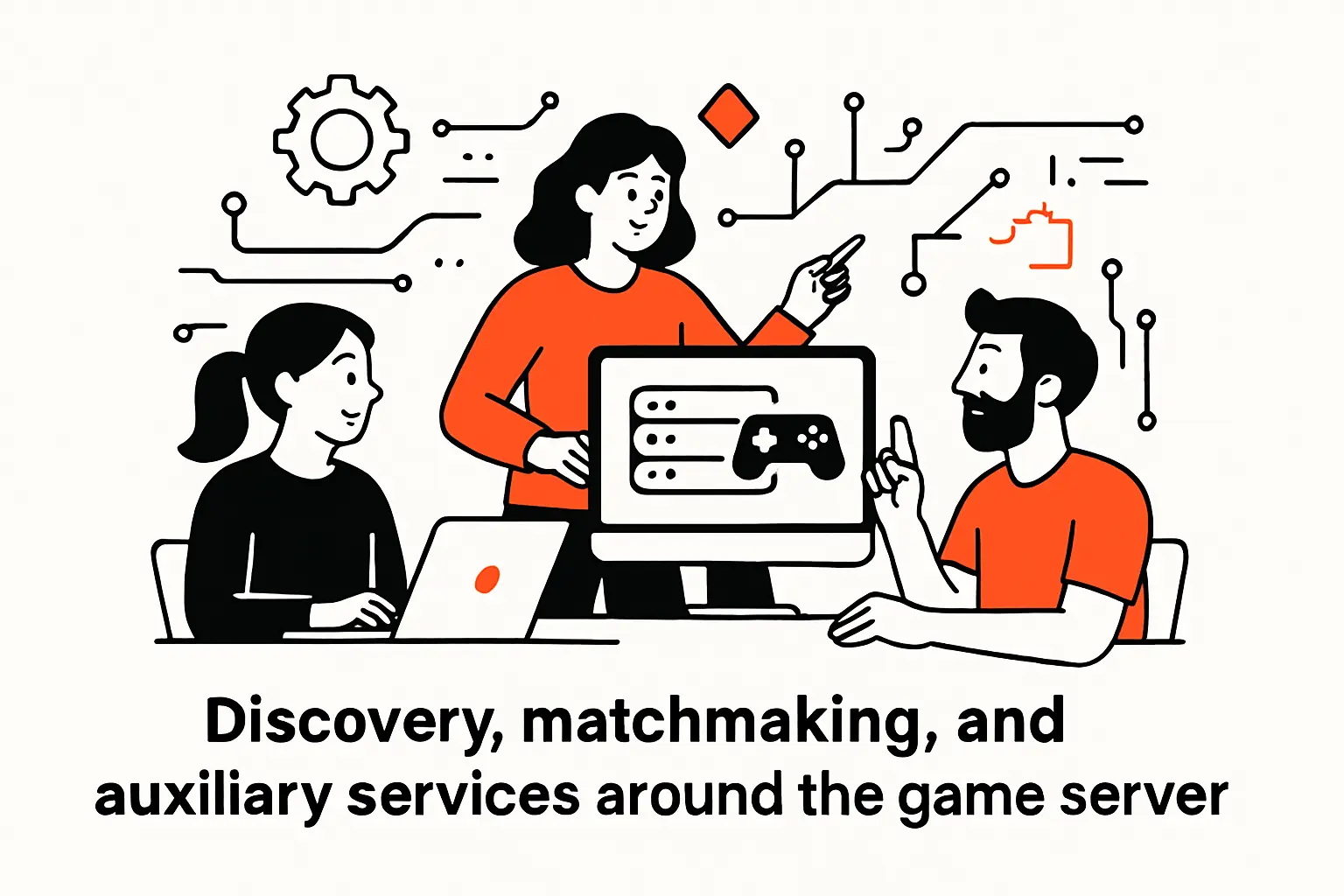
Market overview: Analyst forecasts across games and cloud keep pointing toward ongoing live operations, and we see that trend in procurement and platform requirements. Multiplayer is rarely “just a socket server.” It is a small ecosystem of services. Discovery and matchmaking are where many studios first feel the weight of production reality.
1. LAN discovery via broadcast and why direct IP joining is a usability barrier
LAN discovery feels old-school, yet it still matters. Parties happen. Dorm networks happen. Offline events still exist. Broadcast discovery makes “find my friend’s server” frictionless.
Direct IP joining is powerful, but it is hostile to humans. It requires copy-paste, port knowledge, and patience. It also becomes a support burden. Players mistype. Firewalls block. Then your team answers tickets.
Our practical take
We implement LAN discovery as a convenience layer and keep it separate from internet discovery. We also design for failure. When discovery fails, we show clear, actionable UI. Confusion is the real bug.
2. Catalogue servers for session lists and automated server discovery
A catalogue server is a phonebook for sessions. Game servers register their metadata. Clients query and filter. That keeps game servers focused on simulation, not marketing copy.
In dedicated fleets, catalogues also drive orchestration. They can hide IPs and can route players to regions. They can enforce version compatibility. Then can keep lobbies stable during rolling updates.
Design details that save launches
- Use heartbeats so dead servers disappear quickly.
- Keep metadata bounded to avoid abuse and bloat.
- Validate filters server-side to prevent scraping tricks.
When catalogue design is sloppy, matchmaking becomes random. Random matchmaking feels unfair. Unfair experiences convert into churn fast.
3. Account and login services with token verification between game and account servers
Accounts are not only identity. They are entitlement, bans, and social graphs. The game server should not own those concerns. It should consult a dedicated identity service.
We prefer short-lived tokens that the game server can verify. That reduces load on identity systems. It also reduces blast radius during outages. The game server should degrade gracefully. Players can still finish matches when auxiliary services wobble.
Security posture we recommend
We bind tokens to device context where possible and log suspicious refresh patterns. We also separate “who you are” from “what you can do.” That separation keeps authorization logic consistent. It also limits exploit chains.
Synchronization under real network conditions

Market overview: IDC estimates global edge computing spending could reach $380bn by 2028, and we see the same motivation in multiplayer design. Players want responsive sessions across geographies. Synchronization is where latency becomes visible. It is also where naive prototypes fall apart.
1. Why dumb clients work for turn-based and LAN but break for fast-paced internet play
Dumb clients wait for the server before moving anything. That can work for turn-based games. It can work on a LAN. It fails when inputs must feel immediate.
Fast-paced games require local responsiveness. Players expect instant motion feedback. Waiting on round trips feels like input lag. That sensation ruins control, even if outcomes are correct.
What we do instead
We add prediction, interpolation, and reconciliation. Prediction gives instant feedback. Interpolation smooths remote entities. Reconciliation corrects divergence without jarring snaps. The trick is humility. The client can guess. The server decides.
2. Tick rate, command buffering, and deterministic lockstep synchronization
Synchronization begins with time. Servers simulate on a tick. Clients sample inputs within that cadence. Command buffering compensates for jitter. It keeps the simulation fed, even when packets arrive unevenly.
Lockstep is a special case. Every client advances together. Each client waits until it has all commands for a step. That can produce perfect determinism. It can also amplify latency in wide-area play.
Where lockstep shines
Strategy games often benefit from lockstep. They value fairness and replay fidelity. They can tolerate delay. For action games, we usually avoid full lockstep. We still borrow its discipline, though. Determinism is a debugging superpower.
3. State synchronization with delta updates to reduce bandwidth
Sending full state constantly is expensive. Deltas send only what changed. That reduces bandwidth. It also reduces serialization load. Both matter at scale.
Delta design forces clear data modeling. Entities need stable identifiers. Components need predictable encoding. You also need a story for late joiners. They require a baseline snapshot before deltas make sense.
A compression mindset that works
- Prioritize gameplay-critical fields over cosmetic fields.
- Quantize values that do not need full precision.
- Drop updates for entities outside relevance scope.
We also keep an eye on “bandwidth spikes.” Spikes happen during explosions, spawns, and migrations. A robust delta system keeps spikes bounded.
4. Handling session stability: what host disconnection means for player-hosted games
Host disconnection is the defining weakness of player-hosted sessions. When the host leaves, the session often dies. That is not only technical. It is social. Parties fracture. Progress feels wasted.
Mitigations exist. Host migration can move authority to another peer. Save-state checkpoints can reduce loss. Relays can stabilize connectivity. Still, the experience rarely matches a dedicated server’s stability.
How we frame the business risk
When sessions die, players blame the game. They do not blame topology. That blame affects reviews and refunds. For that reason, we treat stability as a retention feature. Dedicated infrastructure is often cheaper than churn.
Protocols, messaging, and server-side scalability patterns

Market overview: Gartner predicts Fifty percent of organizations will adopt sustainability-enabled monitoring by 2026, and game backend teams feel the same pressure to measure and optimize everything. Protocol choices and scalability patterns are not academic. They decide your cloud bill and your incident rate. They also decide whether engineers can sleep.
1. TCP vs UDP selection based on game pace, reliability needs, and latency sensitivity
TCP provides ordered delivery with built-in reliability. That convenience can be attractive. Yet it can also add latency during loss. Head-of-line blocking is the classic pain point.
UDP gives you raw datagrams. You build reliability where needed. You can also drop non-critical updates on purpose. That is often better for real-time movement. It is also better for voice and transient effects.
Our pragmatic protocol split
We often run gameplay state over UDP with selective reliability. We run chat, commerce, or admin commands over TCP-like reliable channels. The goal is not purity. The goal is predictable player experience under loss. Protocol selection is a product decision.
2. Reliable ordered remote actions and request-answer messaging patterns
Not every message is equal. Some actions must be reliable and ordered. Inventory changes are a common example. Match results are another. Those should not arrive out of order.
Request-answer patterns also appear everywhere. Clients request a join. Servers answer with acceptance or rejection. Clients request a loadout. Servers answer with a canonical loadout. That pattern simplifies debugging because it is explicit.
Idempotency is our safety belt
Retries happen. Timeouts happen. If a client repeats a request, the server should not double-apply it. We design remote actions to be idempotent when possible. That choice prevents rare bugs from becoming financial or progression disasters.
3. Partitioning the backend: authentication, rating, database communication, and game logic separation
Monoliths ship fast. They also fail as one unit. Partitioning creates fault boundaries. It also lets teams scale independently. That is valuable when your auth team is not your gameplay team.
We separate game servers from platform services. Authentication is its own service. Ratings and matchmaking are their own services. Persistence is its own service. Each boundary gets a contract. That contract becomes an integration test target.
Latency-aware separation
We keep real-time decisions close to the simulation. We keep slow decisions asynchronous. For example, rating updates can lag without harming a match. Loadout entitlement checks cannot. This separation keeps gameplay snappy while still remaining correct.
4. Persistence strategy: batching world changes and keeping static design data out of the database
Databases are not game loops. Writing on every action is a trap. It inflates cost and adds latency. It also increases the chance of lock contention during peak load.
We batch persistence where it is safe and we persist on checkpoints, match end, or critical milestones. We also separate static design data from player data. Design data belongs in versioned assets, not transactional tables.
Event streams, not fragile snapshots
For many systems, event streams outperform raw snapshots. Events are append-only. They are easier to audit. They also support replays and dispute tooling. When a player claims “I lost my reward,” events let you answer with evidence.
TechTide Solutions: custom game server architecture tailored to customer needs
Market overview: Gartner expects worldwide IT spending to reach $5.43 trillion in 2025, and that macro budget reality shapes how studios buy engineering time and operational confidence. At Techtide Solutions, we translate business targets into engineering constraints. We also insist on planning for the unglamorous parts. Those parts decide whether launch day is a celebration or an apology tour.
1. Requirements-driven architecture planning for genre, latency targets, and player scale
Every architecture starts with requirements, not diagrams. Genre drives authority choices. Competitive play drives validation strictness. Co-op play drives stability expectations. Social hubs drive concurrency patterns.
Latency targets are product decisions. They influence region strategy and they influence tick budgeting. They influence whether you can rely on lockstep. Then also influence customer support volume. Players file tickets when controls feel “off.”
What we ask in discovery workshops
- What does “fair” mean for this game’s players?
- What fails gracefully, and what must never fail?
- What is the rollback plan for a bad build?
Those questions sound managerial. They are deeply technical. They determine data models, message contracts, and operational runbooks.
2. Custom server development: gameplay services, networking layers, and integrations
We build server cores that match the game’s simulation style. Some projects need physics-heavy simulation. Others need card-resolution logic. Still others need authoritative economy and crafting. The core is never generic for long.
On the networking side, we implement message schemas, session management, and state replication. We also integrate platform services when needed. That includes identity providers, store entitlements, and analytics pipelines. Integrations are often where deadlines go to die, so we design them early.
A philosophy we defend
We keep gameplay logic testable without networking. We keep networking testable without gameplay. That separation shortens iteration cycles. It also reduces the risk of “fix one bug, spawn three bugs.” Engineering velocity is a feature.
3. Deployment support: scaling strategies, reliability planning, and operational readiness
Shipping code is not the finish line. It is when the pager starts. Operational readiness needs dashboards, alerts, and runbooks. It also needs load testing that resembles player behavior, not synthetic perfection.
We help teams plan scaling strategies. That includes regional rollout, queue-based admission control, and safe degradation modes. We also design for failure domains. A bad node should not take a whole region down. A bad region should not corrupt global state.
What “ready” looks like to us
- Clear service ownership and on-call rotation.
- Meaningful metrics tied to player experience.
- Rollback and hotfix paths that are rehearsed.
Reliability is not only uptime. It is also player trust. Trust compounds when incidents are rare and communication is clear.
Conclusion: applying Game server architecture basics to your first multiplayer build
Market overview: The same analyst forecasts that drive cloud, security, and edge investment also raise player expectations for always-on performance and consistent fairness. That expectation is now the baseline. A first multiplayer build should not chase perfection. It should chase a stable foundation that can evolve.
1. Select topology and authority based on cheating risk, cost, and gameplay requirements
Topology is not a religious choice. It is a risk choice. Client-server buys control and auditability. Peer-to-peer buys cost savings and simplicity. Relays buy connectivity resilience.
Authority should follow player incentives. If players benefit from cheating, assume they will try. If outcomes are cooperative, you can loosen rules. Even then, keep critical state guarded. Small exploits grow into big ones once content and economies expand.
A grounded starting point
For most teams, we recommend starting server-authoritative for outcomes. Add client prediction for feel. Use relays only if connectivity demands it. That path keeps complexity purposeful and debuggable.
2. Design for operations early: scalability, fault tolerance, monitoring, and content delivery
Operations is part of architecture. It includes logs, metrics, and traces and includes alert thresholds that match player pain. It includes release strategies that avoid mass breakage.
Content delivery also belongs here. Patch size and rollout speed shape player sentiment. Asset versioning shapes compatibility. If you cannot safely run mixed versions, you will fear every update. That fear slows content, which hurts retention.
Our operational mantra
Make the healthy path obvious and the degraded path acceptable. Make the broken path diagnosable. When those three hold, teams can iterate without dread.
3. Validate the plan with latency testing, load testing, and iterative optimization
Architecture is a hypothesis until tested. Latency testing reveals where prediction breaks. Load testing reveals where serialization costs explode. Chaos testing reveals where dependencies are fragile.
Iteration should be guided by evidence. We start with flame graphs and packet captures. Then we tune relevance, batching, and validation hotspots. Each optimization should improve a player-facing metric, not only a dashboard.
Your next step
If we were sitting with your team today, we would ask a simple question. What is the smallest multiplayer slice you can ship while still proving topology, authority, and operations under real conditions?

