


At Techtide Solutions, we do not rank the best tech blogs by brand halo alone. We rank them by a simpler test: after one reading session, do we know something useful, practical, and hard to fake? The blogs below passed that test for us because they teach judgment, not just jargon. When GitHub explains deployment safety or Cloudflare publishes vulnerability response details, we get operating context that generic recap posts cannot fake.
Quick Comparison of Best Tech Blogs
We think the best tech blogs earn trust with firsthand lessons, not content volume. McKinsey reports that 88 percent of organizations use AI in at least one business function, so engineers and founders need better filters, not more tabs.
We built this quick scan for readers who want to narrow the field fast. Think of it as a shortlist table, not a final ranking. The right choice depends on whether you need strategy, systems depth, community, or a low-noise mix of all three.
| Tool | Best for | From price | Trial/Free | Key limits |
|---|---|---|---|---|
| GitHub Blog | Broad developer reading | $0/mo | Free | Some product slant |
| Stratechery | Strategy and tech business | $15/mo | Free posts | Best work is paywalled |
| Cloudflare Blog | Security and internet ops | $0/mo | Free | Cloudflare-centric |
| Martin Fowler | Architecture judgment | $0/mo | Free | Slow cadence |
| Techtide Solutions | Scale case studies | $0/mo | Free | Dense, specialized |
| Stack Overflow Blog | Beginner-friendly industry context | $0/mo | Free | Less deep on systems |
| Stripe Engineering | API and billing design | $0/mo | Free | Narrow fintech lens |
| Tailscale Blog | Practical networking and security | $0/mo | Free | Product-led framing |
| DEV.to | Community discovery | $0/mo | Free | Quality varies |
| Julia Evans | Clear systems learning | $0/mo | Free | Narrower publishing scope |
Recommended reading: Top 20 Web Developer Portfolio Examples to Inspire Your Next Site
Top 20 Best Tech Blogs Worth Following

That filter matters more now. Gartner expects worldwide generative AI spending to reach $644 billion in 2025, which means the flood of AI-assisted summaries, recycled tutorials, and polished nothing-burgers is still growing.
Below, we review each pick the way we would for a teammate. We focus on fit, depth, pace, and honest deal-breakers. Some of these are classic archives. Others are active engineering feeds. A few are better read weekly than daily. That trade-off matters.
1. GitHub Blog
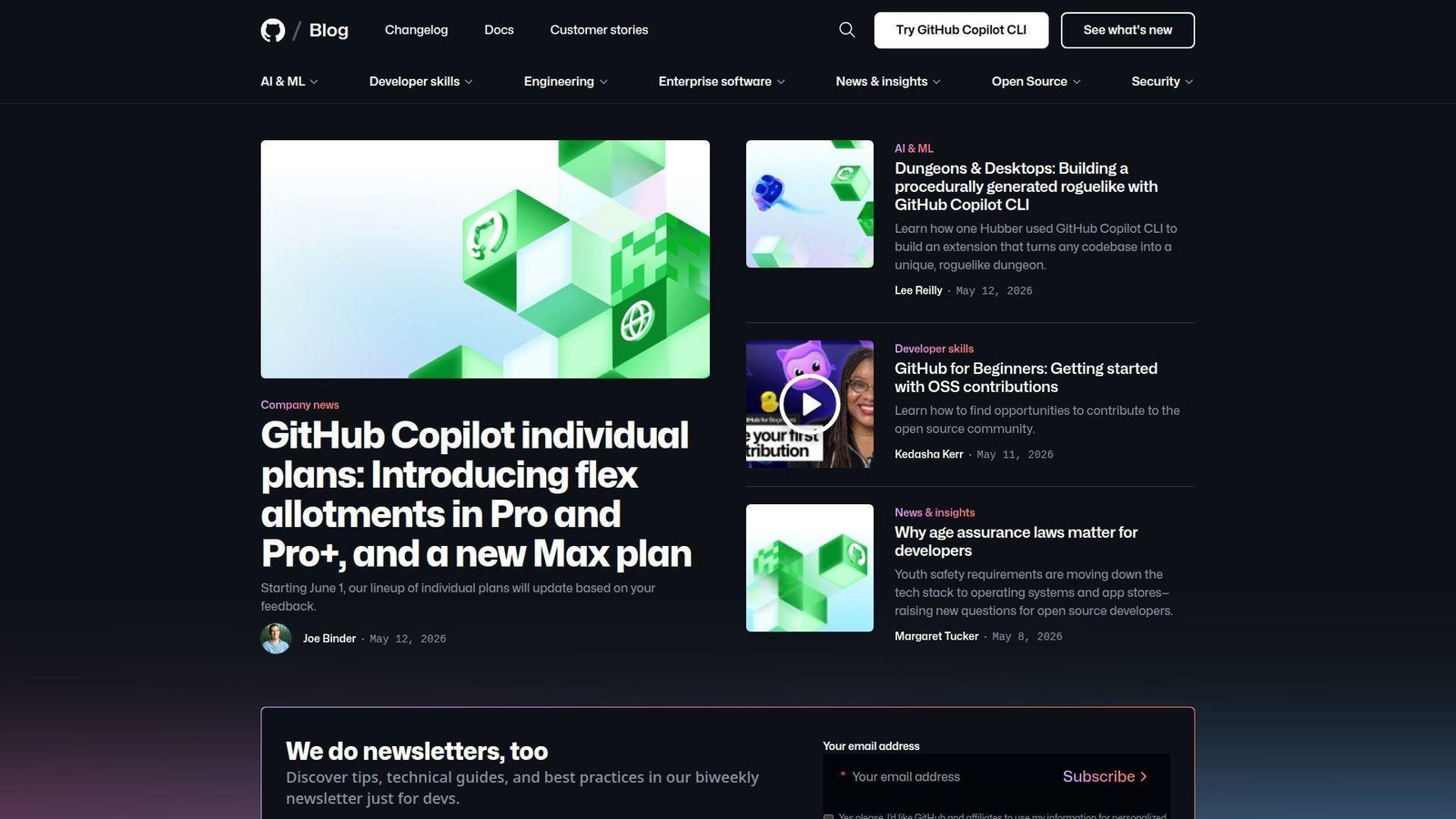
We see GitHub Blog as the broadest company-run entry on this list. GitHub spreads coverage across engineering, security, open source, research, product, and developer skills, so the team behind it is much wider than a typical engineering blog. That breadth is the reason we keep coming back.
Best for: working developers and engineering managers.
- Wide category coverage → you can pair platform engineering posts with open source and policy context instead of reading five separate sites.
- Newsletters and cross-links to docs → you skip a few searches when you want to go from an idea to the official implementation details.
- Readable explainer style → most posts deliver a useful takeaway within one coffee break.
Pricing & limits: From $0/mo. No trial because the archive and dev newsletter are open. There is no seat cap or read limit for readers.
Honest drawbacks: Some posts lean close to product marketing, especially around launches. If you only want raw systems depth, you will still need to cherry-pick.
Verdict: If you want one dependable feed that covers engineering, security, open source, and the wider developer ecosystem, GitHub Blog gives you strong signal with less hopping around. It beats many company blogs on breadth, but it trails Martin Fowler on timelessness.
2. Stratechery
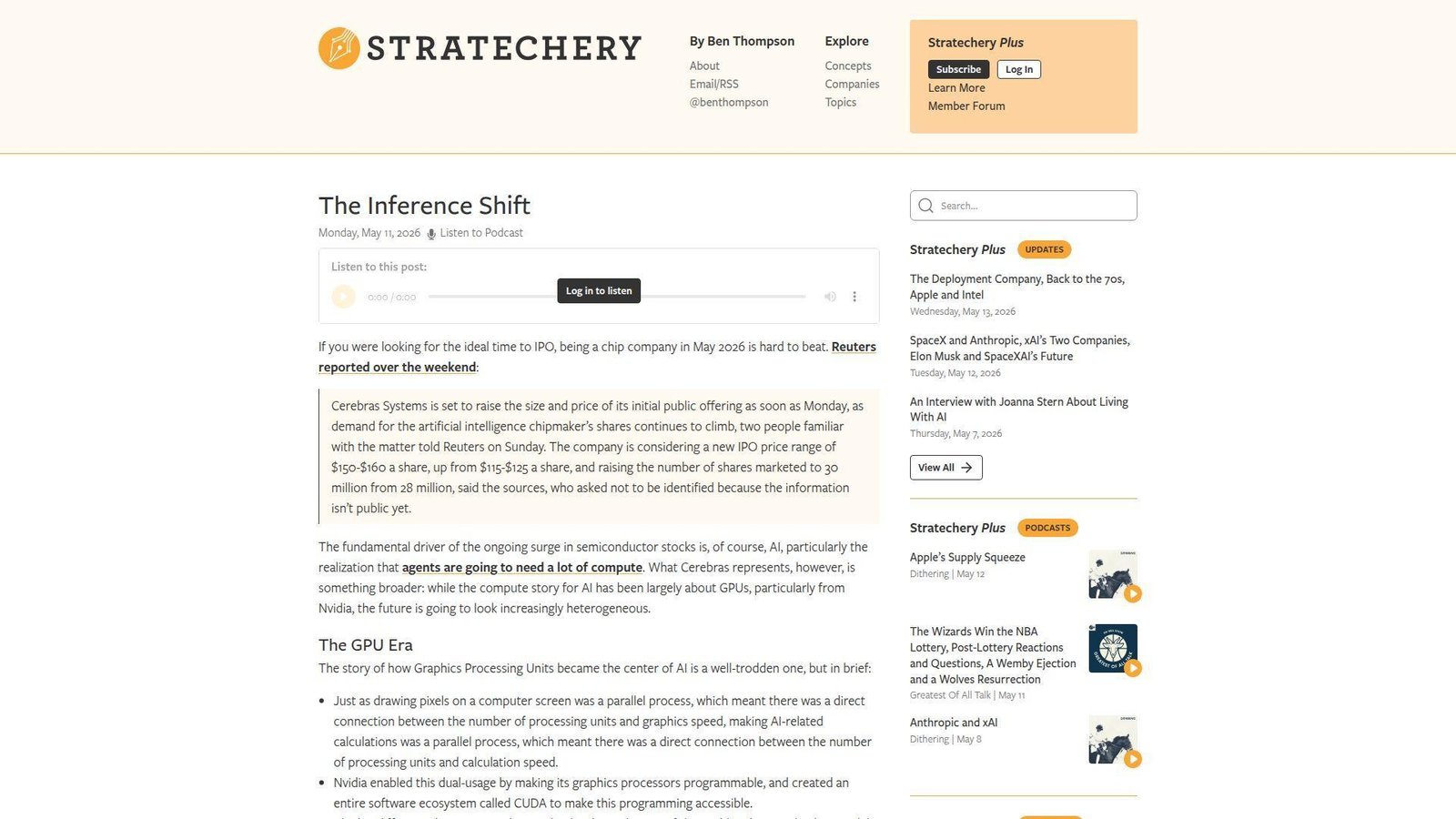
Stratechery is Ben Thompson’s independent strategy publication, and it still feels like one sharp operator thinking in public rather than a diluted media bundle. The core product is Thompson’s analysis, but the paid plan now wraps in interviews, podcasts, RSS, SMS delivery, and a member forum.
Best for: founders and product or strategy leaders.
- Thesis-led analysis → you get clearer takes on platform power, bundling, distribution, and AI market structure instead of headline summaries.
- Podcasts, RSS, SMS, and the forum → you can cover a week of thinking in one commute rather than juggling a stack of newsletters.
- Clean archive by topic and company → one focused read usually gives you a usable mental model fast.
Pricing & limits: From $15/mo or $150/year. There is no free trial on the Plus plan. Free accounts get weekly articles and limited RSS access. Paid access is for one subscriber, with team options available separately.
Honest drawbacks: Readers looking for code, diagrams, and implementation detail may bounce. Also, some of the best material sits behind the paywall, so casual readers may never see the full value.
Verdict: If you need better judgment on where tech markets are moving and why certain companies gain leverage, Stratechery helps you sharpen decision-making fast. It beats general tech news on explanation, but it trails company engineering blogs on implementation detail.
3. Cloudflare Blog
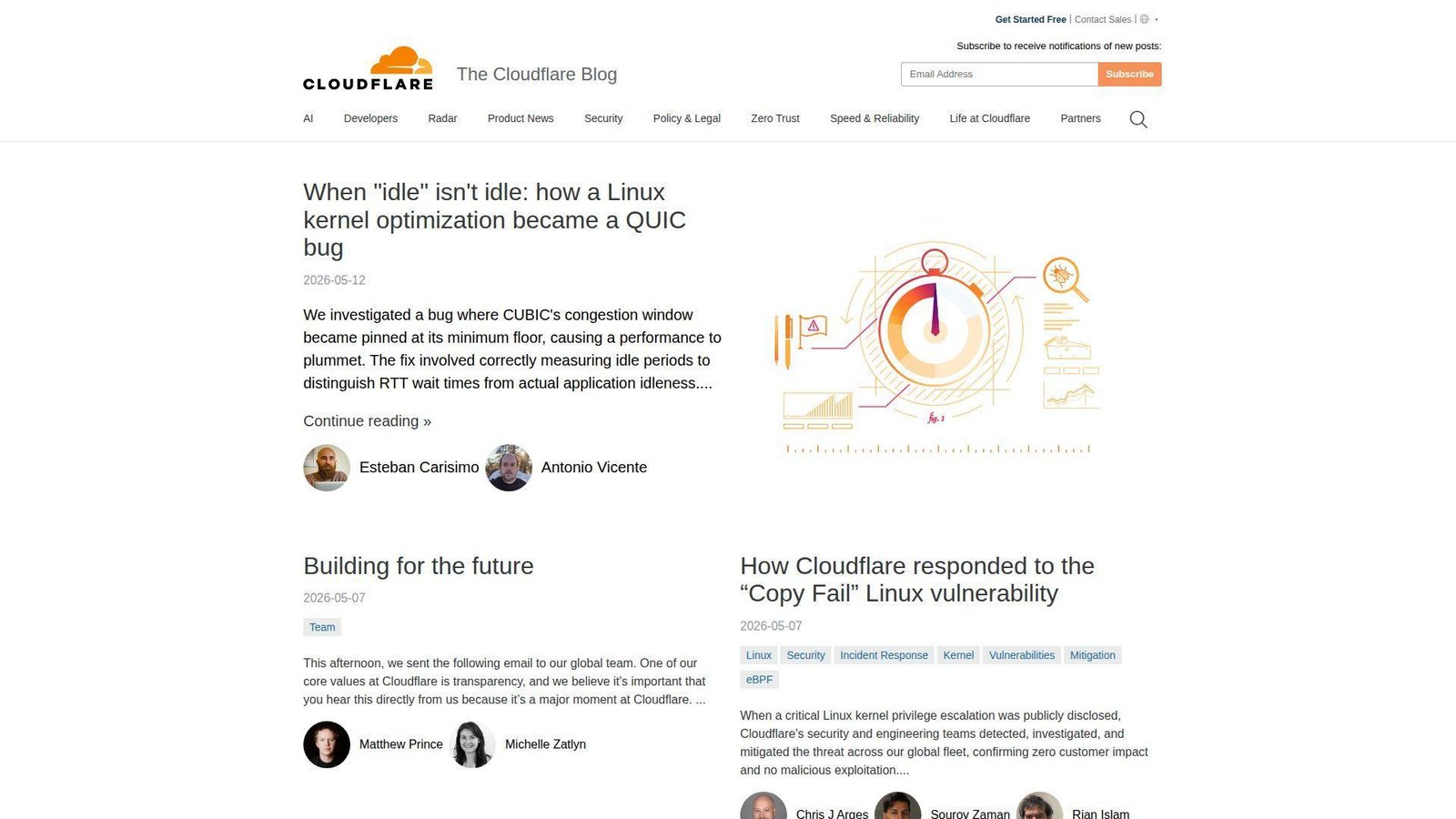
Cloudflare’s blog is written by people who run networks, ship security products, analyze internet traffic, and respond to incidents in public. That mix gives it a rare advantage. We get product detail and internet-scale observation in one feed.
Best for: SREs and security or platform teams.
- Radar and incident coverage → you can connect real internet events to engineering lessons instead of reading abstract best-practice posts.
- Direct paths into product and developer material → you skip extra hunting when a post makes you want to validate a setting or feature.
- Strong tagging and concise intros → most posts prove their value in one quick skim.
Pricing & limits: From $0/mo. No trial because reading and email subscription are free. There is no practical cap for readers.
Honest drawbacks: The site is still Cloudflare’s home turf, so some launch weeks feel product-heavy. A few posts assume more networking or security context than beginners will have.
Verdict: If you care about internet plumbing, security response, and what “reliability” looks like under pressure, Cloudflare Blog is one of the strongest current reads. It beats many company blogs on operational candor, but it trails GitHub on ecosystem breadth.
4. Martin Fowler
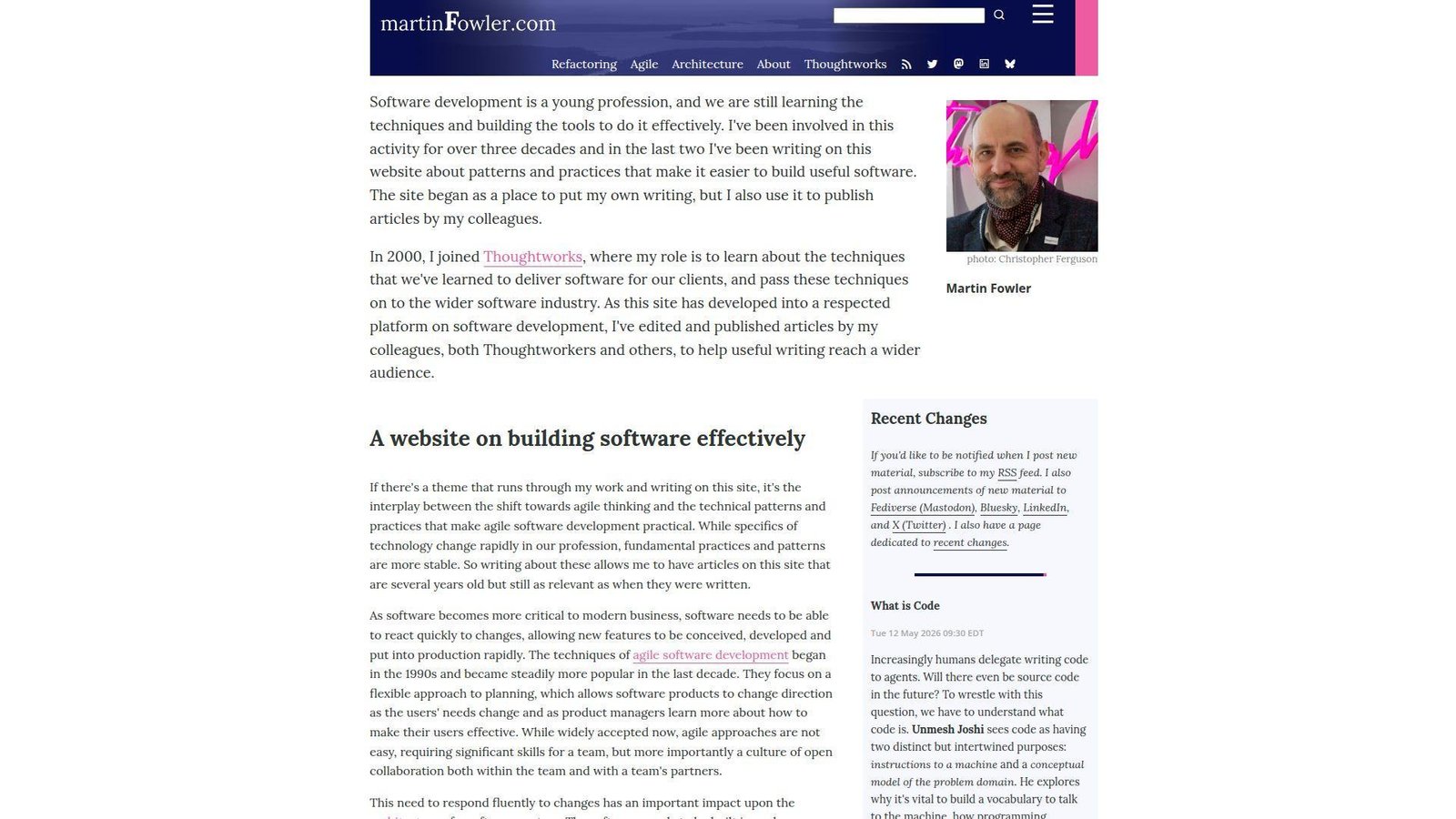
Martin Fowler’s site is less a traditional blog and more a curated library. Fowler writes and edits the site, vets outside contributors, and openly prefers thoughtful, low-volume essays over churn. We trust that editorial stance because it produces fewer, better reads.
Best for: software architects and tech leads.
- Vetted essays on architecture, refactoring, and delivery → you leave with better design judgment, not just a new buzzword.
- Content index and RSS → you can find a classic on a hard topic in one stop instead of bouncing through search results.
- Heavy editing and clean structure → even long pieces pay off in a single focused read.
Pricing & limits: From $0/mo. No trial because the full site and RSS feed are free. There are no read caps or seat limits.
Honest drawbacks: The cadence is slow, and the site is not where we go for fast-moving AI or product news. Some essays reward experience, so newer developers may need patience.
Verdict: If you want writing that still matters years later, Martin Fowler is one of the safest subscriptions you can make. It beats almost everyone on timelessness, but it trails Cloudflare on freshness.
5. TechTide Solutions Blog
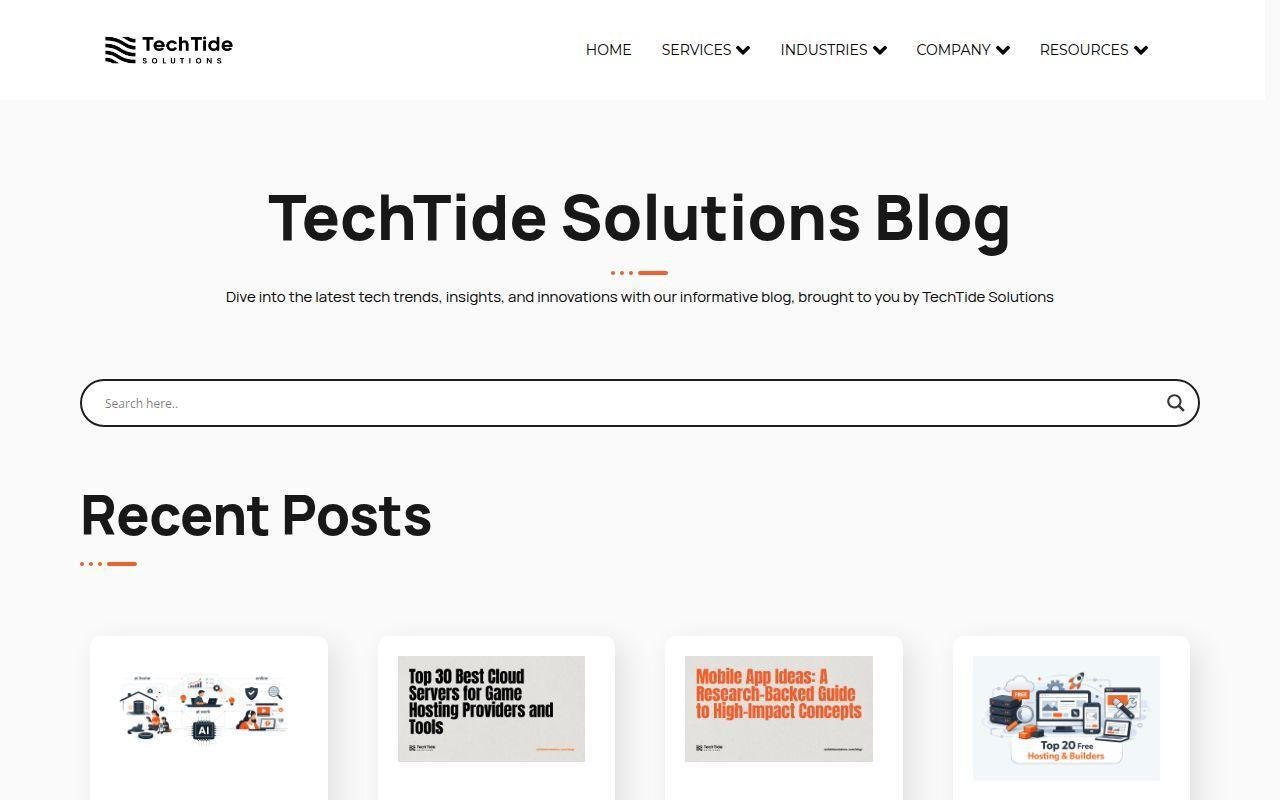
We see TechTide Solutions Blog as a practical, service-backed resource for teams that want technology explainers, software comparisons, market data, and product development context in one place. The blog does not read like a pure engineering diary. It sits closer to a business-facing tech hub, with coverage across software development, SaaS tools, cloud fundamentals, AI, cybersecurity, web development, and digital transformation. That mix is the reason we would use it for research before vendor shortlisting or early project planning.
Best for: founders, product managers, startup teams, and business readers comparing software options.
Broad business-tech coverage → you can move from software development guides to SaaS comparisons, AI explainers, cloud topics, and market insights without leaving the same resource base.
Service-backed perspective → many posts connect technical ideas to real project needs, which helps when you are not just learning a concept but deciding what to build or buy.
Accessible writing style → the articles are written for practical readers, so most sections explain the “why it matters” before getting too deep into implementation details.
Pricing & limits: From $0/mo for readers. No trial is needed because the blog archive is open. There is no public seat cap or read limit for using the content.
Honest drawbacks: Some articles can feel broad rather than deeply technical. If you want low-level systems engineering, original research, or code-heavy breakdowns, you will still need to pair it with sources like Martin Fowler, GitHub Engineering, or official framework documentation.
Verdict: If you want a business-friendly technology blog that connects software development, AI, cloud, SaaS, and digital transformation topics, TechTide Solutions Blog is a useful research stop. It is stronger for practical planning and vendor-context reading than for deep engineering theory, so it works best as a broad guide rather than a final technical authority.
6. Stack Overflow Blog
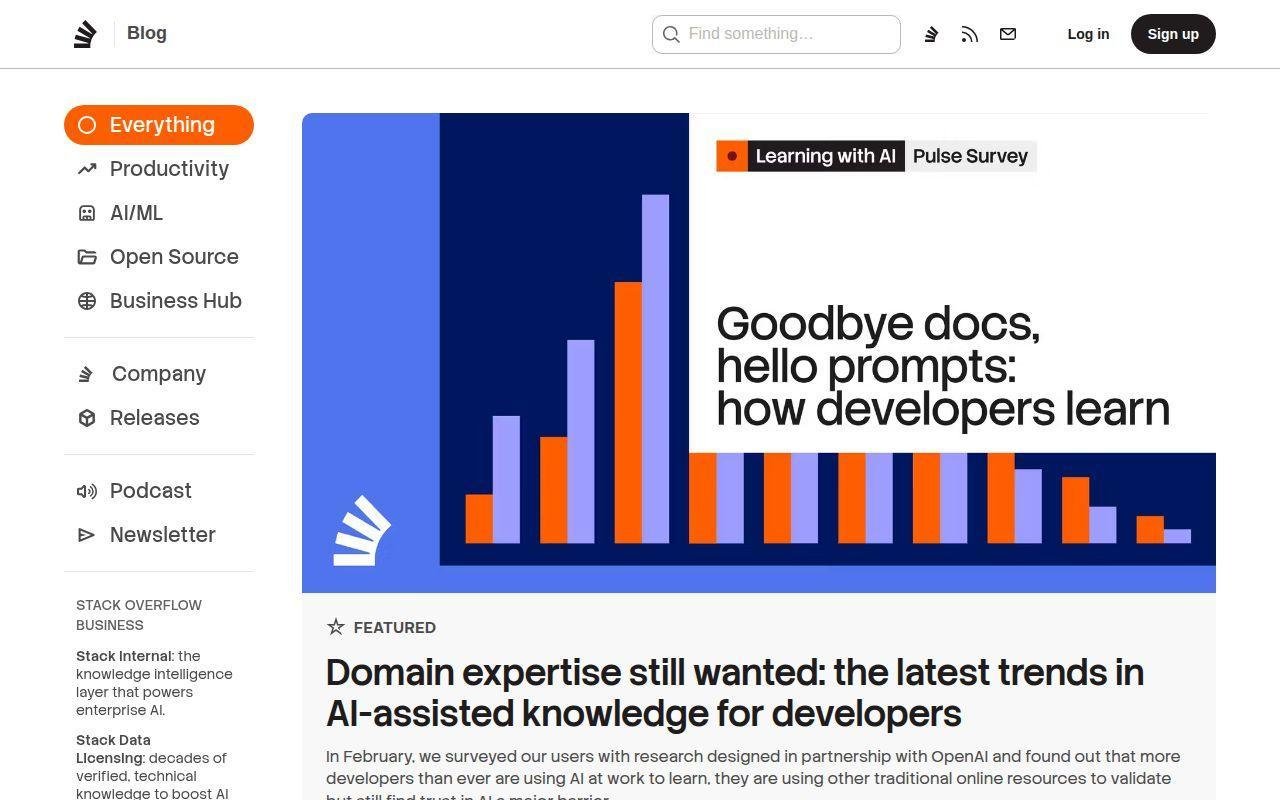
The Stack Overflow Blog sits between a trade publication and a developer community dispatch. Editorial writers, product teams, podcasters, and researchers all feed into it, which makes it broader than the average company blog and much easier for beginners to approach.
Best for: beginners and career switchers.
- Mix of explainers, releases, and network context → you can connect abstract ideas to the questions developers are actually asking.
- Newsletter, podcast, and RSS options → one feed replaces several weekly checks across different channels.
- Accessible tone → most posts make their point quickly without assuming years of context.
Pricing & limits: From $0/mo. No trial because the blog, newsletter, podcast, and release notes are free. There is no read cap.
Honest drawbacks: It is not the deepest archive for systems or architecture. Some posts lean toward company announcements or enterprise themes that experienced engineers may skip.
Verdict: If you want practical industry reading that is easier to digest than a pure engineering feed, Stack Overflow Blog is a strong pick. It beats Meta on accessibility, but it trails Martin Fowler on rigor.
7. Stripe Engineering
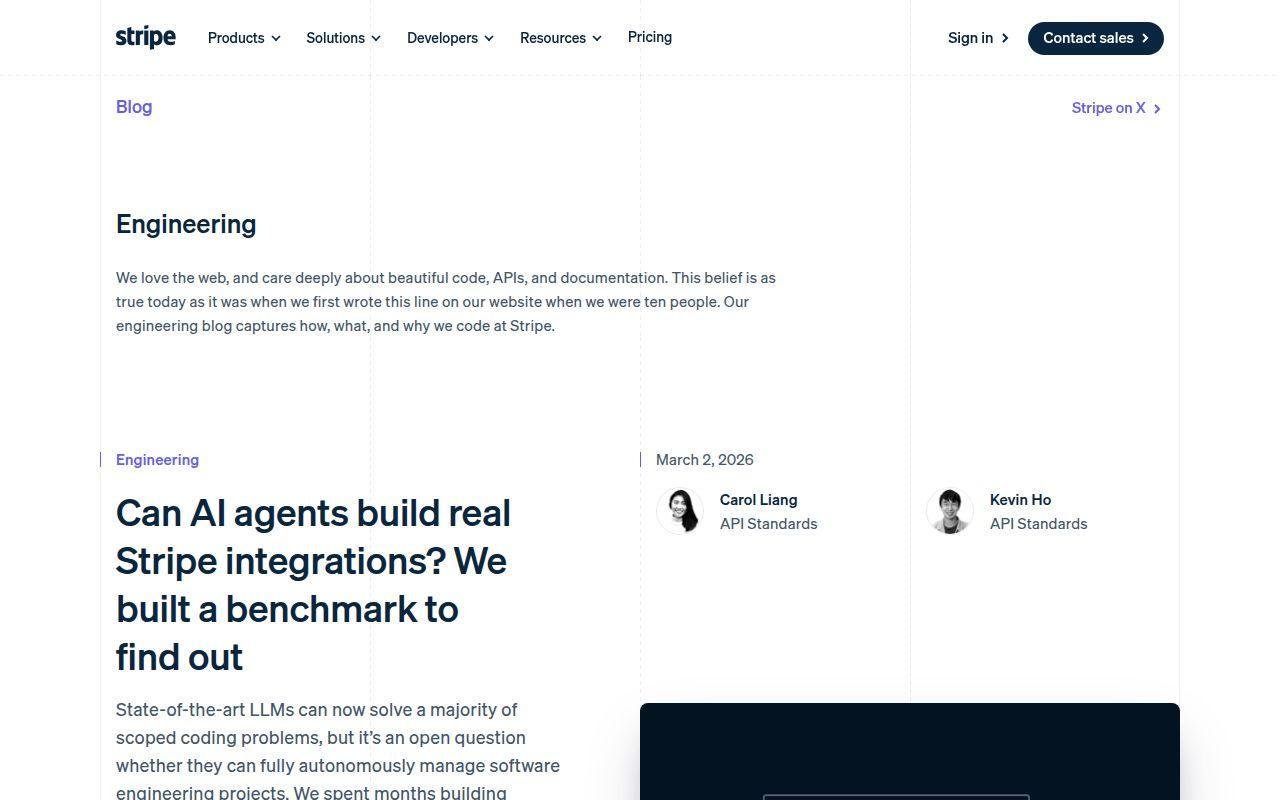
Stripe Engineering is one of the cleanest technical archives we know for API design, billing systems, and product-aware infrastructure. The team writes like engineers who care about documentation as much as the underlying code, and that shows up in the structure.
Best for: API engineers and SaaS product builders.
- “How we built it” posts → you can borrow design patterns without reverse-engineering the lessons yourself.
- Docs and API adjacency → a post often cuts straight into the official material, which saves extra validation work.
- Polished technical writing → you usually get a diagram, principle, or naming pattern worth reusing in one sitting.
Pricing & limits: From $0/mo. No trial because the archive and email subscription are free. There is no seat cap or read limit.
Honest drawbacks: The fintech and payments lens narrows relevance if you do not work near money flows or APIs. The cadence is selective, so it is better as a high-quality occasional read than a daily habit.
Verdict: If you build APIs, internal platforms, or billing-heavy products, Stripe Engineering will make you think more carefully about contracts and system design. It beats many company blogs on API thinking, but it trails Cloudflare on publishing tempo.
8. Tailscale Blog
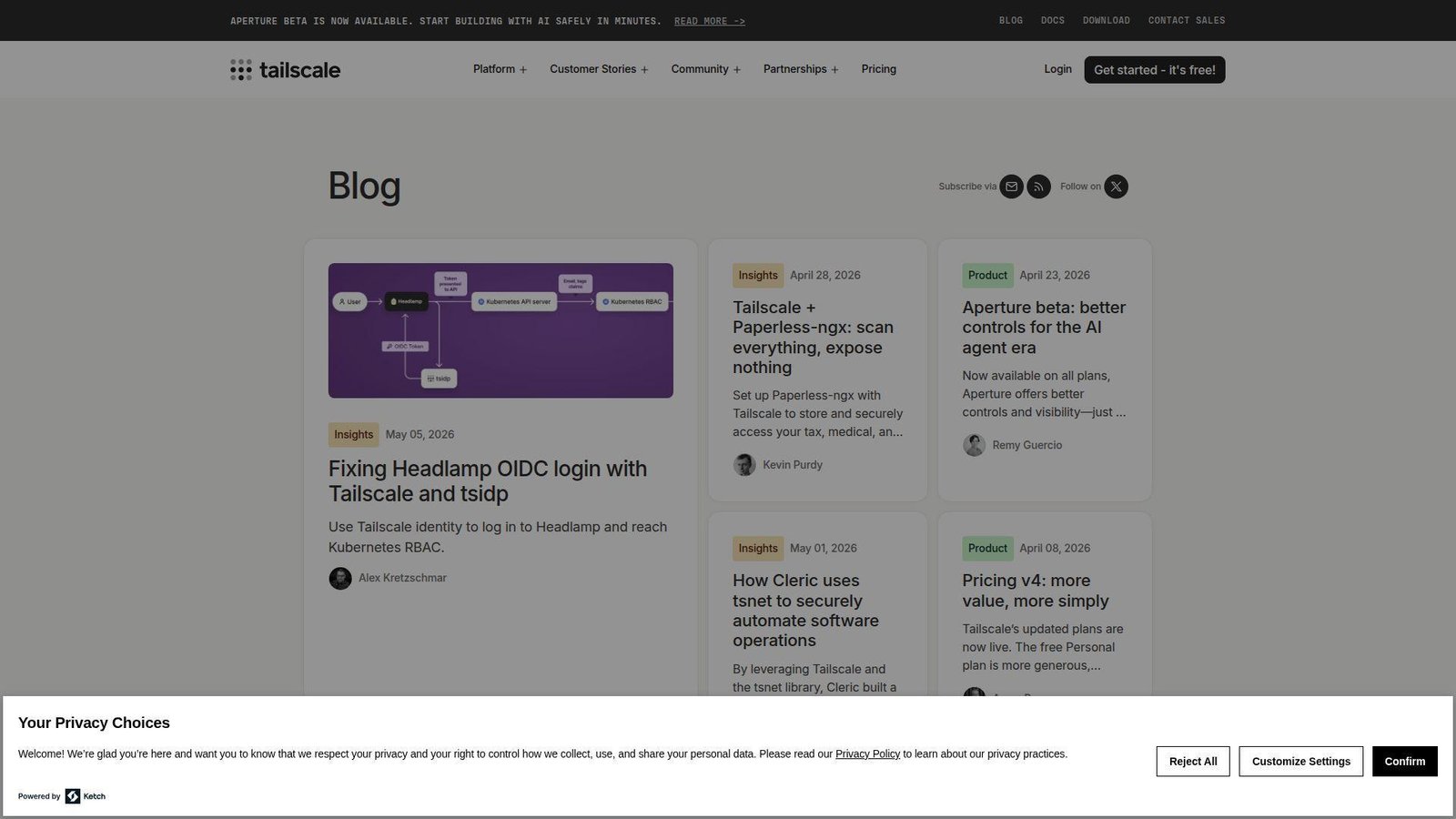
Tailscale’s blog blends product engineering, networking education, customer setups, and community projects. We like it because the team usually writes from the operator’s chair, not the marketer’s. That makes the reading more useful, especially for working admins and generalists.
Best for: infrastructure generalists and security or IT admins.
- Setup-heavy posts → you can turn abstract networking ideas into something testable in your own environment fast.
- Blog, docs, changelog, and community paths → you cut down trial-and-error because the next step is usually obvious.
- Straightforward examples → first value tends to show up within one short reading session.
Pricing & limits: From $0/mo. No trial because reading, email updates, and RSS access are free. There is no read cap for the blog.
Honest drawbacks: The product frame is never far away, so theory-first readers may want something more general. It also goes lighter on timeless architecture thinking than Martin Fowler or Dan Luu.
Verdict: If you want practical writing on networking, secure access, and real setup paths, Tailscale Blog is easy to recommend. It beats GitHub on hands-on private networking, but it trails Cloudflare on internet-wide data.
9. DEV.to
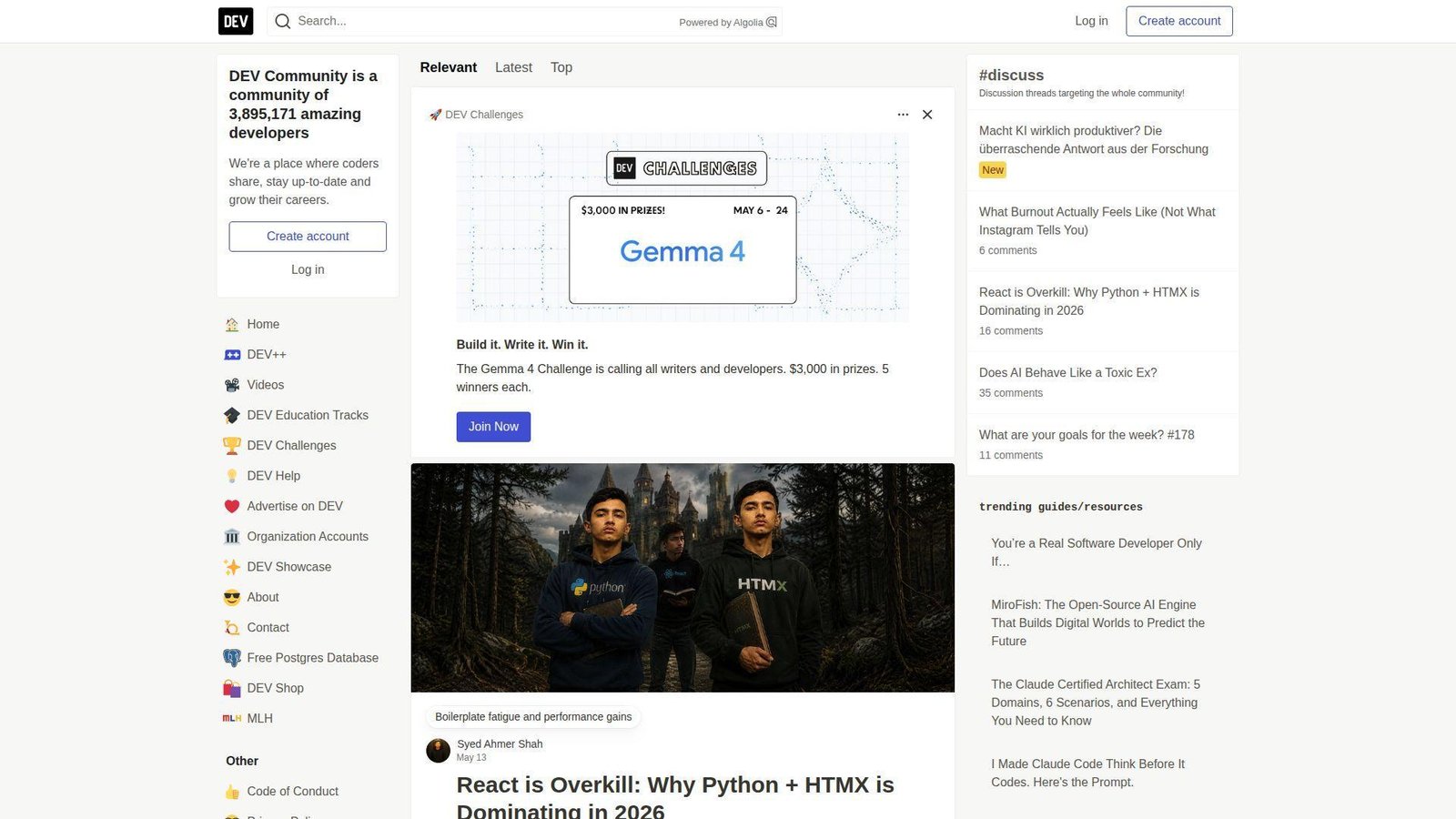
DEV.to is not a single editorial voice. It is a giant community publishing platform where developers share tutorials, career notes, experiments, and hot takes at every quality level. We keep it on this list because community breadth still matters if you curate hard.
Best for: beginners and self-taught developers.
- Tag-driven community publishing → you can find peers working through the same beginner problems you are facing right now.
- Follows, saved posts, and challenges → they turn random browsing into a repeatable reading habit with less drift.
- Low-friction reading and writing → useful posts show up fast, and you can start participating without much setup.
Pricing & limits: From $0/mo. No trial because reading is open and accounts are free. There is no reading cap for public content.
Honest drawbacks: Quality swings wildly. Some posts are thoughtful and experience-based. Others are thin, repetitive, or clearly written for search traffic. You must curate it, or it will waste your time.
Verdict: If you need community, momentum, and many voices instead of one perfect editorial line, DEV.to earns a place in your stack. It beats company blogs on range of voices, but it trails nearly all top picks here on consistency.
10. Julia Evans
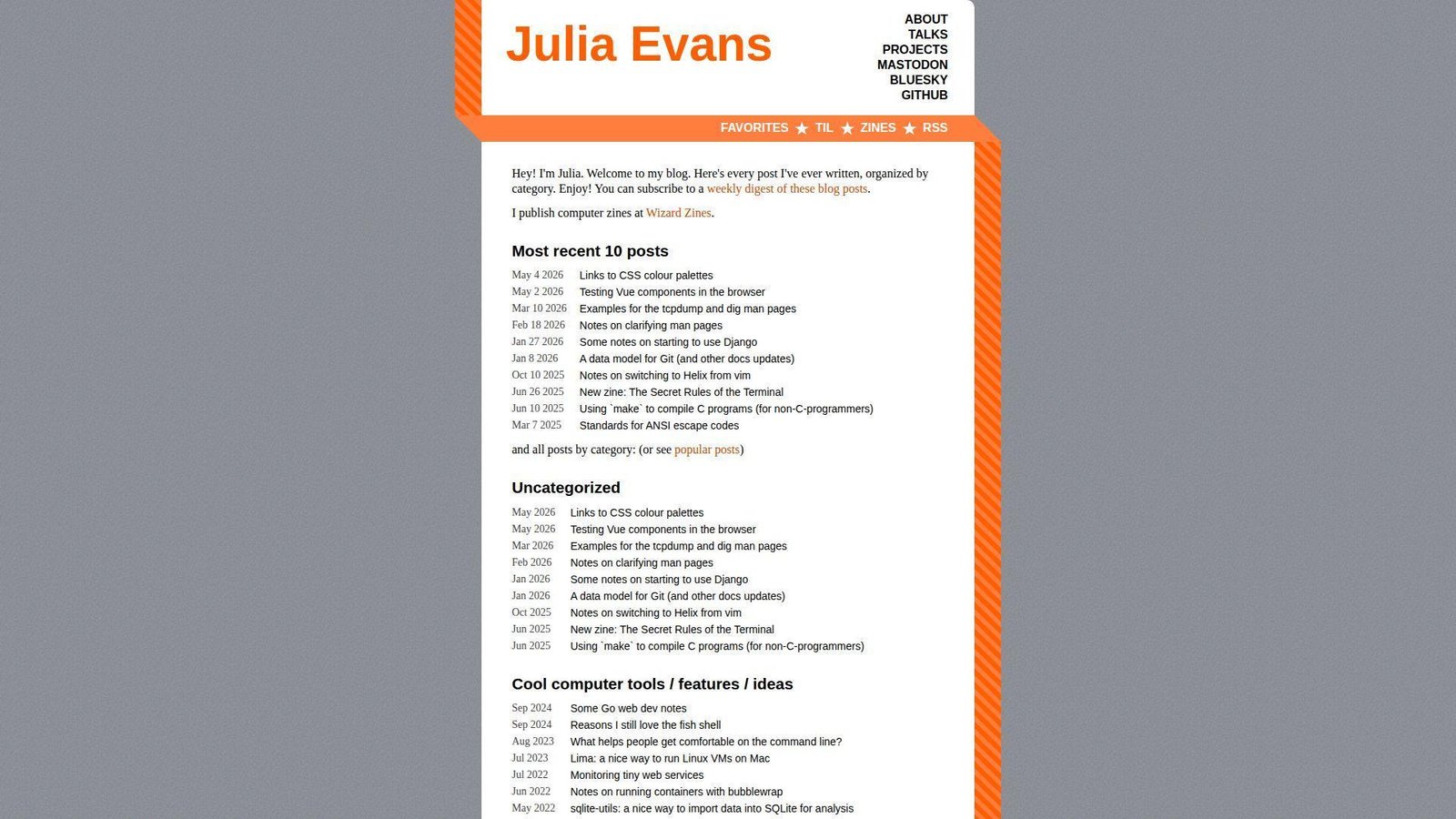
Julia Evans writes the kind of technical blog we wish more people tried to write. She takes topics that scare beginners, like TCP, dig, kernel tools, or SSL, and explains them with curiosity instead of ego. The result is unusually memorable.
Best for: curious beginners and mid-level developers filling systems gaps.
- Approachable systems explainers → hard topics stop feeling like gatekeeping and start feeling testable.
- Weekly digest and zines nearby → you can move from a blog post to deeper practice without buying a full course.
- Compact examples → most posts pay off in one focused sitting.
Pricing & limits: From $0/mo. No trial because the blog, RSS feed, and digest are free. There is no read cap. Paid zines are separate from the blog itself.
Honest drawbacks: The site is personal by design, so it will not cover every trend or every framework. If you want daily industry news, this is the wrong pick.
Verdict: If you want to finally understand the systems beneath your tools, Julia Evans is one of the best tech blogs to add first. It beats Stack Overflow Blog on teaching clarity, but it trails Cloudflare on current infrastructure news.
11. Coding Horror
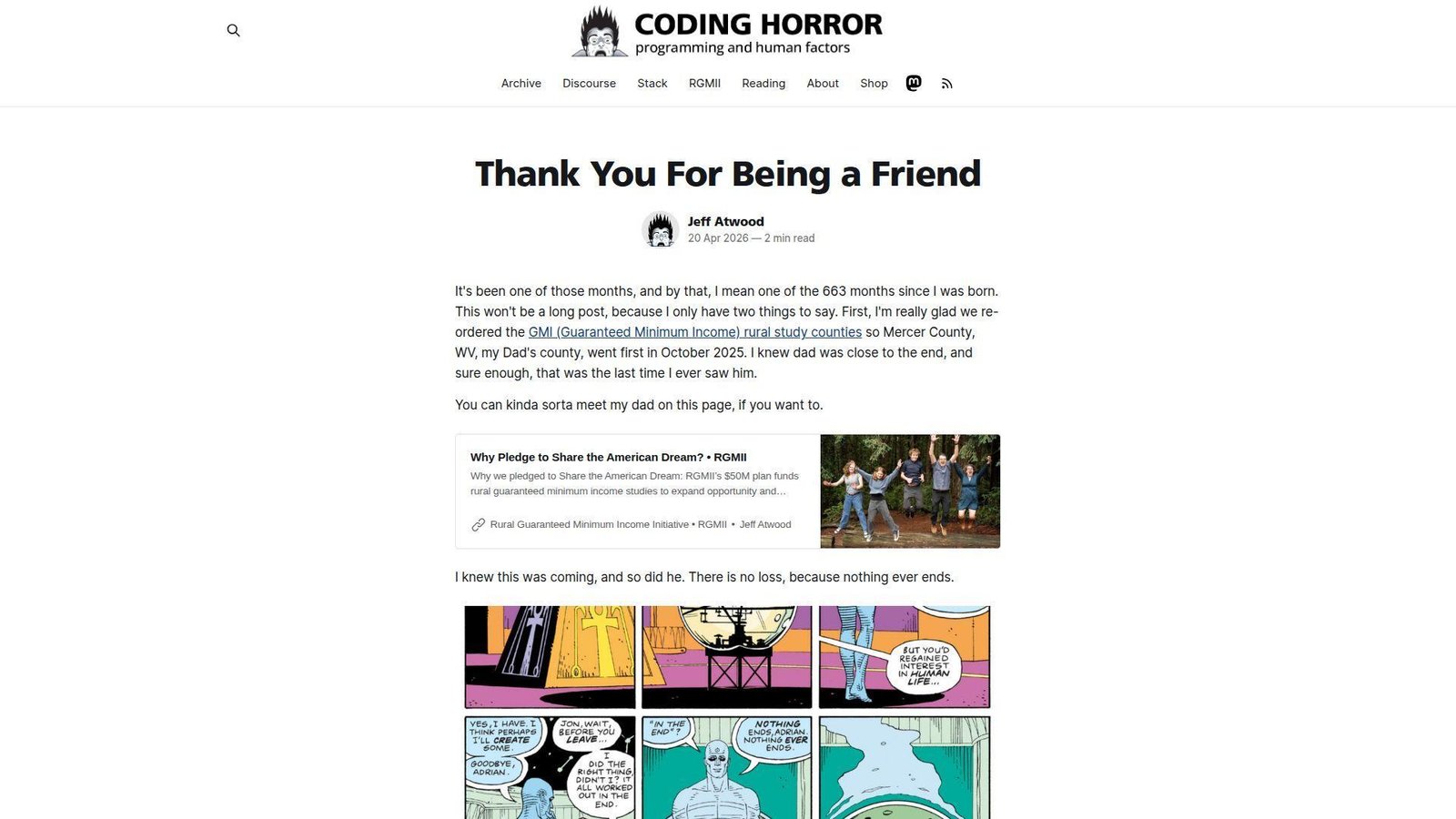
Coding Horror is Jeff Atwood’s personal archive, and that matters. It carries one clear voice, one long history, and one consistent obsession with the human side of software. We still read it when we want perspective, not just mechanics.
Best for: career-minded developers and community builders.
- Deep archive and classic essays → you can pull up evergreen guidance on developer habits, culture, and craft fast.
- Email subscribe and comment flow → keeping up does not require another algorithmic feed.
- Plainspoken writing → you usually know quickly whether a post changed how you think.
Pricing & limits: From $0/mo. No trial because the archive and email subscription are free. There is no read cap.
Honest drawbacks: The cadence is slower now, and some recent topics move beyond day-to-day software work. Readers looking for fresh architecture posts may find the archive more valuable than the newest entries.
Verdict: If you want a blog that reminds you software is built by humans with messy incentives and habits, Coding Horror is still worth your time. It beats most company blogs on voice, but it trails GitHub on freshness.
12. Dan Luu
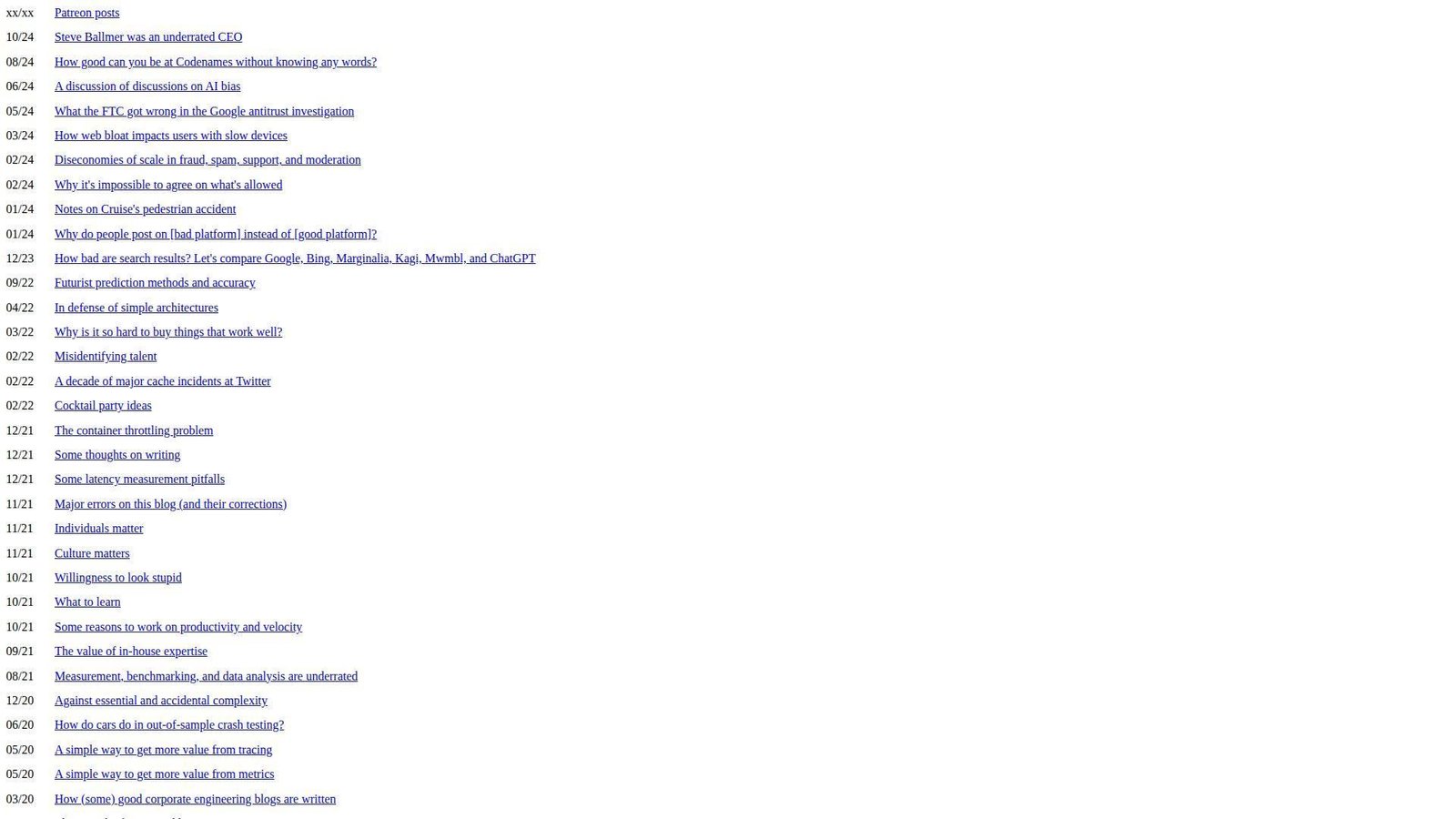
Dan Luu writes dense, skeptical essays about systems, incentives, performance, hiring, search, moderation, hardware, and management failure. We recommend him when a reader wants to think harder, not faster. The archive has real bite.
Best for: senior engineers and analytical generalists.
- Contrarian deep dives → they sharpen your judgment on trade-offs that shallow blogs flatten into slogans.
- Public archive, Patreon layer, and RSS → you can track free work and optional extras without scattering your routine.
- Evidence-heavy structure → a single read often gives you an angle you will remember for weeks.
Pricing & limits: From $0/mo for the public archive. No trial is needed. Some newer extras live on Patreon, while the main site stays openly readable and uncapped.
Honest drawbacks: The writing can be dense, and the publishing rhythm is not especially predictable. Beginners may find the essays more rewarding later than now.
Verdict: If you like technical writing that refuses easy answers, Dan Luu is a strong follow. He beats general tech news on depth, but he trails Julia Evans on beginner friendliness.
13. Patrick McKenzie’s Blog
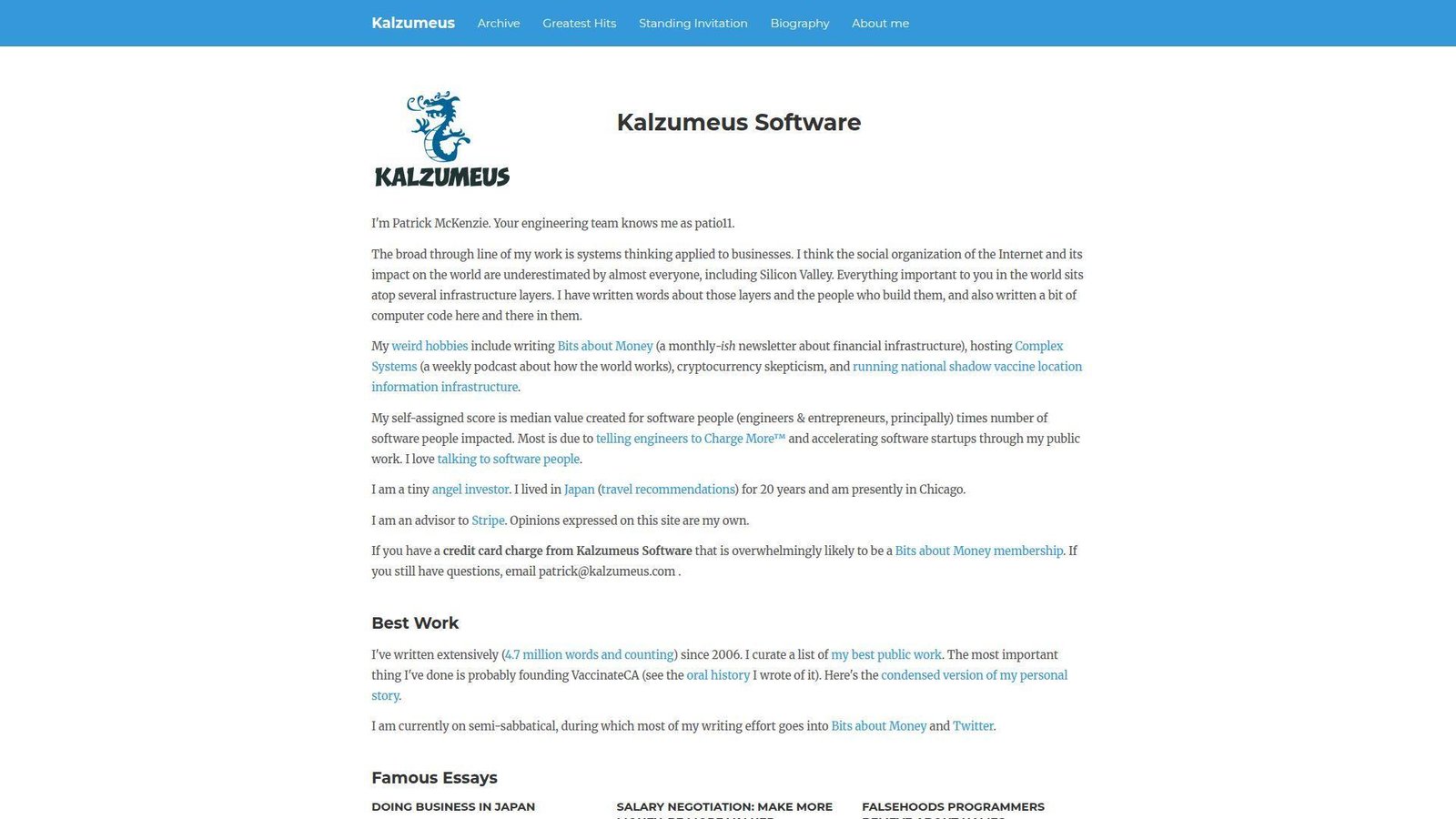
Patrick McKenzie, known to many engineers as patio11, writes from the intersection of software, money, markets, and incentives. His site feels like an operator explaining why technical decisions live inside business systems, not outside them. We find that angle unusually useful.
Best for: founders and product or fintech operators.
- Systems-thinking essays → you connect pricing, hiring, payments, and software choices instead of treating them as separate problems.
- Archive, greatest hits, and related projects → you can go from one essay to a deeper learning path without starting over from scratch.
- Direct prose → most pieces reveal a useful framing within one focused reading block.
Pricing & limits: From $0/mo. No trial because the public archive is free. There is no reading cap on the site, though some of McKenzie’s newer work lives on separate paid properties.
Honest drawbacks: The current writing effort is split across multiple projects, so this site is not the most current stream in his orbit. It is also less code-focused than the name of this article might suggest.
Verdict: If you want essays that make money, incentives, and software feel connected, Patrick McKenzie’s blog still punches above its weight. It beats Stratechery on operator empathy, but it trails it on cadence.
14. TechNewsWorld Tech Blog

TechNewsWorld is the broad-news option on this list. Its tech blog mixes analyst commentary, opinion, reviews, and short analysis across computing, internet, IT, mobile, security, and AI. We use it when we want a fast perimeter scan.
Best for: tech-curious executives and general readers.
- Wide channel coverage → you can monitor AI, devices, enterprise shifts, and security from one place.
- Newsletter options → one inbox pass replaces a pile of scattered site checks.
- Short article format → you can get the main point quickly and move on.
Pricing & limits: From $0/mo. No trial because articles and newsletters are free. There are no meaningful read caps for casual readers.
Honest drawbacks: The trade-off for breadth is lighter technical depth. If you want code, architecture diagrams, or postmortem-style lessons, this is not the blog we would choose first.
Verdict: If your goal is staying generally informed without living on social media, TechNewsWorld does the job. It beats niche engineering blogs on breadth, but it trails them badly on implementation detail.
15. Meta Engineering
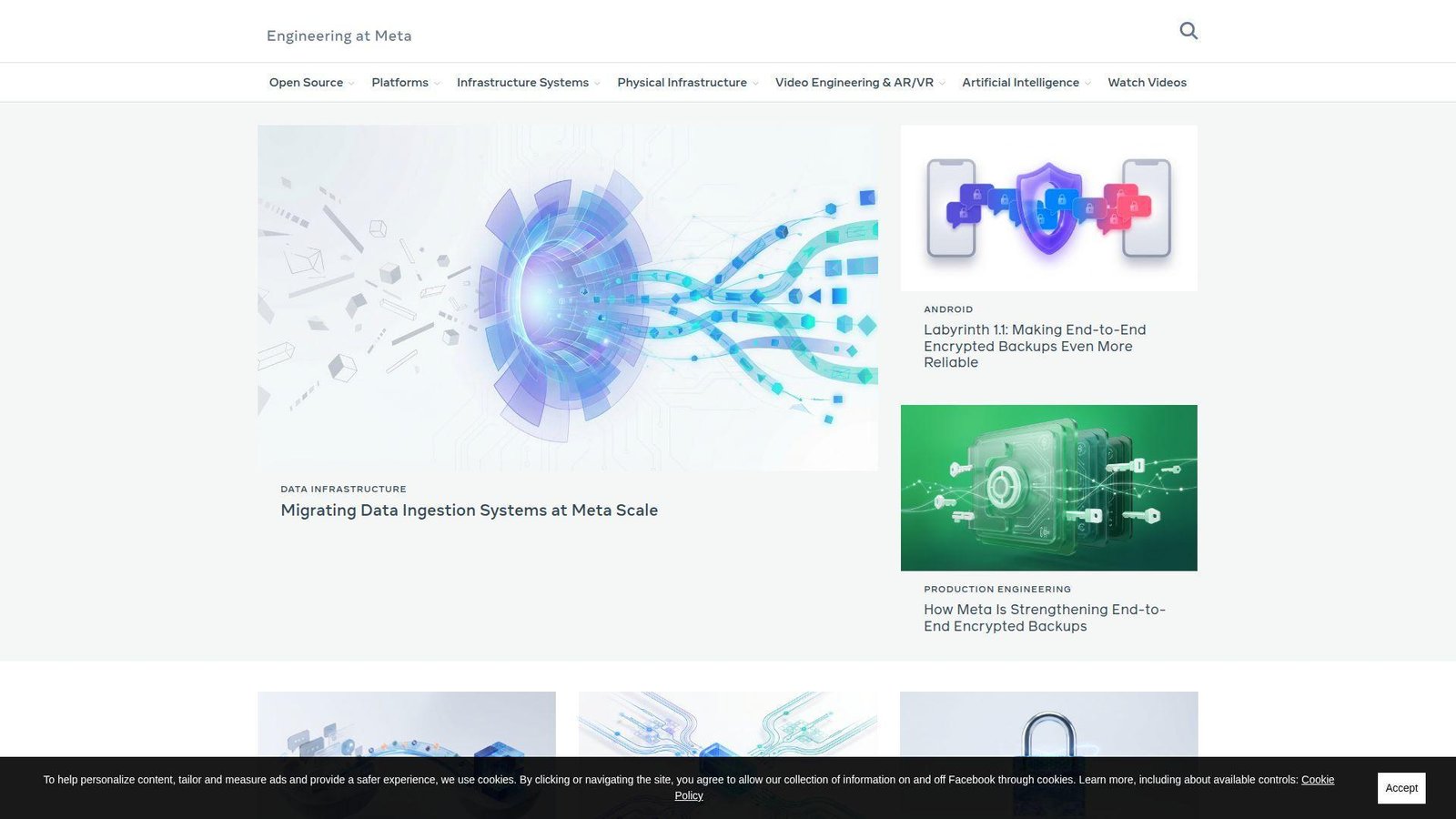
Engineering at Meta is built for engineers who care about scale, infrastructure, data, and production discipline. The site spans core infra, data infra, dev infra, security, networking, AI, and open source, so it works best as a serious specialist feed, not casual browsing.
Best for: staff-plus engineers and infra or data platform teams.
- Hyperscale case studies → they expand what you consider normal failure modes and system boundaries.
- RSS and open source adjacency → you can move from article to code or further reading without much friction.
- Strong taxonomy → domain experts usually get value quickly because the navigation is clear.
Pricing & limits: From $0/mo. No trial because the site and RSS feed are free. There is no seat cap or read limit.
Honest drawbacks: Smaller teams cannot copy most of these patterns straight across. Some posts also assume deep prior knowledge, so beginners may feel like they started in the middle of the movie.
Verdict: If you need to stretch your understanding of large-scale systems and operational design, Meta Engineering is worth the effort. It beats Shopify on raw scale, but it trails Martin Fowler on portability.
16. Shopify Engineering
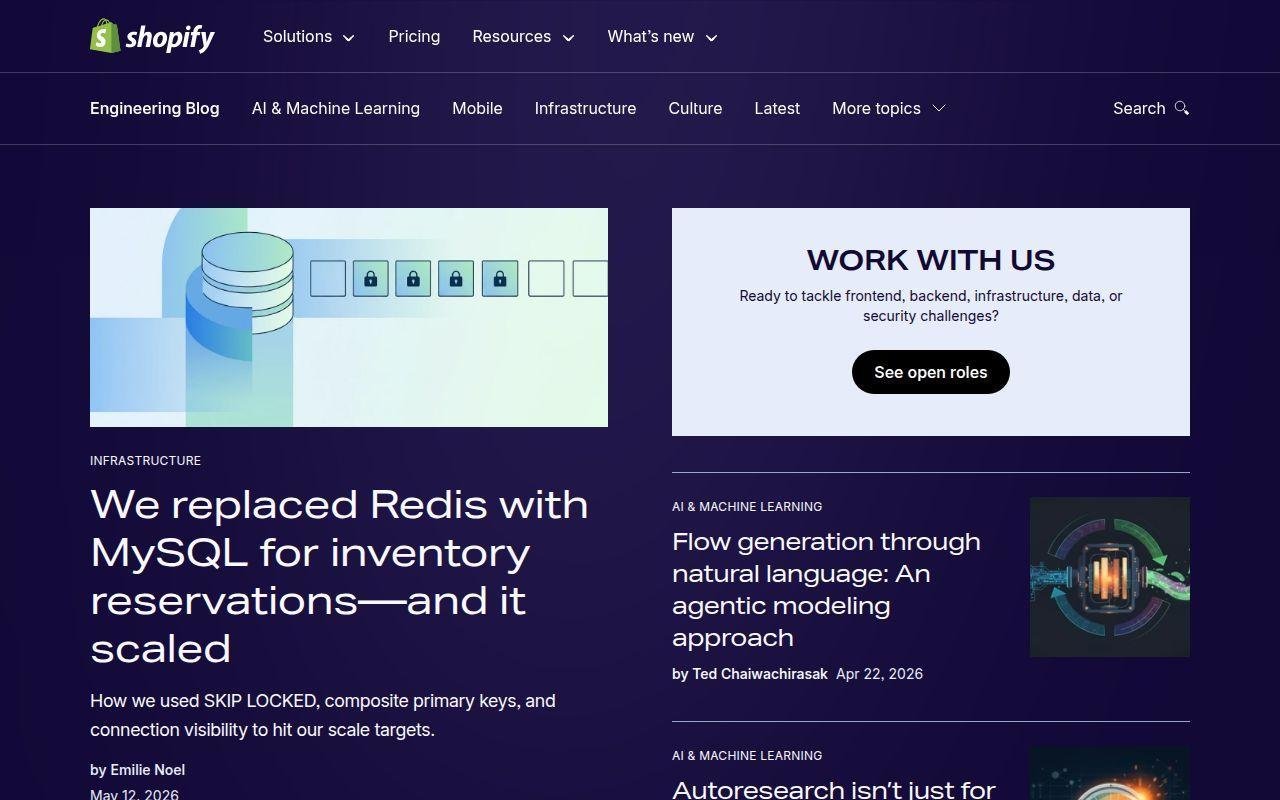
Shopify Engineering does something we value a lot. It connects engineering decisions back to merchant outcomes. The archive covers AI and machine learning, development, infrastructure, security, mobile, culture, and developer tooling, with commerce running through the middle.
Best for: full-stack product engineers and engineering managers at SaaS or commerce companies.
- Product-linked engineering stories → you see how technical choices affect revenue, automation, or merchant workflows.
- Open source and ecosystem references → a post often points you toward the next practical artifact instead of leaving you guessing.
- Readable case-study format → the site usually pays off in one short reading block.
Pricing & limits: From $0/mo. No trial because the blog is openly readable. There is no cap for readers.
Honest drawbacks: The commerce lens can narrow relevance if you work outside product or platform teams. Some posts also carry a mild recruiting vibe, especially around culture.
Verdict: If you build products where engineering choices touch conversion, tooling, and operational cost, Shopify Engineering is a smart follow. It beats GitHub on product-business connection, but it trails Cloudflare on security depth.
17. Dropbox Tech
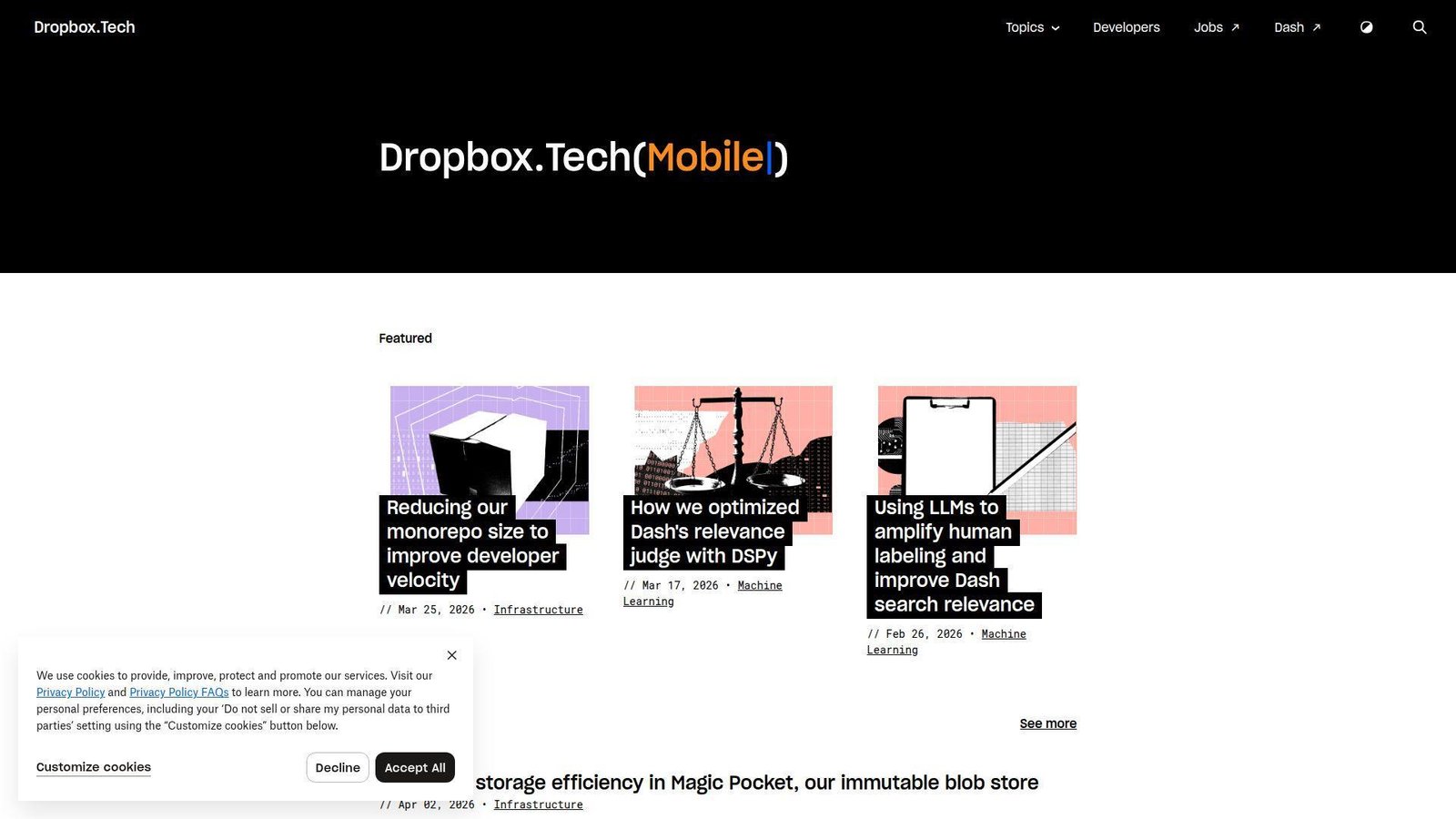
Dropbox Tech is one of the more balanced company blogs on this list. It covers infrastructure, front end, machine learning, mobile, security, culture, and a developer section without making everything feel like a launch post. That balance is why we trust it.
Best for: platform engineers and search or ML teams.
- Clear topic buckets → you can jump straight to monorepos, storage, search, or security instead of wading through everything.
- RSS and developer updates → API-facing changes and engineering essays can live in the same queue.
- Concise write-ups → most posts make their value clear in one short session.
Pricing & limits: From $0/mo. No trial because the archive and RSS feed are free. There is no seat cap or read limit.
Honest drawbacks: Some posts still orbit Dropbox product lines, especially around Dash. The cadence is also moderate, so it works better as a quality add-on than your only feed.
Verdict: If you want pragmatic writing on storage, monorepos, developer experience, and applied ML, Dropbox Tech is easy to recommend. It beats many blogs at practical internal-tooling topics, but it trails Netflix on dramatic scale stories.
18. Jane Street Blog

Jane Street’s blog is where we go when we want something a little different from the usual web stack playbook. The team mixes posts on machine learning, hardware, OCaml, performance, internships, and research-minded engineering with unusually high editorial quality.
Best for: ML researchers and systems engineers who enjoy hard problems.
- Original technical essays → they stretch your mental models beyond mainstream app development.
- Email updates, RSS, podcast, and open source paths → you can follow the work across formats without extra noise.
- Polished long-form writing → one focused read usually leaves you with at least one idea worth revisiting.
Pricing & limits: From $0/mo. No trial because the blog, email updates, and RSS feed are free. There is no reading cap.
Honest drawbacks: The math and FP culture can feel niche if you work in a standard SaaS stack. It is also not the right choice if you want fast career or product-news reading.
Verdict: If you want your brain stretched by original technical writing, Jane Street Blog deserves a spot in your reader. It beats most company blogs on originality, but it trails Julia Evans on accessibility.
19. Joel on Software
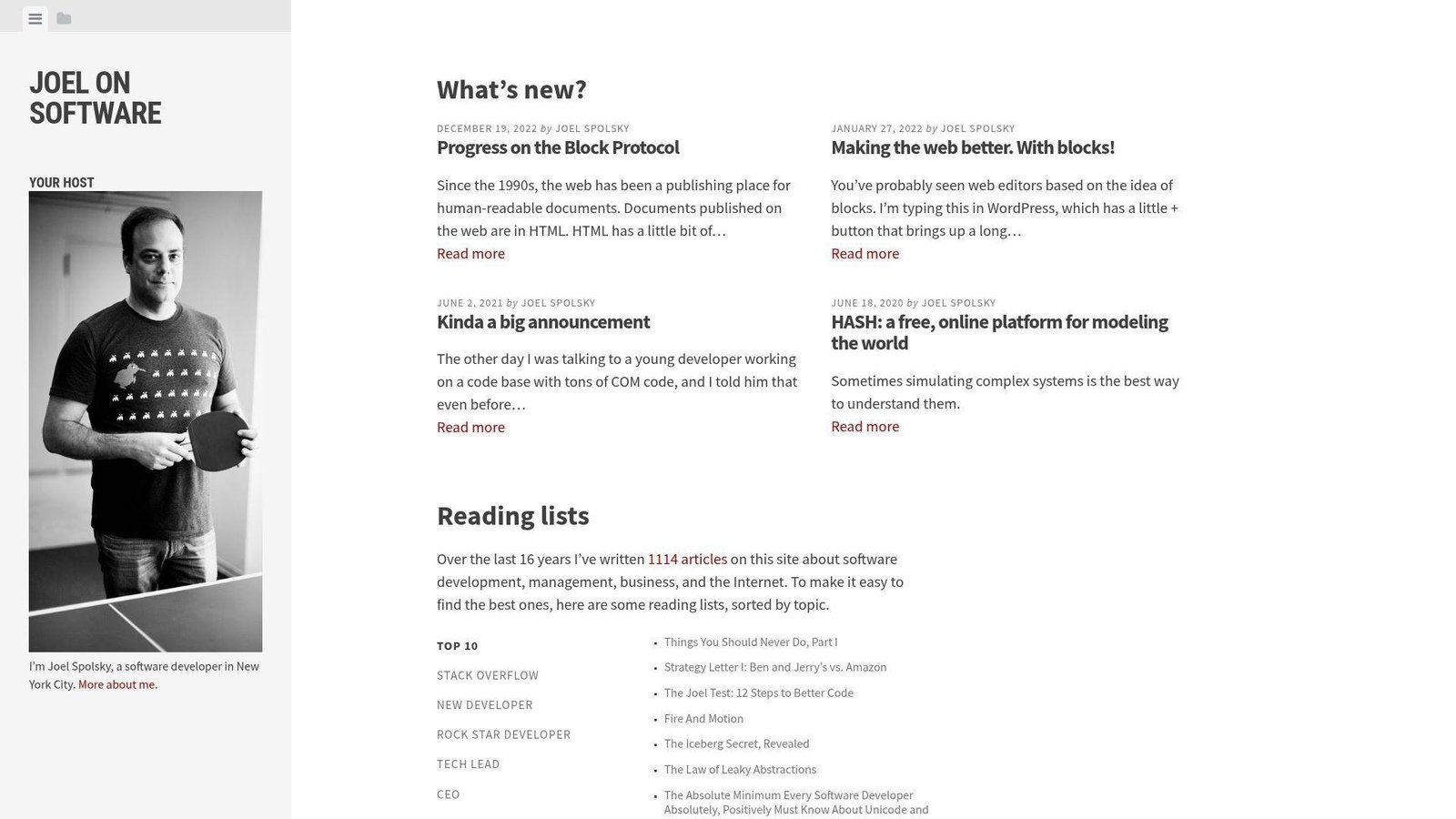
Joel on Software remains one of the best archives for software management, developer careers, and startup judgment. Joel Spolsky organizes much of the archive by reader role, which makes the site far more usable than many classic blogs with similar age.
Best for: tech leads and startup founders.
- Role-based archive → you can find relevant classics fast instead of wandering through a giant back catalog.
- Books and archive organization → the site saves a lot of rummaging when you want reliable management writing.
- Blunt style → the lesson usually lands quickly, even when the post itself is older.
Pricing & limits: From $0/mo. No trial because the archive is free to read. There is no cap for readers.
Honest drawbacks: Some posts clearly show their era, and a few examples are dated. The site is best treated as a classic library, not a source for what changed last week.
Verdict: If you want software management essays that still hold up, Joel on Software is worth bookmarking. It beats many modern hot takes on longevity, but it trails Meta on current practice.
20. Brandur

Brandur’s site is a sharp independent mix of articles, fragments, atoms, sequences, and newsletters. We like it because it respects reader time. You can dip into a short note, then go deep only when a topic earns it.
Best for: backend or API engineers and curious readers who like crisp writing.
- Multiple content formats → you can match your reading depth to the time you actually have available.
- Newsletter and recurring short updates → they replace aimless scrolling with one intentional check-in.
- Concise prose → useful takeaways often land in a very short reading session.
Pricing & limits: From $0/mo. No trial because the site and newsletter access are free. There is no read cap.
Honest drawbacks: The scope is broader and more personal than a pure engineering archive, so some entries drift beyond software. It is also not a catch-all industry source.
Verdict: If you like independent technical writing with strong voice and low friction, Brandur is an excellent last-mile addition to your stack. It beats many company blogs on voice, but it trails them on breadth.
Recommended reading: Top 20 Trending Apps to Watch Across Major Platforms
How to Choose the Best Tech Blogs for Your Role

The best tech blogs change with your role. A beginner, a staff engineer, and a founder should not read the same stack in the same order. We recommend choosing based on your current bottleneck, not on what sounds most impressive.
1. For Beginners Who Need Community and Career Advice
We would start with Julia Evans, DEV.to, Stack Overflow Blog, and Coding Horror. Julia Evans makes core systems feel learnable. DEV.to gives you community and career stories from people who are still close to the beginner stage. Stack Overflow Blog adds approachable industry context. Coding Horror gives the longer view on craft, community, and how developers actually grow.
We would avoid building a beginner stack around Meta, Jane Street, or Netflix first. Those are great reads later, but they can feel like drinking from a fire hose. If a blog makes you feel lost three posts in a row, drop it for now and come back when your footing is better.
2. For Working Engineers Who Want Systems, Scale, and Postmortems
Our first picks here are Cloudflare Blog, GitHub Blog, Stripe Engineering, Dropbox Tech, Netflix TechBlog, and Meta Engineering. Each one teaches a different slice of real engineering work. Cloudflare is excellent for internet operations and security. Stripe is strong on APIs and product-aware system design. Netflix and Meta stretch your thinking on scale. Dropbox is practical. GitHub gives you the broadest mix.
We would not follow all six daily. Pick one scale-heavy source, one practical source, and one broader source. That combination gives you depth without drowning you in architecture theater.
3. For Founders and Tech Leaders Who Need Strategy and Judgment
We would begin with Stratechery, Patrick McKenzie’s blog, Joel on Software, and Martin Fowler. Stratechery helps with market structure and business leverage. Patrick McKenzie ties software to incentives and money. Joel gives classic management lessons. Martin Fowler keeps leadership discussions grounded in real engineering trade-offs.
This mix works because it balances present-day strategy with durable judgment. A founder who reads only tech news will miss the deeper patterns. A founder who reads only timeless essays may miss what is changing right now. We want both.
4. For Readers Who Want AI, Security, Devices, and Industry News
If your reading goal is broader than software alone, we would combine Cloudflare Blog, GitHub Blog, Stack Overflow Blog, Tailscale Blog, and TechNewsWorld. Cloudflare handles security and internet infrastructure well. GitHub helps with developer ecosystem shifts. Stack Overflow Blog is approachable on AI and developer trends. Tailscale stays practical. TechNewsWorld is the fastest broad scan.
That said, breadth comes with trade-offs. TechNewsWorld will not give you Martin Fowler depth. Cloudflare will not give you device-review style coverage. Match the source to the question you are trying to answer.
Recommended reading: Top 30 Weird Links to the Internet’s Strangest Websites in 2026
What Separates the Best Tech Blogs From Shallow Content
After years of reading company engineering posts, independent essays, and community platforms, we keep seeing the same split. The good stuff teaches judgment. The weak stuff just repackages trend words. Here is what we use to tell the difference.
1. A Distinct Point of View Beats Generic Trend Chasing
The strongest tech blogs sound like someone who has actually made decisions, paid for mistakes, and learned from them. That is why Stratechery, Dan Luu, and Patrick McKenzie feel different from anonymous “future of tech” posts. A point of view creates friction, and that friction is useful. Generic content avoids friction because it is trying not to offend search engines or sponsors.
2. Clear Explanations and Strong Structure Beat Buzzwords
We trust blogs that define terms, explain the setup, show the trade-off, and then state the lesson. Julia Evans is outstanding at this. Stripe is also very good at it. When a post hides behind buzzwords, we assume the author either does not understand the topic deeply or does not respect the reader’s time.
3. Real Trade-Offs, Failures, and Implementation Notes Beat Hype
Good technical writing admits cost. It says what was hard, what was messy, what had to be simplified, and what might not transfer to your team. Cloudflare and Dropbox often do this well. Posts that skip limitations usually read like recruiting copy with code words sprinkled on top.
4. Technical Decisions Should Connect Back to Product and Business Outcomes
We are far more likely to trust a post when it explains why the technical decision mattered to users, revenue, cost, reliability, or support load. Shopify and Stripe both do this well. Pure implementation detail without business context can still be useful, but it often leaves out why the decision mattered in the first place.
5. Searchable Archives, RSS, and Manageable Cadence Make Blogs Easier to Follow
A great post is less useful if you can never find it again. Searchable archives, good tagging, RSS, email digests, and a sane publishing pace matter more than many readers think. We would rather follow a site that publishes one useful piece a week than one that posts daily and teaches us nothing.
How to Build a Low-Noise Reading Stack
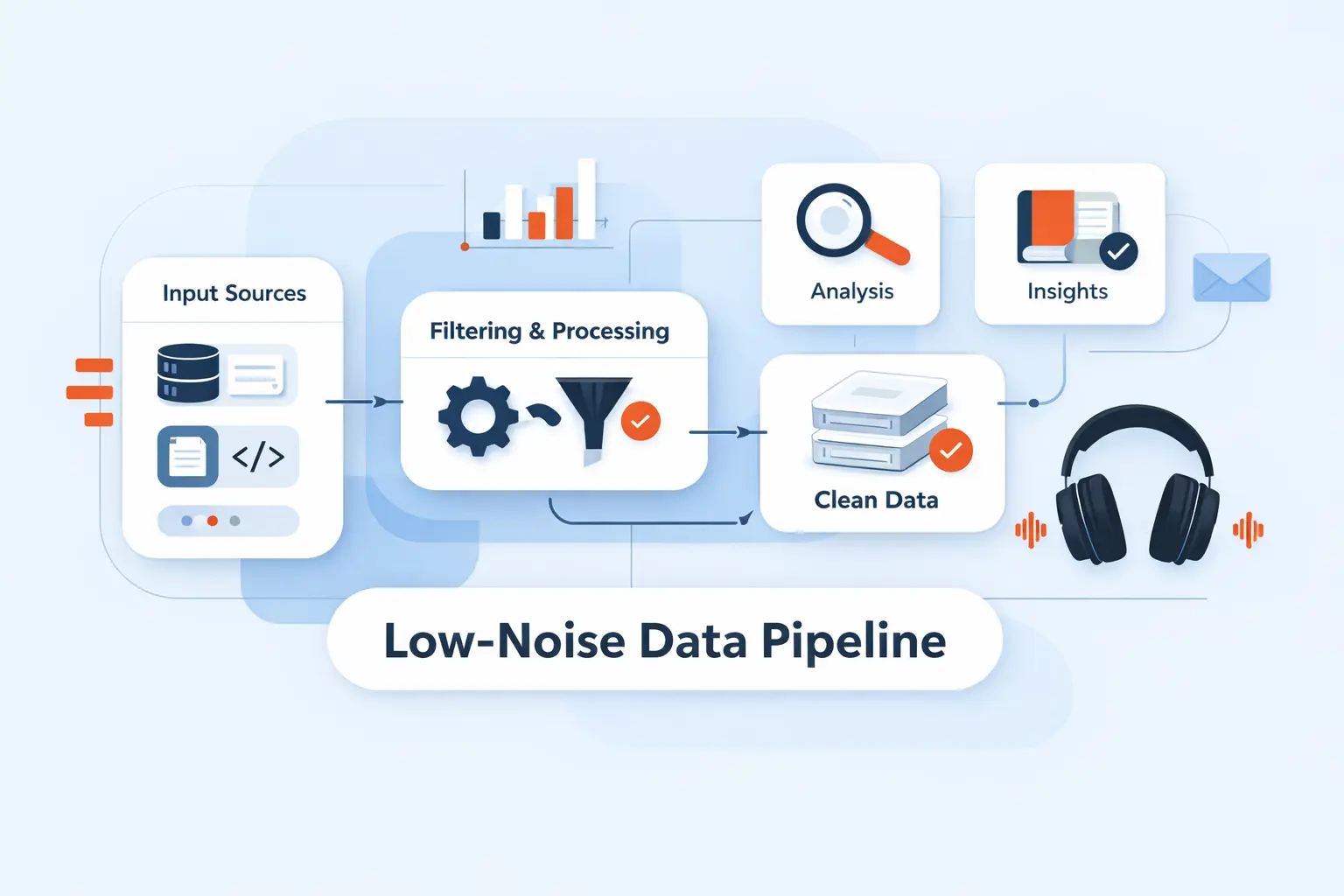
Even the best tech blogs become noise if you follow too many. We recommend building a reading stack you can actually keep up with. A smaller, repeatable habit beats a giant aspirational list every time.
1. Start With Two to Three Core Blogs Instead of Twenty
We would not ask most readers to actively follow more than three core blogs at first. Pick one practical source, one depth source, and one broader source. For example, Cloudflare plus Martin Fowler plus Stack Overflow Blog is already a strong stack for many engineers.
2. Pair One Deep Technical Source With One Broader Discovery Source
A good pairing keeps you grounded. Martin Fowler plus DEV.to works well for a developer who wants strong principles and fresh community context. Stripe Engineering plus Stratechery works well for a founder building software products. Deep-only stacks get narrow. Broad-only stacks get shallow.
3. Use Feeds, Digests, and Saved Queues to Manage Volume
We strongly prefer RSS, email digests, and read-later queues over algorithmic feeds. They make it easier to process posts when you choose, not when a platform nudges you. One weekly review session is often enough if the sources are good.
4. Cut Blogs That Feel More Like Recruiting Than Engineering
If every post sounds like a polished brand campaign, unsubscribe. We are fine with some company voice. We are not fine with content that hides the hard parts. The best tech blogs earn attention with specifics. The weak ones ask for attention with glow and posture.
Best Tech Blogs FAQ

We get these questions a lot from clients, junior developers, and founders building their own reading habits. Here are our blunt answers, based on what we actually recommend people keep reading after the first week.
1. What Are the Best Tech Blogs for Beginners?
Our starter group is Julia Evans, DEV.to, Stack Overflow Blog, and Coding Horror. Julia Evans teaches systems clearly. DEV.to gives beginners community. Stack Overflow Blog explains industry shifts in simple language. Coding Horror adds long-view career and craft lessons. If you want one company blog early, GitHub Blog is the easiest bridge into that world.
2. Should Beginners Start With Blogs or Learning Platforms?
We would use both. Learning platforms and official docs are better for fundamentals. Blogs are better for context, motivation, judgment, and real-world trade-offs. Platforms teach syntax and APIs. Blogs teach how practitioners think when the answer is not obvious.
3. Are Company Engineering Blogs Better Than Independent Tech Blogs?
No. They are better at different things. Company engineering blogs are stronger when you want firsthand implementation notes. Independent blogs are stronger when you want opinion, portability, and sharper judgment. Our favorite reading stacks usually include one of each.
4. Which Tech Blogs Are Best for Architecture, Systems, and Engineering Depth?
We would shortlist Martin Fowler, Cloudflare Blog, Meta Engineering, Netflix TechBlog, Stripe Engineering, Dropbox Tech, and Jane Street Blog. They all cover depth, but in different ways. Martin Fowler is best for timeless architecture thinking. Cloudflare is best for current operations and security. Meta and Netflix stretch your sense of scale.
5. How Many Tech Blogs Should You Follow at Once?
We recommend actively following three to five at most. Beyond that, many readers start skimming everything and learning less. Pick a small set that matches your role, then rotate only when one stops earning its spot.
6. Do the Best Tech Blogs Still Offer RSS Feeds?
Yes. Several of the best tech blogs still make RSS easy to find, including Martin Fowler, Tailscale, Meta Engineering, Dropbox Tech, Jane Street, and Dan Luu. We still prefer RSS because it cuts algorithmic noise and keeps a reading habit stable.
Final Verdict on the Best Tech Blogs
If we were building a low-noise reading stack from scratch, we would start with GitHub Blog for breadth, Cloudflare Blog for operations and security, and Martin Fowler for long-term architecture judgment. Then we would add one role-specific pick. Stratechery is our favorite add for founders. Julia Evans is the easiest add for newer developers. DEV.to is the best community add. Netflix, Meta, and Stripe are the adds we reach for when we want heavier engineering depth.
The real win is not collecting twenty bookmarks. It is picking two or three blogs that sharpen how you build, debug, and decide. Which two are you actually going to subscribe to this week?

