


ERP companies are no longer selling back-office software alone. At TechTide Solutions, we see them selling operating models, data discipline, and decision speed. The wider enterprise application software market is forecast to reach $722 billion by 2029, which tells us ERP now sits near the center of enterprise change rather than at the edge. Our view is simple. The best ERP company is not always the biggest name on the slide. It is the one whose data model, implementation path, and industry depth fit the work your people actually do every day.
Quick Comparison of ERP Companies
We like to start with a fast scan before the demo circus begins. This table strips the first ten vendors down to fit, entry point, and the limit that usually shows up first in real deployments.
That shift changes the shortlist. McKinsey reports that 23% of organizations are already scaling an agentic AI system, so in 2026 we think buyers should test embedded automation, copilots, and workflow intelligence from the start instead of treating them as future add-ons.
| Tool | Best for | From price | Trial/Free | Key limits |
|---|---|---|---|---|
| Microsoft Dynamics 365 | SMB to mid-market ops | $80/user/mo | Free trial | Premium needed for manufacturing and service |
| SAP | Global enterprise | Custom quote | Guided trial | Public edition is more opinionated |
| Oracle | Complex finance-led enterprises | Custom quote | Demo | High implementation and admin lift |
| Workday | Service-centric organizations | Custom quote | Demo | Less depth for plant-heavy manufacturing |
| Infor | Manufacturing and distribution | Custom quote | Demo | Experience varies by CloudSuite |
| IFS | Asset and service-heavy industries | Custom quote | Demo | Best fit is industrial, not general SMB |
| Epicor | Discrete and mixed-mode manufacturing | Custom quote | Demo | Lighter native HR and CRM breadth |
| Sage | Finance-led mid-market growth | Custom quote | Demo | Portfolio fit matters across products |
| QAD | Global manufacturers | Custom quote | Demo | Narrower fit outside manufacturing |
| Acumatica | Growing mid-market firms | Custom quote | Pricing review | Resource-based pricing can climb |
Recommended reading: Top 20 WordPress Website Design Companies for Custom, Scalable Websites
Top 20 ERP Companies to Consider in 2026
We ranked these ERP companies by process depth, industry sharpness, deployment flexibility, AI direction, and how fast a serious buyer can reach first value. We also weighted honesty. A great ERP is not the one with the loudest booth at a conference. It is the one that still makes sense when the warehouse is behind, the month-end close is late, and leadership wants answers by lunch.
We trust this market most when the outcomes are concrete. Infor points to Daikin using its software stack to cut engineering and sales overhead by 50%, which is exactly the kind of operational win that makes an ERP project worth the pain of migration, training, and process cleanup.
1. Microsoft Dynamics 365
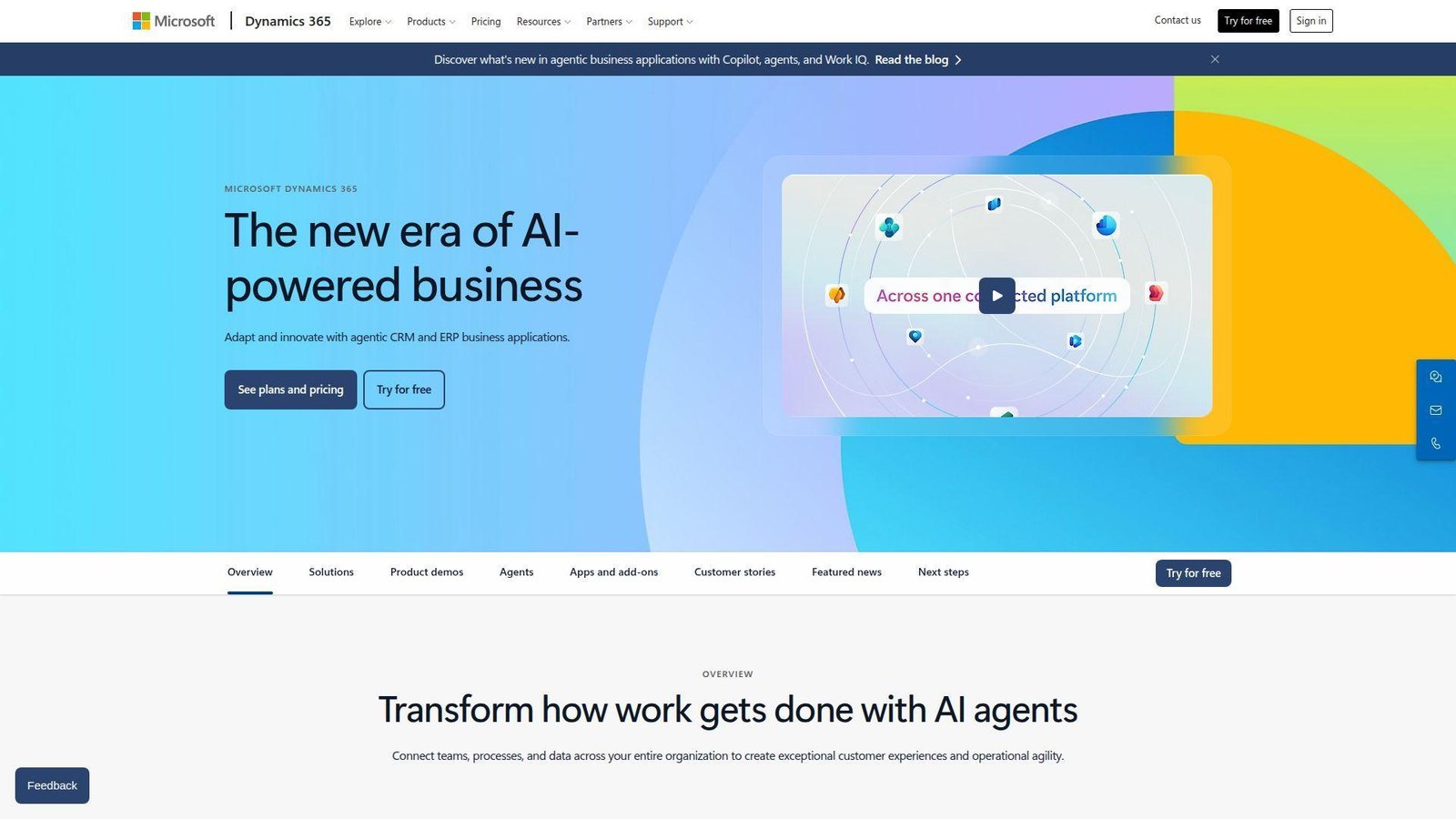
Microsoft brings one of the broadest ERP product and partner teams in the market. We like that Dynamics 365 lets buyers start with Business Central or scale into a larger Microsoft stack without abandoning the ecosystem their staff already knows.
Best for: SMB operators and mid-market finance leaders.
- Unified finance, sales, and operations flows → gives leadership one operating view instead of scattered spreadsheets.
- Microsoft 365, Power BI, and Power Automate integrations → remove approval hops and reduce manual report prep.
- Familiar UX and huge partner bench → many teams reach useful value within an early rollout cycle.
Pricing & limits: From Microsoft’s paid Business Central plans; free trial available; Essentials starts smaller, while Premium is required for manufacturing and service management, and agent usage can add extra consumption costs.
Honest drawbacks: Licensing can get messy once you add CRM apps, Power Platform components, or AI services. Partner quality also swings outcomes more than many buyers expect.
Verdict: If you want flexible cloud ERP tied closely to everyday productivity tools, this helps you standardize core operations in a practical, staged rollout.
2. SAP
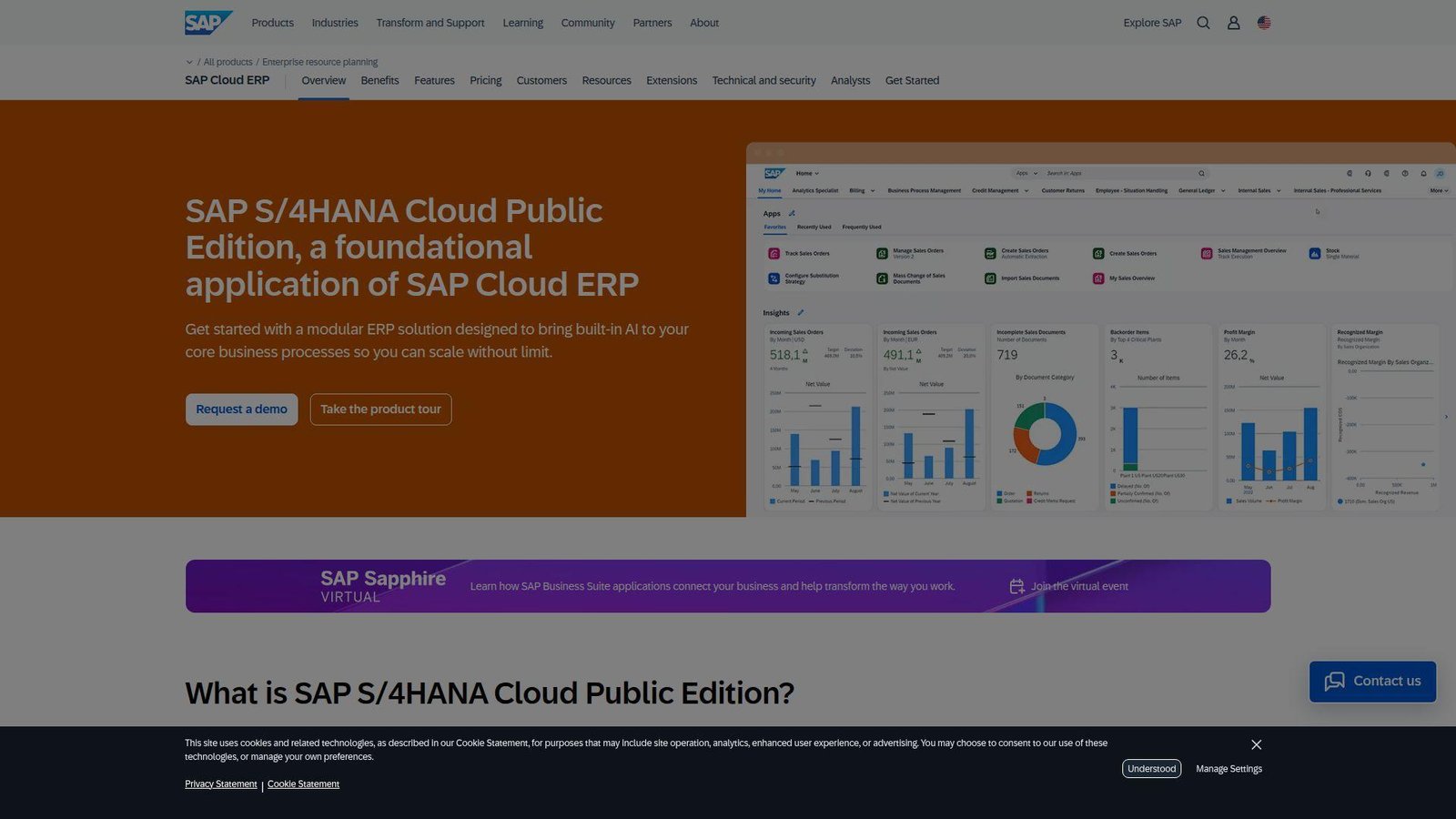
SAP still fields one of the deepest enterprise software product and industry teams in the world. We see SAP at its best when a company needs strong global process control, serious localization, and a platform that can carry both finance and manufacturing complexity.
Best for: global manufacturers and multinational operations teams.
- Preconfigured best-practice processes → reduce blueprinting effort and speed scope definition.
- SAP BTP, analytics, and automation layers → cut custom-code detours and keep extensions cleaner.
- Guided cloud implementation methods → help disciplined teams see initial wins earlier than classic ERP programs.
Pricing & limits: From custom quote; selected public-edition scenarios offer a guided fourteen-day trial; that trial runs in a shared environment with sample data and without deep admin, customization, or integration rights.
Honest drawbacks: SAP rewards process discipline and punishes casual scoping. Public edition can feel rigid if your workflows are highly bespoke, while private edition raises cost and governance demands. Beats Workday on product-centric depth; trails Microsoft on approachability for smaller teams.
Verdict: If you run global operations and need one hard spine for finance, supply chain, and compliance, this helps you build long-term process control rather than short-term convenience.
3. Oracle
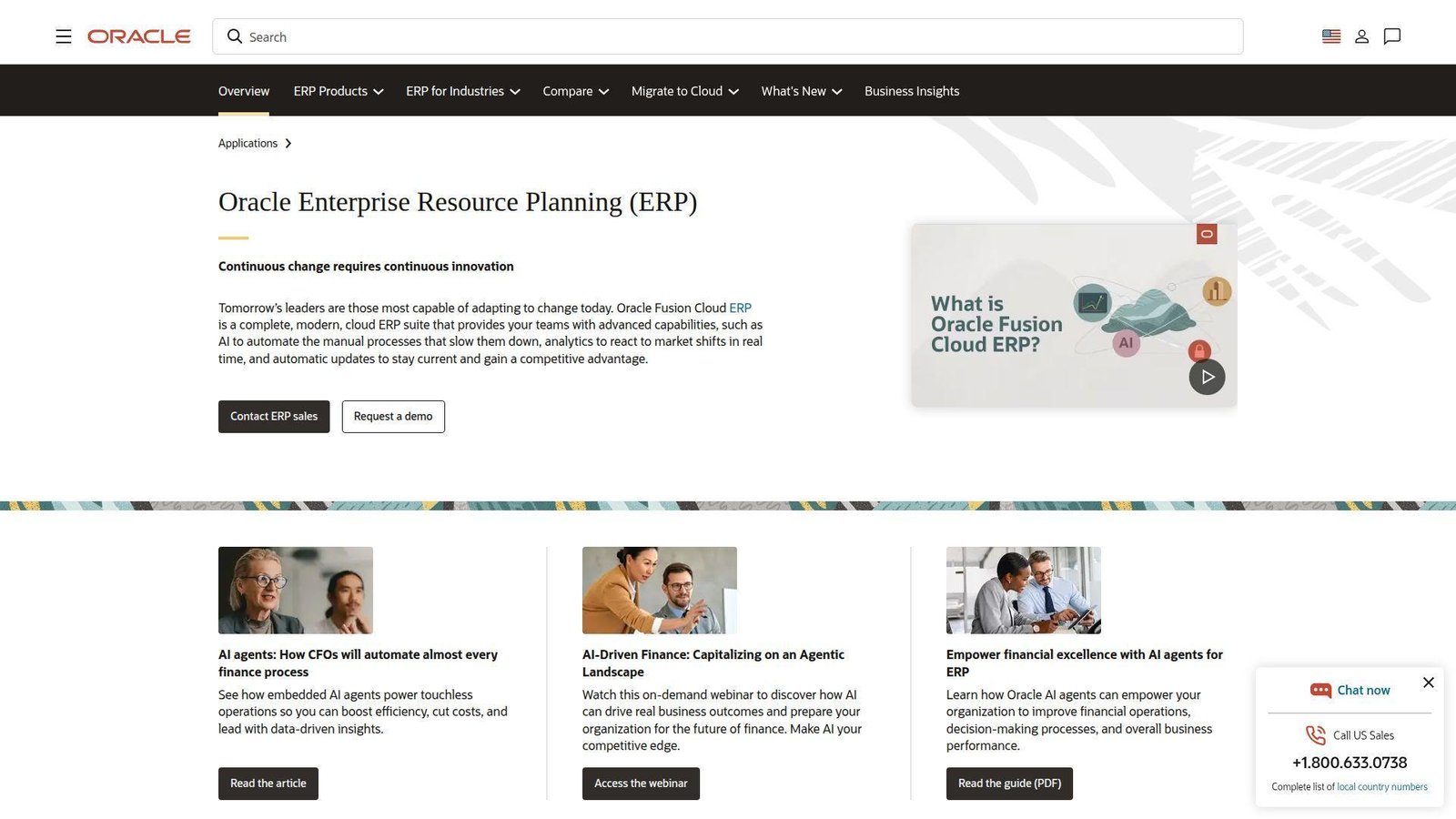
Oracle brings a massive enterprise applications, database, and infrastructure team to the table. We usually shortlist Oracle when finance, procurement, projects, and enterprise reporting all need to move together under strong central governance.
Best for: enterprise CFO teams and procurement-led global businesses.
- Deep financials, procurement, and project controls → tighten spend oversight and improve close-to-report discipline.
- Built-in analytics, AI, and adjacent EPM options → reduce spreadsheet handoffs across planning and execution.
- Large-scale cloud operating model → gives complex teams a predictable path to early enterprise value.
Pricing & limits: From custom quote; no self-serve full ERP trial; costs depend on module mix, contract structure, and the metrics attached to each service in the agreement.
Honest drawbacks: Oracle implementations can sprawl if buyers over-scope too early. The suite is powerful, but power comes with admin depth, change effort, and heavier partner dependence. Beats many rivals on finance breadth; trails Workday on ease of use.
Verdict: If your priority is strong enterprise financial control with serious procurement and project depth, this helps you replace fragmented systems with one governed cloud core.
4. Workday
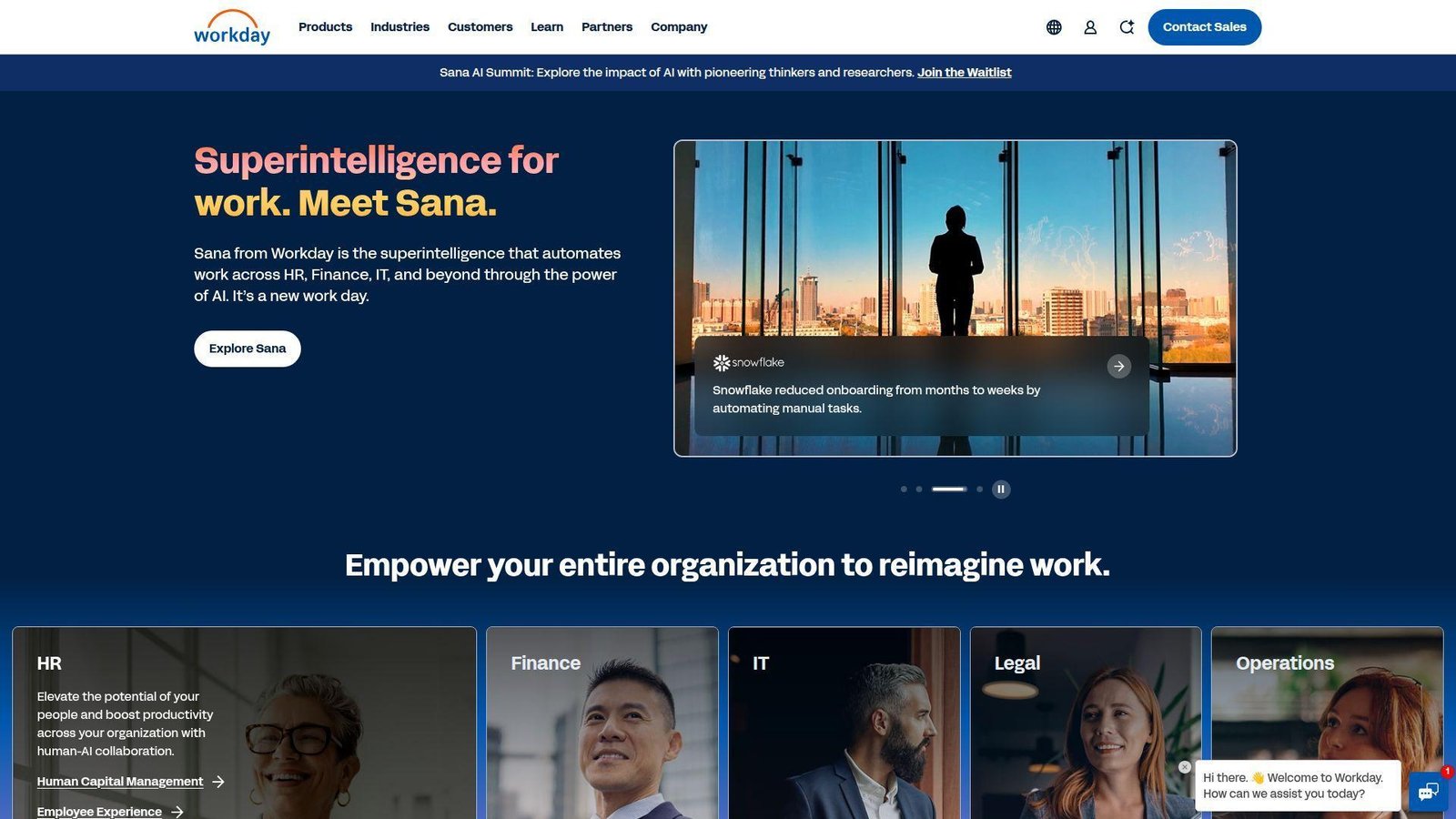
Workday’s team has long focused on finance, HR, and planning as one connected operating system. We think its real strength is not pure ERP orthodoxy, but the way people data and money data live in the same decision space.
Best for: service-centric CFO and CHRO teams.
- Unified finance and workforce data core → improves visibility into labor-driven margins and planning choices.
- Planning, HR, and finance working together → remove export-import loops that slow scenario analysis.
- Configurable business process model → lets teams reach first value without drowning in custom code.
Pricing & limits: From custom quote; no self-serve full ERP trial; scope, worker counts, and add-on planning or HCM modules shape the commercial model.
Honest drawbacks: Workday is less convincing for plant-heavy manufacturers or deep product lifecycle needs. Buyers who expect classic ERP manufacturing depth may find the fit too service-centric.
Verdict: If labor, utilization, and service delivery define your margins, this helps you connect people planning and financial control faster than many traditional ERP suites.
5. Infor
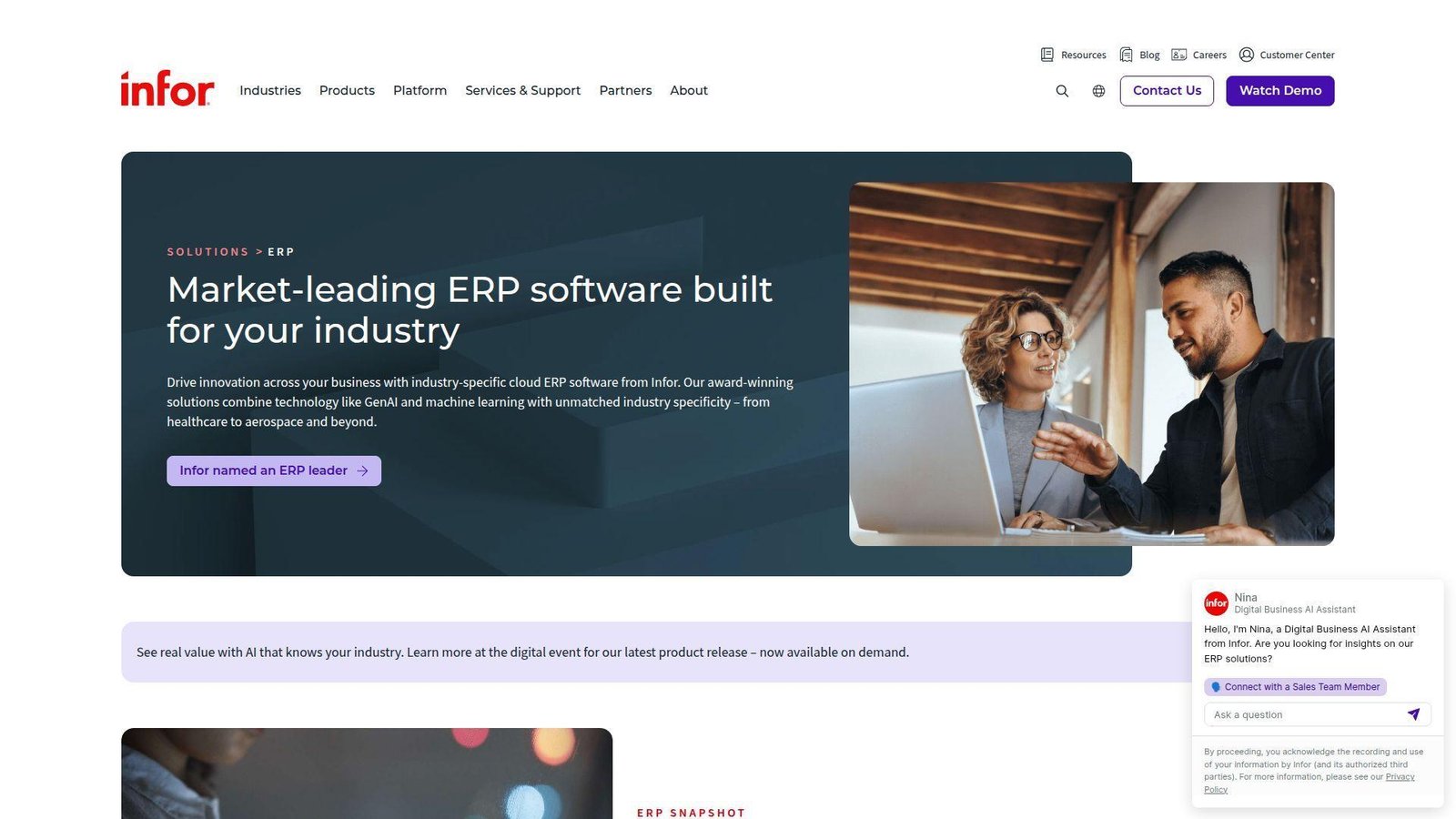
Infor’s strength sits in its industry cloud teams and its willingness to build around sector-specific processes instead of one generic model. We often point product-centric buyers toward Infor when they want more vertical fit than a broad horizontal suite usually gives them.
Best for: manufacturers and distributors with industry-specific process demands.
- CloudSuite portfolios such as M3, LN, and CSI → improve out-of-the-box fit for real operational workflows.
- Industry data models, analytics, and automation → reduce integration layers and shorten process rework.
- Suite-led implementation paths → help focused teams show value without a giant first phase.
Pricing & limits: From custom quote; evaluation is usually demo-led; costs, limits, and rollout speed depend heavily on which CloudSuite and partner motion you choose.
Honest drawbacks: Infor can feel like several strong products under one banner rather than one single personality. That means fit is excellent when you choose well and uneven when you do not.
Verdict: If you want cloud ERP with stronger vertical DNA than a generic suite, this helps you reduce gap analysis and move faster toward operational relevance.
6. IFS
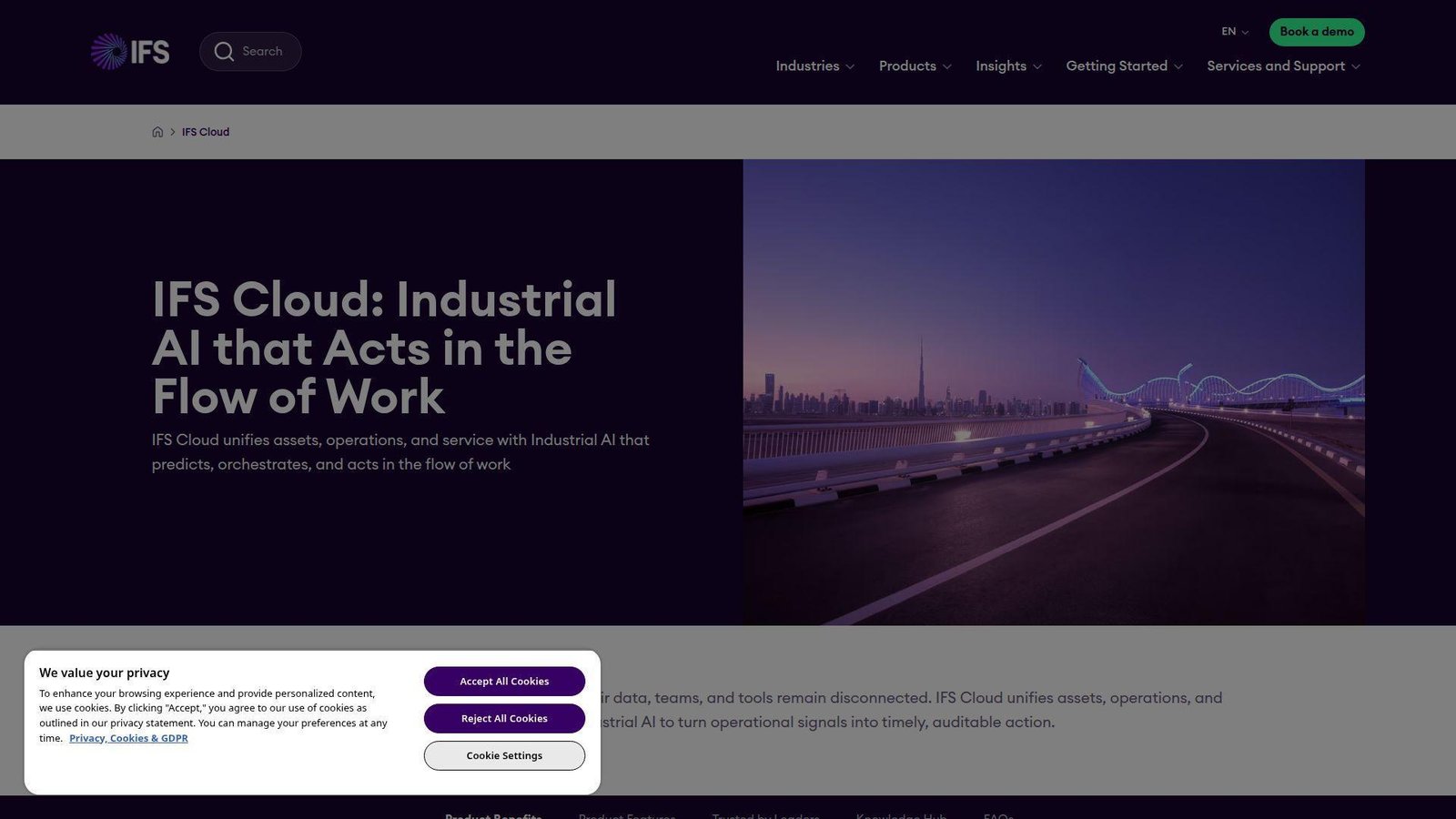
IFS has built a serious industrial software team around the overlap of ERP, asset management, and field service. We think that combination is unusually strong because many industrial companies do not fail in finance first; they fail where assets, crews, and service promises collide.
Best for: asset-intensive operators and field service-led industrial firms.
- ERP, EAM, SCM, and FSM on one platform → close the gap between planning, execution, and service outcomes.
- Embedded industrial AI and automation → cut exception chasing across maintenance, scheduling, and service work.
- Composable evergreen delivery → helps teams land value through focused industrial use cases first.
Pricing & limits: From custom quote; no self-serve trial; commercial structure depends on product scope and operational model rather than a simple seat count story.
Honest drawbacks: IFS is overkill for firms that only need a cleaner general ledger and inventory system. Its ecosystem is also narrower than SAP or Microsoft in some markets. Beats SAP at asset-service convergence; trails Microsoft on channel breadth.
Verdict: If your profits depend on keeping complex assets, projects, and service delivery aligned, this helps you run operations with fewer system seams.
7. Epicor
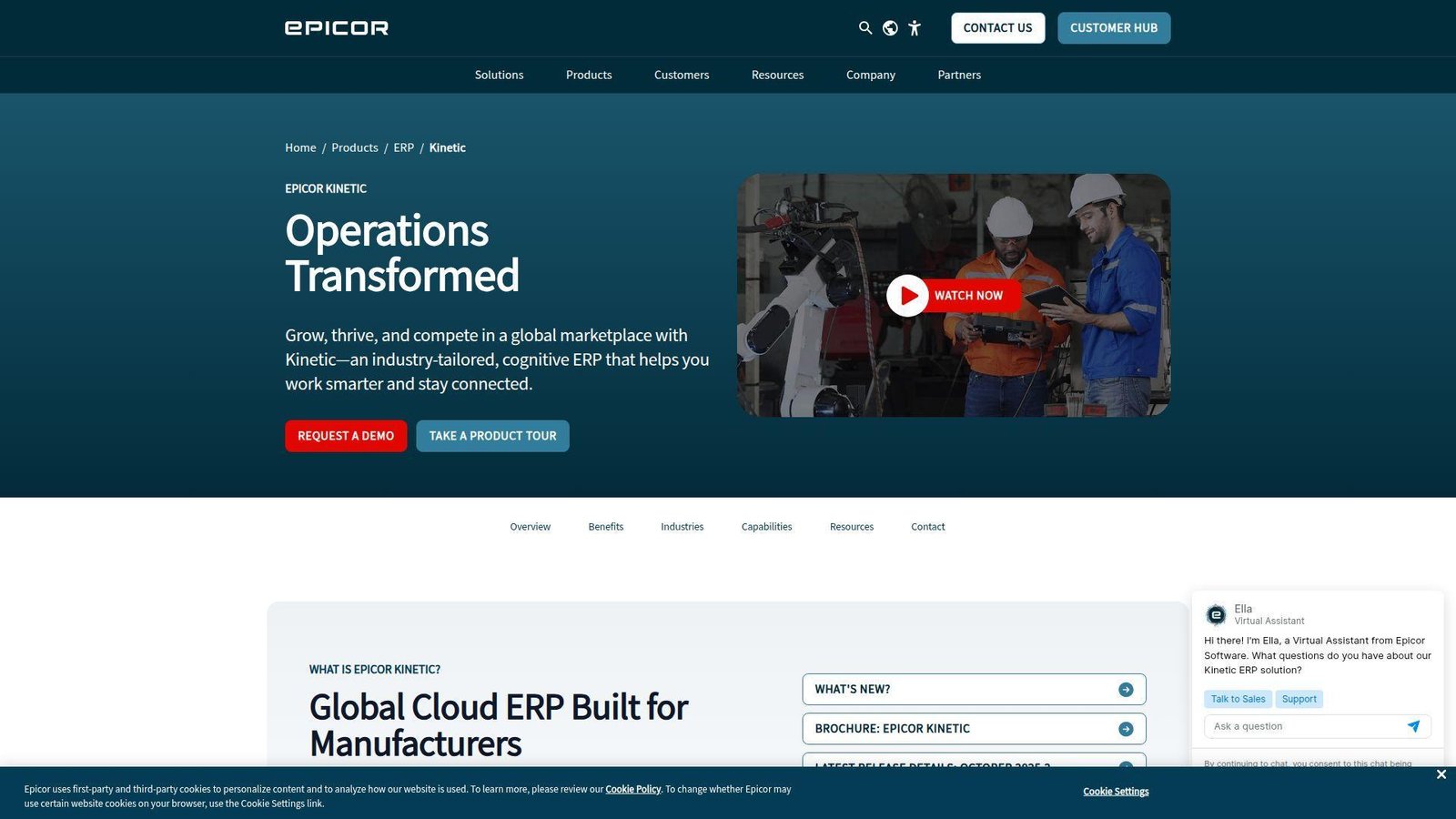
Epicor’s team has stayed close to manufacturers for decades, and Kinetic still feels like a product shaped by shop-floor realities. We usually like Epicor most when buyers care about production truth before they care about broad enterprise brand optics.
Best for: discrete manufacturers and make-to-order operations leaders.
- Manufacturing-centric BOM, MRP, and project flows → improve planning discipline and margin visibility.
- Browser UX and connected data tools → remove desktop lock-in and speed access to current operational data.
- Focused manufacturing rollout model → helps teams see plant-level wins early in the program.
Pricing & limits: From custom quote; demo-led evaluation rather than self-serve trial; deployment choice and module depth shape commercial scope.
Honest drawbacks: Native HR and CRM breadth is lighter than some larger suites. Multinational complexity is manageable, but not as naturally broad as SAP or Oracle. Beats generic suites on manufacturing feel; trails Plex on MES intimacy.
Verdict: If you need ERP to serve planners, buyers, and production leaders first, this helps you run a tighter manufacturing backbone without buying a global behemoth.
8. Sage
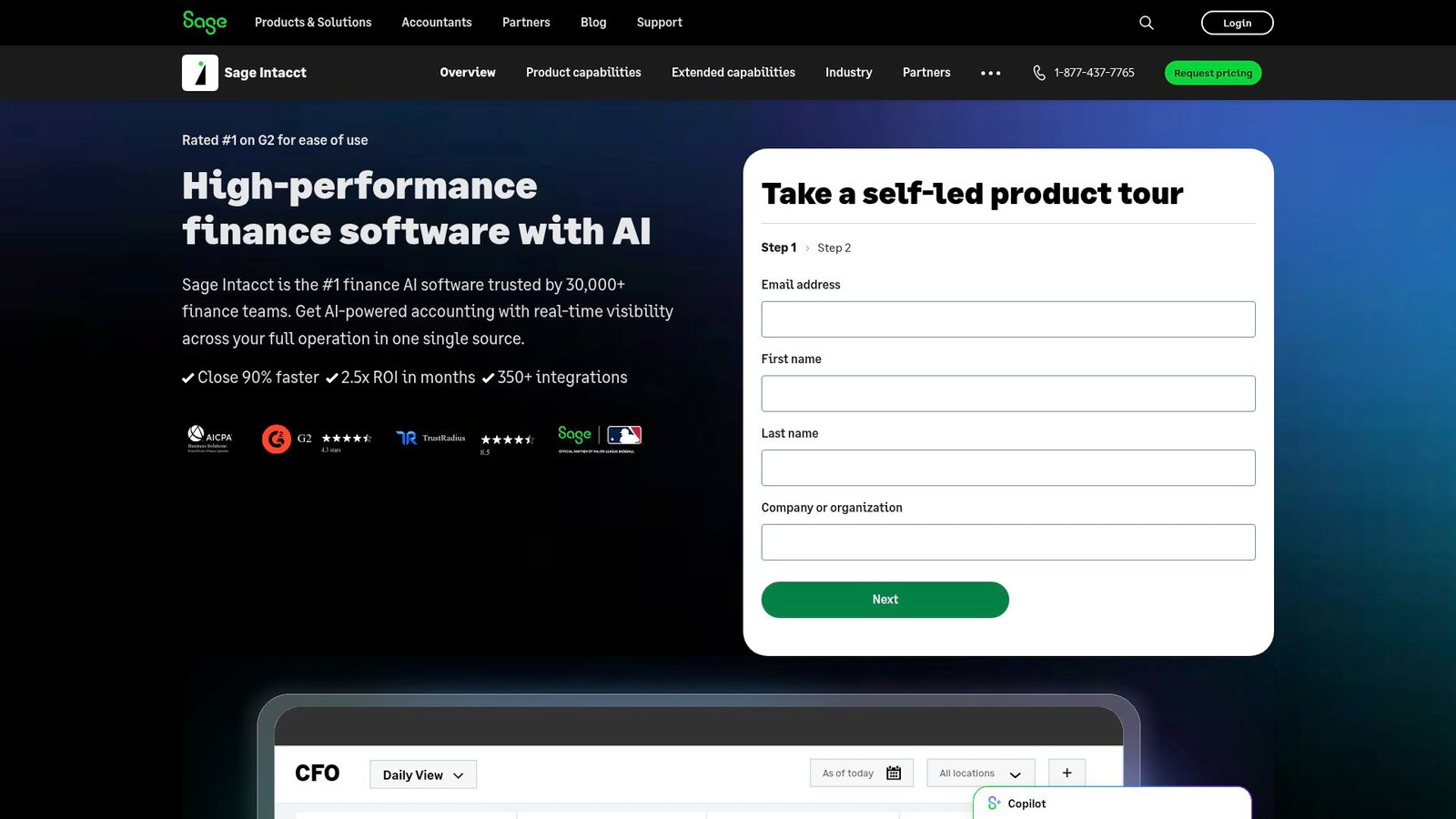
Sage is really a portfolio play, backed by teams that serve finance-led growth companies, mid-market distributors, and manufacturers through different products. We respect Sage most when a buyer knows whether they need Intacct-style finance depth, X3-style ERP breadth, or something more traditional.
Best for: finance-led mid-market firms and growing distributors or manufacturers.
- Strong financial management roots → improve close, reporting, and cash visibility quickly.
- APIs, analytics, and growing AI capabilities → reduce spreadsheet dependence and improve operational insight.
- Multiple product tracks → let teams choose a faster on-ramp based on current complexity.
Pricing & limits: From custom quote; buying is usually demo and consultation led; the main limit is product fit, because Intacct, X3, and Sage 100 serve very different levels of operational complexity.
Honest drawbacks: Sage can confuse buyers who assume the brand is one ERP with one path. Pick the wrong product and you either overbuy or outgrow it too soon.
Verdict: If finance is the first fire to put out and operations can mature in phases, this helps you move from accounting software habits toward structured ERP discipline.
9. QAD
QAD’s team knows manufacturing deeply and says so without apology. We find that refreshing. QAD is not trying to be every kind of ERP for every business. It is trying to be highly relevant for manufacturers facing volatility, compliance pressure, and plant-level complexity.
Best for: automotive operations teams and regulated global manufacturers.
- Six-vertical manufacturing design → improves out-of-the-box fit for real production and supply chain workflows.
- Champion AI, embedded analytics, and low-code extensibility → reduce exception hunting and manual process work.
- Adaptive UX and guided onboarding → help plants and global teams adopt the system with less friction.
Pricing & limits: From custom quote; evaluation is typically demo-led; cost and scope depend on edition, country needs, and the breadth of manufacturing and supply chain processes in play.
Honest drawbacks: QAD is a poor fit if you are not fundamentally a manufacturer. The ecosystem is also smaller than SAP or Microsoft, which can matter in some regions.
Verdict: If you want an ERP built to respect plant reality and global manufacturing variation, this helps you standardize without flattening the business into generic process shapes.
10. Acumatica
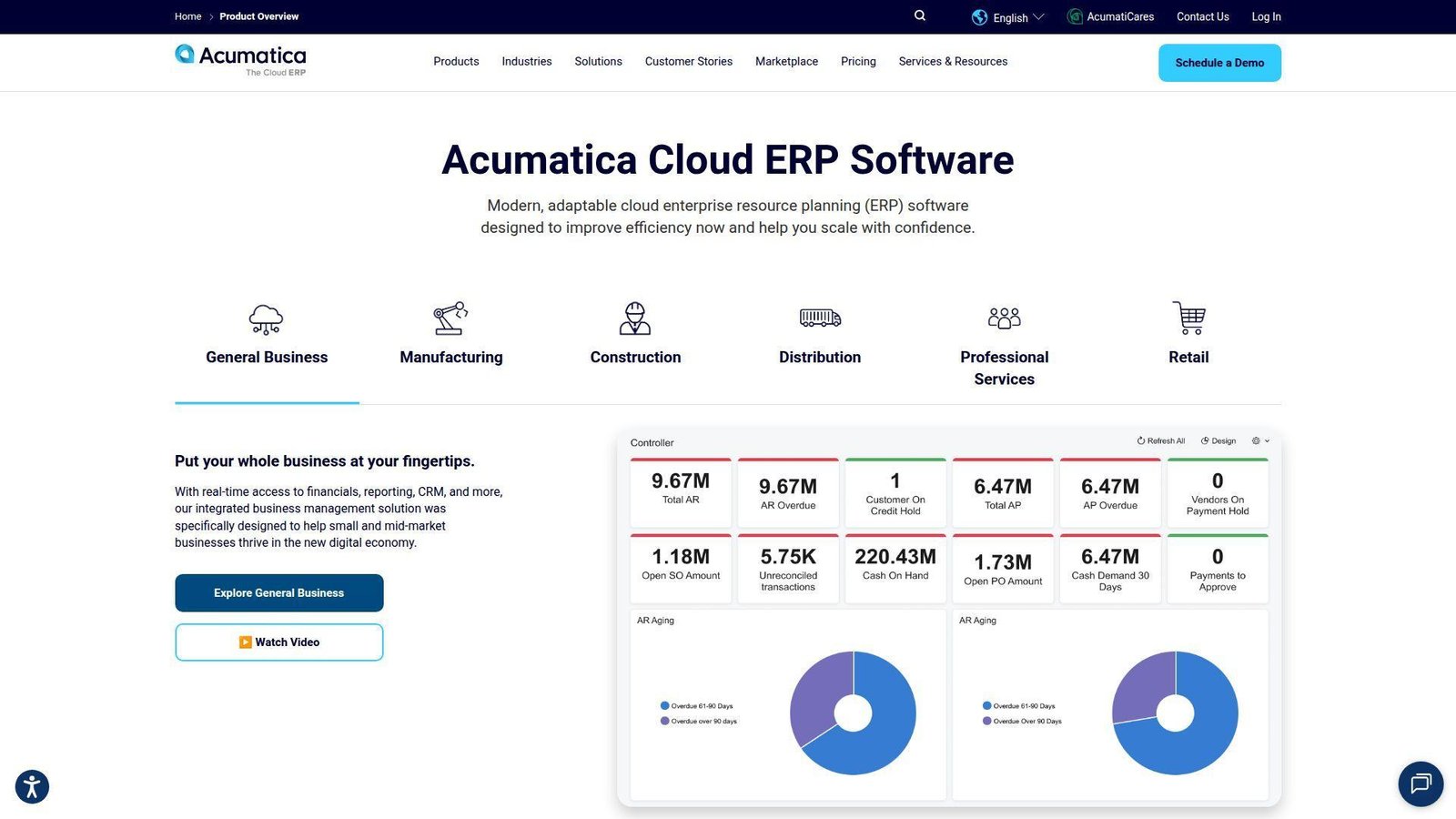
Acumatica has built a strong mid-market team and a partner motion that resonates with growth-stage operators. We think its clearest strategic move is pricing philosophy. Unlimited users changes behavior because companies stop rationing access to the system.
Best for: growing distributors and mid-market construction or manufacturing teams.
- Unlimited-user approach → expands adoption without the usual seat-license anxiety.
- Open APIs and partner ecosystem → remove integration bottlenecks and speed process extension work.
- Browser-based workflows and industry editions → help firms reach first value without a giant enterprise project.
Pricing & limits: From custom quote; pricing is based on applications, projected resources, and license choice; calculators and pricing reviews are available, but high transaction growth can push costs up over time.
Honest drawbacks: Acumatica is not Tier 1 global ERP, and buyers should not pretend otherwise. International localization and very large-enterprise controls are not its strongest card. Beats Sage on pricing clarity philosophy; trails Oracle on enterprise finance depth.
Verdict: If you need a modern mid-market ERP that many employees can actually use, this helps you scale access and process discipline without a giant-seat licensing tax.
11. Odoo
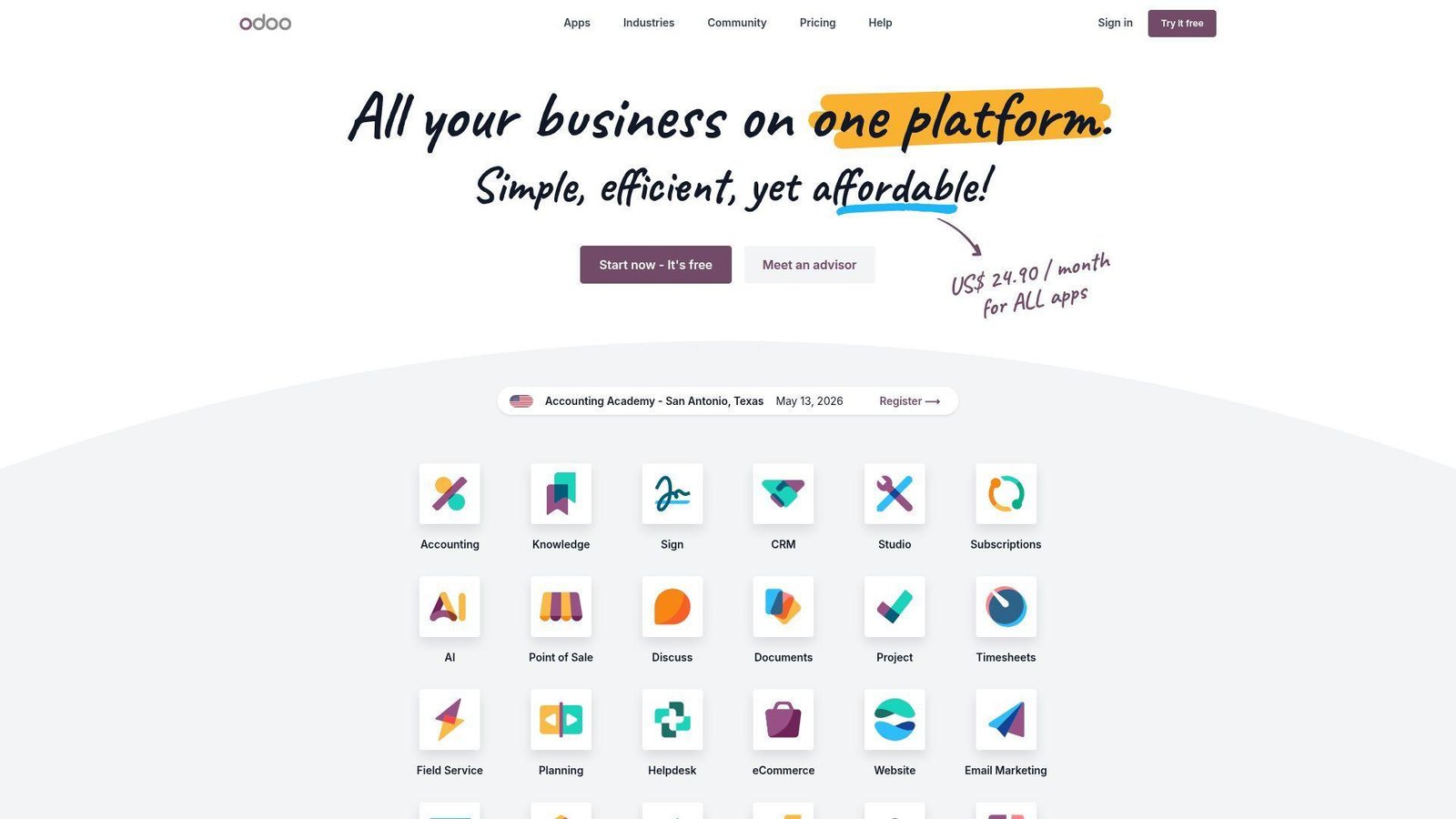
Odoo pairs a large commercial team with a huge app ecosystem and a modular mindset that appeals to practical operators. We like Odoo when a company wants one database for many day-to-day functions and is willing to trade some polish for speed, affordability, and flexibility.
Best for: startups and small businesses that want broad functionality fast.
- One database across CRM, accounting, inventory, and MRP → cuts tool switching and keeps data fresher.
- Studio, custom apps, and API options → automate repeated handoffs without rebuilding the whole stack.
- Instant cloud start and modular rollout → can deliver visible value in days for a focused scope.
Pricing & limits: From $0 for the one-app free plan, $31.10/user/mo for Standard, or $61.00/user/mo for Custom; free trial available; Standard includes all apps on Odoo Online, while Custom adds Studio, multi-company, and external API, and Odoo.sh hosting costs extra.
Honest drawbacks: Module depth varies, and enterprise-grade governance depends heavily on how well you control customization. Large regulated businesses often need more discipline than Odoo’s low-friction pitch suggests.
Verdict: If you want a broad ERP platform without a heavyweight price tag, this helps you unify core operations quickly and grow in stages.
12. SYSPRO
SYSPRO has stayed close to manufacturing and distribution, and that focus shows in the product. We tend to shortlist it when clients need practical control over inventory, production, and warehouse processes more than they need a fashionable brand story.
Best for: industrial distributors and mid-market manufacturers.
- Manufacturing and distribution-specific process depth → improves control over stock, planning, and fulfillment.
- Dashboards, KPIs, and operational insight → reduce lag between shop-floor activity and management decisions.
- Cloud and on-premise flexibility → gives teams a smoother path to early operational value.
Pricing & limits: From custom quote; demo-led buying is standard; scope is shaped by deployment model, module mix, and user requirements.
Honest drawbacks: The UX is improving, but it still feels less modern than some native SaaS rivals. Global ecosystem reach is also narrower outside its core industries and regions.
Verdict: If you want steady manufacturing or distribution control without a bloated enterprise suite, this helps you run a cleaner operation with fewer moving parts.
13. Plex
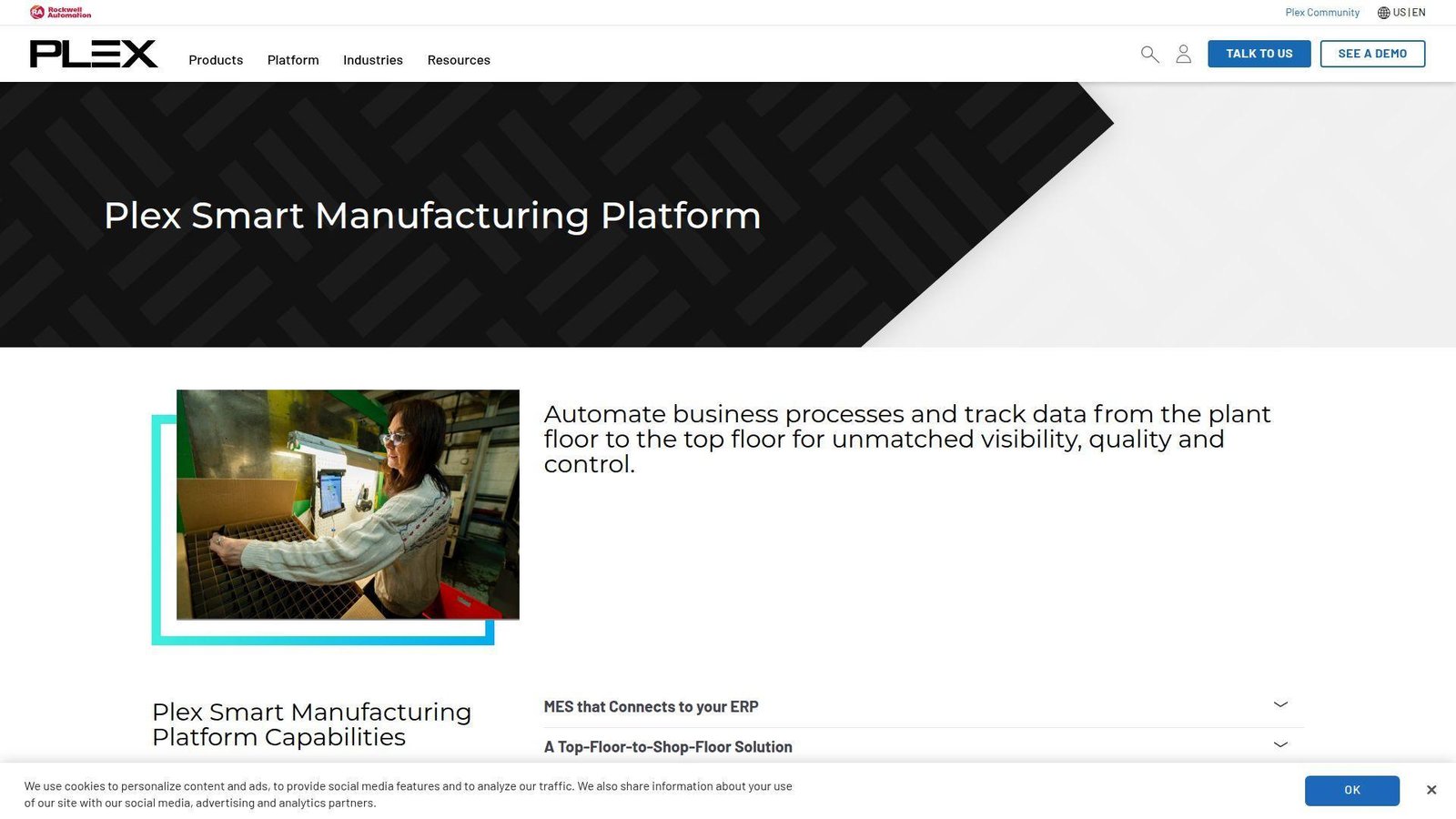
Plex, backed by Rockwell Automation, brings a manufacturing-first team and a platform that ties ERP closer to MES, QMS, and plant data than most generalists can. We see Plex as a serious option when production truth matters as much as finance truth.
Best for: plant operations leaders and quality-driven manufacturers.
- ERP, MES, and QMS in one manufacturing platform → create end-to-end visibility from the shop floor up.
- Machine, quality, and supply chain connectivity → remove paper trails and reduce rekeying across operations.
- Cloud manufacturing focus → helps targeted plants show usable value early in rollout.
Pricing & limits: From custom quote; buying is walkthrough and demo led; the strongest value case appears when you use Plex for more than back-office ERP alone.
Honest drawbacks: Plex is not ideal outside manufacturing. If your complexity lives in services, HR, or broad corporate administration, you may need more surrounding software.
Verdict: If you want ERP that speaks fluently to production, quality, and supply chain execution, this helps you close the gap between plant events and business decisions.
14. Deltek
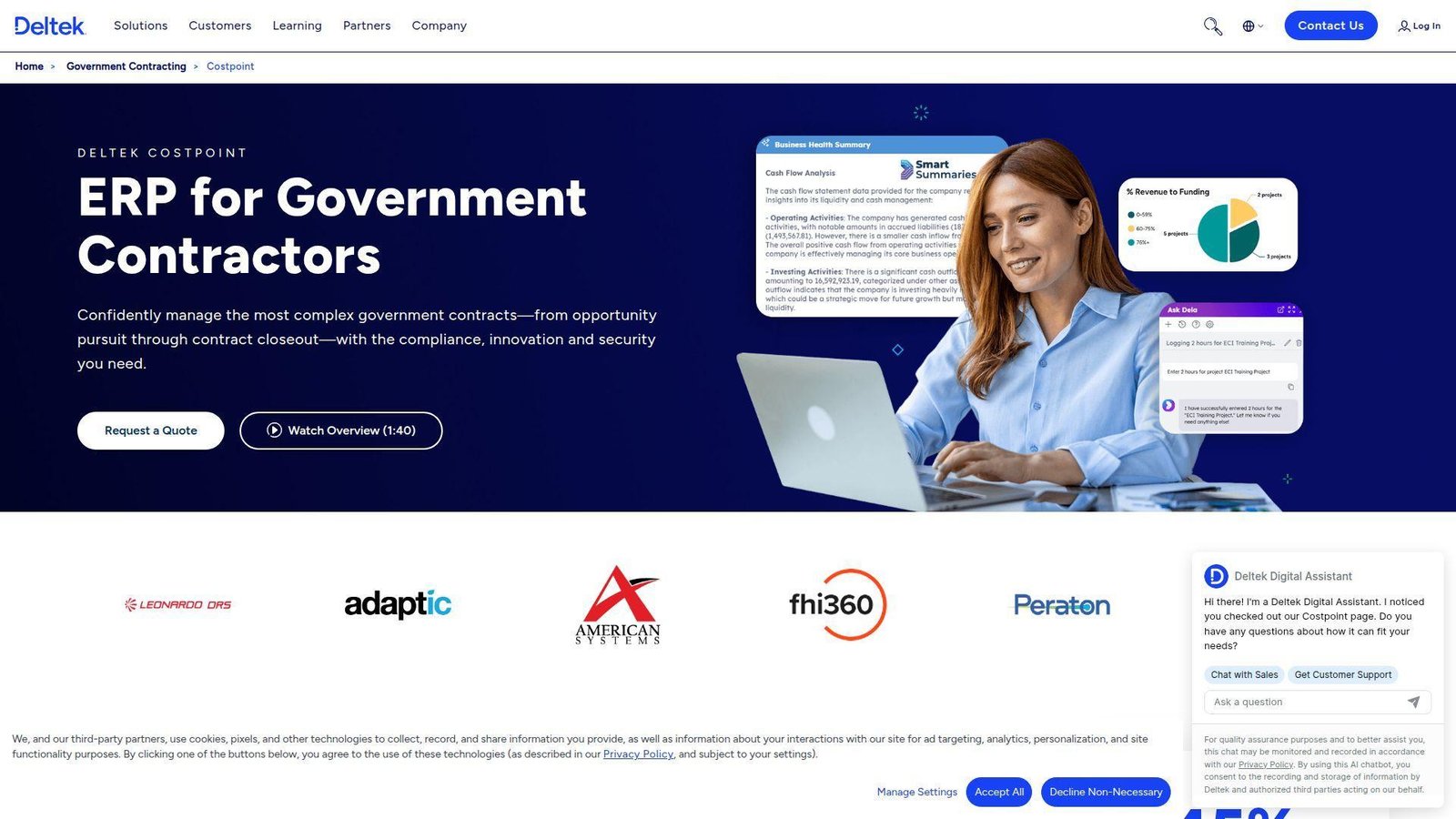
Deltek’s Costpoint team is unapologetically focused on project-centric and government contracting realities. We like that clarity. In GovCon, generic ERP often dies on compliance nuance, indirect rates, and audit readiness long before it dies on user interface complaints.
Best for: small government contractors and compliance-heavy project businesses.
- Project accounting and contract-focused controls → keep finance, projects, and compliance aligned in one system.
- Time, expense, budgeting, and BI in one flow → reduce manual billing work and improve margin visibility.
- Essentials package for smaller firms → gives teams a faster route to usable value than a full custom rollout.
Pricing & limits: From $800/mo for Costpoint Essentials based on a ten-user license, with implementation included; no free full trial; Essentials bundles core ERP, time and expense, business intelligence, and budgeting and forecasting.
Honest drawbacks: Outside GovCon and similar project-heavy environments, Costpoint can feel overly specialized. The terminology and workflow model are not built for casual SMB buyers.
Verdict: If FAR rules, billing detail, and audit posture shape your week, this helps you grow without gambling on software that was never designed for federal complexity.
15. Unit4
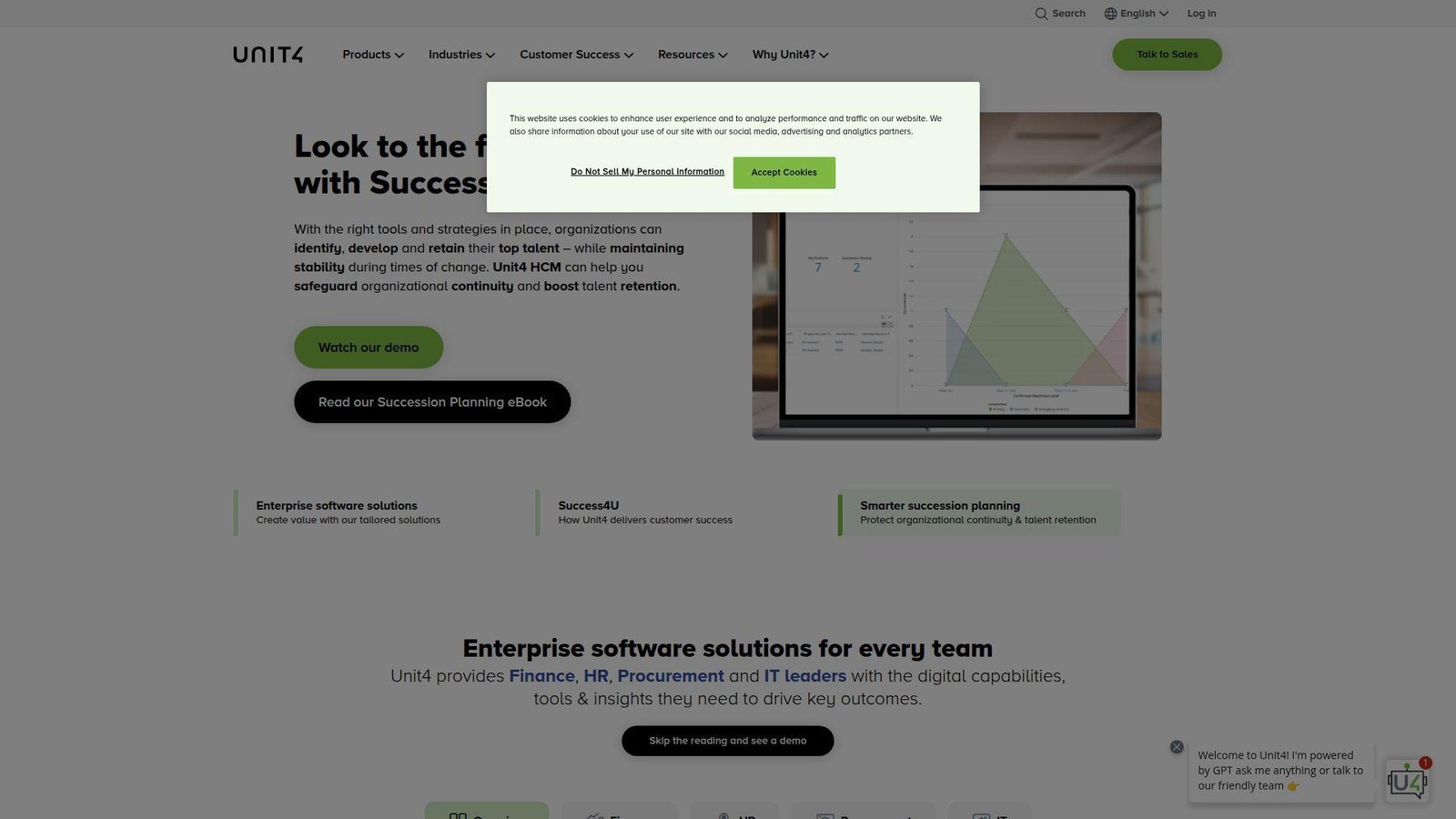
Unit4 has kept its attention on people-centric organizations, and that focus gives ERPx a different flavor from product-centric suites. We think it is strongest where projects, grants, public funding, or service delivery sit closer to the heart of the business than physical production does.
Best for: professional services firms and public sector or higher education finance teams.
- Unified finance, project, and people processes → improve service margin control and reduce admin clutter.
- Microservices and managed integrations → cut custom work and make change easier to absorb.
- People-first user experience → helps service organizations reach meaningful adoption faster.
Pricing & limits: From custom quote; evaluation is demo-led; pricing depends on country scope, project complexity, and the people-process modules required.
Honest drawbacks: Unit4 is not the right answer for discrete manufacturing. Its market visibility in North America also tends to be lower than Workday, Oracle, or Microsoft. Beats product-centric ERPs for service workflows; trails Workday on brand pull.
Verdict: If your organization sells expertise, projects, or public services rather than products off a line, this helps you run finance and delivery with less friction.
16. Priority Software
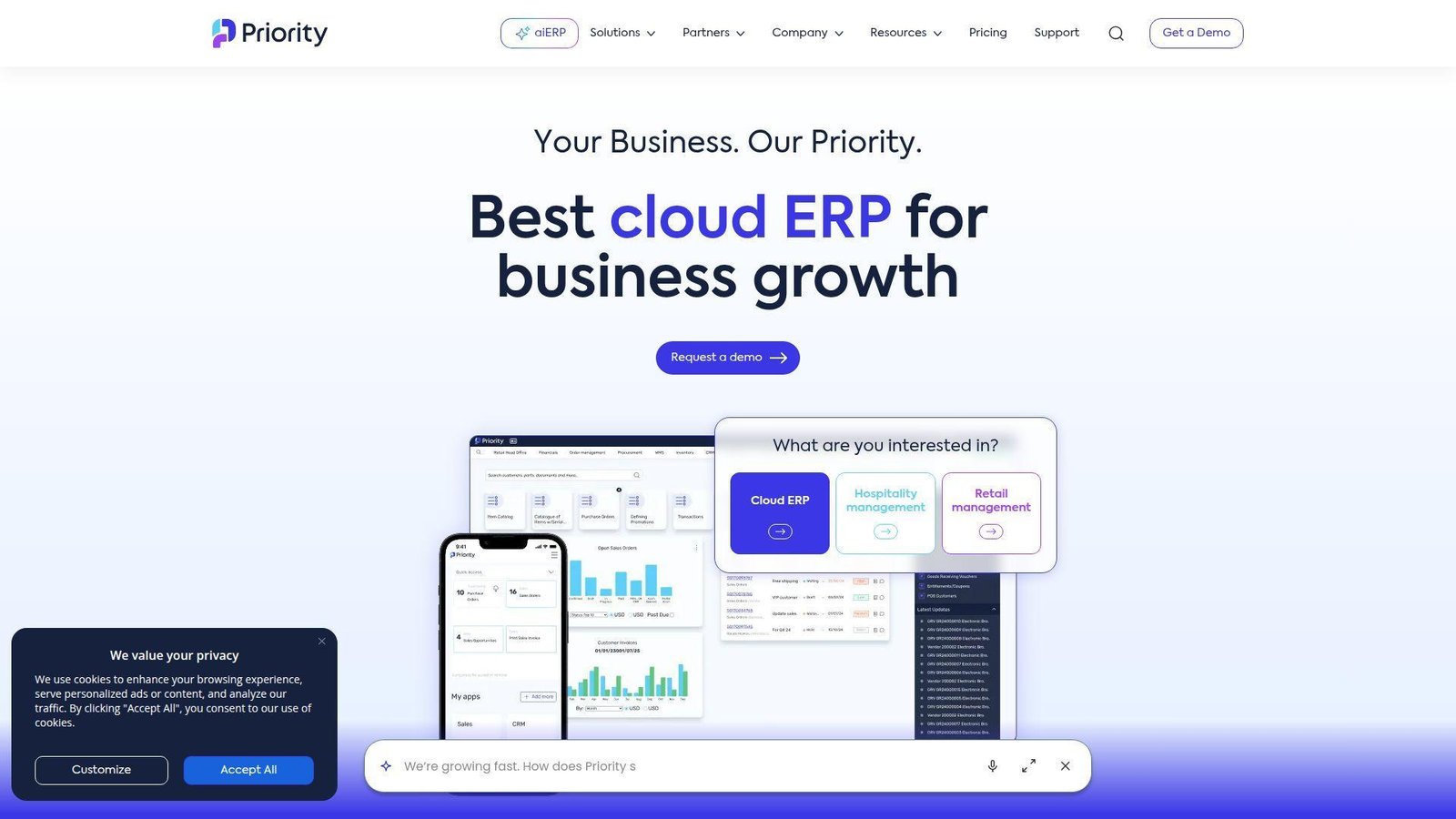
Priority has built an open cloud ERP story that feels more adaptable than many older suites, and its team has pushed hard on embedded AI through aiERP. We tend to like Priority when buyers want a flexible mid-market platform without jumping straight to Tier 1 overhead.
Best for: multi-site mid-market operators and agile manufacturers or distributors.
- Open cloud platform with broad localization options → supports growth into new workflows and regions with less friction.
- Embedded AI and natural-language interaction → reduce reporting, alerting, and rule-building effort.
- SaaS delivery on AWS → helps teams reach usable value quickly without heavy infrastructure work.
Pricing & limits: From custom quote; buying is demo-led; cost is shaped by industry package, localization, and the modules you activate.
Honest drawbacks: North American ecosystem depth is lighter than Microsoft or Oracle. Buyers should also validate partner capability carefully if the rollout is complex.
Verdict: If you want an adaptable cloud ERP with a more modern AI posture than many mid-market incumbents, this helps you automate without buying a giant enterprise machine.
17. Exact
Exact has long served small and mid-sized firms that need more structure than accounting software but less theater than a giant enterprise program. We like it when the goal is to get distribution or manufacturing discipline in place without overengineering the stack.
Best for: small manufacturers and wholesale distributors.
- Integrated financials, CRM, and stock management → reduce app sprawl and keep core data aligned.
- Industry packages for distribution and manufacturing → shorten setup and improve fit for common workflows.
- Self-serve cloud packaging → makes first value possible very quickly for standard needs.
Pricing & limits: From $237/mo for Wholesale Distribution or $422/mo for Manufacturing; free trial available; higher editions and extensions raise monthly cost, and the product is better suited to SMB complexity than global enterprise sprawl.
Honest drawbacks: Exact is not where we would start for very complex multinational structures. The customization ceiling is also lower than what larger platforms can support.
Verdict: If you want structured ERP without dragging your company into a giant transformation program, this helps you modernize core operations with a smaller footprint.
18. Aptean
Aptean is best understood as a portfolio of industry-specific ERP teams rather than one monolithic product. We find that both attractive and risky. Attractive because the fit can be sharp. Risky because buyers must validate the exact product behind the brand.
Best for: food and beverage operators and process-oriented manufacturers.
- Micro-vertical workflows such as traceability, formulation, and QA → reduce the need for workaround-heavy custom design.
- Industry-tailored automation and cloud options → cut manual quality, lot, and compliance steps.
- Focused vertical implementation motions → help teams land value around a specific operational pain point first.
Pricing & limits: From custom quote; evaluation is usually demo-led; pricing and rollout limits depend heavily on the specific Aptean ERP product selected.
Honest drawbacks: Portfolio complexity is the real deal-breaker here. Some buyers think they are choosing a single platform when they are really choosing among several different codebases and roadmaps.
Verdict: If generic ERP keeps missing your industry’s ugly edge cases, this helps you buy closer to the shape of the actual work.
19. abas ERP
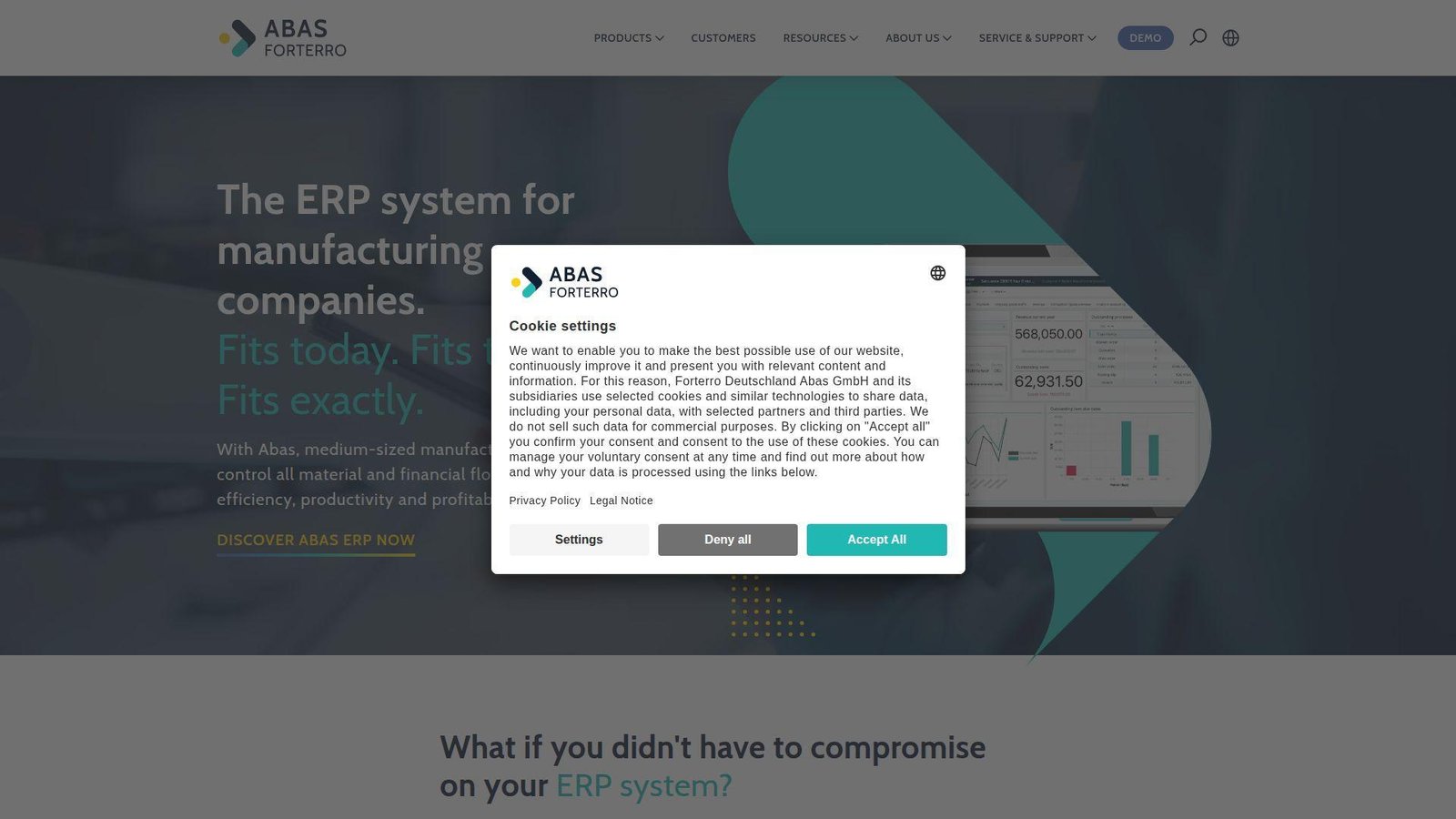
abas stays close to midsize manufacturing, and that focus gives it a practical, grounded feel. We appreciate its stance on controlled customization. Too many ERP systems promise flexibility and then punish every upgrade. abas tries to avoid that trap.
Best for: midsize manufacturers and planning-heavy operations teams.
- Strong scheduling and production control → improve cross-department planning and reduce firefighting.
- Low-code adjustment tools with upgrade compatibility → save rework when the business evolves.
- Midmarket-focused implementation style → helps teams see value without enterprise-scale overhead.
Pricing & limits: From custom quote; demos and consultations are available; costs vary with user count, migration scope, process complexity, and required adjustments.
Honest drawbacks: The ecosystem is smaller than mainstream leaders, especially in North America. Brand familiarity in boardrooms is also lower, which can slow internal buy-in.
Verdict: If you want manufacturing depth and controlled customization without drifting into endless service bills, this helps you stay adaptable while protecting upgrade paths.
20. Rootstock
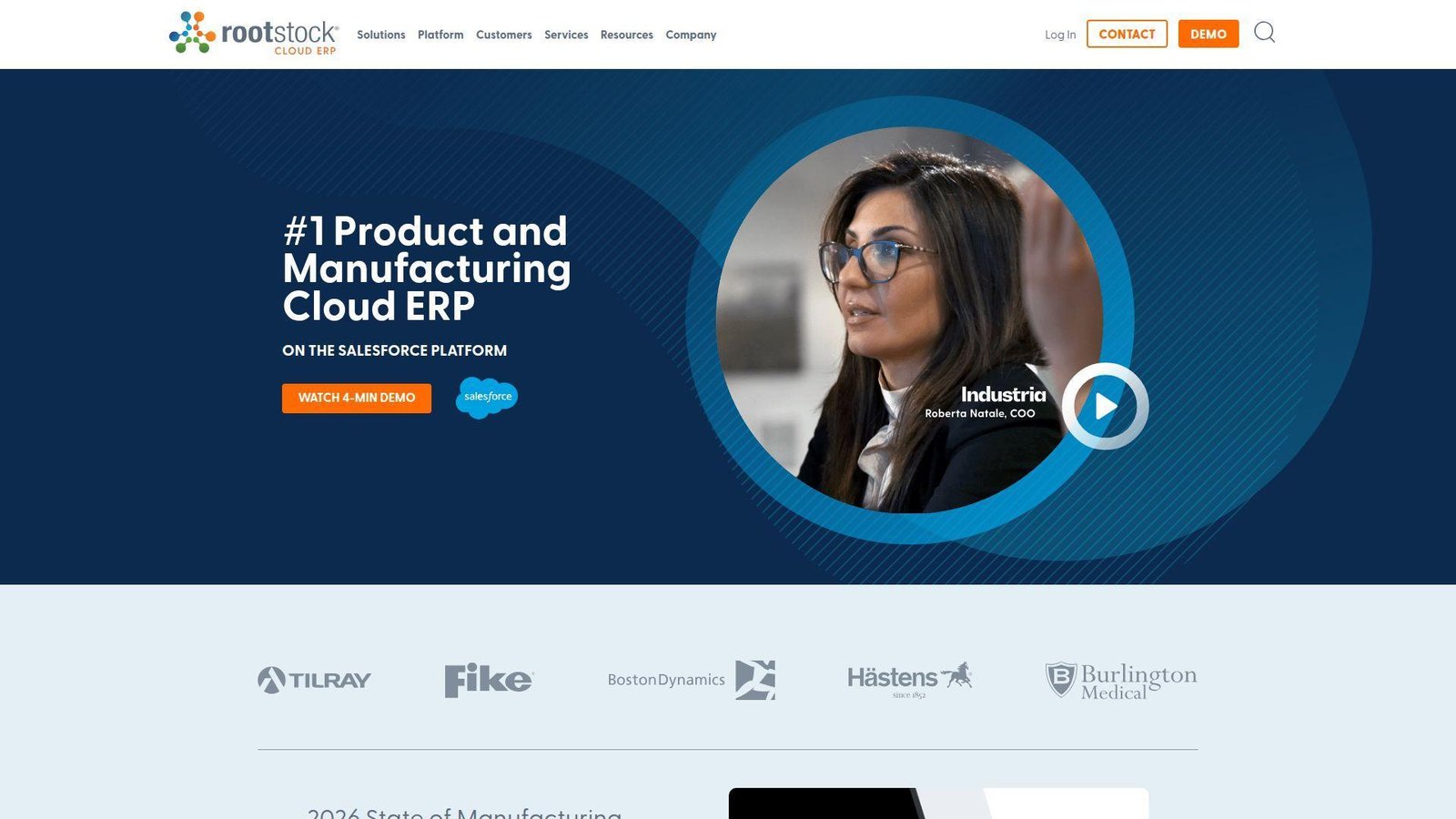
Rootstock has built a clear identity around manufacturing ERP on the Salesforce platform, and that identity is useful. We shortlist it when CRM and ERP need to behave like one system instead of two systems shaking hands through middleware.
Best for: Salesforce-centric manufacturers and growth-minded operations teams.
- One cloud and one data model with Salesforce → improve visibility from sales through fulfillment and service.
- Low-code tailoring and AppExchange ecosystem → reduce bespoke integration work and speed change delivery.
- Manufacturing-focused rollout path → helps teams prove value around sales-to-operations flow early.
Pricing & limits: From custom quote; buying is demo-led; total cost depends on Rootstock scope plus Salesforce licensing and ecosystem choices.
Honest drawbacks: Rootstock makes the most sense if you are already comfortable with Salesforce. Firms seeking very deep global corporate finance controls may still prefer Oracle or SAP. Beats bolt-on connectors at CRM-ERP unity; trails Microsoft on broad portfolio range.
Verdict: If customer, supply chain, and operational data all need to live on one cloud backbone, this helps you remove handoff friction and scale cleaner.
Recommended reading: Top 20 Professional SEO Services for Finding the Right SEO Partner
How ERP Companies Differ by Business Size, Industry, and Deployment
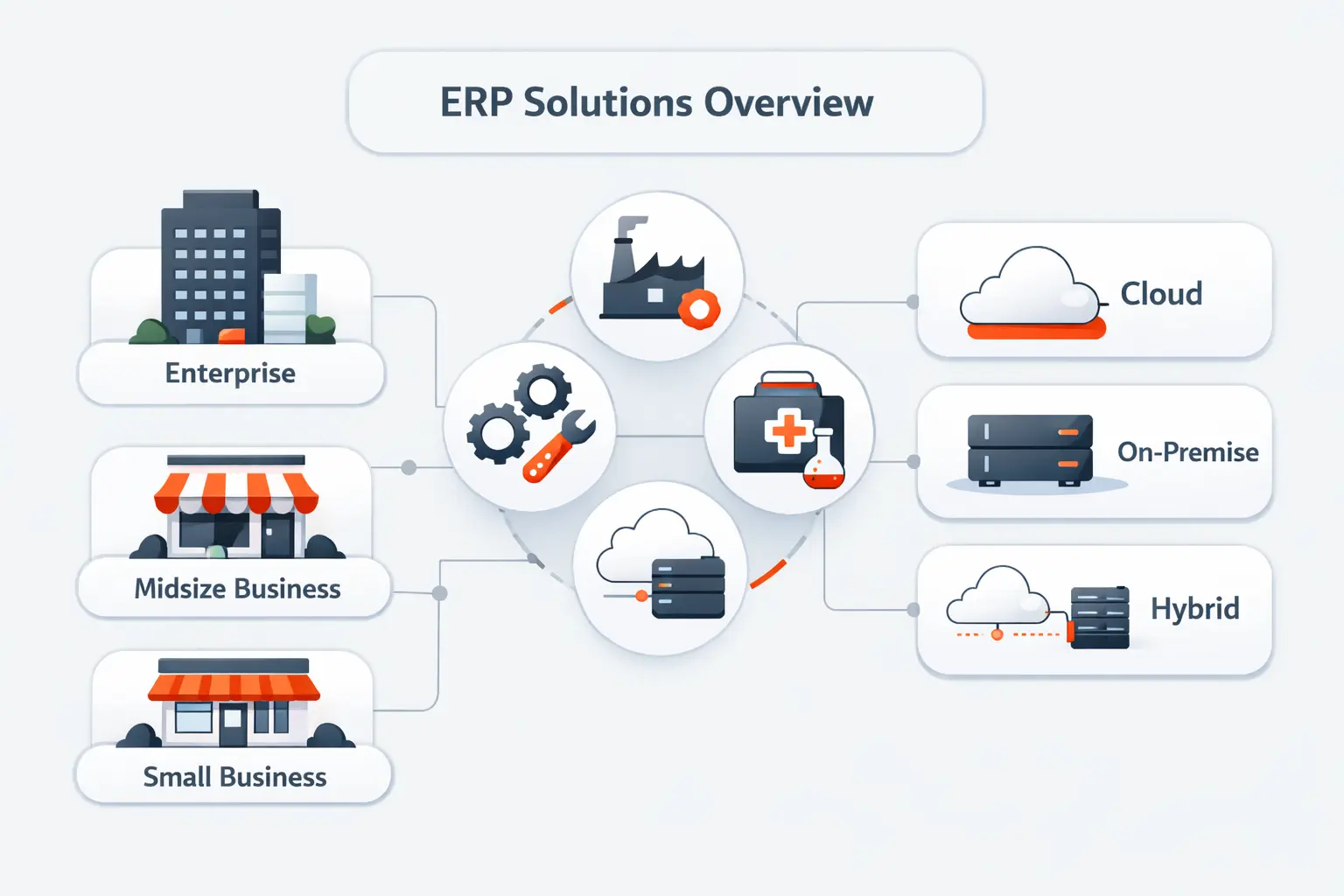
We do not sort ERP companies by brand prestige alone. We sort them by the operational stress they are built to absorb. A small medical device maker can need more rigor than a much larger agency. Likewise, a services firm may care more about utilization and project margins than plant scheduling or warehouse control.
Tier 1 ERP Companies for Complex Global Operations
In our book, Tier 1 means multi-entity finance, intercompany complexity, localization, procurement governance, and a platform that can survive a board’s appetite for expansion. SAP and Oracle live here comfortably. Microsoft reaches into this class with its larger Dynamics 365 stack, while Workday earns its place for service-centric enterprises that want finance, HR, and planning on one data foundation.
The trade-off is obvious. Tier 1 platforms bring more process depth, but they also bring more decisions, more governance, and more change fatigue. We advise buyers to choose Tier 1 only when their complexity is real, repeatable, and expensive enough to justify the heavier operating model.
Mid-Market ERP Companies for Fast-Growing Businesses
Mid-market ERP vendors tend to win on speed, focus, and total cost discipline. Acumatica, Epicor, Sage, SYSPRO, Odoo, Exact, and Priority all compete here in different ways. Some lead with finance. Others lead with operations. The better ones let you phase the journey instead of forcing a one-shot transformation.
We often tell growth-stage companies to look for the vendor that removes the next bottleneck, not every imaginable future bottleneck. If the business mainly needs cleaner inventory control, faster closes, and stronger order visibility, a sharp mid-market ERP usually beats a sprawling enterprise suite.
Industry-Specific ERP Companies for Manufacturing, Distribution, Services, Education, and Public Sector
This is where the shortlist gets interesting. QAD, Plex, IFS, Deltek, Unit4, Aptean, abas, and Rootstock all bring stronger specialization than broad horizontal vendors in at least one lane. That matters because industry fit is where implementation time quietly lives. The more a system already understands lot traceability, government contracts, field service, or grant accounting, the less time you spend inventing workarounds.
We prefer specialists when failure is driven by process nuance rather than by simple scale. Manufacturing, public sector, education, and regulated industries often land here. A vendor that knows the nouns and verbs of your business can save far more than a prettier dashboard ever will.
Cloud, On-Premise, and Hybrid ERP Models
Cloud is the default now, but default is not the same as universal. We still see on-premise or hybrid models make sense where shop-floor latency, local control, custom peripherals, or regional data requirements are material. Hybrid is especially common during transition years, when core finance moves first and plant systems follow later.
That said, cloud usually wins when the real objective is one operating cadence, one security model, and one cleaner data backbone. Rootstock highlights Equipter’s 30% YOY growth, and the larger lesson for us is that standardized cloud process data compounds faster than heroic custom integrations ever do.
Recommended reading: Top 20 Sydney Web Design Companies for Businesses That Want Better Results
How to Evaluate and Shortlist ERP Companies
We are strict about ERP evaluation because the cost of a bad choice lingers for years. Deloitte highlights Gartner research showing more than 70% of recently implemented ERP initiatives may fail to fully meet their original business case goals, and most misses start in scoping, sponsorship, or change management rather than in code.
Industry Fit, Functional Breadth, and Deployment Flexibility
We start with fit. Not brochure fit. Workflow fit. Ask each vendor to run your hardest scenarios in sequence, with your terms and your exceptions. For a manufacturer, that might be engineer-to-order quoting, constrained planning, subcontracting, and warranty traceability. For a services firm, it might be project staffing, revenue recognition, subcontractor billing, and multi-entity reporting.
Functional breadth matters too, but only after you confirm the depth of the few workflows that actually drive margin, risk, and speed. Deployment flexibility is the third leg. Some buyers need pure SaaS. Others need a staged hybrid plan. The shortlist should reflect the road you can actually travel.
Integrations, Data Visibility, and Scalability
An ERP succeeds when it becomes a system of operational truth. That requires strong integration thinking from day one. We look for APIs, event support, connector maturity, and a sane way to manage master data across CRM, eCommerce, WMS, PLM, MES, banking, payroll, and reporting tools.
Visibility is not just dashboards. It is the confidence that finance, operations, and service teams are reading from the same underlying reality. Scalability works the same way. It is not only user growth. It is transaction growth, entity growth, country growth, and exception growth. Many systems handle the easy path well. The better ones stay coherent when complexity arrives.
Implementation Partners, Support, Training, and Change Management
We have seen brilliant software dragged down by mediocre partners and average software rescued by disciplined implementation teams. Partner quality is not a side issue. It is often the whole game. Ask who owns migration, testing, configuration, training, reporting, and post-go-live support. Then ask who on your side owns process decisions.
Training should be role-based, not generic. Change management should begin before configuration is finished, not after. We also prefer buyers who name internal champions in finance, operations, and IT early. ERP has a way of dragging hidden process problems into daylight. That is useful, but only if the organization is ready to act on what it sees.
Total Cost of Ownership, Vendor Stability, and Long-Term Roadmaps
Total cost of ownership is where many buyers lose the thread. License fees are only the opening move. The real bill includes implementation, integrations, testing, data cleanup, custom reports, sandbox needs, training, admin time, and the cost of carrying old process habits into a new system.
We also study vendor roadmaps closely. A vendor with strong product focus, coherent platform strategy, and clear investment in AI, extensibility, and industry updates is usually safer than one growing mainly by stitched-together acquisitions. Stability matters. So does direction. You are not buying software for launch day alone. You are buying a change companion for years.
Recommended reading: Top 20 IT Outsourcing Companies for Growth, Innovation, and Scale
Key Trends Reshaping ERP Companies in 2026
In 2026, ERP companies are no longer judged only as systems of record. We increasingly judge them as systems of action. That means buyers now care about how software senses events, recommends decisions, automates work, and keeps humans in control without slowing everything to a crawl.
AI Agents, Copilots, and Embedded Automation
There is a real difference between a copilot that explains data and an agent that can act on it. We think the strongest ERP vendors are moving carefully from suggestion to execution. Accounts payable, demand planning, inventory balancing, procurement triage, and service dispatch are the obvious early zones because the rules are clearer and the outcomes are measurable.
The catch is governance. Agentic ERP only works if permissions, audit trails, approval thresholds, and exception handling are designed well. Otherwise, automation simply makes mistakes faster. We tell clients to pilot agents where the process is repetitive, the controls are explicit, and the business owner is willing to tune the model.
Micro-Verticalization and Industry-Specific Cloud Suites
Generic ERP still sells, but micro-vertical ERP increasingly wins. Vendors now package data models, KPIs, workflows, terminology, and compliance patterns for narrower industry segments because the market has learned a blunt lesson: process specificity lowers project risk.
We see this especially in food and beverage, automotive, life sciences, professional services, public sector, education, and asset-heavy industries. The more the ERP already understands your vocabulary, the less time your team wastes translating business reality into generic software abstractions.
Composable Platforms, Open Ecosystems, and Low-Code Extensibility
Composable architecture matters because no ERP, no matter how broad, will cover every edge case. The vendors gaining ground are the ones that let teams extend the system without poisoning the core. That means cleaner APIs, low-code tooling, event-driven integration patterns, and better marketplace ecosystems.
We prefer a clean-core approach whenever possible. Keep financial integrity and core transactions stable. Extend rapidly at the workflow edges where the business changes fastest. That one design principle can save a company from years of upgrade pain.
Supply Chain Visibility, Sustainability, and Resilience
Supply chain visibility is now bound up with resilience, customer promise accuracy, and sustainability reporting. ERP vendors are responding by pushing deeper into traceability, scenario planning, supplier risk monitoring, and operational analytics that connect procurement, inventory, transport, and service performance.
We view this as more than compliance work. Better visibility lets companies make fewer blind bets. It helps them reroute demand, protect service levels, and answer increasingly pointed questions from customers, regulators, and investors without hunting through disconnected systems.
Recommended reading: Top 20 Product Development Companies: Complete Guide and Selection Criteria
ERP Companies FAQ
These are the questions we hear most often in discovery calls, boardroom prep, and software replacement projects. The answers sound simple on the surface, but they matter because a weak shared definition usually leads to a weak shortlist.
What Do ERP Companies Actually Do?
ERP companies build software platforms that connect core business processes such as finance, procurement, inventory, production, projects, payroll, service, and reporting. The best ones do more than store transactions. They create a shared operating logic across departments, so decisions are based on one version of the business rather than on a patchwork of tools.
In practice, that means ERP companies are selling structure. They help businesses standardize workflows, reduce duplication, enforce controls, and gain visibility across operations. Some vendors do this broadly. Others do it best within one industry or business model.
Who Are the Largest Players in the ERP Market?
The largest and most visible names are still SAP, Oracle, Microsoft, and Workday, especially when you look at large-enterprise influence and global reach. Infor, IFS, Sage, Epicor, and Acumatica also matter a great deal in their respective segments, while specialists like Deltek, QAD, Unit4, Plex, and Rootstock can be stronger choices in the right context.
We caution buyers not to confuse “largest” with “best fit.” Some of the smartest ERP decisions we see are won by vendors with narrower focus but stronger relevance to the actual business.
What Does ERP Mean for Modern Organizations?
For a modern organization, ERP means operational coherence. It means finance can trust operations data, operations can trust demand data, and leadership can ask one question without getting four conflicting answers. That sounds almost mundane, but it is the foundation for margin control, forecasting, automation, and scalable growth.
Today, ERP also means a data backbone for AI. If workflows are fragmented and master data is messy, AI adds noise. If the ERP core is clean, AI can actually help people move faster and make better calls.
How Do You Match an ERP Company to Your Business Size and Industry?
We match by complexity first, size second. Start with industry workflows, regulatory demands, operating geography, and integration needs. Then look at business size, budget, and change capacity. A specialized mid-market vendor may be the right answer for a complex manufacturer, while a Tier 1 suite may be needless drag for a simple distributor.
The practical rule is this: buy the smallest platform that can handle your real complexity without breaking in two years. That usually produces a healthier decision than buying the biggest brand your board already recognizes.
What Is the Difference Between Cloud, On-Premise, and Hybrid ERP?
Cloud ERP is vendor-hosted and usually subscription-based. It tends to reduce infrastructure overhead and improve update cadence. On-premise ERP runs in your own environment and can still make sense where control, latency, or legacy dependencies are significant. Hybrid ERP combines both, often as a transition strategy rather than a permanent ideal.
We generally favor cloud unless there is a specific operational or regulatory reason not to. Hybrid is often a bridge. On-premise is a deliberate exception. The right model depends on how much standardization, speed, and technical control your business truly needs.
How TechTide Solutions Helps Businesses Build ERP-Ready Custom Solutions
This is the part we know from the inside. At TechTide Solutions, we rarely try to replace the ERP core. More often, we build the missing layers that make an ERP rollout usable, measurable, and scalable in the real world. That edge work is where many projects either harden or unravel.
Custom Software Development for ERP-Centric Workflows
We build custom software around ERP-centric workflows that standard suites often handle awkwardly. That can mean customer portals, supplier portals, approval apps, field data capture, quote configurators, quality workflows, or niche order-entry experiences tied back to the ERP as the system of record.
Our bias is to keep the core clean and move fast at the edges. If a workflow changes every quarter, it probably should not be welded deep into the ERP. We would rather design a stable integration contract and let the business-facing experience evolve safely.
ERP Integrations, Dashboards, and Process Automation
Integration is where ERP projects earn their keep. We help businesses connect ERP with CRM, WMS, MES, eCommerce, payment systems, BI layers, EDI feeds, and custom apps so data moves with less human friction. We also build dashboards that matter to operators, not just to executives. A good dashboard answers what changed, why it changed, and what should happen next.
On automation, we focus on removing swivel-chair work. That includes approvals, notifications, reconciliations, exception routing, and data synchronization. The goal is not automation for its own sake. It is fewer handoffs, cleaner auditability, and faster response when the business moves.
Scalable Web and Application Solutions Tailored to Industry Needs
Different industries need different edges. Manufacturers may need shop-floor tools, supplier collaboration, or production visibility apps. Distributors may need customer order status portals and warehouse mobility. Service organizations may need project dashboards, billing workflow apps, or self-service resource requests.
We design those solutions to scale with the ERP, not compete with it. That means stronger API strategy, clearer security boundaries, and interfaces that reflect the actual job a user is trying to complete. When that alignment is right, ERP adoption gets easier because people experience the system through work that feels native to them.
Final Thoughts on Choosing among ERP Companies
Choosing among ERP companies is less about who gives the flashiest demo and more about what kind of operating discipline you want five years from now. The right platform sharpens margins, reveals bottlenecks, and helps good teams move with less drag. The wrong one turns every close, every replenishment cycle, and every exception into archaeology.
If we were starting the shortlist tomorrow, we would map the hardest workflows first, test the data model second, and judge implementation discipline third. Which bottleneck is costing you more today: delayed visibility, manual handoffs, or brittle integrations?

