


At TechTide Solutions, we see many teams treat IoT cloud architecture like a one-time diagram. We think that misses the point. A sound architecture is the operating plan for how devices sense, send, store, analyze, and act. The stakes are large enough to deserve that discipline. McKinsey estimates IoT could generate up to $12.5 trillion by 2030, which is why small design mistakes can become expensive later. We prefer to start with plain questions. What must happen on the device? What can wait for the cloud? And what happens when the network drops? Once those answers are clear, vendor choices become much easier. In this guide, we walk through the layers, models, data flow, use cases, and habits we use to keep connected systems practical, secure, and worth maintaining.
What IoT Cloud Architecture Is and Why It Matters
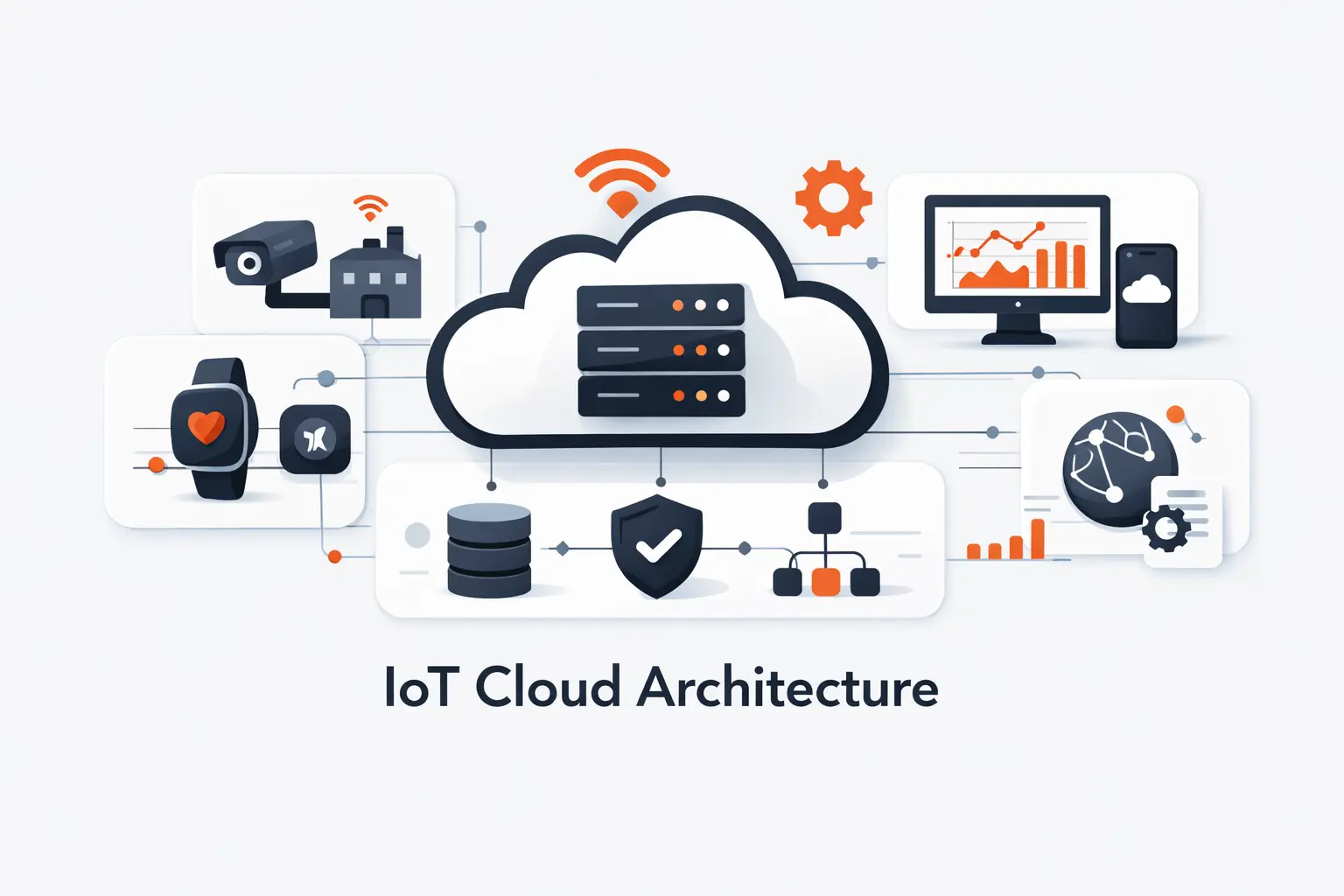
When we talk about IoT cloud architecture, we mean the full blueprint behind a connected system. It covers hardware, network paths, cloud services, applications, and the rules that govern all of them. We like this definition because it keeps teams focused on the whole system, not just the cloud console or the device firmware.
1. How Connected Devices, Networks, and Cloud Services Work Together
Every IoT system starts with a device noticing something in the physical world. A sensor reads temperature, motion, pressure, vibration, or location. Device software packages that signal and sends it across a local network, a gateway, or a wide-area connection to the cloud. The cloud then authenticates the device, stores the event, applies rules, and exposes the result to dashboards or business systems. If the system needs to respond, commands travel back down to an actuator such as a relay, valve, switch, or motor.
2. Key Benefits of IoT Cloud Architecture
The benefits are practical, not abstract. A clear architecture lets teams manage fleets remotely, roll out firmware updates without truck rolls, centralize logs, and compare behavior across sites or product lines. It also creates a shared data path. That means support teams, product teams, and operations teams are not each building their own fragile integration. In our view, that shared path is where reliability starts to feel real.
3. Why Flexibility, Scalability, and Real-Time Insights Matter
Flexibility matters because products change after launch. Scalability matters because fleets rarely stay small. IoT Analytics projected 18.8 billion connected devices by the end of 2024, and that kind of scale punishes rigid designs fast. Real-time insight matters because some signals lose value almost immediately. A cold-chain alert, a safety event, or a machine anomaly needs a low-latency path, clear routing, and a system that can react before the moment passes.
Recommended reading: IoT in Smart Agriculture: Use Cases, Architecture, and Implementation Roadmap
Core Components of IoT Cloud Architecture
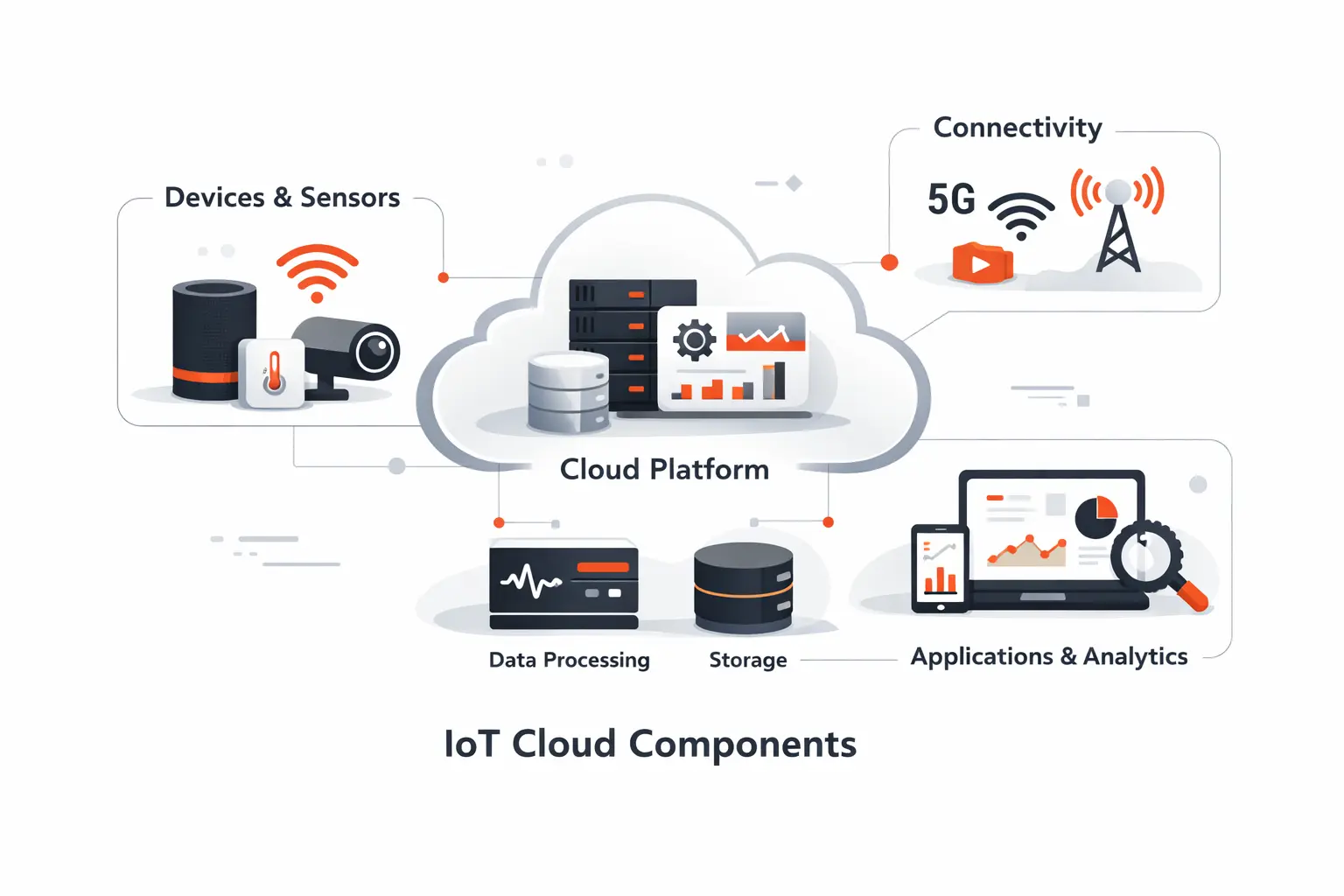
We find it easier to explain architecture by breaking it into moving parts. Each part has a distinct job. Trouble starts when a team expects one component to do everything, or when no one defines where a responsibility really belongs.
1. Devices, Sensors, and Actuators
Devices are the edge of the system where the physical world meets software. Sensors capture signals. Actuators change something in the environment, like opening a valve or switching a motor state. Some devices are tiny and battery-powered. Others are fixed industrial controllers with much more compute. Good architecture respects those limits from the start. If a device has weak memory, limited power, or harsh field conditions, the rest of the stack must adapt around that reality.
2. Connectivity, Gateways, and Communication Protocols
Connectivity decides how data moves. Gateways often sit between field devices and the cloud, aggregating traffic, translating protocols, buffering messages during outages, and enforcing local rules. This is especially useful when older equipment speaks industrial or serial protocols that cloud services do not understand directly. We usually advise teams to be strict here. Every extra protocol adds operational drag, so the communication plan should match real device constraints, not developer curiosity.
3. Cloud Infrastructure, Storage, and Analytics
The cloud side handles the heavy lifting that devices should not carry alone. That usually includes ingestion endpoints, message brokers, a device registry, time-series or object storage, analytics pipelines, alerting, and APIs for web or mobile apps. We also like to separate raw data from curated data. Raw events help with audits and model retraining. Curated data helps operators and business users act quickly without digging through noise.
Recommended reading: IoT Firmware Development: Process, Challenges, and Best Practices
The Key Layers of IoT Cloud Architecture
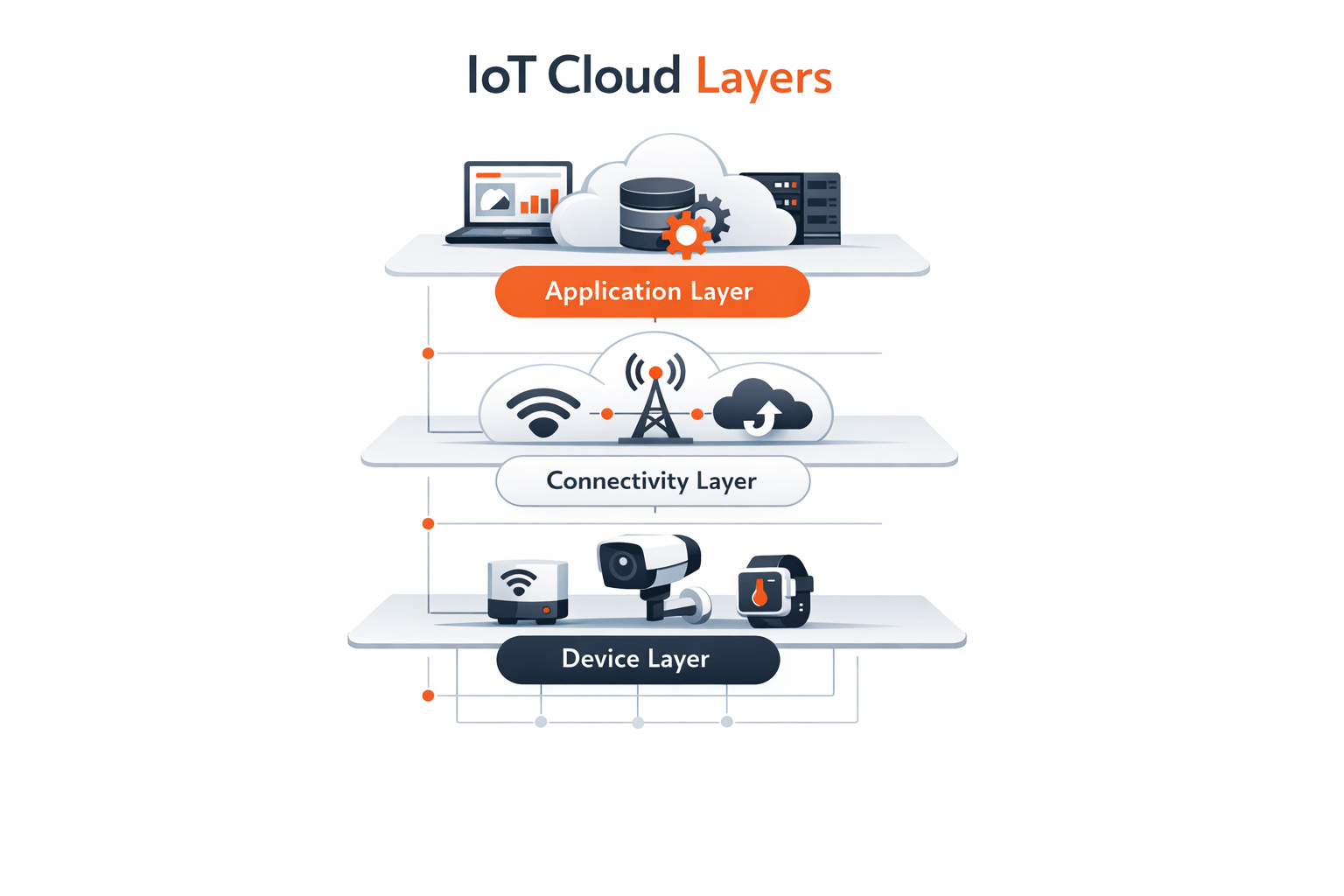
Layered models help us reason about responsibility. We do not treat layers as dogma. We use them to answer a simple question: where should this function live so the system stays understandable, reliable, and maintainable over time?
1. Perception and Device Layer
This is where sensing and local control begin. Devices observe the environment, timestamp readings, filter noise, and sometimes apply small local rules. In better designs, they also handle secure identity, safe boot behavior, and basic buffering. We have learned that weak device design poisons every layer above it. If the data starts bad, the cloud only makes the problem bigger and faster.
2. Network and Communication Layer
The network layer moves data between devices, gateways, and cloud services. It handles transport choices, routing, retries, encryption, and session behavior. This is also the layer that must deal with reality when links are unstable. A clean diagram means little if the system has no answer for dropped packets, duplicate messages, or intermittent backhaul. Good communication design plans for failure before failure arrives.
3. Data Processing Layer
The data processing layer turns raw events into useful information. That includes validating schemas, normalizing units, deduplicating messages, enriching data with asset metadata, and triggering alerts or downstream workflows. We like to catch bad data here, early and loudly. If dirty events flow through unchecked, dashboards become misleading, automations become risky, and machine learning models learn the wrong story.
4. Platform Layer
The platform layer provides shared services for the whole fleet. Think device provisioning, identity, command management, firmware updates, digital twins, rule engines, and developer APIs. We often call this the operating system of the connected product. It is not what end users see first, but it is what keeps new features from becoming a mess of custom scripts and one-off integrations.
5. Application Layer
This is the part users touch. It includes operator dashboards, customer portals, maintenance screens, mobile apps, notifications, and reports. The application layer should turn data into action. A graph by itself is not enough. Good apps explain what changed, what matters, and what the user can do next. We push hard on this point because many IoT projects collect plenty of data and still leave people guessing.
6. Business Layer
The business layer connects the technical stack to outcomes that matter. This is where teams define service levels, billing logic, compliance reporting, maintenance workflows, customer commitments, and product performance targets. In our opinion, architecture starts paying rent here. If the system cannot support business decisions, it may still be clever engineering, but it is not a finished platform.
Recommended reading: IoT Infrastructure: How to Build Scalable, Secure Networks and Platforms
Common IoT Cloud Architecture Models
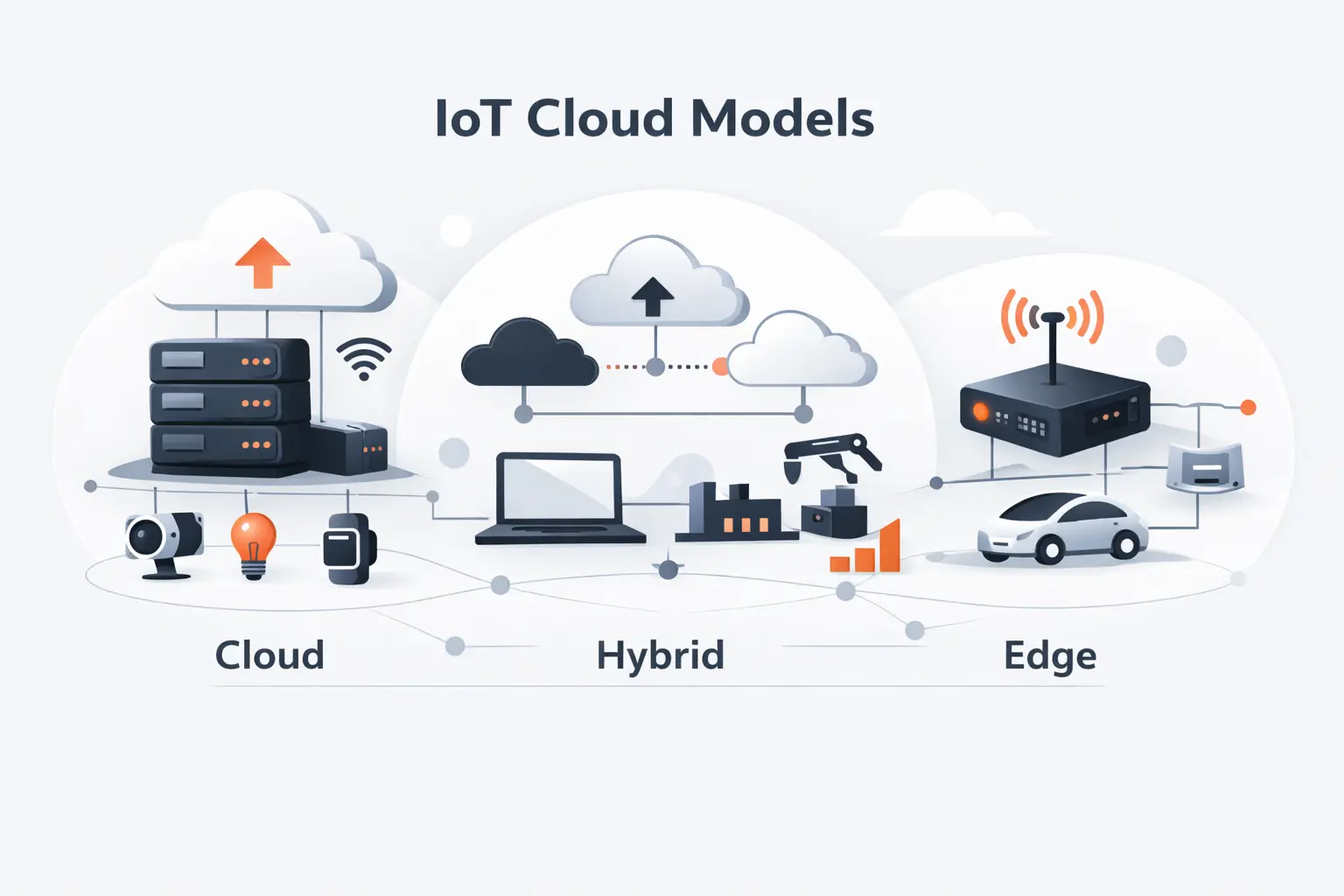
There is no single winning model for every connected system. The right choice depends on latency, bandwidth cost, privacy rules, field conditions, and how much local autonomy the product needs. We usually choose by failure mode first, then by convenience.
1. Centralized Cloud Model
In a centralized cloud model, devices send most of their data upstream and the cloud handles storage, rules, analytics, and orchestration. This approach is easy to reason about and can lower operational overhead for teams that want a simpler stack. It works well when internet access is dependable and local reactions are not time critical. The tradeoff is obvious. If connectivity fails or latency spikes, the product may lose visibility or responsiveness at the worst moment.
2. Hybrid Cloud Model
A hybrid model splits work between local systems and cloud services. Sensitive data, legacy workloads, or plant-specific controls may stay on premises, while fleet analytics, dashboards, or partner integrations live in the cloud. We often recommend this model when teams must respect data residency, keep existing operational systems, or serve regulated industries. The price is complexity. Hybrid designs demand sharper boundaries and stronger operational discipline.
3. Edge-Cloud Model
An edge-cloud model puts time-sensitive processing close to the device while using the cloud for broader coordination, storage, and learning. This is usually the sweet spot when local action must continue during weak connectivity or when sending every raw event upstream would be wasteful. The edge can filter, compress, or infer. The cloud can aggregate, retrain, govern, and compare behavior across the fleet. We think this model fits many serious IoT products best.
4. Choosing the Right Model for Latency, Cost, and Control
Keep a meaningful portion of logic near the asset if the system must react immediately. If the main value comes from fleet-wide trends, long-term history, and cross-site coordination, the cloud can carry more of the load. If privacy or compliance limits where data may live, hybrid becomes attractive. Cost also matters. Heavy backhaul can get expensive, but so can managing distributed edge hardware. There is no free lunch. There is only a clearer tradeoff.
Recommended reading: Internet of Things Examples: How IoT Works and Where You’ll See It in Real Life
Connectivity and Data Flow in IoT Cloud Architecture
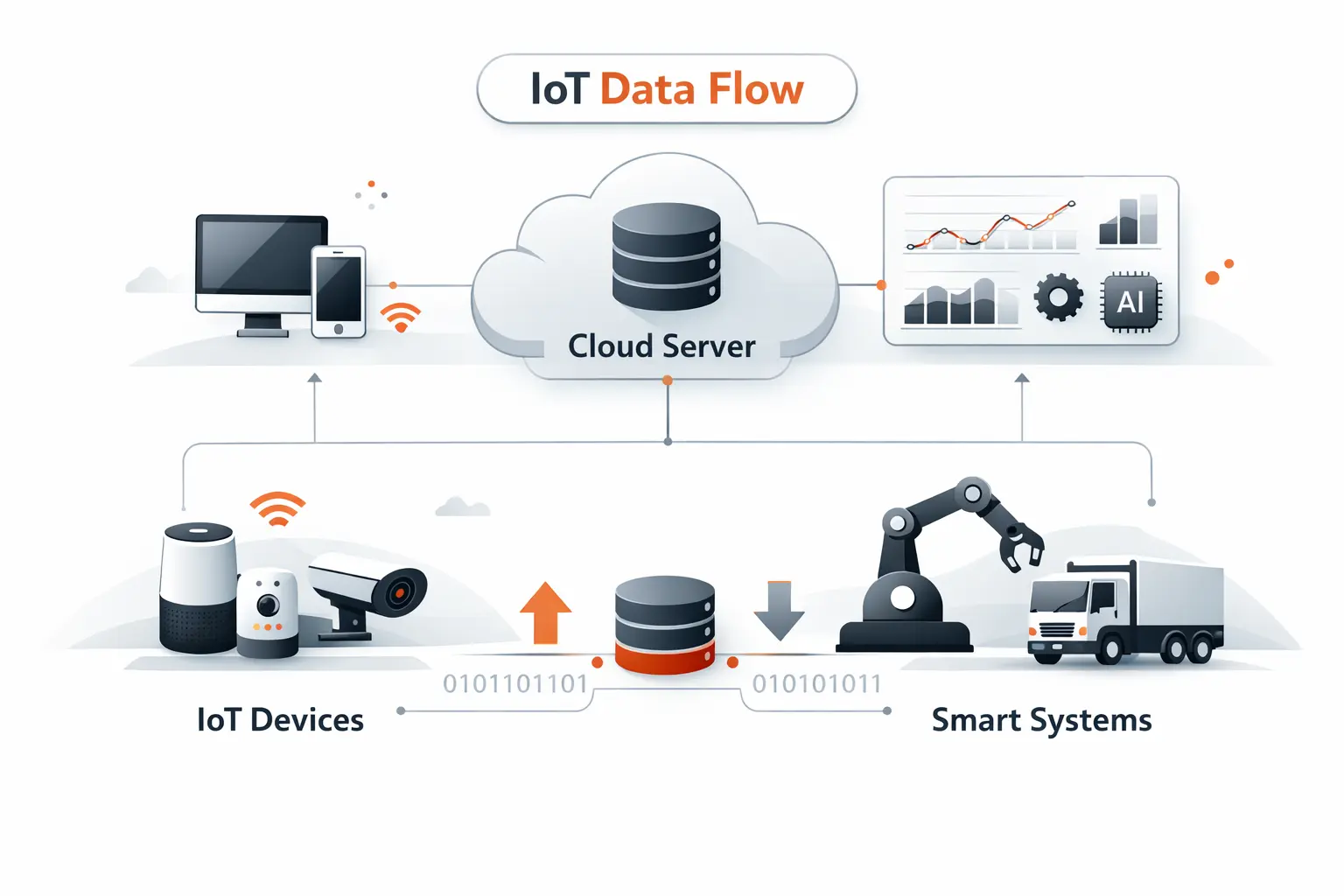
Data flow sounds abstract until packets start dropping or costs start climbing. Then it becomes very concrete. We like architectures that make message paths boring, observable, and recoverable, because boring systems are often the ones that survive production.
1. Messaging Protocols Such as MQTT, CoAP, and AMQP
MQTT is a lightweight publish-subscribe protocol, which makes it a strong fit for event streams from many devices to a broker. CoAP is compact and well suited to constrained devices that need request-response behavior with optional confirmable delivery. AMQP is useful when enterprise messaging, richer routing, and stronger interoperability with back-end business systems matter. We do not treat protocol choice as trivia. It shapes power use, delivery behavior, operational tooling, and how hard the system is to evolve later.
2. Network Options Such as Wi-Fi, Bluetooth, LoRaWAN, and Cellular
Wi-Fi works well for powered devices in buildings where throughput matters. Bluetooth is useful for nearby accessories, wearables, and device-to-phone interactions. LoRaWAN fits sparse, low-power sensing over long distances where payloads are small and battery life matters more than speed. Cellular is the natural choice for remote sites, moving assets, and products that cannot rely on local infrastructure. We always ask the same thing here: what is the minimum network that safely serves the job?
3. Gateways, Bandwidth, and Reliability Considerations
Gateways are not just traffic cops. They can reduce chatter, translate field protocols, apply local filters, and keep data buffered during upstream outages. That matters when bandwidth is expensive or unreliable. We like store-and-forward queues, batching, compression, dead-letter handling, and idempotent writes so retries do not create duplicates. If the system cannot cope with ordinary network hiccups, it is not ready for the field.
Recommended reading: How to Secure IoT Devices: Practical Steps for Homes and Enterprises
Common Use Cases for IoT Cloud Architecture
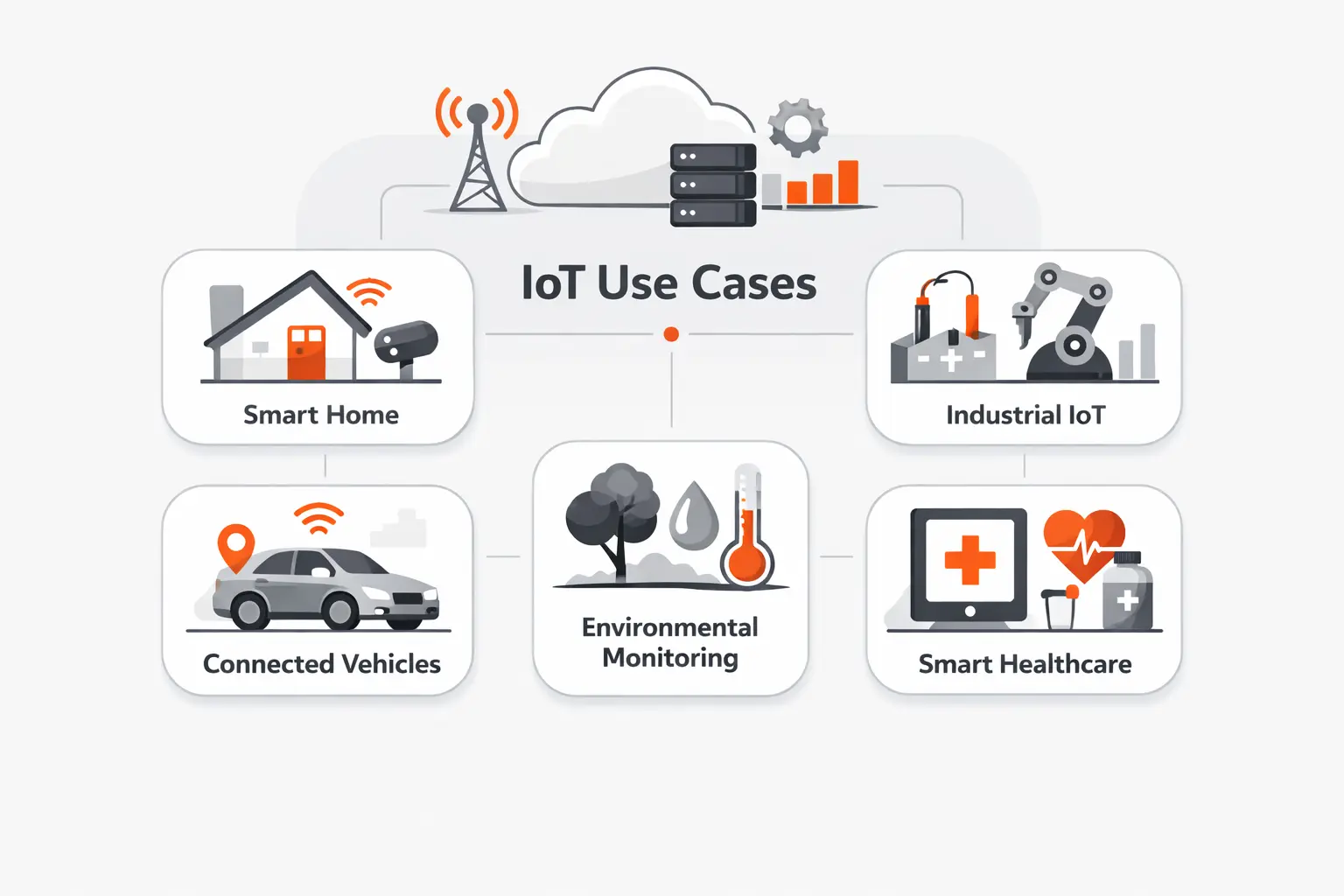
Use cases keep architecture honest. A city intersection, a glucose monitor, and a factory line all care about different risks. Looking at real deployments helps explain why there is no universal blueprint, only patterns that must be adapted with care.
1. Smart Cities and Connected Infrastructure
New York City is piloting street activity sensors at 12 locations, using pole-mounted devices to classify roadway users and generate traffic insight. That kind of system needs privacy controls near the edge, strong governance for who owns the data, and cloud services that can support planners across agencies. We like these projects because they show the full stack clearly. Sensing, anonymization, routing, storage, analytics, and public accountability all have to work together.
2. Healthcare and Connected Devices
Dexcom says its sharing feature lets glucose data reach up to 10 people, which shows how connected health products depend on secure identity, clear consent, reliable alerting, and mobile access that feels immediate. In healthcare, delayed or misrouted data can be worse than missing data because it creates false confidence. We therefore treat auditability, encryption, and careful access control as first-class parts of the architecture, not compliance paperwork to solve later.
3. Industrial Automation and Predictive Maintenance
AWS reports that Arneg’s predictive maintenance model achieved more than 80 percent accuracy, using connected refrigeration data to anticipate service needs before breakdowns happen. Industrial systems like this usually combine edge collection from equipment, cloud processing, time-series history, rules, and integration with service workflows. In our experience, the hidden challenge is not collecting data. It is creating a dependable path from machine signal to maintenance action without flooding teams with false alarms.
Extended Elements That Strengthen IoT Cloud Architecture
Once the core stack is in place, a few extra elements can make the architecture much stronger. We reach for these when uptime, security, or smarter automation really matter and the basic device-to-cloud pattern is no longer enough.
1. Edge and Fog Computing
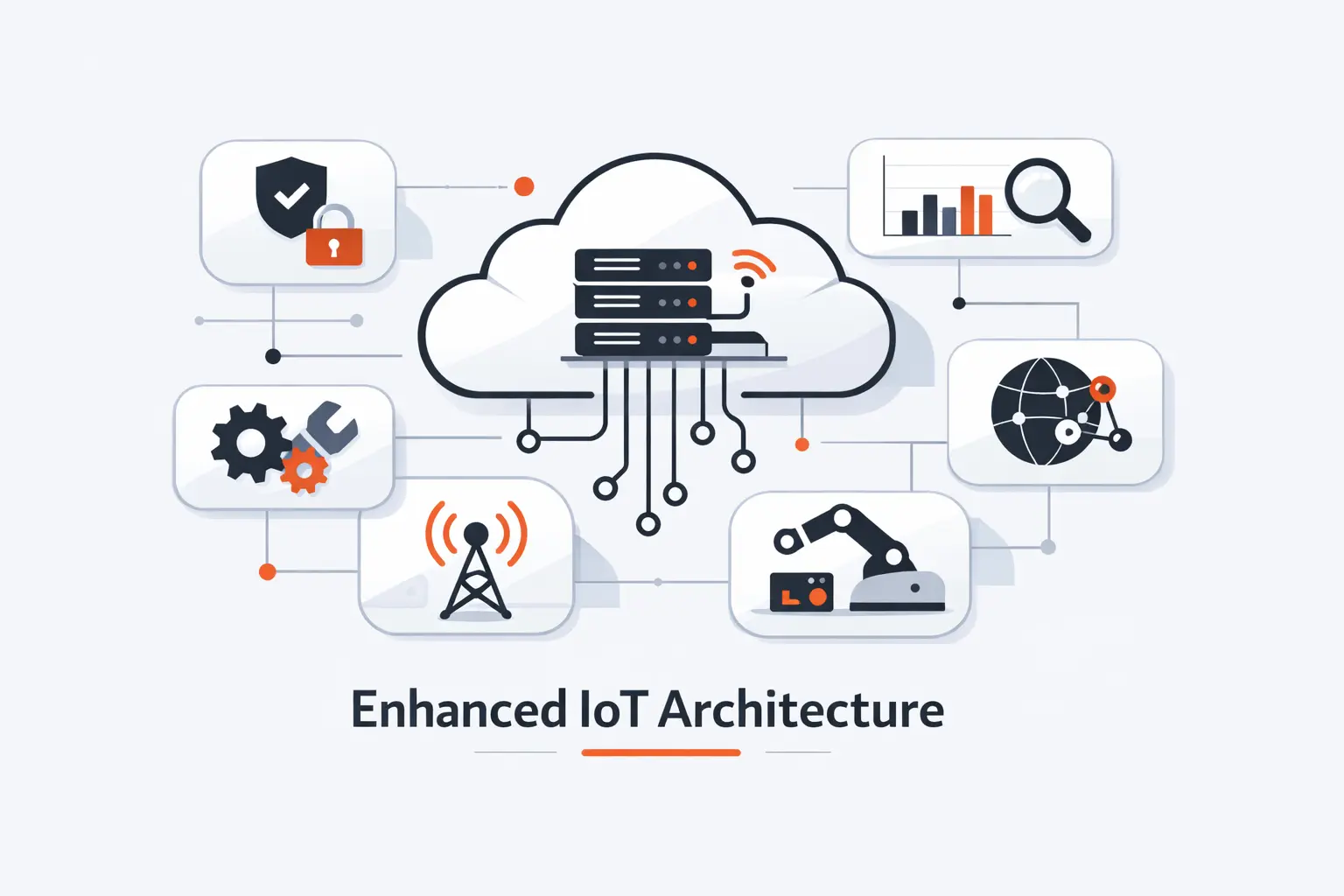
We use edge computing to mean processing on the device or gateway. We use fog computing to mean local site-level processing across several nearby nodes before data moves upstream. Both approaches reduce unnecessary traffic and preserve local responsiveness. They are especially useful for filtering noisy signals, running lightweight inference, or coordinating machines inside a facility. If a system must remain useful during a backhaul outage, edge and fog are often the difference between graceful degradation and total blindness.
2. Security Layer and Governance Controls
We think security should be treated as a full-width layer that crosses every other layer. Device identity, secure boot, signed firmware, certificate rotation, role-based access, audit logs, and retention rules all belong here. Governance answers the human questions around that technical spine. Who can see this data? Who can send a command? How long should records live? Those choices shape trust every bit as much as the code does.
3. AI and Machine Learning for Predictive and Real-Time Insights
Microsoft says Procter & Gamble cut model rollout time by as much as 90% when it standardized how models move from cloud development to factory deployment. That is a strong reminder that AI value depends on delivery mechanics, not just model quality. We like to keep training, fleet comparison, and long-term analysis in the cloud, while placing inference near the device when fast action matters. The harder part is ongoing model governance, versioning, rollback, and drift monitoring.
Best Practices for Building IoT Cloud Architecture
Best practices are where architecture stops being theory. These are the habits we push hardest because they reduce later failure, support easier change, and keep teams from paying the same technical debt over and over.
1. Security by Design in IoT Cloud Architecture
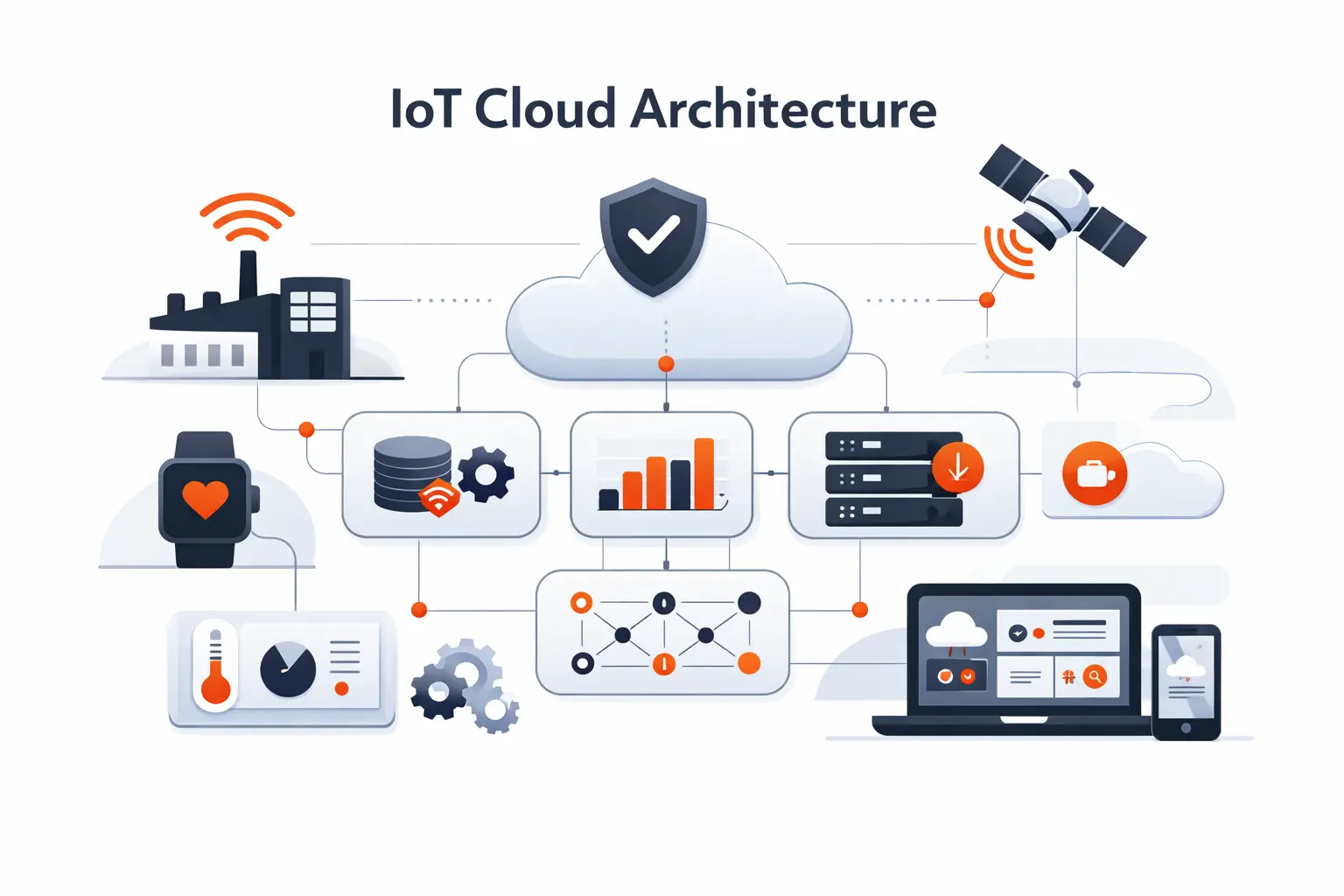
IBM and Ponemon put the global average cost of a breach at $4.4 million in 2025, which is reason enough to treat security as an opening move. We start with secure provisioning, unique device identity, encrypted transport, least-privilege access, signed updates, and secrets that are never hard-coded into firmware images. We also want an inventory of exposed surfaces early. You cannot defend what you never mapped.
2. Open Standards and Interoperable Protocols
Open standards protect the future of the system. When teams rely on common protocols, versioned APIs, and portable data formats, they can swap components or vendors with less pain. We are not anti-platform. We are anti-trap. If every change depends on one product-specific connector or one opaque data model, the architecture becomes expensive to maintain long before it becomes technically obsolete.
3. Cloud-Native Infrastructure and Observability
Cloud-native practices help when fleets grow and usage patterns shift. Managed services, containers, autoscaling consumers, and infrastructure as code all make operations more predictable. Observability matters just as much. We want logs, metrics, traces, queue depth, device health, and alert quality in one coherent view. A production team should be able to answer what failed, where it failed, and whether users felt it without opening five different tools.
4. Data Quality, Access, and Compliance Governance
Bad data breaks trust faster than missing data. We recommend strict schemas, unit normalization, reliable timestamps, and metadata that ties each event to a known asset and state. Access should be role-based and auditable. Retention should match legal and operational needs. If the system handles regulated data, regional storage and clear deletion paths matter too. We have seen teams spend months on analytics when the real problem was inconsistent field data.
5. Energy Efficiency and Lifecycle Management
Battery life and lifecycle costs are architecture concerns, not hardware footnotes. Sampling rates, batching behavior, sleep cycles, retransmission rules, and firmware update strategy all affect energy use. The same goes for certificate renewal, hardware replacement windows, and device retirement. We like systems that know how they will age. A connected product that launches well but cannot be maintained safely for years is only half built.
Frequently Asked Questions About IoT Cloud Architecture
We hear the same questions on almost every project. They usually come from smart teams trying to separate core concepts from buzzwords. Here is how we answer them, as plainly as we can.
1. What Makes Up IoT Cloud Architecture
At minimum, it includes devices, connectivity, ingestion, storage, processing, applications, and governance. In stronger systems, it also includes fleet management, security controls, observability, and lifecycle planning. We view it as the whole operating model for a connected product, not just the cloud account and not just the firmware.
2. How Stage-Based and Layered IoT Models Compare
Stage-based models show a journey, such as sensing, transmitting, processing, and acting. Layered models show responsibility boundaries that exist at the same time. Both are useful. We tend to use stage-based thinking when explaining data flow and layered thinking when assigning ownership across teams and services.
3. Why IoT Architecture Frameworks Use Different Numbers of Layers
Different frameworks group responsibilities in different ways. Some merge platform and data processing into one layer. Others pull business concerns or security out into separate layers because those topics deserve explicit attention. We do not see that as contradiction. We see it as a reminder that the model should serve the system, not the other way around.
4. When Edge and Cloud Processing Should Work Together
They should work together when fast local action and broader fleet intelligence both matter. The edge can handle immediate control, filtering, and resilience during outages. The cloud can handle historical analysis, fleet comparison, long-term storage, retraining, and integrations with other business systems. In practical terms, local systems should react fast, while the cloud should help the whole fleet get smarter over time.
How TechTide Solutions Helps Build Custom IoT Cloud Architecture
This is the part where we speak plainly about our own work. At TechTide Solutions, we do not begin with a favorite tool or a fixed stack. We begin with the job the system must do under real constraints, then shape the architecture around that reality.
1. Custom Architecture Design for Connected Products and Platforms
We start by mapping the product, the data, and the field conditions. That means latency needs, device limits, safety concerns, support workflows, compliance constraints, and business goals. From there, we design a reference architecture that shows where logic belongs, how data flows, and what should be built first. We care a lot about phasing because many teams need a path from pilot to production, not just a perfect end-state picture.
2. End-to-End Integration Across Devices, Cloud Services, and Applications
We work across the full stack, from device communication and gateway behavior to cloud services, APIs, dashboards, and enterprise integration. That end-to-end view matters because most IoT failures happen in the seams. A device message format affects analytics. An alert rule affects support. A cloud identity decision affects mobile access. We design those seams on purpose so the platform behaves like one system instead of several disconnected projects.
3. Tailored Development for Secure, Scalable, and Future-Ready Solutions
We build with long-term operation in mind. That includes secure provisioning, observability, update paths, access control, and room for new device types or new business workflows later. Some clients need a fresh platform. Others need to modernize an existing one without ripping everything out. In both cases, we aim for architectures that are understandable, testable, and ready for change instead of being frozen around a short-term launch date.
Final Thoughts on Building IoT Cloud Architecture
We think the best IoT cloud architecture is rarely the flashiest. It is the one that makes clear decisions about placement, responsibility, and failure handling. It knows what should happen on the device, what belongs near the edge, what belongs in the cloud, and what should never be left ambiguous. That clarity saves time later, especially when the system grows, regulations tighten, or support teams need answers fast.
If we had to boil it down to one rule, it would be this: make the fastest safe decision as close to the asset as you can, keep fleet intelligence and governance in the cloud, and treat security as a constant across the whole stack. Do that well, and the architecture becomes more than plumbing. It becomes the foundation for a product that can keep learning, keep operating, and keep earning trust.

