


At Techtide Solutions, we’ve learned (sometimes the hard way) that “increase website traffic” is either a crisp growth strategy or a vague wish—depending on whether we can measure it, promote it, and improve it in a loop. Traffic is only valuable when it arrives for the right reasons, lands on the right pages, and takes the right next step. Otherwise, it’s just server logs and vanity charts.
Market signals reinforce why disciplined SEO content promotion matters right now. Worldwide ad spending is forecasted to reach US$1.17tn in 2025, which intensifies competition for attention across nearly every channel. Budget pressure is also real: Gartner reported that marketing budgets have dropped to 7.7% of overall company revenue in 2024, and that constraint forces teams to justify content and promotion with evidence instead of enthusiasm.
How to increase website traffic by setting clear goals and expectations
On the ground, we see the same pattern across industries. A local services business can publish helpful explainers for months and still struggle if the content isn’t discoverable or if calls-to-action are unclear. Meanwhile, a B2B SaaS company can publish fewer pieces, earn visibility faster, and win qualified demos simply by matching intent and tightening distribution. The difference isn’t “writing talent”; it’s the system.
In this guide, we lay out the system we use. First, we set goals that define the right traffic. Then, we diagnose reality with analytics and search data. Next, we build content that earns visibility. Technical foundations support that work, and promotion gives it room to compound. Along the way, we share the tradeoffs we prefer, the myths we ignore, and the details that turn SEO theory into business outcomes.
1. Define what the right traffic means for your site community sales or conversions
Before we touch keywords or promotion, we decide what “right traffic” means in business language.
- An eCommerce brand: The “right” visit often includes product-view depth, cart intent, and a clean path to checkout.
- A Community-led site: The “right” visit might be a returning reader who subscribes, comments, or shares.
- B2B: The “right” visit is frequently a stakeholder who reaches a pricing page, requests a demo, or downloads something that signals a real project.
In our delivery work, the fastest way to waste months is chasing more sessions without checking whether they matter. Relevance is the real filter. That clarity changes everything downstream. It shapes the topics we choose, the landing pages we build, the conversions we track, and the channels worth funding when time gets tight.
2. Choose a balanced mix of paid promotions owned promotions and earned promotions
We treat traffic growth like a portfolio, not a single tactic. Paid promotion gives controllable distribution, but it can mask weak landing pages because volume looks impressive even when outcomes disappoint. Owned promotion—email lists, in-product messages, webinars, partner portals—moves slower to build, yet it’s where compounding trust usually lives. Earned promotion—mentions, backlinks, community citations—tends to be the most durable, but it’s also the least predictable because it depends on other people’s incentives.
In practice, balance reduces risk. When a paid channel becomes expensive, owned and earned can hold the line. When organic rankings fluctuate, paid can protect a pipeline while we diagnose. Our preference is to use paid to test messaging and landing pages, then let owned and earned scale the winners without increasing marginal cost forever.
3. Set realistic timelines for new sites based on competition and indexing realities
Search visibility is not a light switch; it’s closer to earning credit. New domains typically need time to be discovered, crawled, indexed, and trusted, and that timeline stretches when the niche is competitive or the site is thin. Even “perfect” on-page SEO cannot force a new site to outrank established publishers immediately, especially for broad, high-intent queries.
From our perspective, realism is a performance advantage. Teams that expect instant outcomes often churn strategies before learning anything, while teams that commit to a measured cadence can ship improvements, gather signals, and iterate. The healthiest expectation we set is simple: early wins come from specificity—tight intent matching, long-tail coverage, and pages that solve a problem completely—then authority and breadth follow.
Recommended reading: SEO On Site Off Site: Differences, Ranking Factors, and a Balanced Strategy
Measure and diagnose current traffic with analytics and search data
1. Use Google Analytics to establish a baseline and compare traffic channels over time
Analytics is where we earn the right to have opinions. In Google Analytics, we start by establishing a baseline: which channels bring visits, which landing pages absorb that demand, and which pages leak it. A baseline is not just a snapshot; it’s a reference point for every future experiment so we can say “this improved” without guessing.
Operationally, we care about consistency more than fancy dashboards. Clean channel grouping, reliable tagging for campaigns, and a shared definition of core conversions prevent internal debates from turning into measurement chaos. Once the baseline is stable, comparing periods becomes meaningful, and promotion decisions stop being political and start being empirical.
2. Use Google Search Console to monitor clicks impressions CTR average position and indexing status
Search Console is our truth serum for organic search. Analytics shows what happened after someone arrived. Search Console shows whether Google is surfacing the page at all, for which queries, and with what click behavior. That distinction matters. It helps us separate weak content from weak titles. It also exposes technical indexing issues that content alone will never solve.
During audits, we often find pages that should rank but do not. Some are not indexed. Others are canonicalized away, blocked from crawling, or buried behind weak internal navigation. Search Console reveals those problems quickly. From there, the workflow stays practical: check coverage, inspect priority URLs, and keep a short list of queries where small improvements can unlock outsized gains.
3. Validate traffic quality by connecting acquisition sources to on site engagement signals
Traffic volume without quality is how teams end up celebrating the wrong work. To validate quality, we connect acquisition sources to engagement signals: do visitors scroll, navigate deeper, return later, or trigger events that reflect real interest? A channel that looks “cheap” can be expensive if it floods the site with low-intent visits that consume support time or distort conversion rates.
From our standpoint, the best diagnostic question is simple: what did we want this visitor to do next? If they did not do it, why not? When source, landing page, and next action align, mismatches become obvious fast. For example, social traffic may land on a dense blog post when a comparison page fits better. Then engagement quickly reveals the mistake.
Recommended reading: How Does a Search Engine Work
Keyword research and on page SEO essentials

1. Build a keyword plan around search intent long tail phrases and achievable competition levels
Keyword research is not a treasure hunt for high-volume terms; it’s a mapping exercise between intent and value. We group queries by what the searcher is trying to accomplish: learn, compare, troubleshoot, or buy. Then we ask which intents our business can genuinely satisfy with a page that is better than what already exists.
Long-tail phrases are where we often see the best early traction because they’re specific, less ambiguous, and easier to satisfy completely. At Techtide Solutions, we like to build “topic clusters” where one foundational page defines the concept and supporting pages answer narrower questions that naturally arise. Over time, this structure does more than rank; it teaches search engines—and humans—that the site is a trustworthy destination for that subject.
2. Place keywords strategically in title tag H1 H2 headings first 100 words URLs meta descriptions and image alt text
On-page SEO is the craft of making meaning obvious. Strategic keyword placement is less about repetition and more about clarity: the title tag should reflect the core promise, headings should outline the logic, and the opening paragraph should confirm the reader landed in the right place. When the structure mirrors intent, both users and crawlers can interpret the page without friction.
In our implementations, we treat URLs like labels, not novels. A clean, descriptive slug helps humans remember and helps teams maintain content without accidental duplication. Image alt text also matters, not as a dumping ground for keywords, but as a way to describe the visual for accessibility and reinforce topical relevance where it naturally fits.
Practical Techtide Habit: Optimize for Scanability First
Instead of forcing exact-match phrases into every element, we scan the page as a user would. If the page communicates its purpose at a glance, search engines usually have enough context as well, and the copy stays readable.
3. Write engaging titles that earn clicks from the search results page
Rankings are not the finish line; clicks are the handshake. Titles that earn clicks tend to be specific, benefit-oriented, and aligned with the query’s implied problem. We avoid vague headlines that sound clever in a brainstorm but meaningless in a results page crowded with near-identical options.
In competitive SERPs, a strong title often includes an angle that signals usefulness: a framework, a checklist, a template, a comparison, or a clear outcome. At the same time, we resist clickbait because it creates pogo-sticking—people bounce back to the results—and that behavior can erode performance over time. The best titles, in our view, sell the truth: “Here’s what you’ll get, and here’s why it’s credible.”
4. SEO myths to ignore meta keywords keyword stuffing keywords in domain names and heading order rules
SEO has more folklore than it deserves. Meta keywords are not a modern ranking lever, and stuffing keywords into copy usually makes pages worse for readers while signaling low quality. Domain names packed with keywords rarely compensate for weak content and can even look spammy in industries where trust is fragile.
Heading order is another common trap. A page can be semantically clear without obsessing over a rigid pattern, especially when modern layouts include reusable components and dynamic content blocks. Our approach is pragmatic: use headings to organize ideas, not to satisfy a superstition. When the page reads like a well-structured argument, we’re usually on the right track.
Recommended reading: How to Get Backlinks in 2026: Proven Ways to Earn High-Quality Links
Create unique evergreen content that attracts and retains visitors

1. Publish consistently with a business blog and focus on evergreen topics
Evergreen content is our favorite kind of asset because it keeps working after the publish-date hype fades. A business blog is not just a place to post updates; it’s a library of problems solved. Consistency matters because it trains both your audience and your internal team: writing becomes a process, not a heroic event.
From our experience, evergreen topics emerge from customer conversations. Sales calls, support tickets, onboarding friction, and product comparisons are all content gold. When we translate those repeated questions into pages that genuinely help, the content earns search visibility and reduces operational load, which is a rare win-win in business.
2. Make content easy to read well organized unique and updated as needed
Search engines can index words; humans need reasons to stay. Readability comes from structure: clear sections, short paragraphs, meaningful subheadings, and examples that remove ambiguity. Uniqueness is not about inventing a new topic; it’s about offering a clearer explanation, a better framework, or a more practical walkthrough than what’s already ranking.
In our editorial practice, updating is part of the definition of “done.” When advice changes—tool interfaces, policies, best practices—the content must evolve or it becomes quietly harmful. A page that was accurate once can still rank while misleading readers, and that mismatch damages trust faster than most teams expect.
3. Strengthen posts with visuals infographics and video to improve engagement and shareability
Visuals are not decoration; they’re compression. A diagram can replace paragraphs of explanation, and a short video can demonstrate a workflow that text would struggle to describe. For technical content, we often use annotated screenshots, simple architecture sketches, and before-and-after comparisons to make the “how” unmissable.
Shareability also improves when previews look intentional. Social cards, compelling featured images, and scannable pull quotes increase the odds that someone will repost your content with pride rather than hesitation. In client projects, we’ve seen average articles become high performers simply because the presentation made the value obvious within a second of seeing it.
4. Refresh and republish older posts to regain rankings and unlock new traffic opportunities
Content refreshes are one of the highest-leverage SEO moves we know, largely because they reuse existing authority. Older posts often accumulate backlinks, brand mentions, and historical relevance, but they lose rankings when competitors publish more complete answers or when the topic shifts. Refreshing lets us reclaim that ground without starting from scratch.
Our workflow is straightforward: identify posts that used to perform, check current SERP intent, improve the content to match what searchers now expect, and tighten internal links so the refreshed page sits in a stronger context. Republish thoughtfully—without rewriting history—and the result is frequently a second life for content the business already paid to create.
Recommended reading: Backlink Strategy Guide for Building Authority, Trust, and Organic Visibility
Technical SEO and site structure that helps crawling indexing and user experience
1. Make sure search engines can crawl and render key resources like CSS and JavaScript
Technical SEO starts with a basic question: can search engines actually see what users see? Modern websites often rely on JavaScript-heavy rendering, deferred content, and third-party resources that can complicate crawling. If critical content only appears after complex client-side execution, indexing can become inconsistent, especially for sites that ship frequent front-end changes.
In our engineering reviews, we look at robots directives, render-blocking scripts, and how navigation is generated. Server-rendered or hybrid approaches often reduce risk because core content and links exist in the initial HTML. When dynamic behavior is necessary, we ensure the baseline experience still exposes the page’s meaning and internal pathways.
2. Organize content with descriptive URLs logical directories and a clear canonical approach for duplicates
Site structure is how you teach a crawler and a reader what matters. Logical directories make content easier to maintain, but they also create predictable patterns that help discovery. Descriptive URLs reduce confusion in analytics, simplify sharing, and make it easier for teams to audit coverage across a topic.
Duplicate content is a quiet killer when it fragments signals across multiple URLs. Canonicals, consistent internal linking, and disciplined parameter handling prevent that fragmentation. Our preference is to decide which version of a page is the “source of truth” and make every system—from navigation to sitemaps—reinforce that decision instead of undermining it accidentally.
3. Improve performance with faster load times and Core Web Vitals focused optimizations
Performance is SEO, conversion, and brand perception rolled into a single user experience. When pages feel heavy, users abandon them, and search engines receive behavioral signals that the result wasn’t satisfying. Core Web Vitals provide a shared language for performance discussions, but the real goal is simpler: make the site feel immediate and stable.
From an implementation angle, we usually start with the biggest offenders: oversized images, excessive third-party scripts, unoptimized fonts, and layouts that shift while loading. The fixes are rarely glamorous, yet they’re compounding. Every millisecond shaved from real user friction is a small competitive advantage that stacks across every landing page and every campaign.
Engineering Lens: Performance Budgets as Product Discipline
Rather than chasing perfect scores, we prefer performance budgets tied to user journeys. If a marketing team adds a new widget, the site should not quietly degrade; budgets force trade-offs into the open.
4. Build for mobile first crawling with responsive design fast mobile pages and complete mobile content
Mobile-first crawling means the mobile experience is not a “lite version”; it is the primary version that search engines evaluate. Responsive design is the foundation, but parity is the real requirement: the mobile layout must include the same essential content, internal links, and structured context that desktop users see.
In our builds, we watch for mobile pitfalls like hidden navigation, collapsed content that never renders, and media that slows interaction on weaker networks. A fast mobile page is not merely a technical win—it’s a market win, because many audiences discover brands on mobile and only later convert on desktop. When mobile is incomplete, the entire funnel becomes brittle.
5. Avoid disruptive experiences such as overly distracting ads and interstitial barriers
Disruption can destroy trust in a single visit. Interstitials that block content, pop-ups that reappear after dismissal, and ad layouts that hijack scrolling are not just annoying; they communicate desperation. Search engines have long signaled that intrusive experiences degrade quality, but even without algorithm talk, users vote with their back button.
At Techtide Solutions, we prefer consent and conversion patterns that respect attention. If a newsletter sign-up is valuable, it should be earned with content quality and clear value, not forced through a barrier. The same applies to ads: a sustainable site monetizes without making the audience feel like the product is their patience.
Recommended reading: Panda Penalty: Causes, Detection, Recovery, and Prevention
Build authority with backlinks internal links and trusted references
1. Earn high quality backlinks from reputable sources to strengthen trust and rankings
Backlinks remain one of the strongest external signals of trust, but quality matters more than quantity. A handful of links from respected, relevant sites can outperform a flood of low-quality directory placements. Earning links is ultimately about earning citations: publishing something useful enough that another author references it to support their own work.
In our campaigns, link-worthy assets often look like original research, practical templates, in-depth explainers, or tools that solve a recurring pain. Partnerships help, too, when they’re real—integrations, guest education, co-hosted webinars—because those relationships naturally create mentions and referrals. The guiding principle is simple: become worth referencing.
2. Use internal linking to build topical authority guide users and distribute value across key pages
Internal links are the most controllable authority lever you have, and many sites underuse them. A good internal linking strategy guides users to the next helpful page while also signaling to crawlers which pages are central. In other words, internal links shape both experience and interpretation.
Our preferred pattern is hub-and-spoke. A hub page defines the theme, while supporting pages cover subtopics in depth and link back with descriptive context. When this is done well, readers stop landing, consuming, and leaving; instead, they explore, self-educate, and develop trust. That behavior often correlates with stronger conversion rates, even when the content itself is not “salesy.”
3. Support discoverability with relevant outbound links and descriptive anchor text
Outbound links are a signal of confidence: they show you’re willing to cite other authoritative sources rather than pretending your site is the entire internet. In our writing, we link out when it improves the reader’s understanding, validates a claim, or helps them complete a task. Done thoughtfully, this also reduces the pressure to explain everything inside one page.
Anchor text matters because it sets expectations. “Click here” wastes context, while descriptive anchors tell readers what they’ll get and tell crawlers what the linked page is about. As a rule, we link out to support the narrative, not to leak attention. When the page remains the best answer even after citing others, users come back.
4. Use free PR and press release style outreach to generate earned mentions and referral traffic
PR is not only for big launches. A press-release style mindset helps smaller teams package stories that journalists, bloggers, and community curators can reuse: a new tool, a customer milestone, an industry insight, a strong opinion backed by evidence. The key is to lead with relevance, not self-praise.
In outreach, we focus on alignment. A niche newsletter that your audience actually reads can send more valuable traffic than a broad outlet that treats you like filler. Over time, consistent outreach builds relationships, and relationships build repeat mentions. That earned distribution is one of the few marketing advantages that competitors cannot instantly copy with a budget increase.
Promotion playbook social email community PR ads and local listings
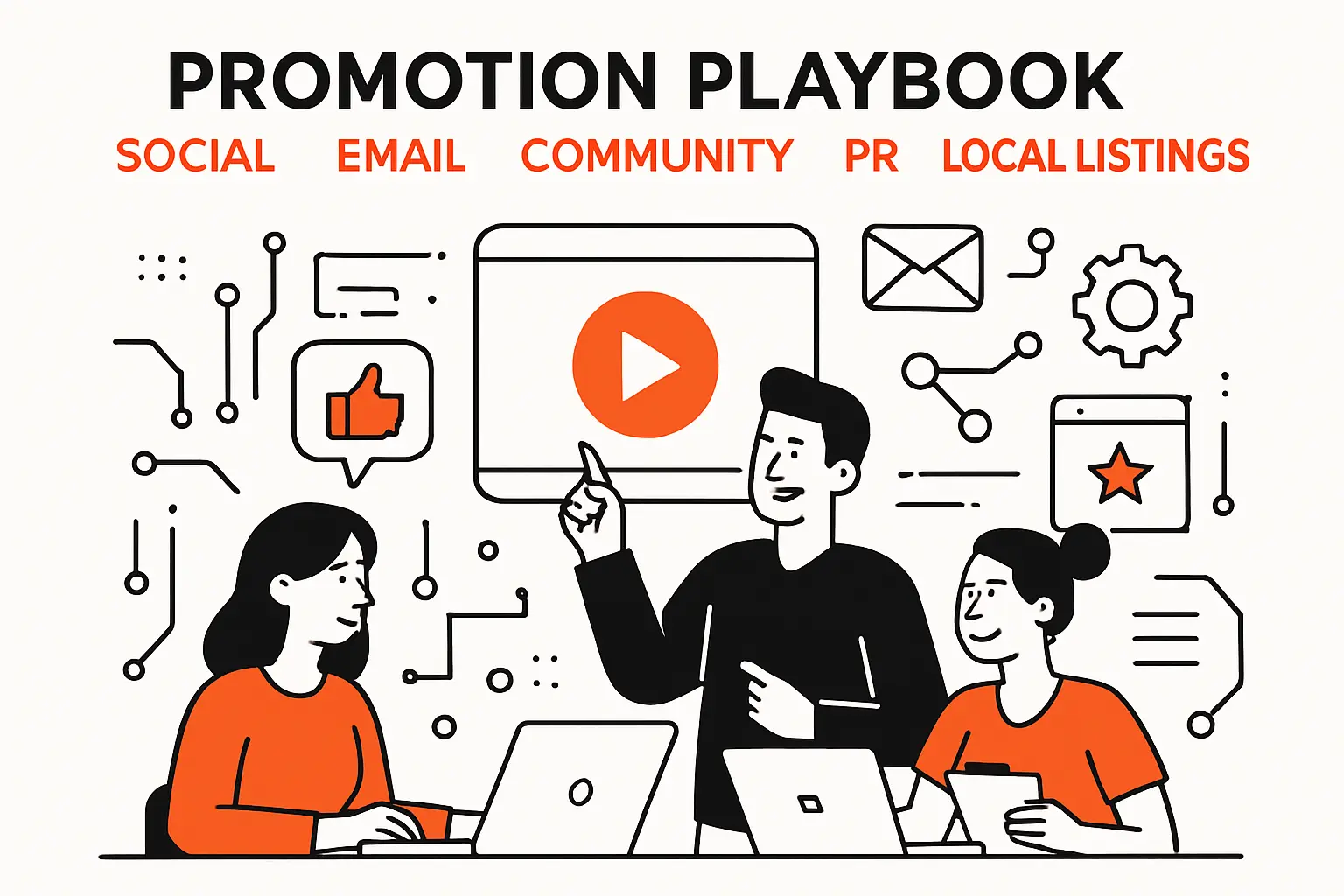
1. Organic social media promotion with platform fit consistent publishing and share friendly previews
Organic social works best when the content matches the platform’s native behavior. A deep tutorial might thrive as a thread or carousel, while a product lesson might perform better as a short screen recording with a strong hook. Consistency matters because algorithms and audiences both respond to reliability; sporadic posting rarely builds momentum.
From a technical angle, share-friendly previews are low-hanging fruit. Social cards, clean titles, and relevant images make your links look intentional. When a preview is broken or generic, people hesitate to share, and your best content dies in silence. We treat preview quality as part of SEO because distribution and discovery are inseparable in real life.
2. Email lists newsletters and targeted campaigns that drive readers to specific landing pages
Email is still one of the most dependable owned channels because it doesn’t depend on daily algorithm moods. Newsletters are especially powerful when they have a point of view: curated insights, practical tips, and a predictable rhythm. Targeted campaigns go a step further by matching a segment to a specific landing page with a single purpose.
In our builds, we prioritize frictionless pathways from email to action. That means fast landing pages, message match between subject line and page headline, and forms that don’t ask for more than the offer justifies. Deliverability and trust matter here; if your email feels like a pitch every time, attention decays and unsubscribes rise.
3. Community engagement by participating in forums groups and discussions with a value first approach
Community marketing is slow, but it’s resilient. Participating in forums, professional groups, and discussion spaces works when the intent is to help, not to harvest clicks. A value-first approach often means answering questions without linking anything at all, then earning curiosity because your explanation was unusually useful.
In our experience, communities reward specificity. A generic answer sounds like marketing, while a detailed answer sounds like competence. When linking is appropriate, we point to a resource that genuinely extends the help, not a homepage. Over time, this approach builds a reputation moat: people recognize your name, trust your contributions, and then your content earns traffic as a side effect of credibility.
4. Influencer relationships and collaboration that build credibility and awareness
Influencers are not only social celebrities; they’re often niche educators with the audience you actually want. Collaboration can look like co-authored guides, podcast interviews, webinars, joint demos, or partner toolkits. The win is not just reach; it’s borrowed trust.
At Techtide Solutions, we prefer collaborations that create durable assets. A one-time shout-out may spike attention, but a co-created resource can rank, earn backlinks, and convert for months. Alignment matters more than audience size: if the influencer’s community shares your buyer’s pain, the traffic will be warmer and the engagement will be more honest.
5. Digital advertising strategies with clear targeting measurable outcomes and realistic expectations
Paid ads are most effective when they’re treated as a controlled experiment rather than a magic faucet. Clear targeting starts with intent: search ads capture demand, while social ads often create it. Retargeting can be powerful, but it must respect user experience and privacy expectations to avoid feeling creepy.
Measurement is where paid either becomes a growth engine or a budget drain. We insist on clean attribution, dedicated landing pages, and conversion definitions that reflect business value rather than superficial clicks. Realistic expectations matter, too: ads can accelerate learning and pipeline, but they cannot compensate for a confused offer, a slow site, or a product that doesn’t deliver on its promise.
6. Local visibility through local search reputation testimonials and optimized business listings
Local traffic is a different game because proximity and reputation shape intent. Optimized business listings help you appear for local queries, but reviews and testimonials often determine whether the click turns into a call. For service businesses, this is where “traffic” becomes tangible: phones ring, calendars fill, and directions are requested.
Operational discipline is the hidden advantage. Consistent business information across directories, thoughtful responses to reviews, and location pages that explain services clearly all contribute to visibility and conversion. In local SEO, trust is not abstract; it’s a pattern of signals that says, “This business is real, responsive, and worth visiting.”
7. Prevent audience fatigue by avoiding over promotion and tactics that can be perceived as manipulation
Over-promotion is how good brands become background noise. When every post is a “must-read,” nothing is. Audiences can sense manipulation—manufactured urgency, fake scarcity, forced engagement bait—and they punish it quietly by ignoring you.
In our playbooks, restraint is strategic. We rotate formats, vary channel emphasis, and give more value than we ask for. When a promotion is warranted, we make the reason explicit: “Here’s who this helps and why.” That honesty tends to earn more long-term attention than any short-term growth hack, and it keeps your brand from sounding like it’s talking to itself.
TechTide Solutions building custom software to support scalable traffic growth
1. Custom web development that bakes in technical SEO performance and mobile first foundations
As a software development company, we don’t treat SEO as a plugin; we treat it as an architecture concern. Technical SEO decisions—rendering strategy, routing, canonical logic, sitemap generation, image pipelines, caching, and accessibility—are easier to do correctly during development than to patch later under pressure.
In our builds, we aim for foundations that marketing can scale without breaking: reusable templates that enforce good metadata habits, content components that remain crawlable, and performance budgets that protect speed as new features ship. Mobile-first foundations are non-negotiable because modern discovery happens on mobile even when revenue closes elsewhere.
2. Marketing workflow automation and integrations for email social publishing and lead capture
Traffic growth stalls when publishing is painful. Automation reduces friction: CMS workflows that enforce review steps, integrations that push content to email and social with consistent previews, and lead capture pipelines that route inquiries to the right team without delay. The less manual coordination required, the more consistent promotion becomes.
From an engineering viewpoint, integration quality is a revenue lever. When forms reliably create CRM records, when tags flow into email segments, and when campaign parameters are standardized, reporting becomes credible and optimization becomes fast. This is where “marketing ops” stops being a buzzword and becomes a competitive advantage powered by software.
3. Analytics and experimentation solutions that turn GA4 and Search Console data into decisions
Data is only valuable when it changes what you do next. Our analytics work often focuses on turning raw events into decision-ready signals: dashboards that reflect business questions, automated anomaly alerts, and experimentation frameworks that connect hypotheses to outcomes. Search Console and analytics together can reveal whether a problem is discovery, click appeal, page relevance, or conversion friction.
In our experience, the biggest unlock comes from making insights unavoidable. When teams can see which landing pages underperform, which queries are drifting, and which campaigns attract the wrong audience, decision-making speeds up. Experimentation then becomes routine: adjust titles, improve internal linking, refine content depth, and test calls-to-action with discipline rather than guesswork.
Conclusion turning these tactics into a repeatable traffic growth system
1. Start with measurement then prioritize the highest impact SEO and content improvements
Measurement is the foundation that keeps SEO honest. Once a baseline exists, prioritization becomes clearer: fix indexing and technical visibility issues first, improve the pages closest to conversion next, and expand content coverage where intent aligns with revenue or retention. Without measurement, teams often default to producing more content when the real problem is discoverability or mismatch.
From our perspective, the best prioritization framework is impact versus effort with a bias toward compounding. A small technical fix that improves crawlability across the site can outperform a month of new writing. Likewise, a refreshed, better-structured page can unlock traffic that was already “almost there” but never quite clicked.
2. Promote consistently across channels while building authority with links and community trust
Promotion is the bridge between “published” and “found.” Consistency across channels—social, email, communities, PR, partnerships, and selective paid—turns content into an asset instead of a sunk cost. Authority grows when others reference you, but those references are more likely when your content actually reaches the people who care.
In our day-to-day work, we treat community trust as the most durable distribution engine. Helpful participation earns attention that cannot be bought easily, and that attention turns into mentions, backlinks, and direct traffic over time. When promotion feels like service instead of self-advertising, audiences stick around.
3. Review performance regularly and iterate content technical fixes and distribution based on results
SEO content promotion is not a campaign; it’s operations. Regular reviews prevent drift: we look for pages losing visibility, queries changing intent, technical regressions, and channels that are sending the wrong audience. Iteration then becomes the habit: update content, improve internal paths, refine conversion steps, and adjust distribution to match what the data is actually saying.
At Techtide Solutions, we end with a practical next step: pick a single high-intent landing page, diagnose its discovery and engagement using analytics and search data, then improve content and promotion around that page until the process feels repeatable. If you had to choose just one page to turn into a growth engine, which page would you bet on—and what would the data tell you to fix first?

