


At TechTide Solutions, we treat IoT as the moment software stops living only on screens and starts living in the physical world. A thermostat, a vibration sensor on a pump, a badge reader at a warehouse door, or a smart refrigeration controller all become “computers with consequences” once they sense, decide, and act.
1. What Is IoT and What Does IoT Infrastructure Include?
1. Internet of Things basics: connected physical objects with sensors, software, and processing
Practically speaking, an IoT system is a chain of responsibilities: sensing the environment, encoding signals into data, transporting that data reliably, transforming it into something meaningful, and then triggering actions that humans and machines can trust. Seen this way, “IoT infrastructure” is not a single platform you buy; it’s the end-to-end set of components that makes the chain predictable under stress.
From our delivery experience, the biggest architectural mistake is assuming the device is the product. In reality, the device is a participant in a living ecosystem—one that needs identity, connectivity, observability, and safe change management as much as any modern software service does.
2. Why “Internet of Things” can be a misnomer: devices may use private networks, not the public internet
Despite the name, plenty of “IoT” deployments barely touch the public internet. Inside factories, hospitals, airports, and utilities, we often see devices sitting on segmented private networks, communicating through gateways, brokers, or industrial protocols that never expose a routable endpoint to the outside world.
In our view, that’s not a downgrade; it’s usually a sign the organization has thought seriously about blast radius. Private addressing, dedicated radio networks, and site-to-cloud tunnels can reduce exposure while still enabling centralized analytics and fleet operations.
Market overview: the global IoT market is forecast to be worth around 419.8 billion U.S. dollars in 2025, and that level of investment makes the network boundary itself a strategic asset rather than an implementation detail.
Operationally, “not on the public internet” still doesn’t mean “safe by default.” Lateral movement, insecure commissioning, and overly permissive internal routing can be just as damaging as a public exposure, especially when device fleets are managed at scale.
3. Consumer IoT vs Industrial IoT: how the use case changes infrastructure requirements
Consumer IoT is often optimized for onboarding convenience and cost sensitivity, while industrial IoT is optimized for uptime, safety, and the ability to survive harsh environments. That difference reshapes infrastructure choices all the way from hardware selection to incident response.
In a home, losing device data from a smart plug is annoying. In a factory, losing device data from a pressure sensor can turn into a safety problem or stop production. Because of that, industrial systems need backup connections, careful change control, and clearer lines of responsibility between IT teams and the teams that run machines and plant systems.
Design trade-offs also shift around power and maintenance. Battery-operated devices in remote or hard-to-reach locations push us toward low-power radios, aggressive edge filtering, and firmware strategies that minimize unnecessary communication.
From our perspective, the “right” infrastructure is the one that matches the consequences of failure. When failure costs are high, we build systems that assume components will break and still keep the overall service reliable.
4. Where IoT shows up: consumer, commercial, industrial, and infrastructure applications
Across industries, IoT appears wherever physical processes can be measured and improved. Smart buildings use occupancy, air quality, and equipment telemetry to balance comfort with energy cost. Retail uses sensors to reduce shrink and optimize cold storage. Logistics tracks condition and location for sensitive goods. Cities deploy connected lighting and parking systems. Utilities modernize metering and monitor field equipment.
In industrial settings, teams track vibration and temperature on spinning machines. Quality stations send data to edge models. Production line devices also feed maintenance processes directly. Commercial settings usually prioritize something else. These systems need clear dashboards for staff. They also need role based access and links to existing support or facility platforms.
Our rule is simple: whenever a business has physical assets, it also has data exhaust. That exhaust can become a decision engine. The real infrastructure question is whether that engine will stay trustworthy, resilient, and economical over time.
Recommended reading: Internet of Things Examples: How IoT Works and Where You’ll See It in Real Life
2. IoT Infrastructure Elements: Sensors, Controllers, Cloud, Apps, Analytics
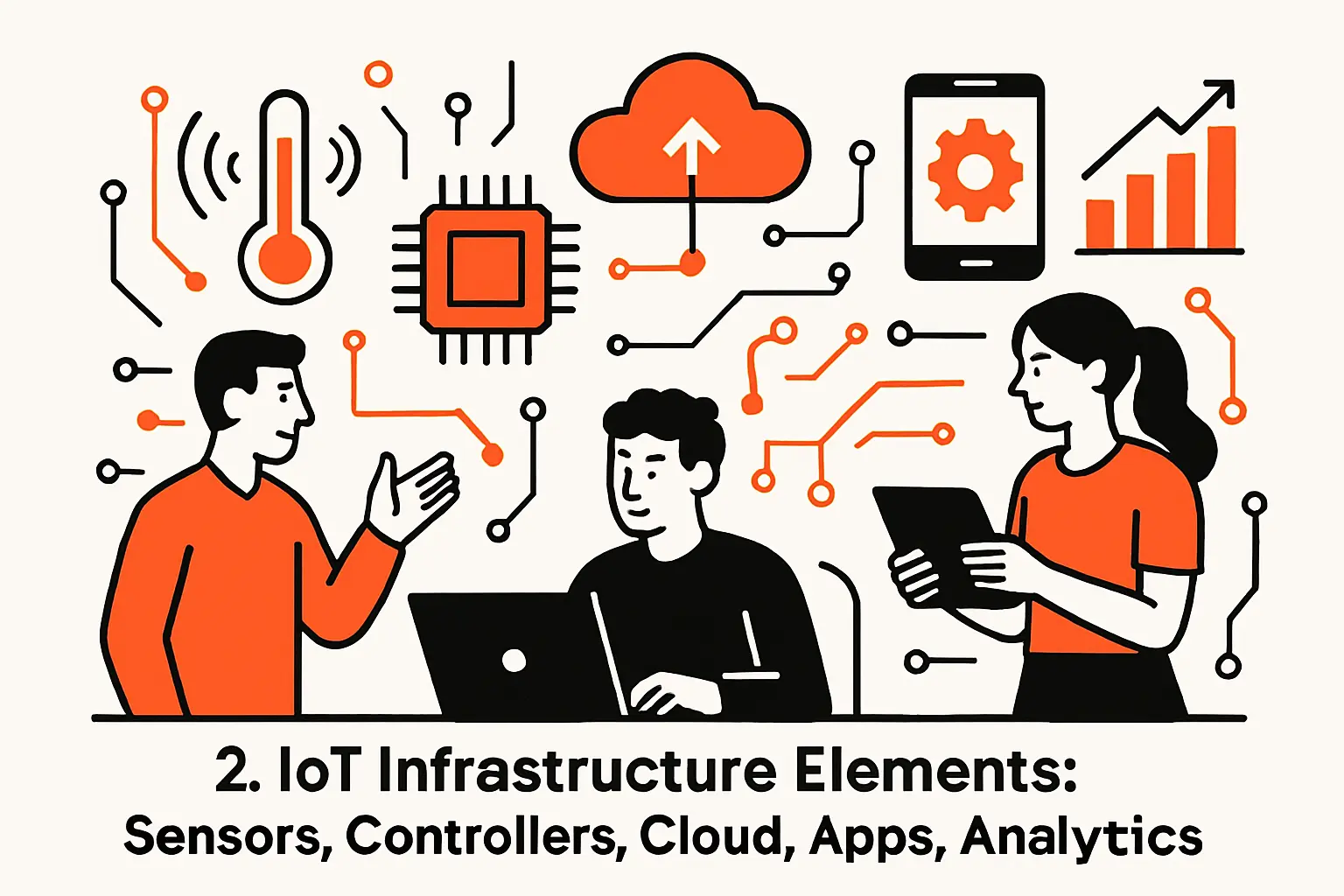
1. Sensor hardware and actuators: capturing real-world signals and triggering actions
Sensors translate messy reality into measurable signals, and actuators push decisions back into the world. That translation is never neutral: sampling rates, calibration drift, environmental noise, and physical placement all affect the truthfulness of the data stream.
In our builds, we treat sensors like “data contracts with physics.” If the signal is unreliable, every layer above it becomes a sophisticated way to misunderstand the world. For example, a cold-chain program lives or dies on probe placement, insulation effects, and the ability to detect when a door opening creates a benign transient versus a true excursion that threatens product integrity.
Actuators introduce another layer of responsibility because software can now cause motion, heat, or shutoffs. Guardrails matter: safety interlocks, command authorization, rate limiting, and clear rollback behavior are all part of infrastructure, not “nice-to-have” features.
2. Controllers and embedded compute: the device “brain” and the shift toward edge computing
Controllers sit between raw sensor readings and meaningful events. Sometimes that’s a microcontroller reading an analog signal; other times it’s an embedded computer performing local inference, buffering, and protocol translation.
Edge computing, in our experience, becomes compelling the moment bandwidth is expensive, latency is critical, or connectivity is intermittent. Instead of streaming every raw sample, we often design local logic that summarizes, compresses, or detects anomalies and only escalates what matters.
Reliability is the real reason edge matters. When a site temporarily loses upstream connectivity, a well-designed controller keeps local operations safe and coherent, then resumes synchronization without corrupting the story the data tells.
From a software engineering standpoint, that shifts the work toward remote management, secure updates, and deterministic behavior under constrained resources—an environment where sloppy assumptions get punished quickly.
3. Network connectivity: enabling device-to-device and device-to-cloud communication
Connectivity is the circulatory system of IoT. It determines what data can move, how quickly it can move, and how often it arrives late, duplicated, or not at all.
Within one location, devices often talk directly to each other to manage local tasks—for example, lights reacting to room-use sensors or industrial machines syncing their status. Across multiple locations, device-to-cloud communication supports central operations, such as tracking fleet health, reviewing performance data, enforcing policies, and comparing results between sites.
In our practice, “connectivity design” includes more than choosing a radio. Addressing strategy, segmentation, certificate distribution, retry semantics, and traffic shaping all belong to the same conversation because they collectively determine how failure behaves.
4. IoT cloud resources: compute, storage, and gateway services for ingesting device data
Cloud resources give IoT systems elasticity: bursty ingestion, long-term retention, and the ability to evolve analytics without forklift upgrades at every site. Yet cloud is not magic; it’s a set of managed primitives that still require careful modeling of throughput, tenancy, and security boundaries.
When we design ingestion paths, we think in terms of “what is the durable source of truth.” Sometimes the truth is the event log in a broker; sometimes it’s an append-only store; other times it’s a database optimized for time-ordered data. Choosing poorly can create silent failure modes where you store plenty of data but can’t reconstruct accurate histories when you need them.
Gateway services—whether managed or self-hosted—often become the policy enforcement point: authenticating devices, normalizing payloads, routing data streams, and applying throttles. In many projects, that gateway is where we win or lose scalability.
5. User-facing applications: mobile and web apps for monitoring, control, and user management
IoT applications are where infrastructure becomes legible to humans. A dashboard that hides context, floods users with noise, or makes controls ambiguous turns a technically sound platform into an operational liability.
In the field, mobile matters because technicians work in motion—on ladders, in plant rooms, at loading docks, and in remote service areas. On the operations side, web applications matter because supervisors need cross-site views, auditability, and the ability to delegate responsibilities without sharing credentials.
We generally build user-facing apps around roles and workflows rather than around devices. A facilities manager cares about zones and comfort outcomes; a reliability engineer cares about assets and failure precursors; a compliance officer cares about traceability and retention. Infrastructure becomes “usable” when it aligns with those perspectives.
6. Analytics layer: ETL, data warehouses, machine learning, and insight generation
Analytics is where IoT stops being a telemetry hobby and becomes a business system. Data must be extracted, cleaned, time-aligned, and contextualized before it can be trusted for decision-making.
ETL in IoT is uniquely tricky because device data is rarely uniform. Firmware versions drift, vendors change payload formats, clocks skew, and sites have local quirks. Instead of assuming a static schema, we prefer pipelines that can evolve: schema versioning, validation, and quarantine paths for malformed data keep downstream analytics honest.
Machine learning can help, but only when the fundamentals are solid. In our experience, the most valuable models are often humble: anomaly detection, forecasting, and classification that reduce human triage effort and highlight emerging issues earlier than manual review would.
Recommended reading: How to Secure IoT Devices: Practical Steps for Homes and Enterprises
3. Connectivity as the Backbone: Designing IoT Networks and Protocol Choices
1. Coverage and bandwidth planning for uninterrupted transmission from devices to the cloud
Coverage planning starts as a radio problem and quickly becomes a business continuity problem. Dead zones, interference, and building materials don’t care about project timelines, so we treat site surveys and propagation modeling as core engineering activities rather than deployment chores.
Bandwidth planning is equally nuanced. Some sensors emit tiny readings infrequently, while others produce bursty or sustained streams that can saturate uplinks if left unchecked. Designing for uninterrupted transmission means deciding what must be real-time, what can be buffered, and what should be summarized at the edge.
In our projects, resilience comes from layered strategies: local buffering, backpressure-aware protocols, and clear priorities for which messages get delivered first when connectivity degrades. That is how an IoT system avoids becoming “all-or-nothing” during network turbulence.
2. Wired foundations: structured cabling for stability and large data loads
Wired networks are still the steady foundation of many IoT systems, especially in buildings with fixed layouts and equipment that stays in place for years. Structured cabling gives stable speed, more consistent delay, and fewer unknowns than wireless connections.
As systems grow, wired infrastructure can also make power delivery easier and help prevent day-to-day surprises. In commercial environments, for example, a wired core can support gateways, controllers, and the most critical sensors, while wireless is saved for mobile uses and places that are difficult to reach.
Maintenance teams often value wired reliability because it reduces stop-and-start failures that are very hard to repeat and investigate. When a sensor “sometimes disappears,” trust in the system drops quickly, even when the real cause is just an understandable radio clash.
3. Wireless scaling: supporting mobility, high device density, and flexible deployments
Wireless shines when the environment changes: moving assets, temporary installations, retrofits, and wide-area coverage needs. It also introduces complexity: interference, contention, roaming behavior, and power constraints demand careful design.
Scaling wireless is not only about picking a protocol; it’s about managing airtime and coordination. Dense deployments—like smart lighting in large buildings or sensors scattered across a busy warehouse—can fail in subtle ways if every device talks too often, retries too aggressively, or broadcasts without discipline.
In our builds, we look for architectures that degrade gracefully. Local mesh behavior, adaptive duty cycles, and edge aggregation often matter more than theoretical peak throughput, because operations cares about predictability over perfection.
4. Optical and fiber connections: high-speed links for smart cities and large IoT ecosystems
Fiber and optical links become relevant when IoT is part of a broader urban or campus-scale system. Backhaul for smart city infrastructure—traffic management, public safety sensors, environmental monitoring, and connected facilities—often needs reliable high-capacity links that can carry aggregated telemetry and video alongside traditional IT traffic.
In that context, we think of fiber as the “spine” that lets edge systems remain local while still participating in centralized governance and analytics. By pushing aggregation close to where data is produced and moving only what needs to travel, fiber helps keep the architecture scalable without forcing every subsystem into the same operational model.
Operationally, optical infrastructure also encourages clearer demarcation points: where a municipality’s network ends, where a vendor-managed subsystem begins, and where security controls should be enforced.
5. IoT connectivity options: Wi-Fi, cellular, BLE, NFC, LoRa, Zigbee, and other protocols
Choosing a protocol is less about brand recognition and more about constraints: range, power, mobility, topology, and the cost of operating the network. Wi‑Fi can be practical when power is available and existing coverage is strong; cellular is compelling when sites are distributed and you need managed wide-area reach; BLE and NFC are common in proximity interactions and commissioning flows; LoRa is attractive for low-power long-range telemetry; Zigbee often appears in local mesh ecosystems for buildings and devices.
Messaging protocols matter just as much as radio protocols. A common pattern we rely on is a lightweight publish/subscribe messaging transport protocol, because decoupling producers and consumers reduces cascading failures when downstream systems change.
LoRa-based deployments tend to succeed when payloads are compact and operations values longevity and coverage over raw throughput. For teams evaluating it, a low power wide area end-to-end system architecture designed to wirelessly connect battery operated things is a helpful framing because it emphasizes the system model, not merely the radio link.
6. Hybrid networks: balancing wired reliability with wireless agility as the system grows
Hybrid networks are where most mature IoT programs land. Purely wired deployments struggle with mobility and retrofits, while purely wireless deployments can struggle with consistency under heavy load or in challenging RF environments.
A balanced approach typically uses wired backbones for gateways and core controllers, then uses wireless for the last stretch to sensors and actuators. In multi-site rollouts, that hybrid model also helps standardize operational practices: site teams can maintain a consistent core while adapting edge connectivity to local conditions.
From our experience, the hidden advantage of hybrid design is organizational. It allows IT and operational teams to share responsibility in a more natural way: IT anchors the backbone and identity layers, while field teams manage edge placement and physical realities.
Recommended reading: What is IoT Solution? A Practical Guide to IoT Solutions, Components, Connectivity, and Use Cases
4. Cloud, Edge, and Data Centers: Where IoT Data Is Processed
1. Device, edge or fog, and cloud roles: choosing the right level for time-sensitive decisions
IoT processing is a placement problem: where should a decision happen, and what information needs to be present to make it correctly? Devices are closest to the signal, edge systems are closest to the environment, and cloud systems are closest to global context and long-term storage.
In our architectures, we separate “control loops” from “learning loops.” Control loops—like safety shutoffs, local stabilization, and immediate alarms—belong near the environment because they need to work even when upstream services are unreachable. Learning loops—like fleet-wide optimization and trend analysis—benefit from centralized data and more flexible compute.
Fog patterns, where intermediate nodes coordinate local groups of devices, can reduce chatter and simplify security by consolidating trust boundaries. Done well, fog becomes a way to scale operations without scaling complexity at the device layer.
2. Edge computing for low latency: processing closer to the source for real-time actions
Edge computing is often sold as a performance trick, but we see it primarily as an operational stability strategy. By processing closer to the source, systems can continue to function during upstream outages and can respond to local conditions without waiting for round trips through multiple network layers.
Consider a manufacturing line where vision-based inspection flags defects. Sending every frame to the cloud is usually wasteful and risky, while local inference can keep throughput steady and only escalate exceptions. In a smart building, local control can keep air handling stable even if the central analytics platform is undergoing maintenance.
Edge also reduces privacy exposure by keeping raw data local and emitting derived insights upstream. That matters in environments like healthcare facilities and workplaces where sensitive signals can accidentally leak more than intended if the architecture is careless.
3. IoT gateways as a bridge: coordinating acquisition, local processing, and cloud transfer
Gateways are translators, buffers, and policy enforcers. They speak “device” on one side and “platform” on the other, which makes them one of the most leverage-heavy components in an IoT stack.
In our implementations, a gateway’s responsibilities often include protocol conversion, payload validation, local caching, secure tunneling, and fleet configuration distribution. That sounds like a long list because it is: gateways frequently inherit complexity that would be dangerous or impractical to distribute to every sensor node.
Hardware choices matter, yet lifecycle choices matter more. A gateway that can be updated safely, observed remotely, and recovered without dispatching a technician becomes the difference between a scalable fleet and an expensive set of one-off installations.
4. Data centers for IoT: storage, processing, uptime, and scalable designs for evolving ecosystems
Even in cloud-heavy deployments, data center thinking still applies: capacity planning, redundancy, disaster recovery, and observability remain essential disciplines. IoT systems are long-lived, and the “shape” of their data tends to evolve as devices and use cases expand.
Storage strategy is a common inflection point. Raw telemetry can be valuable for forensic analysis, yet it can also become a cost sink if retained without purpose. Our approach is to define tiers: hot data for operations, warm data for near-term analytics, and cold archives for compliance or long-term learning—while keeping a clear policy for what is retained and why.
Uptime goals should be expressed in terms of business impact, not just platform pride. A dashboard outage is different from a control-plane outage, and a control-plane outage is different from an emergency shutdown system failing.
5. Build vs buy decisions: provisioning your own infrastructure vs using cloud service providers
Build-versus-buy is not a philosophical debate; it’s a risk and capability assessment. Owning infrastructure can provide deep control and predictable locality, while managed cloud services can provide speed, elasticity, and a lower operational burden.
For many organizations, the deciding factor is governance maturity. If a team has strong DevOps practices, security engineering, and on-call capability, a self-managed stack can be viable. If those muscles are still forming, managed services often reduce the odds of operational debt piling up faster than the business can pay it down.
At TechTide Solutions, we regularly design “escape hatches” either way: abstraction layers that allow migration, contract-first integrations, and portable data pipelines. The goal is to avoid making today’s convenience become tomorrow’s constraint.
5. Data Management, Dashboards, and AI: Turning IoT Data into Action
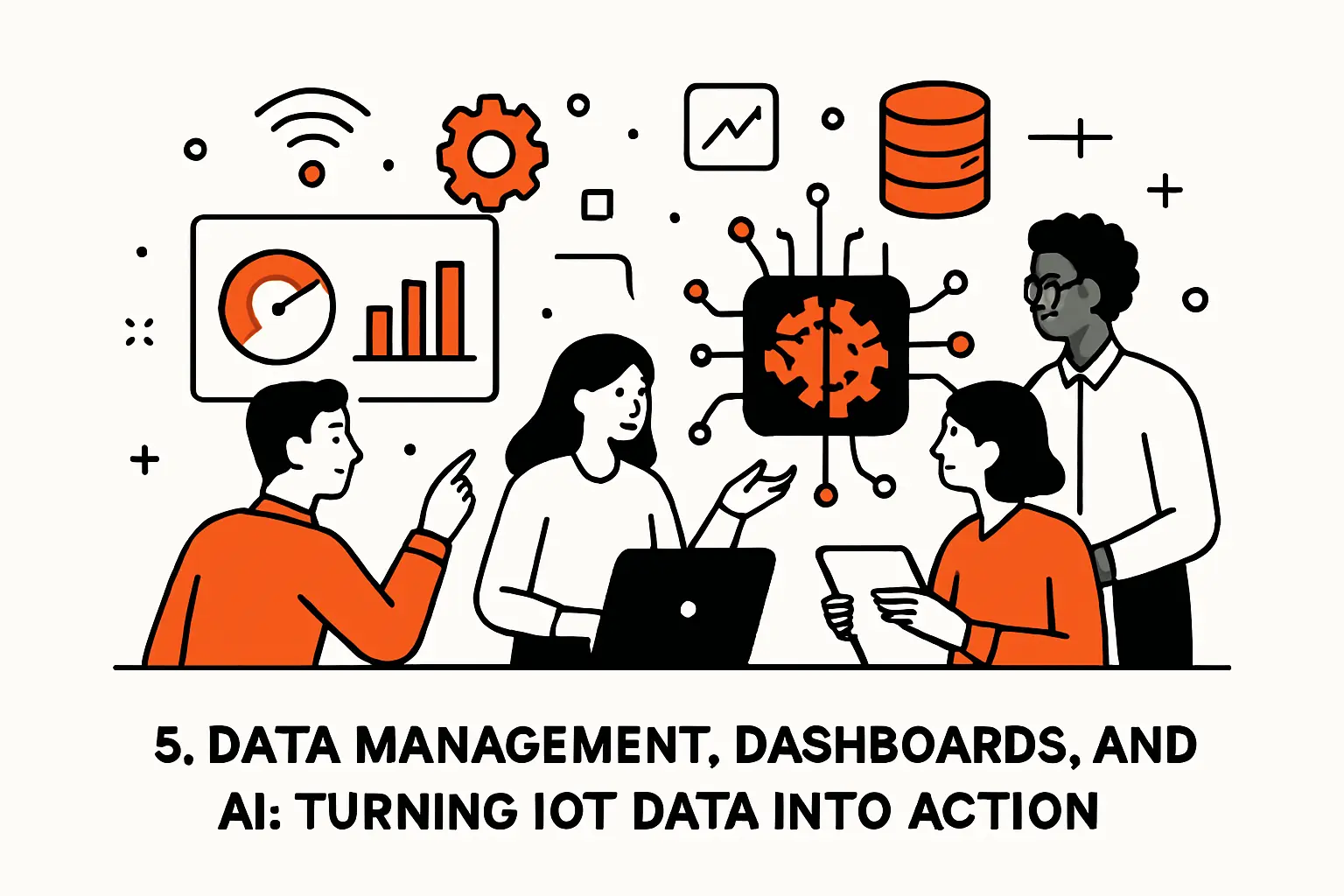
1. End-to-end data management: acquisition, transfer, aggregation, analysis, and application
End-to-end data management is about narrative integrity. A business leader wants to trust that a chart reflects reality, a technician wants to trust that an alert reflects a real condition, and an engineer wants to trust that a model was trained on coherent inputs.
Acquisition is where we validate payloads and attach identity. Transfer is where we handle retries, ordering, deduplication, and buffering. Aggregation is where we align device streams with asset metadata, location context, and operational state. Analysis is where we compute features and detect patterns. Application is where we present outcomes in workflows that people will actually use.
In our experience, the difference between “IoT data” and “operational intelligence” is disciplined context management. Without that, teams end up with dashboards that look impressive but fail the moment someone asks a forensic question.
2. Analytics and intelligence: big data tools, machine learning, and predictive analytics for IoT
Analytics in IoT can be as simple as thresholding and as complex as fleet-wide causal modeling. The art is choosing the simplest approach that produces stable value, then building the pipeline so it can support richer methods later.
Big data tooling often enters when retention grows and queries become multi-dimensional: asset histories, site comparisons, seasonal patterns, and correlations across subsystems. In those situations, we favor architectures that keep raw events immutable while allowing derived datasets to be recomputed as business logic evolves.
Predictive analytics becomes meaningful when the organization can act on predictions. A forecast without an operational playbook is just a prettier chart, so we design analytics outputs to connect directly to work orders, inventory planning, and maintenance windows.
3. AI in IoT infrastructure: enabling predictive maintenance and more autonomous operations
AI is most valuable in IoT when it reduces uncertainty and accelerates response. Predictive maintenance is a classic case: it turns scattered sensor signals into a probability story that helps teams plan interventions before failures cascade.
More autonomous operations emerge when AI is paired with guardrails. Instead of letting a model “run the plant,” we often build bounded autonomy: models recommend, rules constrain, and humans approve in stages until trust is earned. Over time, some decisions can become automatic, but only after careful monitoring shows the system behaves well under edge cases.
From our perspective, the infrastructure requirement for AI is not only compute. The real requirements are lineage, reproducibility, and feedback loops—knowing what data trained a model, how it was deployed, and how its outcomes were validated in the real world.
4. Visualizations and reporting: dashboards, user roles, and actionable views for stakeholders
Dashboards should answer questions, not merely display data. The best operational views we build tend to be boring in appearance but powerful in outcome: clear status, clear exceptions, and a clear path from insight to action.
User roles shape everything. Operators need a “now” view that highlights anomalies and critical states, while managers need trend summaries and performance indicators aligned to goals. Security and compliance stakeholders need audit logs, access histories, and evidence of policy enforcement.
We also think about reporting as a contract with time. If someone needs to prove what happened during an incident, the system must provide traceable event histories, not just rolling snapshots. That is why we design dashboards alongside storage and logging, not as an afterthought.
5. Alerting and response: custom alarm notifications for critical sensor readings
Alerting is where many IoT programs stumble because noise is easier to generate than signal. A naive threshold creates pager fatigue, and pager fatigue quietly turns into ignored alarms.
Effective alerting requires context: asset state, maintenance schedules, known sensor quirks, and the difference between transient fluctuations and sustained deviations. In our deployments, we often add suppression rules, escalation paths, and “actionability checks” so that alerts arrive with recommended next steps rather than raw numbers.
Response workflows matter just as much as notification channels. An alert that cannot open a ticket, identify the impacted asset, and guide a technician to likely causes is a missed opportunity to turn infrastructure into operational leverage.
6. Business value outcomes: efficiency, productivity, new models, and data-driven decision-making
Business value from IoT tends to fall into a few repeatable buckets: reducing downtime, improving energy efficiency, extending asset life, increasing throughput consistency, and enabling new service models. The infrastructure exists to make those outcomes repeatable rather than episodic.
In commercial contexts, we often see IoT enable “service as a relationship” rather than “service as a visit.” Instead of waiting for a customer complaint, operators can proactively detect drift, schedule interventions, and document performance—turning trust into a differentiator.
Data-driven decision-making also becomes more credible when leaders can trace conclusions back to raw signals and governance rules. Our view is that IoT is not only instrumentation; it is an accountability system that makes operational reality harder to ignore.
6. Security, Privacy, and Trustworthiness in IoT Infrastructure
1. Security as a cross-cutting requirement: influencing device, network, cloud, and app design
Security in IoT is not a feature you bolt on; it is an architectural property that emerges from how identity, communication, updates, and access are designed across layers. When any layer is treated casually, attackers tend to use it as the easiest entry point.
At TechTide Solutions, we anchor security planning in recognized guidance rather than improvisation. For device capabilities, a device cybersecurity capability core baseline generally needed to support common cybersecurity controls is a practical starting point because it frames security as required behaviors over a lifecycle, not as a checklist of buzzwords.
Network design must reflect security intent through segmentation and least-privilege routing. Cloud services must enforce tenant boundaries, key management practices, and auditability. Applications must support strong authentication, fine-grained authorization, and safe operational workflows that prevent accidental misuse.
2. Protecting data in transit and at rest: encryption choices and secure data storage
Data protection in IoT is about preventing eavesdropping, tampering, and accidental disclosure. In transit, that typically means authenticated encrypted channels, device identity verification, and careful handling of certificate rotation and expiry.
At rest, storage protection requires more than “turning encryption on.” Key management, access patterns, and retention policies determine whether encryption actually reduces risk or merely decorates a weak operational model. For example, if every service account can read every device stream, encrypted storage does not prevent internal overreach or compromised credentials from becoming catastrophic.
In our designs, we segment data by sensitivity and purpose. Raw payloads, derived features, user metadata, and audit logs often have different privacy expectations and regulatory implications, so we store and protect them accordingly.
3. Access control and secure gateways: managing who can post, retrieve, and act on device data
Access control in IoT must cover machine identities and human identities. Devices need credentials that cannot be easily cloned, while humans need role-based permissions that reflect operational responsibility without granting unnecessary power.
Secure gateways are crucial because they can enforce policies consistently even when devices are simple. Authentication, authorization, rate limiting, and protocol validation at gateways prevent malformed or malicious traffic from poisoning downstream analytics or triggering unsafe actions.
From an operational viewpoint, auditability is non-negotiable. Knowing who changed a configuration, who issued a command, and what data was accessed makes incident response realistic rather than speculative.
To strengthen ecosystem-wide thinking, we often point stakeholders to best practice for the secure design, development and deployment of IoT services, because IoT security is as much about lifecycle and governance as it is about cryptography.
4. Trustworthiness model: security, privacy, safety, reliability, and resilience as one objective
Trustworthiness is the umbrella objective that keeps IoT honest. Security prevents unauthorized influence, privacy prevents inappropriate exposure, safety prevents harm, reliability prevents avoidable outages, and resilience ensures recovery when the unexpected happens.
In our work, trustworthiness is not a slogan; it is a set of engineering trade-offs made explicit. For instance, buffering strategies improve resilience but can complicate forensic timelines unless event ordering is carefully preserved. Remote update capability improves maintainability but can become an attack vector unless signing and rollout controls are rigorous.
Safety deserves its own emphasis because IoT blurs the boundary between information systems and physical systems. Whenever a platform can trigger actions—opening valves, changing temperatures, unlocking doors—the architecture must assume mistakes will happen and must contain those mistakes.
5. Compliance and governance: regulations, audits, and protecting personal or sensitive data
Compliance in IoT is rarely about a single regulation; it is about aligning with a shifting landscape of privacy laws, sector-specific obligations, and contractual commitments. Governance is how organizations translate that landscape into repeatable practices.
Device fleets create governance challenges that traditional IT often underestimates. Asset ownership, data ownership, update responsibility, and end-of-life handling must be decided upfront or the program will inherit invisible liabilities over time.
For supply chain and lifecycle perspectives, security guidelines for the whole lifespan from requirements and design to maintenance and disposal align closely with what we see in real deployments: the long tail of maintenance is where trust is preserved or lost.
7. Scaling and Operating IoT Infrastructure Over Time
1. Scalability planning: adding devices, users, features, and workloads without redesigning everything
Scaling IoT is not only about handling more messages; it is about handling more change. Device counts grow, sites diversify, firmware evolves, and stakeholders request new workflows that were not imagined during the pilot.
In our architecture reviews, we look for “scaling seams”: places where the system can expand without breaking contracts. Identity systems should support hierarchical grouping and delegation. Data models should tolerate schema evolution. Messaging infrastructure should handle bursts without collapsing or silently dropping data.
Cost is part of scalability as well. If every incremental device meaningfully increases operational overhead, the program will stall under its own weight. We aim for automation-first fleet operations: provisioning, policy rollout, monitoring, and update orchestration that can be repeated safely.
2. Interoperability and integration: connecting IoT software with existing business systems
IoT rarely replaces existing systems; it usually feeds them. Maintenance teams live in work-order systems, customer operations live in CRM platforms, security teams live in identity providers and logging tools, and finance teams live in asset registries and procurement systems.
Integration is therefore a first-class infrastructure concern. Data must be translated into the language those systems understand: assets, locations, events, incidents, and service requests. In many deployments, the highest ROI comes not from the dashboard but from automation that reduces manual swivel-chair work between tools.
From our standpoint, interoperability is also a hedge against vendor lock-in. When you integrate through stable APIs, event contracts, and standardized identity, you can swap devices, gateways, or analytics tooling without re-platforming the whole business process.
3. Operational monitoring and maintenance: detecting anomalies, preventing failures, and updating devices
Operating IoT infrastructure means monitoring the platform and the fleet. Platform health includes ingestion latency, broker backlogs, database performance, and API errors. Fleet health includes device connectivity, battery state, firmware status, sensor plausibility, and security posture.
In the real world, anomalies often present as “soft failures”: a device that reports intermittently, a sensor that drifts slowly, or a gateway that is up but misconfigured. Catching those issues requires observability that understands context, not just uptime checks.
Updates are where operational maturity is tested. Safe rollouts, staged deployment rings, rollback capability, and clear ownership for incident response are what separate a scalable fleet from a fragile one. For teams building testing discipline, security issues associated with the Internet of Things and better security decisions when building and deploying IoT technologies is a useful lens because it frames testing as an ecosystem practice rather than an endpoint task.
4. Minimizing deployment friction: cohesive architectures, easier rollout, and easier ongoing management
Deployment friction is where many IoT programs bleed time and budget. Every manual step—hand-entering serial numbers, manually configuring networks, or physically re-flashing devices—doesn’t just slow rollout; it increases inconsistency and error rates.
Cohesive architecture reduces friction by standardizing provisioning flows, automating configuration distribution, and making device onboarding repeatable. In practice, that can mean QR-based enrollment, secure bootstrap credentials, and centralized policy templates that apply across sites.
Ongoing management improves when architectures are designed for operators, not only for engineers. Clear failure states, remote diagnostics, and understandable logs help field teams resolve issues without requiring specialist intervention every time something goes sideways.
5. Avoiding vendor lock-in: integrating with varied sensors and IoT devices across project needs
Vendor lock-in in IoT has a distinctive flavor: it can happen at the sensor layer, the gateway layer, the cloud ingestion layer, or the application layer. Once data models, device identities, and operational workflows are tightly coupled to a vendor’s assumptions, migration becomes expensive.
At TechTide Solutions, we prefer “portable commitments”: open messaging patterns, explicit data contracts, and modular device adapters that isolate vendor-specific logic. Even when a project chooses a managed platform, we design boundaries so that swapping components remains feasible.
Procurement strategy also plays a role. When organizations can source devices from multiple suppliers while keeping a consistent onboarding and telemetry model, they gain negotiating leverage and reduce supply chain risk—benefits that matter as much as technical elegance.
8. How TechTide Solutions Builds Custom IoT Infrastructure Solutions
1. Requirements discovery and solution architecture tailored to your iot infrastructure goals
Our IoT engagements start with requirements discovery that is intentionally cross-functional. Instead of interviewing only engineering, we speak with operations, security, compliance, and the people who will actually respond to alerts at inconvenient hours.
From that discovery, we create a solution architecture that maps purpose to placement: we decide what must run on-device, what belongs at the edge, what is centralized, and what the operational failure modes will be. We include threat modeling and data governance early, because designing trust in is always cheaper than retrofitting it later.
Architecturally, we aim for a coherent “spine” of identity, messaging, and observability that stays stable while devices and analytics evolve. That spine is what makes scaling feel like growth rather than constant reinvention.
2. Custom web and mobile applications for device monitoring, dashboards, and operational workflows
Custom applications are often where IoT becomes operationally real. Off-the-shelf dashboards can be useful, yet many organizations need domain-specific workflows: asset commissioning, maintenance triage, compliance reporting, customer service escalation, and role-based operational controls.
In our builds, we design interfaces around decisions. A technician should see what failed, what changed recently, what the likely causes are, and what actions they can take. A manager should see trends, bottlenecks, and where to allocate attention. Security stakeholders should see audit logs and permission boundaries without needing to reverse-engineer behavior from scattered system logs.
Because IoT programs evolve, we design apps as living products: we use feature flags, modular UI components, and API-first backends to integrate new device types and new analytics outputs without needing a full rewrite.
3. Secure integrations and lifecycle support across edge, cloud, data pipelines, and existing enterprise systems
Integration is where infrastructure either becomes a platform or remains a collection of parts. Our implementation approach focuses on secure, testable contracts between components: device telemetry schemas, event routing rules, identity mappings, and operational APIs.
Lifecycle support is equally important. Devices will need updates, certificates will rotate, new sites will come online, and new stakeholders will demand new reporting views. We support teams with operational playbooks, observability setups, and deployment pipelines that make those changes routine rather than risky.
Over time, the goal is not merely to keep the system running. Instead, we aim to help organizations build a capability: a repeatable way to extend connected operations without sacrificing security, reliability, or clarity.
9. Conclusion: Building Reliable IoT Infrastructure That Grows with You
1. Start with purpose: align iot infrastructure design to the specific use case and environment
Purpose is the compass that keeps IoT infrastructure from becoming an expensive science project. The environment—factory floor, retail site, remote field asset, or consumer home—determines failure modes, connectivity realities, and safety expectations.
At TechTide Solutions, we’ve learned to ask unglamorous questions early: Who responds when an alert fires? What happens when connectivity drops? Which data is sensitive? How will teams update devices years from now? Those answers shape architecture far more than trendy platform choices do.
When purpose is explicit, trade-offs become rational. Without it, teams end up optimizing for the wrong metric and discovering too late that the infrastructure can’t support the outcomes the business actually cares about.
2. Build for growth: scalable networking, data platforms, and continuous operations
Growth in IoT is multidimensional: more devices, more sites, more users, more integrations, and more operational expectations. Teams should design infrastructure as a program, not as a launch.
Scalable networking means hybrid connectivity patterns, disciplined segmentation, and predictable failure behavior. Scalable data platforms mean schema evolution, lineage, and cost-aware retention. Continuous operations mean observability, safe updates, and runbooks that empower teams to respond quickly without guesswork.
In our view, the best sign of a healthy IoT program is when teams can onboard new device types with minimal drama. That kind of calm doesn’t happen by accident; teams engineer it.
3. Design for trust: security, privacy, and resilience as non-negotiable infrastructure attributes
Trust is the currency of IoT. If operators doubt the data, they ignore dashboards. If security teams doubt the controls, they block deployments. And if customers doubt privacy, adoption stalls.
Resilience and security are not separate goals; they reinforce each other. A system that can recover cleanly from outages is easier to defend, and a system with clear identity boundaries is easier to operate safely under pressure.
As a next step, what would your IoT infrastructure look like if we designed it backward from trust—starting with how you prove integrity, safety, and governance—rather than forward from devices and connectivity?

