
App advertising cost becomes far easier to manage once we stop treating “ads” as a single line item and start treating them as an operating system: creative production, analytics instrumentation, attribution, experimentation, and the constant tug-of-war between scale and efficiency. Market context matters here, too: ad spend in the In-App Advertising market worldwide is forecasted to reach US$390.04bn in 2025, which helps explain why pricing can feel like an auction-house on fast-forward rather than a predictable media buy.
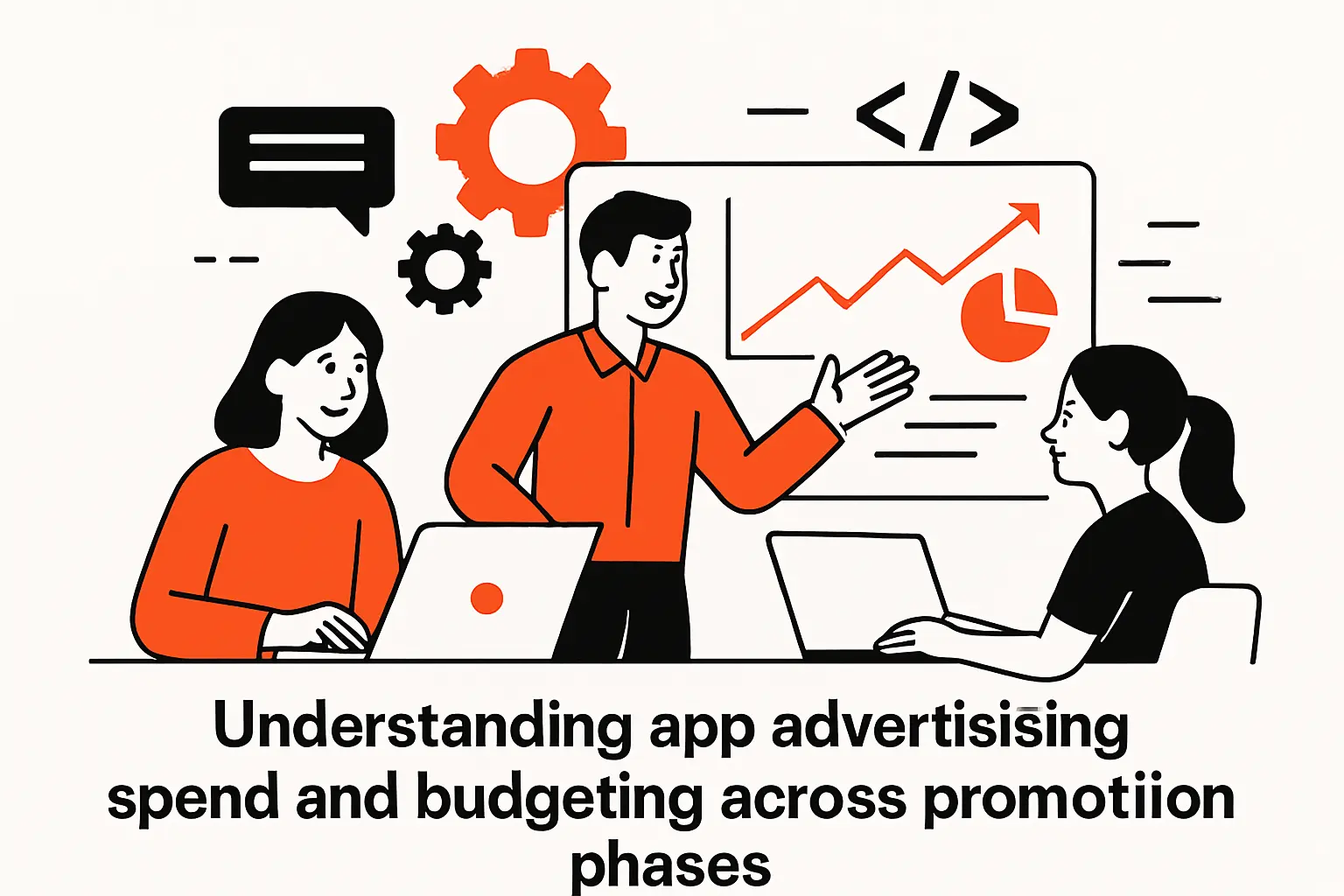
Understanding app advertising spend and budgeting across promotion phases
From our seat at TechTide Solutions, the teams that win aren’t necessarily the teams with the biggest budgets; they’re the teams that treat spend as a learning engine and treat retention as the real product. That mindset changes how we plan pre-launch, how we evaluate launch-week performance, and how we defend post-launch profitability when campaigns inevitably drift.
1. What app advertising spend covers: platforms, placements, and campaign objectives
App advertising spend is not just “the money going to networks.” In practice, it covers platform fees, delivery costs, creative production, measurement tooling, and the operational labor needed to keep campaigns accurate and compliant. Across most app businesses, the complexity comes from the fact that each platform is effectively its own market with its own auction logic, ad review standards, event definitions, and attribution constraints.
From a systems perspective, we group spend into three buckets: acquisition delivery (media), conversion infrastructure (store listing, landing flows, deep links, event tracking), and optimization overhead (creative testing, bidding rules, audience segmentation, and reporting). Put differently: a click or impression is only the visible surface of a much larger machine.
What we include in a realistic spend model
- Creative pipeline work: concepting, production, localization, and versioning
- Tracking implementation: event schema, consent signals, and data QA
- Attribution and analytics: MMP configuration, cohort dashboards, and anomaly alerts
- Campaign operations: naming conventions, budget pacing rules, and fraud controls
On real projects, the “invisible” pieces are the difference between a campaign that looks profitable in a slide deck and a campaign that is truly profitable in the bank account.
2. Budgeting by phase: pre-launch, launch, and post-launch activities
Budgeting by phase forces discipline because each phase has a different job to do. Pre-launch is about de-risking: validating positioning, ensuring analytics integrity, and building a creative inventory that can sustain rapid testing. Launch is about controlled acceleration: buying enough traffic to learn quickly while protecting unit economics from chaos. Post-launch is about sustaining growth: expanding audiences, diversifying channels, and turning early signals into stable forecasting.
At TechTide Solutions, we treat pre-launch as an engineering deliverable, not a marketing warm-up. Without clean event definitions, deterministic deep links, and a reliable source of truth for campaign performance, launch-week data becomes noisy enough to mislead even experienced teams. In our experience, the fastest way to burn budget is to scale before measurement is trustworthy.
How phase-based budgeting reduces waste
- Pre-launch: invest in tracking, creative variations, and store readiness rather than broad scale
- Launch: focus on learning speed (creative, audience, funnel friction) rather than vanity volume
- Post-launch: prioritize marginal efficiency gains, retention loops, and channel diversification
Done well, each phase funds the next phase with better information instead of bigger guesses.
3. Acquisition vs retention: why ROI depends on keeping users engaged
Acquisition ROI is mostly an illusion if retention is weak. An install that churns before it experiences value is not a customer; it is a short-lived analytics artifact. Retention is where business models actually become real: subscription apps need habit formation, marketplaces need repeated supply-demand matches, and games need long-term engagement loops that monetize without exhausting the user.
Operationally, retention changes how we interpret ad costs. A “cheap” user who churns immediately can be more expensive than a “costly” user who sticks, refers, and converts later. That is why we push teams to think in cohorts, not daily averages. Cohorts reveal whether a channel is delivering future revenue or just temporary activity.
Retention-first measurement we recommend
- Align optimization events to meaningful value moments (activation, habitual use, purchase intent)
- Validate that “conversions” are not just accidental taps or incentive-chasing behavior
- Use incremental testing where possible to avoid mistaking correlation for causation
From our viewpoint, the best budget optimization trick is still the hardest one: building an app experience worth coming back to.
App advertising channels and typical cost ranges
Channels don’t just differ in price; they differ in what they are “good at.” Some channels create awareness, others create intent, and a few create both—if we bring the right creative and the right landing experience. Cost ranges are useful as guardrails, but they become genuinely valuable only when paired with a hypothesis about user behavior and a plan to measure it.
1. In-app ads: banner vs interstitial vs rewarded video pricing differences
In-app ads sit in an ecosystem where users are already “in flow.” That’s why format matters so much: banners are low-friction and easy to place, interstitials interrupt attention, and rewarded video trades attention for value. Each of those mechanics attracts a different kind of advertiser demand and produces a different user response pattern.
From a business lens, the pricing differences are an external reflection of internal dynamics: engagement, completion rate, viewability, and downstream conversion quality. Rewarded video usually earns premium demand because the user has opted in; interstitial can perform strongly when timed at natural breaks; banners often scale impressions but struggle to produce high-intent actions unless paired with excellent targeting and a tight message.
Where we see teams misjudge in-app format economics
- Overusing intrusive formats and paying the retention penalty later
- Treating rewarded placements as “free” because users opt in, while ignoring reward design
- Optimizing for short-term install volume when the business needs long-term value
When we architect ad-supported experiences, we treat ad format selection as product design, not only monetization.
2. Display ads: typical $3–$10 per 1,000 people reached range
Display advertising is often the first place teams go for reach, remarketing, or cheap testing—especially when social inventory becomes volatile. The typical range above is useful because it sets a baseline expectation: display can be cost-efficient for awareness, but it can also drift upward when targeting becomes narrow or competitive.
Creatively, display tends to punish vague messaging. A display impression is a tiny window; if the value proposition isn’t instantly legible, performance usually collapses into low-quality clicks or passive impressions. Strategically, we prefer to treat display as a funnel component: it can “prime” an audience, reinforce brand recognition, or support retargeting sequences that close conversions elsewhere.
Practical display use cases that tend to work
- Retargeting users who bounced from a web landing flow before installing
- Awareness campaigns that warm up audiences ahead of a performance push
- Contextual placements aligned with the app’s job-to-be-done
Display works best when we decide what it is for—and refuse to grade it on the wrong metric.
3. Social media advertising: typical annual spend of $1,000–$25,000
Social advertising remains a workhorse channel because it combines creative flexibility, algorithmic delivery, and rapid iteration cycles. What makes it tricky is that “social” is not one market: each platform has different user intent, different content norms, and different learning behavior in the delivery system.
From an operational standpoint, we’ve found that social campaigns succeed when the creative pipeline can keep pace with fatigue. When teams treat creative as a one-time asset, costs rise and learning slows. Conversely, teams that build repeatable creative production—UGC-style variations, founder-led narratives, feature demos, and “before/after” stories—tend to stabilize performance because they keep giving the algorithm fresh options.
How we keep social spend accountable
- Connect ad engagement to on-app behavior, not just platform metrics
- Separate prospecting from retargeting to avoid cross-contamination in reporting
- Run experiments that test incremental lift, not only blended results
Social media can scale quickly, but it also hides inefficiency well unless the measurement layer is built with care.
4. Influencer marketing: $500 to $1 million per sponsored post range
Influencer marketing is often misunderstood as “paying for reach.” In reality, it is paid distribution plus borrowed trust, packaged as content. The problem is that the same deliverable—a sponsored post—can behave like a conversion asset, a brand asset, or a very expensive lesson depending on fit, authenticity, and reuse rights.
From our perspective, the most practical way to treat influencer spend is like creative acquisition with a distribution kicker. If the brand can repurpose the content into paid ads (with proper permissions), the ROI math changes dramatically. Without reuse rights or a clear content strategy, influencer spend becomes a one-shot bet—and one-shot bets are rarely friendly to budgeting.
Influencer programs we’ve seen perform consistently
- Creator partnerships that feel native to the creator’s audience and storytelling style
- Content-first deals where the brand plans paid amplification workflows ahead of time
- Longer-term relationships that reduce the “first post feels forced” problem
When we advise on influencer strategy, we push for operational clarity: deliverables, rights, tracking, and a plan for iteration.
In-app advertising pricing models: CPM, CPC, and CPA
Pricing models are not just billing methods; they are incentive contracts. CPM incentivizes delivery, CPC incentivizes click behavior, and CPA incentivizes the completion of a defined action. The model we choose shapes who takes risk: the advertiser, the network, or the publisher.
In practical app growth work, we rarely use only one model forever. Instead, we use models tactically—sometimes even within the same campaign—based on funnel maturity and measurement confidence.
1. CPM: paying per 1,000 impressions for brand awareness campaigns
CPM is the workhorse model for awareness and reach planning, especially when we want predictable exposure. Under the hood, CPM is also the model that most resembles classic media buying, which is why it remains deeply embedded in how many platforms package inventory.
What we like about CPM in app advertising is that it forces us to confront creative quality and audience relevance early. If the creative is weak, impressions become expensive “wasted looks.” If targeting is too broad, impressions become cheap but meaningless. CPM works best when we are deliberate about what an impression is supposed to accomplish—recognition, recall, or priming for a later conversion path.
CPM pitfalls we watch for
- Optimizing to cheap impressions while ignoring downstream engagement quality
- Over-targeting until reach collapses and auction pressure spikes
- Using CPM without a reliable way to connect exposure to later behavior
For awareness, CPM can be elegant; for performance, it demands disciplined measurement.
2. CPC: paying when a user clicks to drive traffic
CPC is appealing because it appears to align spend with intent: someone clicked, so something happened. The catch is that clicks are not value; they are only movement. In mobile contexts, clicks can be accidental, curiosity-driven, or incentive-seeking—especially when creatives are flashy or placements are crowded.
From a technical standpoint, CPC campaigns often succeed or fail based on what happens after the click: deep link reliability, store load speed, install friction, and the quality of the first-run experience. That is why we often treat CPC work as a full-funnel engineering problem rather than a bidding problem. A small drop in funnel friction can do more than a large bid adjustment.
How we make CPC more honest
- Audit post-click paths: deep links, deferred deep links, and store redirects
- Map click intent to landing relevance (message match matters more than many teams expect)
- Detect click spam patterns using timing anomalies and behavioral signals
When CPC is paired with clean measurement and strong landing relevance, it becomes a powerful lever; otherwise, it becomes a budget leak.
3. CPA: paying when a defined action is completed such as install or purchase
CPA shifts risk away from advertisers and toward publishers or networks, which is why CPA inventory can be harder to access at scale unless the offer is strong and the measurement is trusted. In app growth, the devil is in the definition: “action” might be an install, a subscription start, a purchase, or an activation event like completing onboarding.
In our experience, CPA performs best when the action is tightly coupled to real business value and when the signal is hard to fake. Overly shallow actions can be gamed; overly deep actions can starve delivery. Finding the right action definition becomes a strategic decision, not a tracking detail.
CPA design choices that matter
- Action quality: choose an event that correlates with long-term value, not just activity
- Signal integrity: ensure the event is consistently fired and validated across app versions
- Feedback speed: pick actions that happen soon enough for optimization to learn
CPA can create strong efficiency, but only when we define the “A” like we mean it.
2025 in-app benchmarks by ad format and rate
Benchmarks are not promises; they are starting points. In our work, we use benchmarks the way engineers use performance budgets: as guardrails that tell us when something is broken, misconfigured, or being outbid.
At the same time, benchmarks are useful for cross-team alignment. Product teams, finance teams, and growth teams rarely speak the same language by default; benchmarks give everyone a shared reference without forcing every stakeholder to become an ad platform specialist.
1. Format benchmarks: banner $0.10–$1.00 CPM and interstitial $1.00–$6.00 CPM
The banner-versus-interstitial contrast is a practical illustration of attention economics. Banners buy persistence; interstitials buy interruption. Each has legitimate use cases, and each can punish misuse.
From our product-minded stance, banners are best treated as “background monetization” or “background exposure” mechanisms. Interstitials should be treated as a timed mechanic: they belong at natural breaks, not as random roadblocks. When teams follow that rule, interstitial performance tends to stabilize because user frustration stays bounded.
When teams ignore that rule, interstitials often create a hidden cost: churn, negative reviews, and lower lifetime value that later makes acquisition look “mysteriously” less efficient.
2. Premium formats: rewarded video $6.00–$12.00 CPM and native $3.00–$10.00 CPM
Rewarded video is premium because it is, in a sense, negotiated attention: users choose to watch and receive value in return. That opt-in dynamic tends to reduce hostility and improve completion rates, which is precisely what advertisers pay for. Native ads, by contrast, earn premium pricing when they genuinely fit the surrounding experience—when they look and behave like part of the app, not like an alien overlay.
Our strongest opinion here is that “premium format” is not purely a monetization label; it is a UX contract. If rewarded video is stingy or manipulative, it stops being rewarding. If native ads are deceptive or poorly labeled, they stop being native and start being trust erosion.
A real-world pattern we often see
- Games: rewarded video tied to progress mechanics tends to keep users engaged
- Content apps: native placements that recommend relevant content can feel additive
- Commerce apps: native placements that match shopping intent can behave like discovery
When premium formats are implemented ethically and intentionally, they can fund growth without poisoning retention.
3. Overall benchmarks: CPM $2–$15, CPC $0.10–$2.00, and CPA $1–$10+
Overall benchmark ranges are most useful when we’re troubleshooting. If performance falls outside the guardrails, it usually indicates a clear cause: targeting too narrow, creative mismatch, inventory quality problems, funnel friction, or measurement errors.
At TechTide Solutions, we also use “overall” benchmarks as a communication tool with finance and leadership. Instead of arguing over a single campaign’s short-term results, we anchor expectations around what the market typically allows and then focus the debate where it belongs: product fit, funnel quality, and the learning plan.
How we use these ranges without being trapped by them
- Use benchmarks to detect anomalies, not to set goals in isolation
- Segment performance by cohort and intent instead of blending everything together
- Review benchmark fit by app category and geography before making conclusions
Benchmarks are guardrails; strategy is the steering wheel.
Factors that influence app advertising cost
Advertising cost is shaped by a familiar set of forces—supply, demand, and perceived value—but those forces manifest differently in apps because attention is more personal and measurement is more constrained. In our work, we’ve found that cost variation usually becomes understandable once we map it to user experience: how interruptive the ad is, how relevant the audience is, and how likely the user is to complete the desired action.
1. Ad format size and complexity: simple banner creative vs interactive ad formats
Format complexity changes cost because it changes outcomes. Interactive and rich media creatives often command higher pricing because they can produce higher engagement and longer dwell time—assuming they load fast and don’t feel gimmicky. Meanwhile, simple banners are easy to serve and easy to ignore.
From an engineering angle, complexity also changes operational risk. Rich creatives introduce asset weight issues, rendering differences across devices, and more chances for tracking to break. That risk shows up as hidden cost: longer QA cycles, more edge cases, and more performance regressions if the creative pipeline is unmanaged.
What we advise when teams want “interactive everything”
- Prioritize lightweight execution: fast load beats fancy animation
- Separate creative experimentation from production stability so teams can iterate safely
- Measure engagement honestly: interaction is not automatically conversion intent
Sometimes the simplest creative wins—not because it is simple, but because it respects the user’s time.
2. Operating systems: Android vs iOS CPM differences
OS-level differences often show up in pricing due to audience composition, device ecosystems, and privacy frameworks. In many categories, advertisers value certain OS audiences differently because downstream monetization behavior differs, and because measurement constraints can differ by platform policy.
In practice, we encourage teams to stop treating OS as a “targeting checkbox” and start treating it as a product surface area. Purchase flows, onboarding experiences, and performance profiles differ across OS. If the app’s experience is weaker on one OS, advertising costs can effectively rise because conversion rates fall and platforms learn that the traffic is less valuable.
OS-aware optimization we routinely implement
- Separate funnels and event QA by OS to avoid hidden data quality issues
- Align creative to OS-native expectations (UI patterns and trust cues matter)
- Verify attribution logic per OS so reporting doesn’t drift into fiction
When the app experience is consistent across platforms, cost differences become manageable rather than mysterious.
3. Device type: smartphone vs tablet inventory, engagement, and screen-size impact
Device type influences cost because it influences attention and interaction. Screen size affects what feels intrusive, what is readable, and how quickly users can act. Inventory availability also shifts by device mix, which influences auction pressure.
From our view, the bigger issue is often creative and landing mismatch. A creative designed for a phone may look awkward on a tablet; a store flow may behave differently; and in-app onboarding may not scale visually as intended. Those small UX mismatches can reduce conversion and raise effective acquisition costs even when media rates look stable.
Device-specific checks we recommend
- Preview creatives across device classes before scaling spend
- Test the full install-to-onboarding flow on real hardware, not only emulators
- Monitor performance metrics by device group to catch drift early
When device experience is ignored, advertising becomes an expensive way to discover UI bugs.
4. Geography and time of day: purchasing power by region and peak-usage bidding pressure
Geography changes cost because it changes purchasing power, advertiser competition, and inventory volume. Time-of-day effects appear because user behavior clusters: certain hours produce more sessions, more commerce intent, or more entertainment consumption, and auctions respond accordingly.
We’ve learned to treat geo-and-time as a strategy layer rather than a mere segmentation detail. A campaign can look “bad” in aggregate while quietly being excellent in a specific region or during a specific behavioral window. Conversely, a campaign can look “good” while relying on a narrow pocket of efficient traffic that cannot scale.
Operational tactics that help here
- Use geo cohorts to separate market fit issues from bidding issues
- Schedule creative themes to match user context (commute, leisure, decision-making moments)
- Localize not only language but also value framing and trust signals
Regional nuance is often where sustainable efficiency is hiding.
5. Targeting depth, app category, and seasonality: audience value and demand spikes
Targeting depth can be a double-edged sword. Narrow targeting increases relevance but also increases competition and reduces inventory, which can raise costs quickly. App category matters because advertiser demand follows money: categories tied to high-value outcomes attract more bidders. Seasonality introduces periodic demand spikes that can temporarily distort what “normal” costs look like.
At TechTide Solutions, we try to keep category and seasonality from becoming excuses. If costs rise, the productive question is: “What can we control?” Usually, the controllable levers are creative resonance, funnel conversion, offer clarity, and retention improvements that increase lifetime value and make higher acquisition costs tolerable.
What we do when seasonality gets aggressive
- Shift testing to earlier windows so learning isn’t priced at peak auctions
- Refresh creative before demand spikes to avoid simultaneous fatigue and inflation
- Protect retention systems so new users don’t churn under onboarding stress
High demand doesn’t have to mean low profitability, but it does require preparation.
Trends changing mobile advertising costs
Mobile advertising costs are being reshaped by format evolution, privacy constraints, and automation. The net effect is not simply “more expensive” or “cheaper”; rather, it is more operationally complex. In our work, complexity is cost: it shows up as measurement overhead, experimentation friction, and delayed decision-making when teams can’t trust the numbers.
1. Video and interactive formats: higher engagement and shifting ad budgets
Budgets continue to move toward formats that hold attention. Short-form video, interactive units, and opt-in experiences are attractive because they can compress storytelling into moments that feel native to mobile behavior. For many apps, especially entertainment and gaming, video has become the default creative language.
From our standpoint, the hidden cost is creative throughput. Video-heavy strategies require production capacity, rapid iteration, and a library mindset. Teams that can’t produce variants end up with fatigue, rising costs, and a false belief that “the channel stopped working.” In reality, the creative supply simply failed to keep up with the algorithm’s appetite for novelty.
How we operationalize video at scale
- Build a repeatable template system (hooks, demos, proof, call-to-action)
- Instrument creative metadata so performance can be analyzed by concept, not only by ad ID
- Connect creative testing to product iteration so messaging reflects real user value
When video is treated like a product pipeline, costs stabilize because learning compounds.
2. Privacy regulations and user consent: targeting constraints that increase operational complexity
Privacy rules and consent expectations have changed what “targeting” means. In many cases, we are optimizing with less deterministic data, more aggregation, and more reliance on modeled outcomes. That pushes teams toward better first-party data practices and more careful experimentation methods.
In our experience, privacy-driven complexity raises costs indirectly: teams spend more time reconciling dashboards, debating attribution, and implementing consent-aware tracking. The teams that adapt best are the teams that treat privacy compliance as a design constraint rather than a last-minute legal patch. Cleaner data pipelines and consistent consent handling reduce operational chaos, which improves decision velocity.
Consent-aware engineering habits we encourage
- Design event schemas with explicit consent states and clear fallback behavior
- Prefer server-side validation where appropriate to reduce client-side fragility
- Use incrementality and holdouts to test what is truly working
Privacy doesn’t end optimization; it demands better optimization discipline.
3. Ad tech automation: tools for optimizing placement, targeting, and performance tracking
Automation is changing how costs behave because it changes how auctions are fought. Automated bidding, creative rotation, and optimization algorithms can reduce manual labor, but they can also hide problems if teams stop asking hard questions about causality and value.
From our view, the winning posture is “trust but verify.” Automation is excellent at exploring large decision spaces, but it is not responsible for our business outcomes. We still need guardrails: budget pacing rules, fraud checks, creative QA, and analytics that expose performance by cohort and by funnel stage.
Automation patterns we’ve seen succeed
- Automated bidding paired with strict measurement hygiene and anomaly detection
- Creative automation supported by a human-led concept strategy
- Cross-channel reporting that normalizes metrics so comparisons are fair
Automation reduces busywork, yet it increases the value of good governance.
Reducing ad spend without sacrificing growth
Cost reduction is often framed as “cut budget,” but that’s usually the bluntest instrument available. In our experience, the highest leverage move is improving efficiency: better conversion, better retention, better creative, and better analytics. Those improvements let teams spend less for the same outcome—or spend the same and grow faster.
1. Low-cost visibility tactics: communities, user-generated content, and content marketing
Low-cost visibility is about earning distribution rather than buying it. Communities—whether niche forums, creator ecosystems, or professional groups—can deliver high-intent traffic if the app solves a real problem and the messaging respects the community’s norms.
From our viewpoint, user-generated content is the bridge between community and paid growth. When users naturally demonstrate the product, that content becomes proof, education, and social validation in one package. Later, that same content can often be repurposed into paid creatives (with permission), reducing production costs and increasing authenticity.
What we encourage teams to build
- Shareable moments inside the app (results, transformations, achievements, summaries)
- Lightweight prompts that invite users to post without feeling coerced
- Content that answers real questions instead of sounding like ads
Organic traction rarely replaces paid growth completely, but it can reduce dependency and improve creative quality.
2. Social media promotion on a budget: choosing the right platforms and engaging consistently
Budget-friendly social promotion works when teams pick the right battlefield. Not every app belongs everywhere, and spreading effort thin is a common failure mode. The best choice is usually the platform where the app’s value can be demonstrated quickly and where the target users already spend attention.
Consistency matters because social algorithms reward ongoing relevance. From a practical standpoint, consistency is easier when the team creates a content system: recurring series, repeatable formats, and a clear editorial voice. We also recommend using social channels as a feedback loop: comments and DMs are often the earliest signal of confusion, objections, or unmet needs that later show up as conversion friction in paid funnels.
Our preferred approach to budget social
- Pick a small set of content formats and iterate them relentlessly
- Let product updates drive content themes so promotion stays grounded
- Use social feedback to refine onboarding and store page messaging
When social is treated as product discovery rather than brand theater, it contributes directly to growth efficiency.
3. ASO investment options and costs: in-house, tool subscriptions, and professional services
App Store Optimization is often the quiet profit multiplier behind paid acquisition. Better ASO improves conversion from store view to install, which effectively lowers acquisition costs without changing bids. That is why we encourage teams to treat ASO as a growth infrastructure investment rather than a one-time keyword exercise.
In our experience, ASO works best as a continuous practice: testing icons and screenshots, improving value proposition clarity, and aligning reviews with real user outcomes. Tools can accelerate keyword research and competitor monitoring, while professional services can help teams build the process and avoid common traps. The key is operational ownership: ASO cannot be “set and forget” because competitors and user expectations constantly shift.
ASO levers that matter most in practice
- Message match between ads and store page visuals
- Clear first-screen promise: what the app does and why it is different
- Review strategy focused on real satisfaction moments, not spammy prompts
When ASO improves, paid spend becomes more efficient because the funnel stops leaking at the store.
4. Optimization tactics: test and iterate creatives, use programmatic buying, and diversify channels
Optimization is where budgets are won or lost. Creative testing is usually the highest leverage lever because it affects every step: click-through, conversion, and downstream engagement quality. Programmatic buying can improve efficiency by expanding inventory access and enabling more granular decision-making. Channel diversification protects performance when any single platform changes algorithms, pricing, or policies.
At TechTide Solutions, we like to treat optimization like software development: ship, measure, learn, iterate. That implies reliable analytics, stable naming conventions, and a culture that treats failed experiments as valuable information rather than embarrassment.
Optimization habits we consistently recommend
- Maintain a creative backlog with hypotheses, not just random variations
- Build cross-channel reporting so comparisons aren’t distorted by inconsistent attribution
- Use structured experiments to separate creative effects from audience effects
The goal isn’t constant change; the goal is constant learning with controlled risk.
5. Common pitfalls that waste budget: weak audience research, neglected reviews, and missing analytics
Budget waste is rarely dramatic; it is usually incremental. Weak audience research leads to irrelevant targeting and low-quality traffic. Neglected reviews reduce store conversion and quietly increase acquisition costs. Missing analytics creates the worst outcome of all: teams keep spending without knowing why results move.
From our experience, the most expensive pitfall is “optimizing the wrong thing.” Teams chase installs when they need activation, chase clicks when they need qualified intent, or chase short-term ROAS while ignoring retention decay. Each of those mistakes can look good temporarily, which is why they are so dangerous.
Our internal checklist for avoiding budget waste
- Confirm event integrity before scaling spend
- Audit store presence regularly: screenshots, messaging, and review themes
- Validate that optimization events correlate with real business value
When the basics are strong, optimization becomes compounding progress instead of compounding confusion.
TechTide Solutions: custom software to manage and reduce app advertising cost
Most “ad cost problems” become software problems as soon as an app scales beyond a small campaign set. Data lives in too many places, definitions drift, teams argue over dashboards, and optimization slows down. This is where we, as TechTide Solutions, often step in: not to replace marketing teams, but to give them systems that make decision-making faster, cheaper, and more reliable.
1. Custom analytics dashboards to track CPC, CPM, CPA, and CPI in one place
Unified dashboards are not about pretty charts; they are about single-source-of-truth governance. We build analytics layers that unify network data, attribution data, and in-app behavioral data so that teams can answer practical questions quickly: Which creative concept drives high-quality activation? Which campaign is scaling volume but degrading retention? Where is attribution disagreeing, and why?
From a technical angle, the core is data modeling: consistent campaign naming ingestion, normalized metrics, and a canonical event schema that prevents “same metric, different meaning” disasters. When dashboards are reliable, teams spend less time reconciling spreadsheets and more time improving outcomes.
Capabilities we commonly deliver
- Cross-network ingestion with consistent dimensions (campaign, ad set, creative, geo)
- Cohort analysis that links acquisition source to downstream engagement and monetization
- Alerting for sudden drift, tracking outages, and suspicious traffic patterns
When the measurement system is stable, budget optimization becomes a repeatable process rather than a weekly fire drill.
2. Campaign operations automation: integrations across ad networks, BI tools, and internal systems
Campaign operations is where hidden cost accumulates: manual updates, inconsistent naming, human error, and slow feedback loops. We build automation that connects ad platforms to internal BI systems, data warehouses, experimentation platforms, and approval workflows.
Operationally, automation enables guardrails: budget pacing rules, creative approval pipelines, compliance checks, and automated tagging. Technically, we focus on reliability and auditability—because when an automation changes budgets or pauses campaigns, the business needs a clear explanation of what happened and why.
Automation outcomes we aim for
- Faster iteration cycles with fewer manual steps
- Reduced human error in campaign setup and reporting
- Clear audit logs that support finance, compliance, and performance reviews
Automation doesn’t replace strategy, yet it removes the operational drag that makes strategy hard to execute.
3. Optimization tooling tailored to customer needs: experimentation workflows, reporting, and ASO support
Off-the-shelf tools often get teams partway, then stall at the messy edges: custom KPIs, niche funnels, hybrid monetization models, or complex consent requirements. We build optimization tooling that fits the app’s realities rather than forcing the business into generic dashboards.
From our engineering perspective, the most valuable tooling supports experimentation: defining hypotheses, managing variants, tracking results, and documenting learnings so that knowledge doesn’t evaporate when team members change. For ASO, we often support structured testing workflows, creative asset management, and performance tracking that ties store improvements to downstream value.
What “tailored” really means to us
- Experiment tracking aligned with the app’s actual value moments
- Reporting that speaks both to marketers (performance) and executives (profitability narrative)
- ASO workflows that connect creative changes to measurable funnel outcomes
When optimization is systematized, advertising cost becomes manageable because the organization learns faster than the market shifts.
Conclusion: turning benchmarks, metrics, and strategy into a sustainable advertising plan
Sustainable app advertising is less about finding a magic benchmark and more about building a disciplined loop: measure accurately, learn quickly, improve the product experience, and scale what truly works. Benchmarks can anchor expectations, but they cannot replace strategy. Pricing models can shape incentives, but they cannot replace retention. Automation can reduce operational friction, but it cannot replace clarity about what success means.
At TechTide Solutions, we’ve come to believe that the best “budget optimization” is a business capability, not a one-time initiative: clean data, repeatable experimentation, honest attribution, and product decisions that increase lifetime value. If we were to recommend a next step, it would be this: before increasing spend, can we name the single most important question we want the next campaign to answer—and do we have the instrumentation to trust the answer?