


At Techtide Solutions, we’ve learned that “global internet access” is rarely global in the way business leaders imagine. Connectivity is shaped by national firewalls, streaming licenses, corporate security controls, carrier-level filtering, and risk engines that quietly decide whether a login is “normal” or “suspicious.” Sometimes those constraints are legitimate. Other times, they’re blunt instruments that lock out students, founders, journalists, researchers, and distributed teams that are simply trying to do honest work.
Proxies sit in the middle of that tension. When people use them carefully, they create a controlled bridge between users and the public internet that can improve speed, lower risk, and help spread-out teams work better. When people use them carelessly, they can become an easy path for abuse, fraud, and compliance problems. Our view is practical: proxies are not automatically good or bad. They are part of the infrastructure, and the way they are used depends on the people running them.
The problem proxies solve: restricted internet access and digital borders
In the broader security economy, proxy-centric controls are also riding a bigger budget wave: Gartner forecasts worldwide end-user spending on information security to total $213 billion in 2025, a signal that organizations are investing heavily in the very layers where proxies often live (edge protection, access control, traffic governance).
Below, we’ll explain how proxies actually route traffic, where they genuinely expand access, how they strengthen (and sometimes weaken) security posture, and how we at Techtide Solutions engineer proxy-enabled software that stays reliable under real-world constraints.
1. Geo-blocking and censorship as “digital gatekeepers”
Digital borders usually appear in two main forms: business-based region blocking and government content blocking. Region blocking often comes from business or legal reasons, such as content rights, pricing rules, tax handling, or local regulations. Government blocking is different. It often means forcing limits on access by blocking news sites, slowing down messaging apps, filtering certain words, or shutting off whole types of online services. Either way, the user experience feels the same: “You can’t access this here,” even when the user is trying to do something normal and legal.
From our point of view, these control points affect much more than entertainment. These policies shape how SaaS products behave. They decide whether developer guides load, whether you can open a payment provider’s admin panel, and whether an identity service can finish a device check. In client work, we’ve seen “region mismatch” trigger waves of support tickets. The tickets look like app bugs, but network and policy decisions outside the app actually cause the failures.
2. Why restrictions disrupt education, entrepreneurship, and cross-border collaboration
Restrictions are rarely “surgical.” When networks block broad domains, they often block dependencies: analytics scripts, package registries, captcha providers, video hosting, or cloud assets. That collateral damage hits education first, because learning resources are scattered across many platforms. It hits entrepreneurship next, because small teams can’t afford redundant infrastructure in every jurisdiction, nor can they debug every edge case caused by invisible filtering.
Cross-border collaboration suffers in quieter ways. A designer in one region might be unable to preview a staging site that lives behind an allowlist. A QA engineer traveling for family reasons might get locked out when the auth system misreads travel as account takeover. Even meeting notes can fail to sync if a document host gets blocked. In those moments, what teams need is not “a hack,” but a repeatable connectivity layer with clear governance.
3. Where proxies fit in the modern connectivity toolkit for individuals and businesses
Proxies are just one part of a larger set of network tools, along with VPNs, DNS controls, CDNs, access gateways that check user identity, and zero-trust access tools. Each one handles a different part of the job: VPNs extend private networks, CDNs speed up content delivery, and identity-based gateways apply rules based on who the user is. In our experience, proxies are the most flexible way to direct traffic. They can be limited to certain kinds of traffic, used only for specific domains, and set up so teams can log, limit, and watch what happens.
For individuals, proxies are often about reaching resources that would otherwise fail—while accepting that privacy and security depend heavily on operator trust. For businesses, proxies are frequently about consistency: predictable egress locations, stable allowlisting, controlled automation, and defensive filtering. Put simply, proxies are the plumbing that makes a distributed world feel less brittle.
Recommended reading: What Your IP Address Is: How to Find It, What It Reveals, and How to Protect It
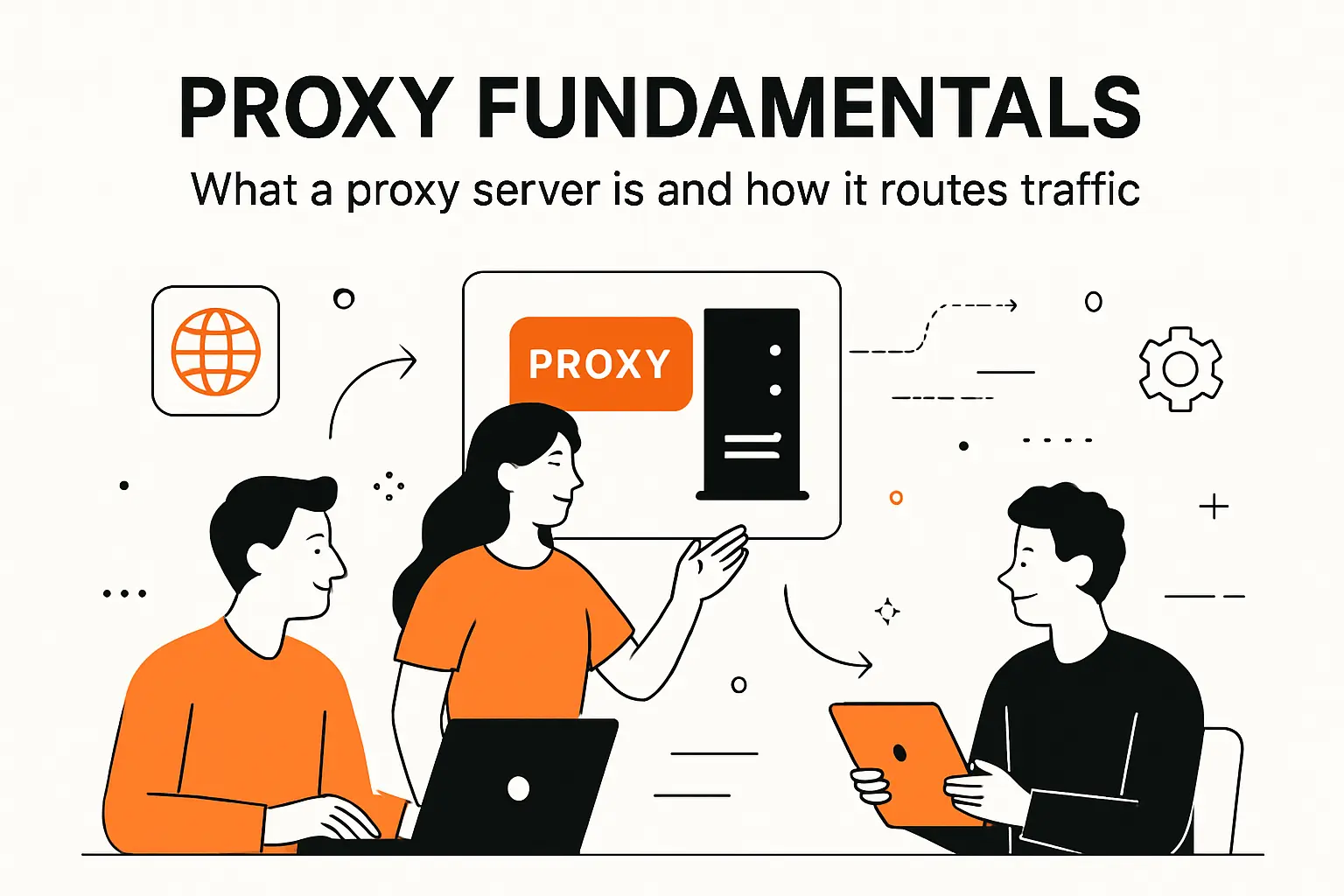
Proxy fundamentals: what a proxy server is and how it routes traffic
1. Request and response flow: client request, proxy forwarding, server response, user delivery
Conceptually, a proxy is an intermediary that receives a client’s request and then decides what to do next: forward it, block it, rewrite parts of it, or serve a cached response. We like MDN’s concise framing that a proxy intercepts requests and serves back responses, because it highlights the core power: interception creates an opportunity for governance.
In a typical flow, the user agent (browser, mobile app, automation worker) sends an outbound request to the proxy. The proxy establishes a connection to the target server, forwards the request (often with modified headers), receives the server’s response, and delivers that response back to the client. This “middle hop” is where performance features (caching, compression) and security features (allow/deny rules, threat inspection) can live without changing the origin application.
2. IP masking basics: how proxies change what websites can identify about a user
Most public websites infer “where you are” from your IP address, and many security systems treat IP reputation as a leading indicator of fraud. A forward proxy changes the apparent origin by making the target server see the proxy’s IP as the source of the request. That sounds simple, but the impact is deep: geolocation shifts, risk scoring shifts, and rate-limits shift. In authentication-heavy apps, that shift can be the difference between a smooth login and a locked account.
Still, IP masking is not invisibility. Device fingerprints, cookies, TLS traits, language headers, and behavioral patterns can continue to identify a user. In our builds, we treat IP masking as one signal among many, not a magic cloak. The responsible approach is to reduce unnecessary exposure—especially for automation and testing—without pretending that proxies erase identity from the web.
3. Caching, filtering, and traffic governance for performance and control
Proxies often double as performance optimizers. When many clients request the same resources, a proxy cache can store responses and serve them faster, reducing both upstream latency and bandwidth consumption. On the standards side, this document defines HTTP caches and the associated header fields that control cache behavior, which matters because “caching” is only safe when freshness, validation, and privacy boundaries are respected.
Filtering and governance are the other half. At Techtide Solutions, we view policy as code: allowlists for critical SaaS domains, denylists for known-malicious endpoints, content-type constraints, and request-shaping rules that keep automation from looking like a denial-of-service accident. When teams deploy proxies well, those proxies become an enforceable contract between users and the internet: here’s what we allow, here’s what we forbid, and here’s what we log.
Recommended reading: How to Use FTP: Connect, Browse, and Transfer Files Safely
How proxies are bridging global internet access in practice
1. Accessibility through multi-region IP availability
Multi-region egress is the most practical way proxies “bridge” the internet: they give users an exit point in a region where a service is reachable and stable. For a distributed team, that can mean predictable access to internal admin panels, localized storefronts, partner portals, and developer resources. In our experience, a proxy pool is less about “being somewhere else” and more about being somewhere consistent.
Consider a global QA workflow: a commerce site behaves differently across regions due to shipping rules, tax display, and payment methods. Without multi-region access, QA is guessing. With region-specific proxy routing, QA can validate what real users see, while the business reduces false positives in fraud monitoring because test traffic no longer comes from random hotel networks. That is bridging access in a way that directly protects revenue.
2. Overcoming censorship and bypassing geo-restrictions with off-region routing
Off-region routing is the blunt—sometimes necessary—tool for censorship scenarios: when a service is blocked in-region, routing traffic through a proxy outside that region may succeed. Yet “may” is doing a lot of work here. Modern censorship systems can block by IP ranges, by TLS traits, by SNI patterns, or by traffic timing. Meanwhile, services themselves may enforce geo-policy based on payment country, account history, or identity proofing, independent of IP address.
From our standpoint, the durable use case is not “breaking rules,” but preserving legitimate operations when networks are unstable or overly restrictive. A traveling employee who needs access to their company’s documentation is not committing fraud; they’re trying to do their job. A proxy can restore reachability while maintaining company logging, policy enforcement, and rate limits—controls that a random workaround would lack.
3. Flexibility for travelers and global teams by maintaining consistent access patterns
Travel is a security event whether we like it or not. Identity providers see sign-ins from unfamiliar networks and often step up verification. Payment providers see “impossible travel” patterns and may freeze accounts. Collaboration tools see new IP reputations and sometimes degrade service quality. A well-governed proxy strategy can smooth that friction by keeping egress stable, even when people move.
In client implementations, we often separate “human browsing” from “automation” from “service-to-service” traffic, each with distinct proxy rules. That separation reduces accidental coupling: a developer’s web session should not inherit the same routing as a scraping job, and an API integration should not share egress with casual browsing. Consistency is the real gift proxies offer global teams: fewer surprises, fewer lockouts, and fewer frantic support chats during critical launches.
Recommended reading: What Is a URL: A Practical Guide to Web Addresses and How They Work
Security and privacy benefits, plus what proxies don’t guarantee
1. Privacy buffering: reducing exposure to trackers by concealing the device’s origin
Proxies reduce exposure in two ways: they hide the client IP from the target, and they centralize outbound traffic so you can enforce controls consistently. In privacy terms, that matters because IP-based profiling is still common in advertising and fraud ecosystems. Masking the endpoint’s origin also reduces direct targeting of a device, which can be valuable for activists, researchers, and high-risk staff roles—provided the proxy operator is trustworthy.
Trust is the catch. A proxy can see destination domains, timing, and often content metadata; in non-encrypted scenarios, it can see content itself. For that reason, we treat “privacy buffering” as a risk transfer: you are shifting visibility from many third parties to a smaller number of infrastructure operators. Our recommended posture is to choose providers with transparent policies, narrow the scope of proxied traffic, and avoid placing sensitive credentials on networks you do not control.
2. Filtering and barrier protections: blocking malicious content before it reaches the endpoint
Security teams like proxies because they create a choke point. Block malicious domains, quarantine risky file types, and throttle suspicious request patterns. That can reduce endpoint exposure, especially when organizations support unmanaged devices or contractors. In our own designs, we often pair proxies with URL categorization, malware scanning hooks, and rule-based response handling that prevents risky payloads from ever touching a laptop.
Barrier protections also help with data loss prevention in a practical sense: outbound uploads to unknown destinations can be flagged, and accidental credential leaks can be reduced through policy. Yet proxies are not a silver bullet. Phishing still happens inside allowed platforms, insiders can still exfiltrate data using permitted channels, and encrypted traffic limits deep inspection unless you deploy additional controls. Strong security comes from layers, not from a single “smart gateway.”
3. Proxy vs VPN: routing scope, encryption expectations, and when each approach fits best
A proxy typically routes specific application traffic (often web traffic), while a VPN commonly routes broader device traffic through a secure tunnel. That difference changes both capability and risk. With a VPN, the organization can enforce network-level policies for many applications at once, but that can also create more blast radius if the tunnel is misconfigured. With a proxy, the scope is narrower and easier to reason about, but non-proxied apps may still leak traffic outside your governance model.
Encryption expectations are another key distinction. Many VPNs emphasize strong encryption as a primary feature, while proxies may or may not provide transport security depending on the protocol and configuration. In practice, we choose based on intent. If you need private access to internal systems, start with VPN-like tooling. If you need controlled egress, consistent IPs, or web-layer governance, choose proxies—they usually fit more cleanly. A hybrid is common in mature environments, and the best architecture is the one you can audit and operate reliably.
Recommended reading: What Is IPTV and How Internet Protocol Television Works
Types of proxy servers and services, mapped to real needs
1. Residential vs datacenter proxies: authenticity and trust signals vs speed and cost efficiency
Residential proxies generally appear to originate from consumer networks, which can look more “natural” to many target sites. Datacenter proxies usually come from cloud or hosting providers, which often means higher throughput and lower cost, but also higher scrutiny from anti-bot defenses. In our experience, the right choice depends less on ideology and more on the target’s threat model: some platforms treat datacenter IPs as suspicious by default, while others barely care.
Operationally, residential proxies can be more fragile because they depend on consumer-grade last-mile networks and often have variable quality. Datacenter proxies can be easier to scale and monitor, but may trigger more blocks for sensitive workflows like ad verification or marketplace monitoring. When we design proxy-enabled systems, we avoid “one-size-fits-all” pools; instead, we route based on the business workflow’s tolerance for latency, block rates, and identity continuity.
2. Forward proxies vs reverse proxies: user-side anonymity and policy control vs server-side shielding and load balancing
Forward proxies sit between a client and the internet, shaping outbound requests and often masking the client’s origin. Reverse proxies sit in front of servers, receiving inbound requests and forwarding them to origin services while adding protection and performance features. In other words, forward proxies help clients reach the world, while reverse proxies help the world reach servers safely.
On the reverse proxy side, we often point to mainstream infrastructure patterns rather than niche tools. For instance, Cloudflare describes that a reverse proxy is a network of servers that sits in front of web servers, forwarding or handling requests on the origin’s behalf. In practical business terms, reverse proxies enable WAF controls, bot filtering, caching, and routing rules that keep origin systems resilient. Meanwhile, forward proxies enable controlled egress, acceptable-use enforcement, and predictable IP allowlisting for third-party integrations.
3. HTTP and HTTPS proxies, SOCKS5 proxies, transparent proxies, anonymous proxies, high anonymity proxies
Proxy “types” can sound like taxonomy for its own sake, but the distinctions matter when reliability is on the line. HTTP/HTTPS proxies are common for web traffic and are often easiest to integrate into browsers, mobile stacks, and automation frameworks. Other proxy protocols are more flexible for non-HTTP applications, but they require careful client support and stricter operational controls to avoid accidental data leaks.
Transparency and anonymity labels usually describe what the target server can infer: does the proxy reveal that it is a proxy, does it pass through identifying headers, and does it leak client IP information through misconfiguration. In our engineering reviews, we treat these labels as marketing hints, not guarantees. Real anonymity depends on correct header handling, consistent TLS behavior, DNS routing choices, and disciplined session management—details that separate “it works on my laptop” from “it survives production.”
Recommended reading: Networking Solutions: Simple, Secure Strategies for Modern Business and Industrial Connectivity
Proxy networks at scale: reliability, speed, and scalability considerations

1. Building a dependable proxy network: balancing cost, security, speed, and scalability
Scaling proxies is not just buying more IPs. A dependable network needs predictable uptime, sane rotation behavior, stable routing, abuse prevention, and observability that lets operators answer simple questions quickly: What failed? Where? For whom? Under what policy? At Techtide Solutions, we think of proxy networks as distributed systems with all the classic hazards: partial failures, noisy neighbors, rate limits, and inconsistent upstream behavior.
Cost pressure often tempts teams to cut corners—shared pools, weak isolation, thin logging—until something breaks. Security pressure pulls in the opposite direction—tighter controls, more inspection, more auditing—until latency creeps up. The workable balance is achieved by designing tiers: a small set of high-trust, high-stability routes for critical workflows, and broader pools for lower-risk tasks. That tiering is how we keep both finance and security from fighting over the same dial.
2. Minimizing latency by placing proxy infrastructure close to end users and target services
Latency is not just distance; it is also congestion, handshake overhead, and retries caused by upstream blocks. Proxy placement matters because every additional hop adds variance, and variance is what breaks user experience. In our designs, we aim to keep the client-to-proxy path short, and we also try to keep the proxy-to-target path stable by using regions and networks that are known to have healthy peering with the target services.
Sometimes the “closest” proxy is not the best proxy. A proxy inside the same country as the user may still be behind restrictive filtering, while a nearby region across a border might have cleaner routes. Likewise, placing proxies near major cloud regions can reduce jitter when targets live on those clouds. The key lesson we’ve internalized is that latency optimization is an empirical practice: measure, route, measure again, and only then standardize.
3. Maintenance essentials: monitoring, updates, backups, and continuity planning
Operational maturity is where proxy strategies either become quietly powerful or quietly dangerous. Monitoring should include not only uptime, but also success rates per destination, handshake errors, captcha frequency, and anomaly spikes that hint at blocks or abuse. Patch cadence matters as well, because proxies are internet-facing by design; an outdated component is an invitation.
Continuity planning is often overlooked. A proxy provider outage can lock out remote staff, break CI pipelines, or cripple automation workflows. In our client playbooks, we include fallback routing rules, circuit breakers, and “degraded mode” behaviors that keep the core business running when premium routes fail. Backups, configuration versioning, and access key rotation are the unglamorous practices that turn proxy infrastructure from a risky dependency into a manageable one.
Static residential proxies for reliable web applications and long sessions
1. Session stability, trusted digital footprints, and simpler IP whitelisting workflows
Long-lived sessions break easily when IP addresses change midstream. Many platforms tie session risk to IP reputation and continuity. Rotate too aggressively, and you may trigger step up checks, forced logouts, or temporary blocks. Static residential proxies help by providing a stable, consumer like egress that stays consistent over time. That stability matters most for workflows requiring persistent authentication.
From an operations standpoint, stable egress also simplifies allowlisting. Instead of chasing a rotating pool, security teams can approve a fixed set of routes for partner access, admin consoles, and vendor portals. At Techtide Solutions, we’ve seen this reduce onboarding friction for third-party systems that still rely on IP-based access control. That said, stability increases the blast radius if credentials are compromised, so we pair static routes with strong identity controls and tight scope.
2. Use cases: e-commerce monitoring, ad verification, SEO research, localized testing, social media automation
Most business use cases for static residential proxies are about reproducibility. E-commerce monitoring requires seeing what customers see—inventory, pricing, availability messages—without being blocked as “suspicious.” Ad verification needs consistent regional viewpoints to confirm that creatives render correctly and that placements are legitimate. SEO research often depends on localized search results and consistent ranking perspectives, which can be distorted by data center footprints.
Localized testing is the most straightforward: product teams want to validate language, currency, and compliance banners the way a local user experiences them. Social media automation is trickier because it intersects with platform rules and abuse detection. When we build automation, we treat it as a product feature with guardrails, not as a growth hack. Clean scheduling, realistic pacing, and permissioned use are what keep proxy-enabled automation aligned with brand safety instead of undermining it.
3. Best practices and ethics: emulate real behavior, follow platform rules and laws, protect credentials, and use hybrid static-plus-rotating strategies when needed
Ethics is not a footnote in proxy design; it is a requirement. People use proxies the wrong way when they impersonate identity, dodge lawful controls, or scrape data without permission. Those choices reliably trigger bans, legal exposure, reputational damage, and collateral harm to real users whose networks get abused.
Our internal rule stays simple: if we can’t explain the workflow comfortably to a compliance officer, we don’t ship it.
Practical best practices flow from that stance:
- Behavior should be paced and predictable, with retries and backoff instead of aggressive looping that looks like abuse.
- Credentials must be protected with secret managers, scoped tokens, and strict environment separation between development and production.
- Hybrid routing should be used when appropriate, keeping long sessions stable while allowing rotation for low-risk, high-volume discovery tasks.
TechTide Solutions: custom software that makes proxy-enabled access secure and reliable

1. Tailored proxy integration for web apps, mobile apps, and automation workflows based on customer requirements
Proxy integration is rarely “flip a switch.” Different clients need different outcomes: stable access for distributed staff, deterministic test routing for QA, controlled scraping for market intelligence, or resilient outbound traffic for API integrations. At Techtide Solutions, we start by mapping requirements to traffic classes—interactive sessions, background jobs, and service calls—because each class needs different timeouts, retry policies, and identity behavior.
Implementation details matter. Browser-based routing might rely on system proxy settings or per-request agents in application code. Mobile apps often require careful handling of certificate stores and network libraries to avoid breaking TLS validation. Automation frameworks need session orchestration that respects cookies, headers, and pacing. Instead of forcing a single proxy pattern everywhere, we build integration layers that abstract provider differences and enforce consistent policies across stacks.
2. Security-by-design implementation: policy enforcement, traffic controls, logging strategy, and monitoring hooks
Security-by-design means the proxy layer is treated as a governed boundary, not as a hidden utility. Policy enforcement includes allowlists, destination constraints, and methods/headers rules that prevent accidental data exfiltration. Traffic controls include rate limiting, concurrency caps, and anomaly detection, because even legitimate automation can resemble an attack if it is unbounded.
Logging strategy is where many teams get stuck: log too little and you cannot investigate incidents; log too much and you create privacy and compliance risk. Our approach is purpose-built logging: request metadata, routing decisions, and error classes, with redaction for sensitive fields and clear retention rules. Monitoring hooks then turn those logs into operational signals: success rates per route, block indicators, and latency percentiles that reveal when a provider’s “healthy” status is masking a regional failure.
3. Scalable proxy management capabilities: routing rules, health checks, performance dashboards, and operational automation
At scale, proxy management becomes an orchestration problem. Routing rules need to be declarative and auditable: which domains go through which pools, which users are allowed to use which egress, and which workflows require sticky sessions. Health checks must be realistic, testing not only “can we connect,” but also “can we complete the kind of transaction the business cares about.”
Dashboards are essential for trust. When product owners can see that a failure was caused by upstream blocking rather than a code regression, incident response becomes calmer and faster. Operational automation then closes the loop: automatic quarantine of failing exits, controlled rotation when blocks spike, and safe fallbacks when premium routes degrade. The result is what we aim for in all infrastructure: boring reliability, backed by visible evidence.
Conclusion: using proxies responsibly to expand access without compromising security

1. A practical checklist for choosing and testing a proxy provider before committing
Choosing a proxy provider is choosing an operational partner. Before committing, we recommend testing along the dimensions that matter in production rather than relying on marketing claims. A practical checklist looks like this:
- Transparency: clear acceptable-use rules, abuse response processes, and data handling policies.
- Consistency: stable routing behavior, predictable session handling, and minimal unexplained jitter.
- Observability: metrics and logs you can actually use during an incident, not just a status page.
- Real-world reach: success on your specific target services, not only generic connectivity tests.
- Exit hygiene: low contamination from abusive tenants and evidence of active reputation management.
2. Aligning proxy type, configuration, and governance with privacy, security, and performance needs
Alignment is the difference between “proxies as a workaround” and “proxies as strategy.” Privacy needs push you toward minimized logging, tight scoping, and trustworthy operators. Security needs push you toward policy enforcement, monitoring, and isolation. Performance needs push you toward smart placement, caching where appropriate, and fast failure handling. Any proxy design that optimizes only one axis will fail the business eventually.
In our own delivery work, governance is what keeps the triangle balanced. Access controls define who can use which routes. Change management ensures routing rules are reviewed like code. Incident response playbooks clarify what happens when targets block traffic or when a provider degrades. When those controls exist, proxies can expand access without becoming a shadow IT channel that undermines the very security posture the company is funding.
3. What to expect next: stronger detection, smarter stability, and more compliance-aware proxy operations
Detection systems are becoming more behavior-aware, and simple IP changes are less persuasive than they used to be. Meanwhile, proxy operations are becoming more disciplined: providers are improving routing intelligence, stability tooling, and abuse controls because enterprise buyers demand it. Compliance expectations are also rising, pushing teams to document why proxying is used, how data is handled, and how policies are enforced.
From where we sit at Techtide Solutions, the next step is clear: treat proxies as governed infrastructure, integrate them with observability and security controls, and test them like any other production dependency. If your organization needs to bridge digital borders without creating new risk, what would it look like to pilot a narrowly scoped proxy workflow—measured, monitored, and policy-driven—before expanding it further?

