



At TechTide Solutions, we think the Starbucks digital transformation matters because restaurant technology is now judged on two fronts at once. Customers still want convenience first, with 58% of diners ranking it as the top driver when they choose how to order, and speed close behind. At the same time, personalization has become table stakes, with 76% of consumers saying tailored communication affects brand consideration. Starbucks tried to solve that equation with its digital flywheel. What makes this case worth studying is where the company went next: from adding more digital demand to rebuilding store flow, labor deployment, loyalty design, and the physical coffeehouse around the same operating logic.
Why Starbucks Digital Transformation Shifted From Flywheel to Flow
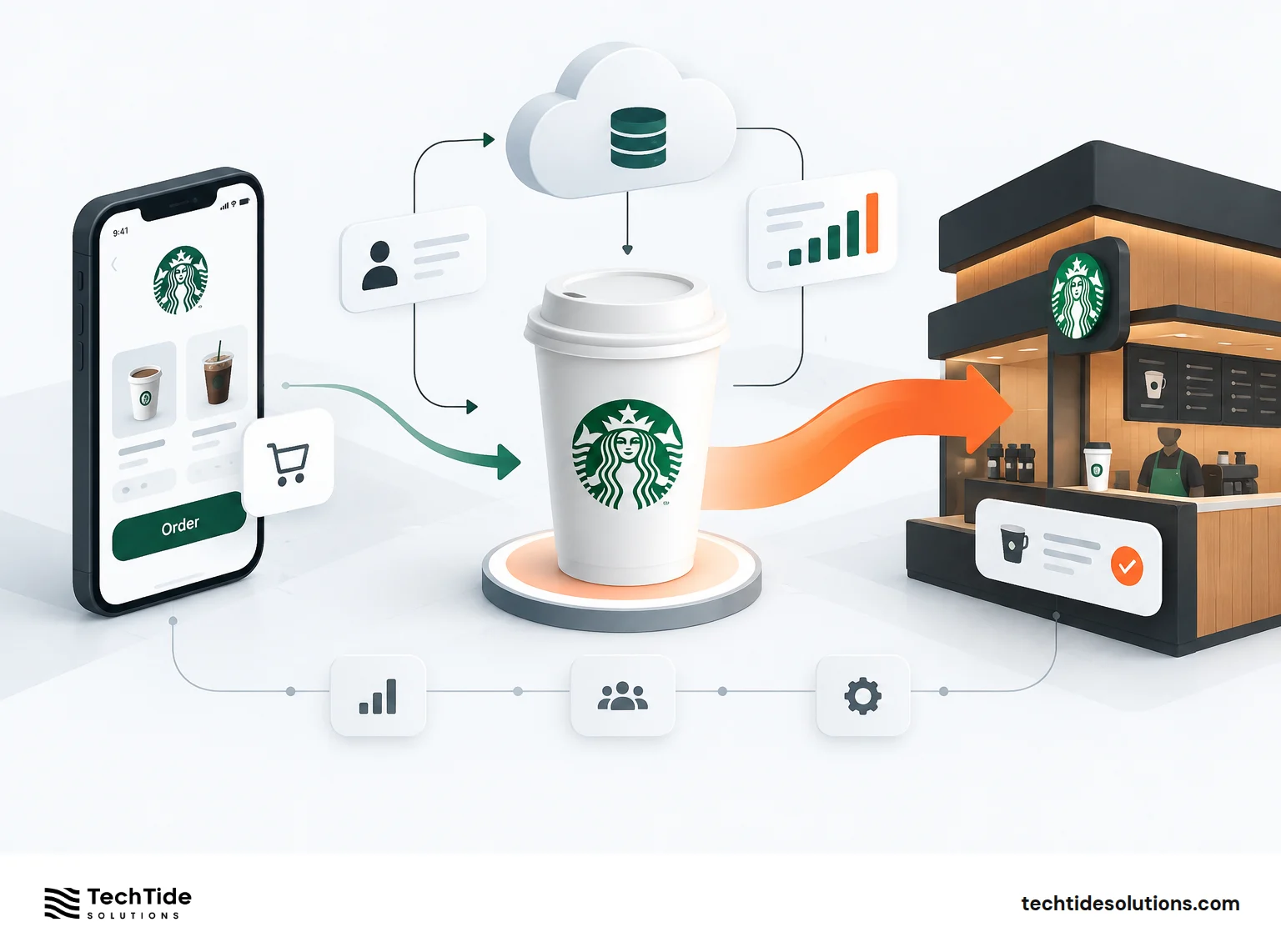
Starbucks did not abandon digital. It changed the job digital had to do. We read this phase as a shift from demand generation toward service orchestration, because the app, offers, and AI stack stopped mattering if the store could not absorb the order load cleanly.
1. Triple Shot Put Deep Brew and Tech Architecture Center Stage
On November 2, 2023, Starbucks said Triple Shot Reinvention would reset its tech architecture around Deep Brew while extending generative AI collaborations with Microsoft, Apple, and Amazon. That framing placed digital capability at the center of the company’s next growth plan, alongside store expansion, efficiency, and partner culture.
We see the logic clearly. When a consumer brand says it is “resetting” architecture, it is admitting feature velocity had become constrained by the stack underneath. That is a familiar moment for enterprise teams. Personalization ambitions often outrun data plumbing, release cadence, and channel consistency long before the customer notices the word “architecture.”
2. Q2 2024 Added a $600 Million Store Digitization Plan
On April 30, 2024, management added $600 million over three years to digitize stores, including digital menu boards and more investment in Deep Brew for personalization and operating decisions. The spending signaled that Starbucks still believed technology could widen the funnel, even as traffic pressure was already showing up inside the store.
From our side of the industry, this is the classic midpoint mistake and midpoint necessity. Once a retail network has real app scale, it cannot stop investing in digital surfaces. Yet if that spend lands before queue control, staffing logic, and pickup design are stable, the investment raises load faster than the operation can absorb it.
3. 2024 Sales Misses Forced a Store-First Reset
When Starbucks reported that same-store sales fell 4% in Q2 FY2024, the case for a store-first reset stopped being theoretical. Weak traffic in the U.S. and China exposed a harder truth: digital reach did not fix the coffeehouse when value perception, throughput, and in-store experience were all wobbling at once.
We would call this the moment the company had to move from a flywheel story to a flow story. Growth loops work when the service system underneath is stable. When it is not, each new offer, menu item, and app touchpoint creates more variance. That is why the turnaround later sounded more operational than promotional.
Recommended reading: Nike Digital Transformation: Real-World Case study, And Examples
Green Apron Service Became the New Operating System
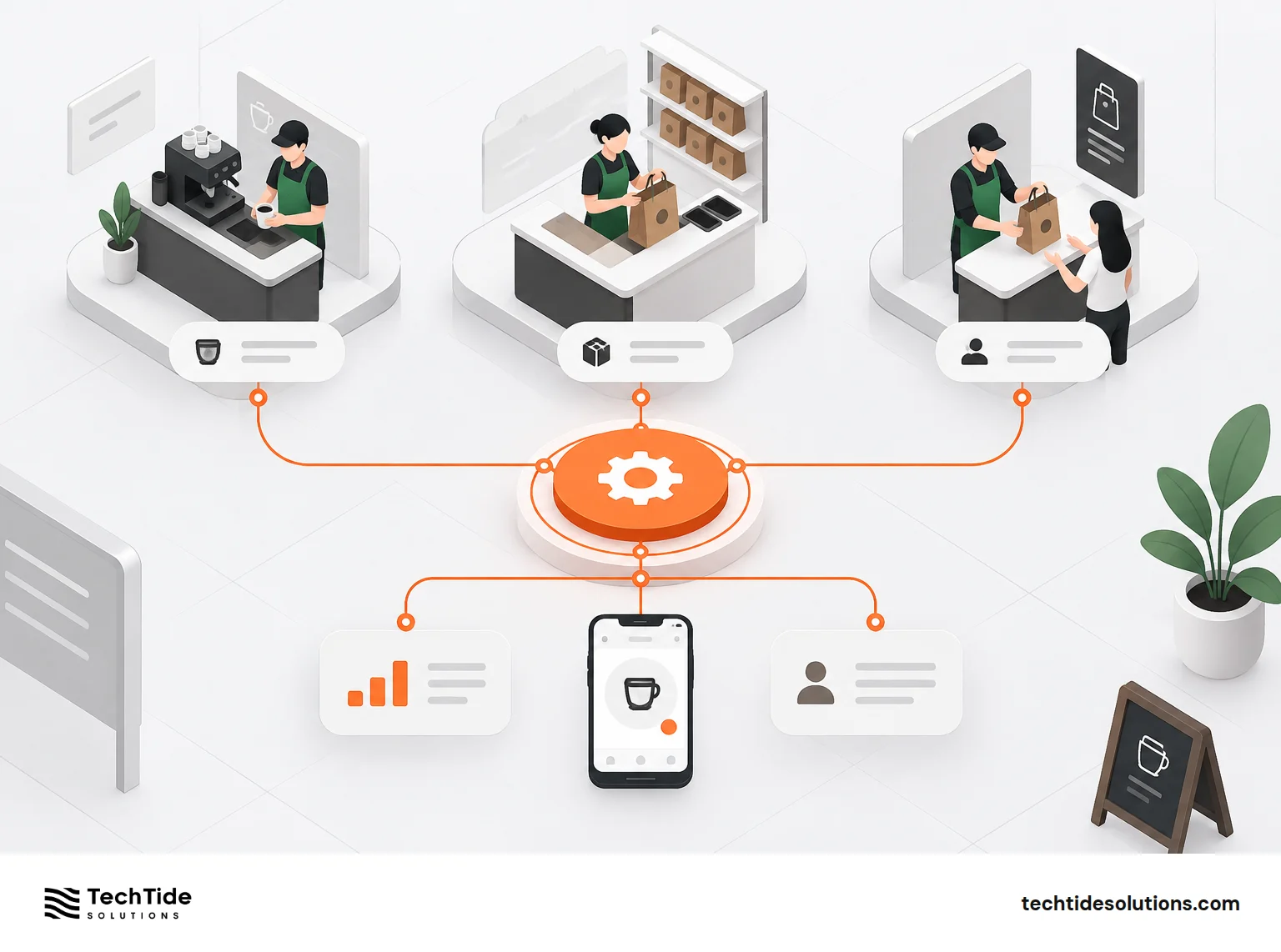
This pillar is the real center of gravity. Starbucks stopped talking about digital transformation as a front-end channel win and started treating service as the system that every channel runs through. Green Apron Service is important because it translates strategy into repeatable store behavior.
1. Starting Five Pilots Grew to 650 Coffeehouses Before Launch
Green Apron Service started as a Chicago Starting Five pilot in May 2025 and expanded to 650 coffeehouses before its August launch. In the same Investor Day account, management described Starting Five as a test model built around five live locations where ideas are adjusted before they scale.
We like this sequence because it reflects how operating systems actually mature. A five-store pilot is small enough to see friction fast. A 650-store expansion is large enough to prove the model survives variation in labor, layout, and peak mix. Many transformations fail because they jump from prototype to mandate without that middle layer.
2. Pilot Stores Kept a 2-Point Transaction Growth Edge
At Investor Day, Starbucks said those pilot locations were still ahead of the wider system by 2 points in transaction growth. That mattered more than a vanity satisfaction score because it suggested the service model was affecting repeatable customer behavior, not just manager enthusiasm during a pilot window.
We pay attention to this kind of signal because transaction lift is usually where service redesign proves it has economic teeth. Teams can fake adoption decks. They cannot fake repeated customer choice for long. The harder part is keeping that edge after rollout, when local exceptions and training drift start creeping back in.
3. GROW Lifted Four-or-More-Shot Scores by Over 30 Points
In the Q2 FY2026 earnings call, Starbucks said the GROW reporting system had increased the share of U.S. company-operated coffeehouses delivering four-or-more-shot scores by over 30 percentage points since its October launch. Management positioned GROW as a simplified ranking tool that turned service execution into a visible weekly discipline.
We see the pattern here again. Transformations get traction when teams reduce the number of measures that matter in the field. A smaller set of visible scores does two useful things. It clarifies what good looks like, and it gives district leaders something concrete to coach instead of narrating broad culture goals.
4. About 80% of Stores Reached Wait-Time Targets by Q2 FY26
By late April 2026, Reuters reported Starbucks said about 80% of stores were meeting its 4-4-12 service targets across café, drive-thru, and mobile pickup. That was one of the first system-level signs that the turnaround was moving from pilot evidence to network behavior.
We think this is where credibility turns. A service program becomes real when management can describe portfolio-wide compliance, not just flagship stores or “best markets.” The tradeoff is that once targets are public, misses become visible too. That is healthy. It forces the operating model to stand on measured performance instead of brand halo.
Mobile Order Went From Growth Engine to Queue Problem
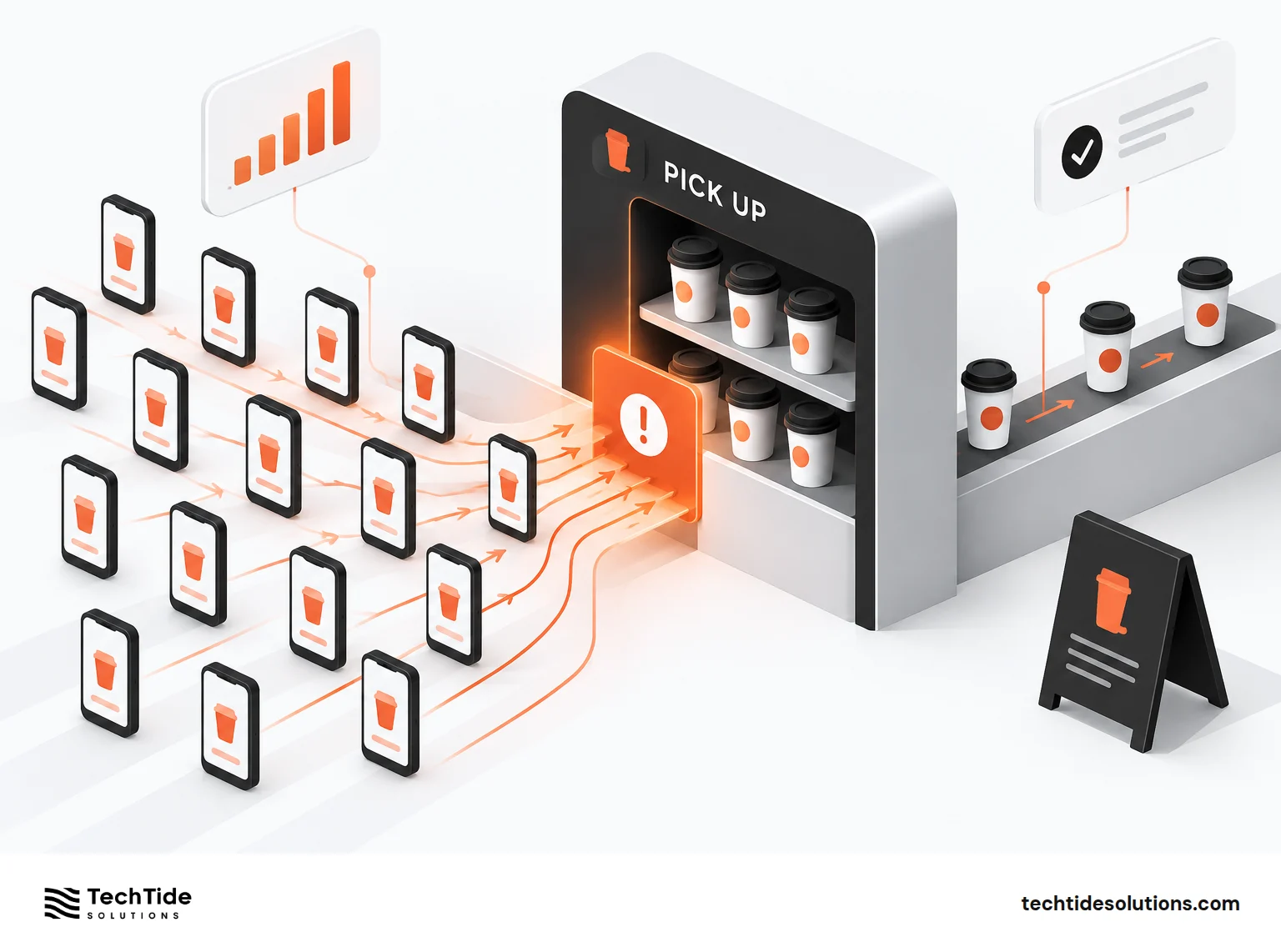
Mobile order was once Starbucks’ cleanest digital advantage. Then it overloaded the handoff plane. The company’s response is useful because it shows how omnichannel commerce breaks when order capture, sequencing, and pickup promises are designed separately.
1. Niccol Called Mobile Order Floods a Coffeehouse Bottleneck
In January 2025, Reuters reported Niccol was trying to tame mobile-order floods with an in-store prioritization algorithm after describing sequencing, rather than beverage capacity, as the bigger issue. That is a subtle but important diagnosis because it shifts blame from barista speed to orchestration logic.
We see this constantly in high-volume commerce systems. Leaders assume the bottleneck is production. Often it is promise stacking. If the queue engine releases too many “ready soon” orders into one labor window, the operation looks slow even when the team is working at full pace. Fixing that requires software and service policy, not just effort.
2. Smart Queue Rebalanced Cafe, Drive-Thru, Mobile, and Delivery
At Investor Day, Starbucks said Smart Queue would sequence orders across every major access point, including café, drive-thru, mobile, and delivery. The point was not a prettier app feature. It was a new decision layer that balances multiple service channels against the same production reality.
We would call this the overdue middleware move. Omnichannel brands often add channels faster than they unify rules. Once that happens, the store becomes the integration point by default, and frontline staff end up resolving conflicts that software should have solved upstream. Smart Queue is an attempt to move that burden back into the system.
3. Scheduled Pickup Windows Arrived in May 2026
Starbucks announced that scheduled ordering would launch on May 11, 2026, with five-minute pickup windows available up to an hour ahead in North America. The feature matters because it turned mobile order from “send it now” into a planned arrival product, which is a very different operational promise.
We think scheduled pickup is less about convenience theater and more about demand shaping. It gives the algorithm a chance to place work into future capacity instead of letting every customer declare the same immediate urgency. Teams that skip this step often discover that order-ahead still behaves like line-ahead.
4. Promise-Time Discipline Reset Mobile Order Around Predictability
By the Q2 FY2026 earnings discussion, Starbucks was still defining mobile success through better than twelve minutes for mobile pickup promise times. That framing is revealing. Starbucks was no longer selling speed in the abstract. It was selling a pickup promise the store could keep.
We think that is the right reset. Customers will tolerate a wait they understand more readily than a short estimate that keeps slipping. Predictability also protects staff morale. Once the app overpromises, every late handoff feels like a frontline failure, even when the real defect sits in queue logic and timing assumptions.
Rewards and Personalization Reopened Growth Beyond Loyalists
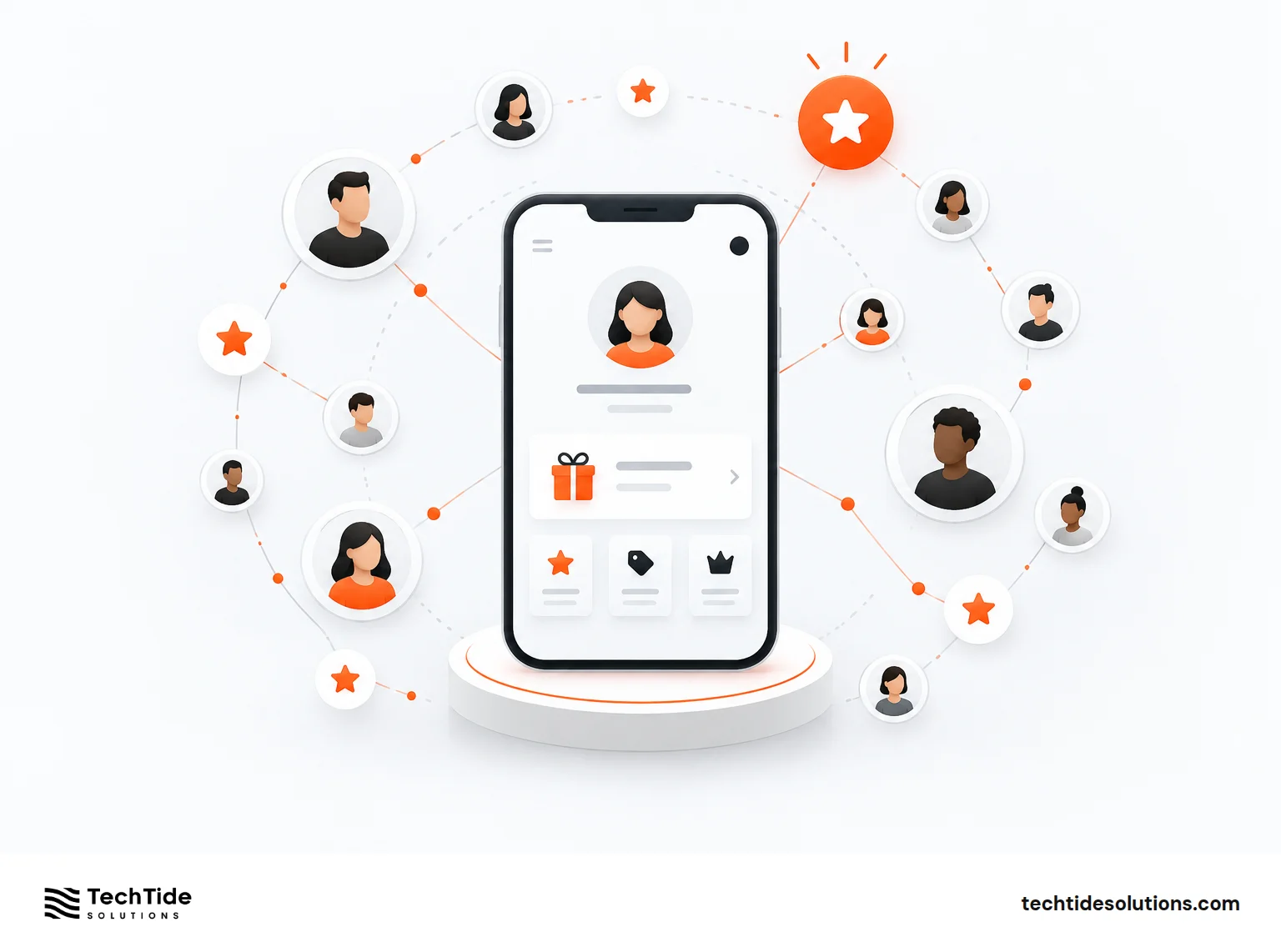
Starbucks did not treat loyalty as a coupon engine in this phase. It treated loyalty as a way to widen access, regain occasional users, and make personalized value feel easier to earn. That distinction matters because mature rewards programs can become too optimized for heavy users and too thin for everyone else.
1. Opening the App to All Customers Targeted Occasional Visitors
In the April 2024 earnings call, Starbucks said it would open the app for all in July so it could reach non-Rewards customers, serve occasional visitors better, and improve conversion into membership. That was a meaningful change in the company’s digital posture because the app stopped being a members-only utility and became a broader acquisition surface.
We read this as a smart correction. Many loyalty apps quietly exclude the very audience a brand most needs to grow. If the first useful experience sits behind sign-up friction, occasional customers stay occasional. Opening the surface first and monetizing the relationship later is usually the better sequence.
2. Active Rewards Members Hit 35.5 Million in Q1 FY26
Reuters reported Starbucks entered 2026 with 35.5 million active U.S. members in the program. Management used that scale to justify a redesign aimed at making the program work harder for different usage tiers instead of assuming one value ladder could serve everyone equally well.
We think scale cuts both ways in loyalty. A giant base gives you more behavioral data and more room for targeted offers. It also makes blunt changes more dangerous. Once membership is this large, small tweaks in redemption value, earn logic, or onboarding flow create real P&L effects very quickly.
3. Q2 FY26 Pushed Rewards to 35.6 Million Members
Starbucks then said its 90-day active Rewards base grew to 35.6 million members in Q2, with both member and non-member transactions increasing year over year. That combination is the important part. The company was not just squeezing more from loyalists. It was claiming broader traffic recovery at the same time.
We look for this pattern whenever a brand refreshes loyalty during a turnaround. If only members grow, the program may be papering over core demand weakness. If members and non-members both improve, the brand is usually rebuilding relevance outside the app too. That is the healthier signal.
4. The 60-Star Reward Became the Most Used Redemption
By spring 2026, Starbucks said the new 60-star option had become the program’s most popular redemption. That tells us the redesign was tuned to immediacy. A small, reachable reward can shape routine behavior faster than a richer prize that feels distant.
We have seen this dynamic across subscription and commerce systems. Mid-funnel incentives often outperform grand rewards because they reduce psychological distance. The tradeoff is margin discipline. Brands have to design these easier wins carefully so they stimulate frequency without training customers to wait for discounts.
5. U.S. Delivery Surpassed $1 Billion in Fiscal 2025
At Investor Day, Starbucks said U.S. delivery sales had surpassed $1 billion in fiscal 2025. Delivery was presented as a reach extender beyond the coffeehouse footprint, which is notable because the company was simultaneously re-centering the in-store experience rather than framing delivery as a replacement for it.
We think that balance is the hard part. Delivery expands occasions and reach, but it also adds another queue claimant to the store. The win comes when the network treats delivery as an incremental access point with explicit sequencing rules, not as free volume that magically fits around every other promise.
Automation Was Rewritten as Partner Support, Not Labor Cuts
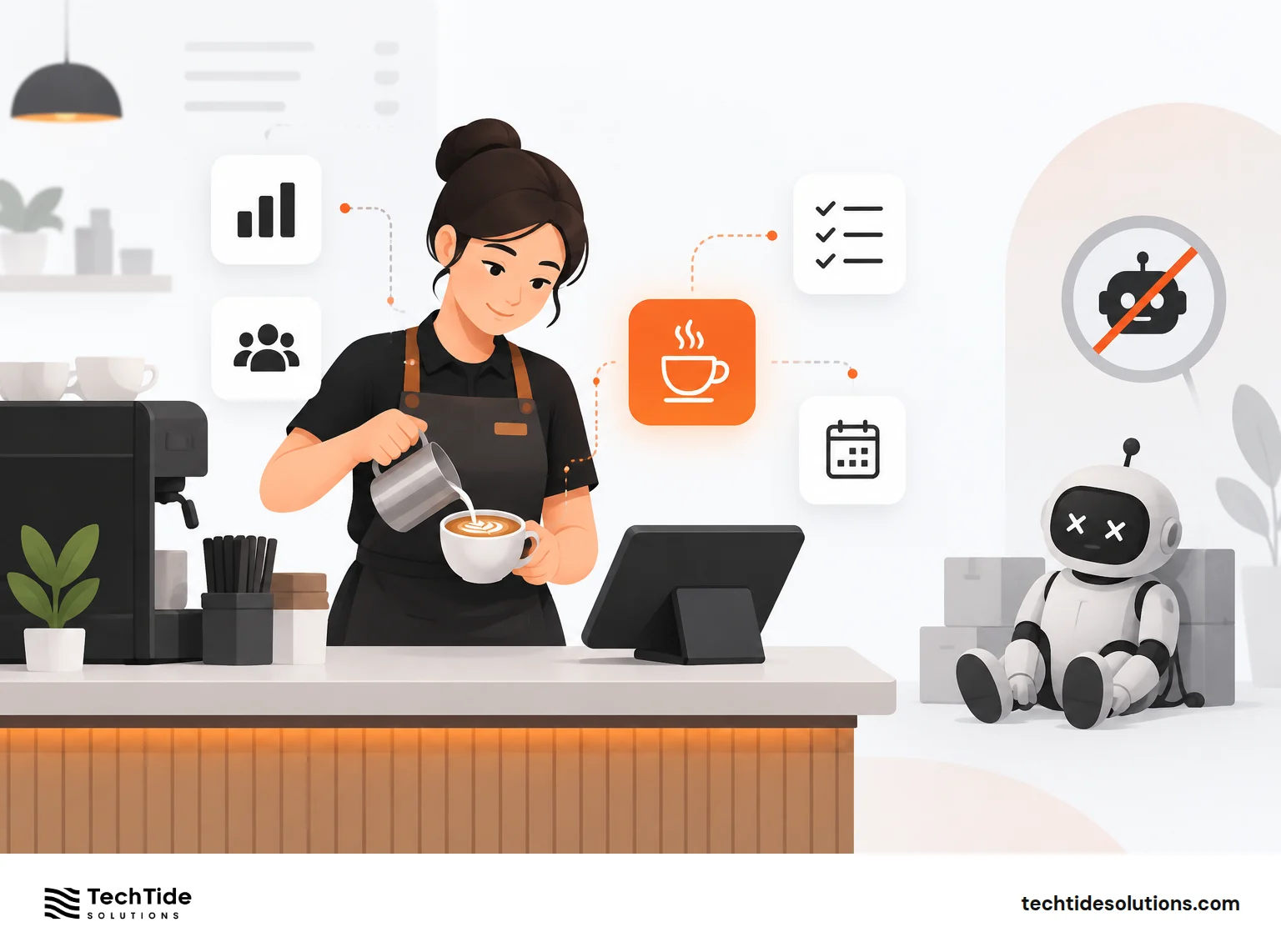
One of the more interesting parts of this case is what Starbucks did not do. It did not pitch AI and automation as a clean substitute for labor. Instead, it recast technology as support for baristas and managers, while pulling back where tools failed to improve real store performance.
1. Starbucks Slowed Siren and Reinvested in Store Staffing
In April 2025, Reuters reported Starbucks would slow the Siren craft system rollout and increase staffing, limiting installations to very targeted stores rather than pushing the equipment broadly. That was a meaningful strategic turn because the company chose labor coverage and deployment over the old automation-first narrative.
We think this was one of the clearest signs management had identified the real constraint. Automation is useful when it relieves a stable bottleneck. It disappoints when the deeper issue is labor placement, shift coverage, or order mix volatility. Chipotle, by contrast, kept talking publicly about kitchen automation during the same period, which shows how differently chains can read the labor problem.
2. Green Dot Assist Entered as a Generative AI Coffee Companion
On June 10, 2025, Starbucks introduced Green Dot Assist as a generative AI companion and said it was being piloted in 35 coffeehouses. The use case was practical: answer recipe, standards, and troubleshooting questions on in-store iPads so partners could get help in the flow of work.
We like this use of AI because it is narrow, immediate, and measurable. Frontline assistants work best when they reduce lookup friction and decision delay. They struggle when leaders ask them to solve big abstract efficiency goals with no clean workflow entry point. Green Dot Assist starts in the right place.
3. An AI Inventory Tool Was Retired After Nine Months
Reuters reported on May 21, 2026 that Starbucks had retired an AI inventory-counting program nine months after deployment across North America. That is exactly the kind of reversal a credible case study needs, because it shows the company was willing to walk away from a tool that did not justify the friction it created.
We think teams should pay more attention to retirements like this. Failed tools are not proof that AI is empty. They are usually proof that a use case was under-specified, the workflow cost was too high, or the accuracy gains did not land where labor pain was actually felt. Knowing when to stop is part of the operating discipline.
4. Tech Bets Shifted Toward Flow, Scheduling, and Accuracy
By April 2025, Starbucks was saying a pilot that better paced mobile orders had improved wait times, with a majority of in-store waits now below four minutes. That is the clearest summary of the new technology agenda. Tools had to improve flow, scheduling, and handoff accuracy inside the store, not just add digital gloss.
We see this as a healthy narrowing of ambition. In turnarounds, the best tech roadmap is often less exciting than the original one. It favors queue discipline, labor visibility, and execution support. Those systems rarely make headlines, but they are the ones that keep demand growth from blowing the operation apart.
The Third Place Returned as a Measurable Growth Lever
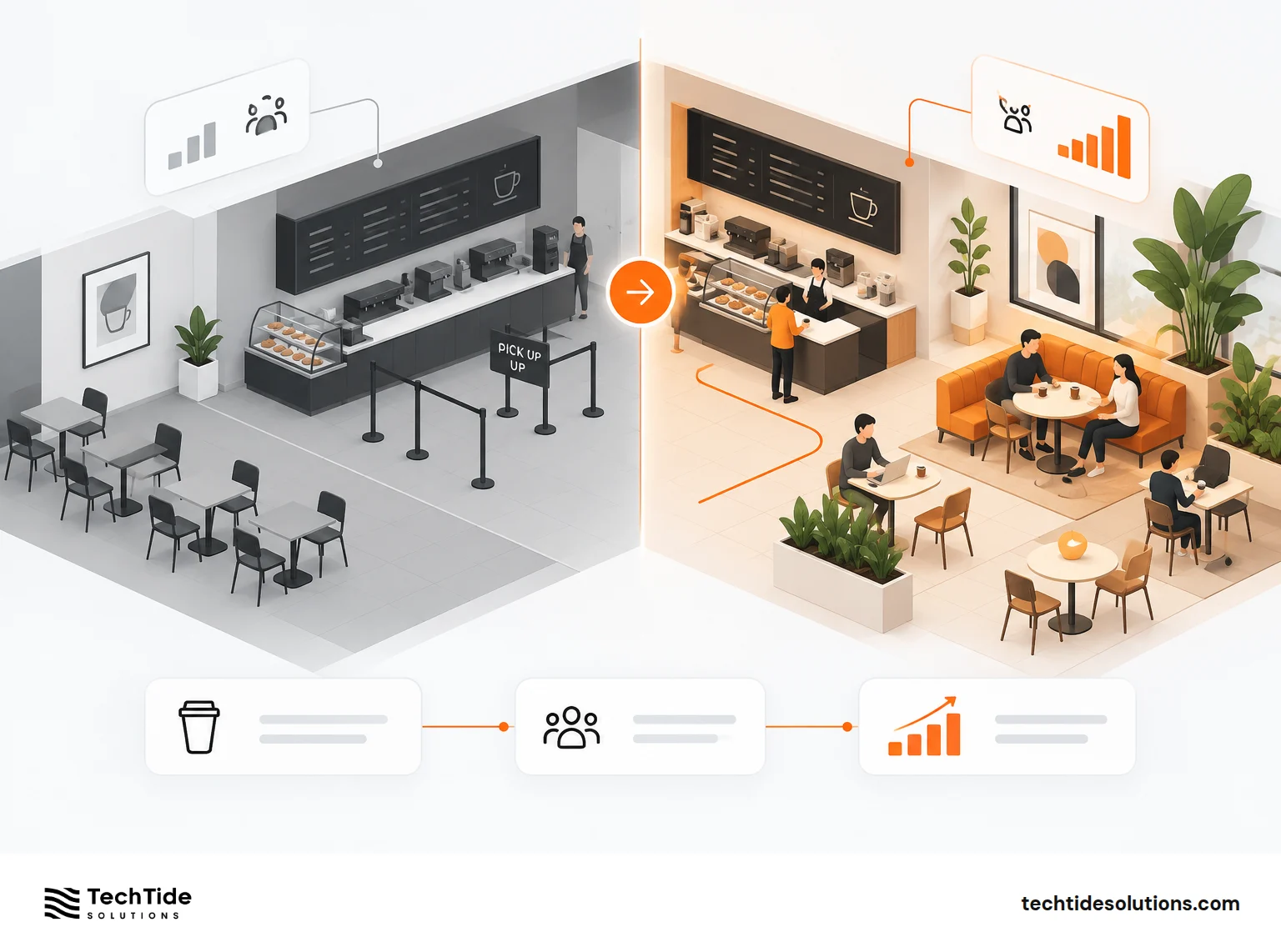
Starbucks did something many digital-first operators resist. It treated physical environment as part of the operating model again. We agree with that call. In a dense omnichannel network, seating, pickup geometry, and dwell quality directly affect throughput, attachment, and brand memory.
1. Niccol Called Lost Seating a Strategic Misfire
In June 2025, Niccol said Starbucks’ move away from seating had been a misfire and argued the company had to get seats back into the coffeehouse. That admission matters because it reframed store design as a growth input rather than a real-estate afterthought.
We think many operators underestimate what seating communicates. When a brand strips dwell space to squeeze throughput, it may help unit economics on paper. It can also weaken perceived warmth, reduce attachment occasions, and make every transaction feel interchangeable. Starbucks was trying to reverse that cultural drift.
2. Uplift Planned 25,000 More Seats by End of FY26
At Investor Day, Starbucks said it planned to add 25,000 additional seats to U.S. cafés by the end of fiscal 2026. The company framed those uplifts as part of a warmer, more welcoming store strategy, even while smaller-format builds and drive-thru growth stayed on the roadmap.
We see a pragmatic rather than nostalgic move here. The company is not rejecting convenience formats. It is trying to keep the core café from becoming a purely transactional shell. That matters because the physical coffeehouse still shapes how customers judge speed, quality, and whether the brand feels worth a premium.
3. Ceramic Mugs and Condiment Bars Marked the Cafe Reset
On January 27, 2025, Starbucks brought back condiment bars and ceramic mugs across U.S. and Canada cafés as part of its “stay awhile” reset. These were small visible changes, but they mattered because they restored self-service personalization and signaled that lingering in the café was welcome again.
We would not dismiss this as cosmetic. Small service artifacts often carry outsized meaning in hospitality systems. They tell customers what kind of place they are in and tell staff what kind of experience they are expected to deliver. When those cues align, operational habits follow faster than when a memo alone tries to change culture.
4. Falling U.S. Coffee Spend Share Raised the Stakes
AP reported that Starbucks’ share of spending at U.S. coffee shops had fallen to 48%, down from 52% in 2023, according to Technomic. That made the Third Place reset more than a brand preference. It became a competitive defense against drive-thru specialists, fast-growing challengers, and rivals that were attacking value and convenience from different angles.
We think this is where the whole case tightens up. If category share is slipping while competitors like Dunkin, Dutch Bros, Scooter’s, and Blue Bottle sharpen distinct value propositions, then every store-level design choice suddenly has strategic weight. The café experience is no longer brand theater. It becomes part of the retention moat.
China and the Portfolio Model Joined the Transformation
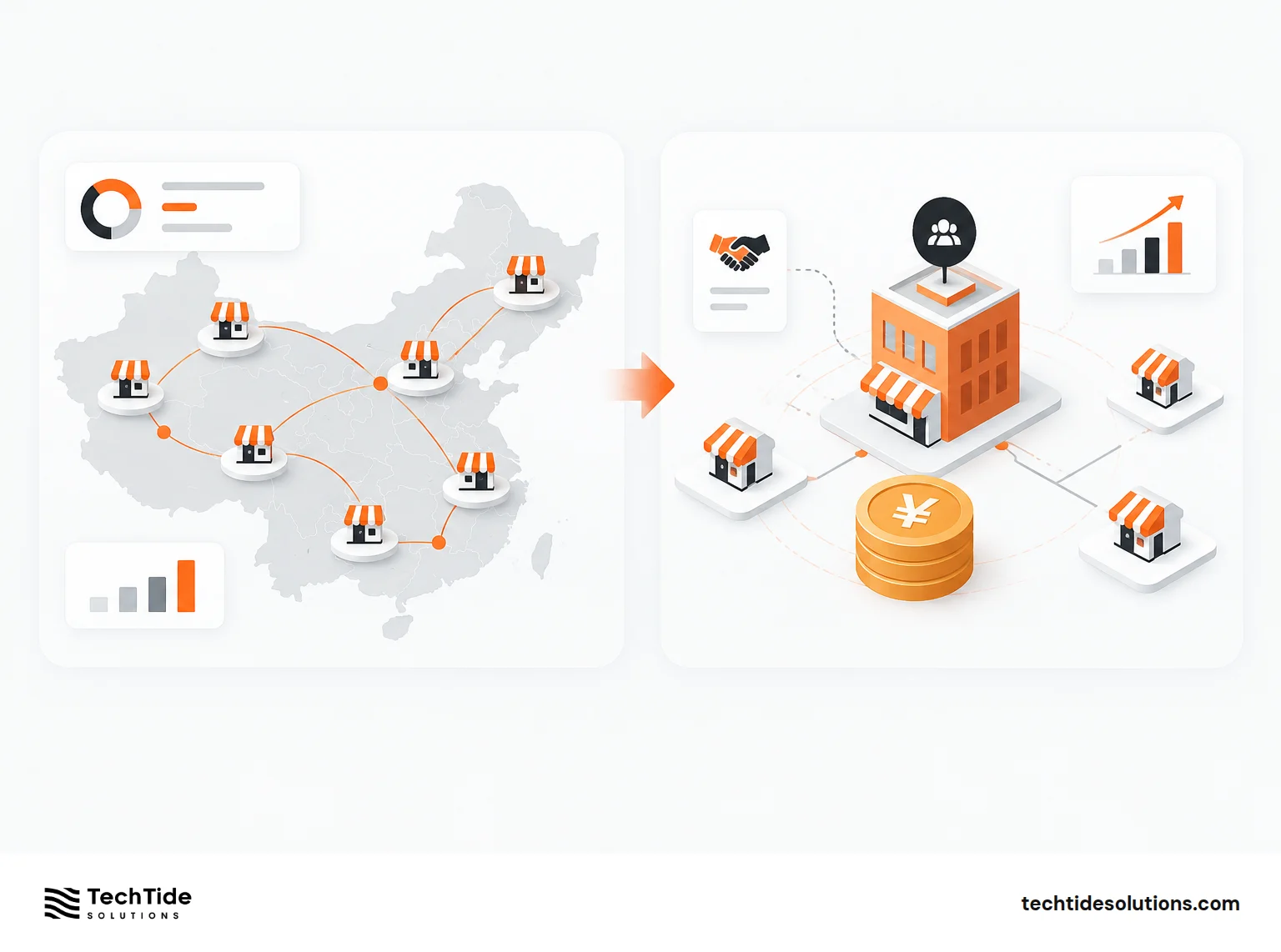
The turnaround was not confined to U.S. operations. Starbucks also changed how it thought about portfolio structure, especially in China. We read this as a move to separate brand control from capital intensity, while preserving the ability to scale with a local operating partner.
1. Q1 FY26 Marked China Retail as Held for Sale
During Q1 FY2026, Starbucks classified its China retail operations as held for sale as part of the planned Boyu transaction. That accounting step mattered because it made the China portfolio part of the transformation story, not just a separate geographic issue on the side.
We think this move reflects a broader portfolio lesson. Global brands often hit a point where capital structure, local execution, and speed to market need different answers by region. Treating every market under one ownership template can create hidden drag, especially when the local competitive tempo is rising.
2. Boyu Took Up to 60% of China Retail While Starbucks Kept 40%
On November 3, 2025, Starbucks said Boyu would acquire up to 60% of China retail while Starbucks retained a 40% stake and continued to own and license the brand and intellectual property. That is a classic control-versus-capital rebalance rather than a clean retreat.
We read the structure as disciplined, not defensive. Keeping brand ownership while reducing operating ownership preserves influence over standards and economics, while giving a local partner more room to drive pace and localization. For many international operators, that is the real middle ground between full control and full exit.
3. Investor Day Targeted More Than 2,000 Net New Stores by 2028
At 2026 Investor Day, Starbucks said it expected to add more than 2,000 net new coffeehouses across its global company-operated and licensed system by fiscal 2028. That target showed the company was pairing a service-led turnaround with a renewed unit growth agenda instead of waiting for a perfect reset before expanding again.
We think that sequencing makes sense if the operator believes the model is finally stabilizing. Once the core service architecture is clearer, expansion becomes a test of portability. The risk, of course, is reopening the old problem by scaling faster than the new operating discipline can travel.
4. International Outside China Added More Than 2,000 Stores in Three Years
Starbucks said its international business outside China had grown by more than 2,000 coffeehouses in three years, with markets such as India, Mexico, and South Korea expanding strongly. That is useful context because it shows Starbucks was not trying to rediscover growth from scratch. Parts of the portfolio were already proving the expansion model.
We think this is the right way to read the global picture. The company’s issue was not a universal lack of demand. It was uneven operating fit across markets and channels. When some regions are already scaling well, the turnaround question becomes how to import the right disciplines, not whether growth exists at all.
FAQ About Starbucks Digital Transformation
These are the practical questions we hear most often when teams study this turnaround. The short answers are useful, but the nuance is where the playbook lives.
1. What Is the Digital Transformation Strategy of Starbucks?
It is a shift from digital acquisition alone toward a linked system of queue control, loyalty design, labor deployment, AI support, and coffeehouse redesign. In our reading, Starbucks stopped treating the app as the strategy and started treating the store as the execution layer every digital promise must pass through. That is why service metrics and physical layout became as important as personalization.
2. What Is the Four-Minute Rule at Starbucks?
It is the service benchmark that anchors the turnaround’s operating discipline in the café and drive-thru. More broadly, it represents a promise that speed must be paired with accurate handoff and a human moment, not chased as a timer by itself. The rule matters because it gives the company a visible test for whether store flow is actually improving.
3. Is Starbucks Replacing Baristas With AI?
No. The pattern we studied points the other way. Starbucks introduced AI to answer frontline questions and improve sequencing, while slowing or retiring tools that did not make stores easier to run. That is support technology, not labor substitution.
4. Why Did Starbucks Shift From Automation to Staffing?
It shifted because leadership concluded the bigger constraint was flow, coverage, and deployment inside the store. When the bottleneck sits in sequencing and roster design, extra labor often outperforms broad equipment rollout. In practice, automation still has a place, but only where it serves a clearly defined operational need.
5. How Important Is Starbucks Rewards to the Turnaround?
It is very important, but not as a standalone perk engine. Rewards helped Starbucks reopen the top of the funnel, reconnect with occasional users, and create more reachable value points for everyday visits. The key lesson is that loyalty worked best once it was tied to better service flow and a stronger store experience.
How TechTide Solutions Helps You Build Omnichannel Service Systems
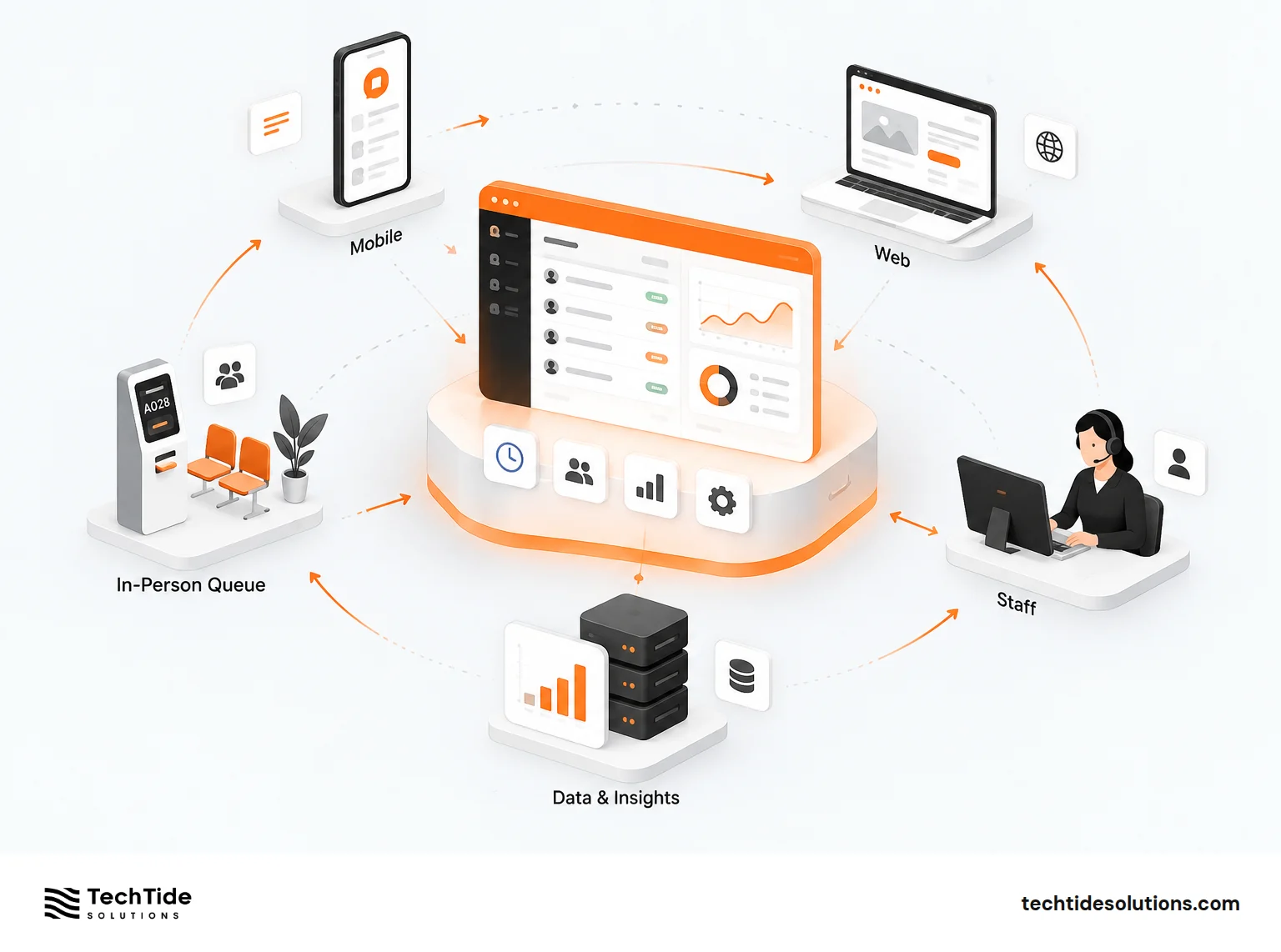
At TechTide Solutions, we approach omnichannel service systems the way this case eventually did. We start with the operational choke points, then connect apps, interfaces, workflows, data, and controls around them.
1. Build Smart Queue Style Order Orchestration for High-Volume Retail
We build web and mobile app development programs, UI/UX design systems, and SaaS development layers that help retailers route demand against real production capacity instead of static promises. That matters when café orders, delivery tickets, pickup windows, and in-store customers all compete for the same labor pool. The same pattern shows up in retail stores, healthcare intake flows, and logistics networks where one channel can quietly overload the rest.
2. Redesign Loyalty Apps for Occasional Customers and Core Members
We redesign loyalty surfaces when a program has become too optimized for heavy users and too hard for everyone else to enter. That work spans web and mobile app development, UI/UX design, and SaaS development for offer logic, profile state, and experimentation. In retail and fintech especially, the winning move is often reducing friction at the first useful interaction, then personalizing value after the customer has a reason to stay.
3. Deploy Generative AI Assistants for Frontline Enablement
We treat generative AI development as workflow design, not a novelty layer. The best assistants answer real questions inside the task, whether that task lives in a retail store, a healthcare operation, a logistics control room, or a fintech support flow. When teams keep the scope tight, define the knowledge boundary, and design a clear handoff to humans, AI becomes faster to trust and easier to measure.
4. Modernize POS, Scheduling, and Inventory Across Store Networks
We modernize the systems behind the counter as connected software, not isolated tools. That can include SaaS development for scheduling and task visibility, industry-specific software for retail and logistics network operations, and the interfaces that help staff act on the right signal at the right moment. For healthcare and fintech operators, the equivalent problem is often a fragmented workflow stack where one team holds the customer promise and another team holds the capacity truth.
5. Secure Payment, Profile, and Order Data Across Digital Channels
We handle cybersecurity consulting where payments, identities, and order histories move across apps, APIs, and store systems. In some environments, blockchain development can also support auditability, settlement visibility, or loyalty-state integrity when multiple parties need a shared record without manual reconciliation. The core principle is simple: once omnichannel service becomes the business model, security architecture has to protect the same customer journey the product team is trying to simplify.
Conclusion Lessons From Starbucks Digital Transformation
We think this case is strongest when read as an operating redesign, not a digital feature story. The most durable moves were the ones that tied software, labor, and store design to the same service promise.
1. Store Flow Must Improve Before Digital Growth Pays Off
We take the clearest lesson to be this: demand capture is easy to celebrate and hard to monetize if the store cannot absorb it. Digital channels amplify whatever operating truth already exists underneath them. If the queue is unstable, more app adoption can make the defect louder rather than fix it.
2. Loyalty Programs Need New Entry Points, Not Just More Perks
We see Starbucks’ rewards redesign as a reminder that mature programs can drift too far toward power users. Occasional customers need faster reasons to engage, easier entry into value, and less sign-up friction at the edge of the journey. Perks matter, but access design matters first.
3. AI Wins When It Supports Staff Workflows, Not Abstract Automation
We think the company’s best AI decisions were the narrow ones. Tools that answer questions, improve sequencing, or reduce frontline lookup time tend to earn trust faster than big promises about labor elimination. When AI fits the workflow, teams keep it. When it does not, they should retire it quickly.
4. Coffeehouse Design Still Shapes Digital Performance
We would not separate physical space from digital performance in a business like this. Seating, pickup layout, dwell comfort, and self-service touchpoints all affect how customers experience speed and value. The coffeehouse is part of the interface, which means design decisions show up in metrics whether leaders admit it or not.
5. Clear Service Metrics Make Turnarounds Harder to Fake
We like this case because Starbucks eventually chose measures that exposed whether the operation was truly changing. Once a company commits to visible service standards, pilot lift, and portfolio compliance, the story gets harder to spin and easier to learn from. If your own growth plan depends on more channels, more offers, or more AI, what would have to change in the service system first so those investments land cleanly?


