
At TechTide Solutions, we’ve learned that “SaaS marketing” is not simply digital marketing with a subscription checkout. Recurring revenue turns every promise into an ongoing obligation: the product must keep earning its seat in the customer’s stack, the onboarding must actually land, and the story you tell in month one must still feel true in month twelve.
The macro backdrop makes the stakes clear. Gartner forecasts worldwide public cloud end-user spending will total $723.4 billion in 2025, and that scale changes how buyers evaluate software: categories mature quickly, switching costs shrink with better integrations, and “good enough” competitors appear faster than most founders expect. McKinsey goes further, estimating cloud adoption could generate $3 trillion of EBITDA value by 2030, which explains why CFOs now interrogate renewal risk as intensely as they interrogate acquisition cost.
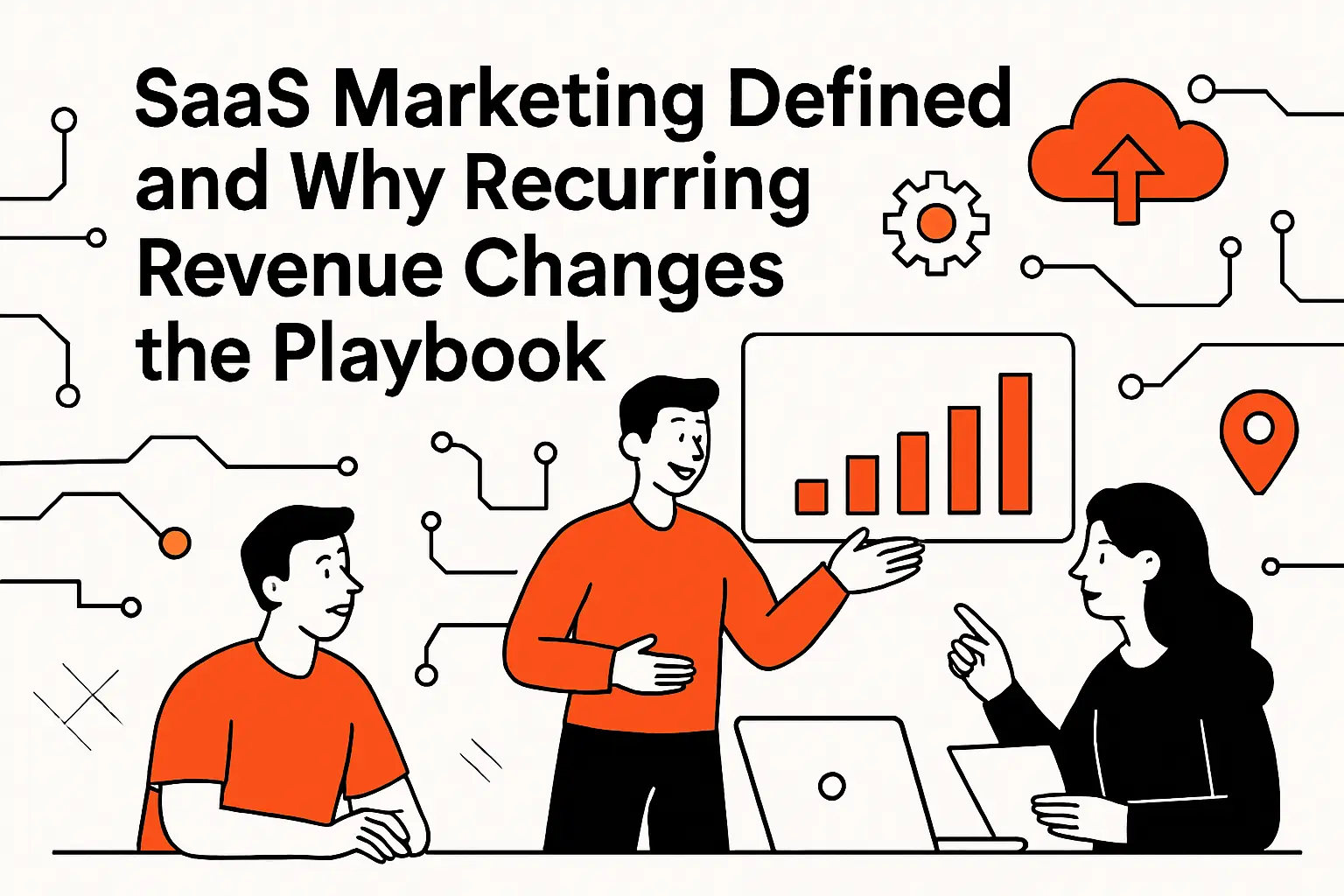
SaaS marketing defined and why recurring revenue changes the playbook
In that environment, B2B SaaS winners tend to look familiar: Salesforce built a category-defining subscription business by pairing product depth with ecosystem gravity, HubSpot used education as a growth engine, and Atlassian proved that self-serve can coexist with enterprise expansion when the product experience stays coherent. Our goal in this guide is to map the strategy, channels, metrics, and optimization discipline that make those outcomes repeatable—even when you’re not a household name yet.
1. Subscription products require ongoing value delivery, not one time transactions
Unlike a one-off sale, subscription revenue is a daily referendum on whether value is still being delivered. Product expectations don’t pause after the contract is signed; instead, they shift from “convince me” to “prove it continuously.” In our delivery work, that means marketing cannot stop at demand capture. Messaging has to match what the customer will experience in the first session, the first workflow, and the first moment of friction—because that friction is where churn is born.
Operationally, we treat SaaS marketing as value operations: you’re managing promise, adoption, and perception as one system. When teams separate “growth” from “customer success,” they often create a silent mismatch where the funnel accelerates but retention quietly erodes.
2. Acquisition and retention must be balanced to maximize lifetime value
Growth becomes fragile when acquisition is celebrated and retention is treated as housekeeping. Customer acquisition cost has a long shadow in SaaS because it is “paid up front” while revenue arrives in small monthly increments. On the other hand, retention compounds quietly: better activation increases expansion opportunities, which increases tolerance for paid acquisition, which funds better onboarding, which improves retention again.
From our perspective, the balance shows up in roadmap decisions. When a marketing team asks for more leads, we also ask: can the product reliably convert and keep them? If the answer is unclear, the fastest path to growth might be fewer leads and a tighter post-signup journey.
3. Intangible software benefits from trials, demos, and education to reduce friction
Software is abstract until it’s experienced, so buyers reach for evidence: “Can I see it?” and “Will it work for our reality?” Trials and demos are not just conversion mechanics; they are trust-building devices that let the customer test fit with minimal social risk. Education plays the same role for complex categories: it turns uncertainty into a shared vocabulary.
In practice, we design “proof paths” that match product type. A workflow automation tool might need a sandbox that runs on realistic sample data, while a compliance tool may need an annotated demo that explains the logic behind each control. Either way, friction falls when buyers can learn without feeling sold to.
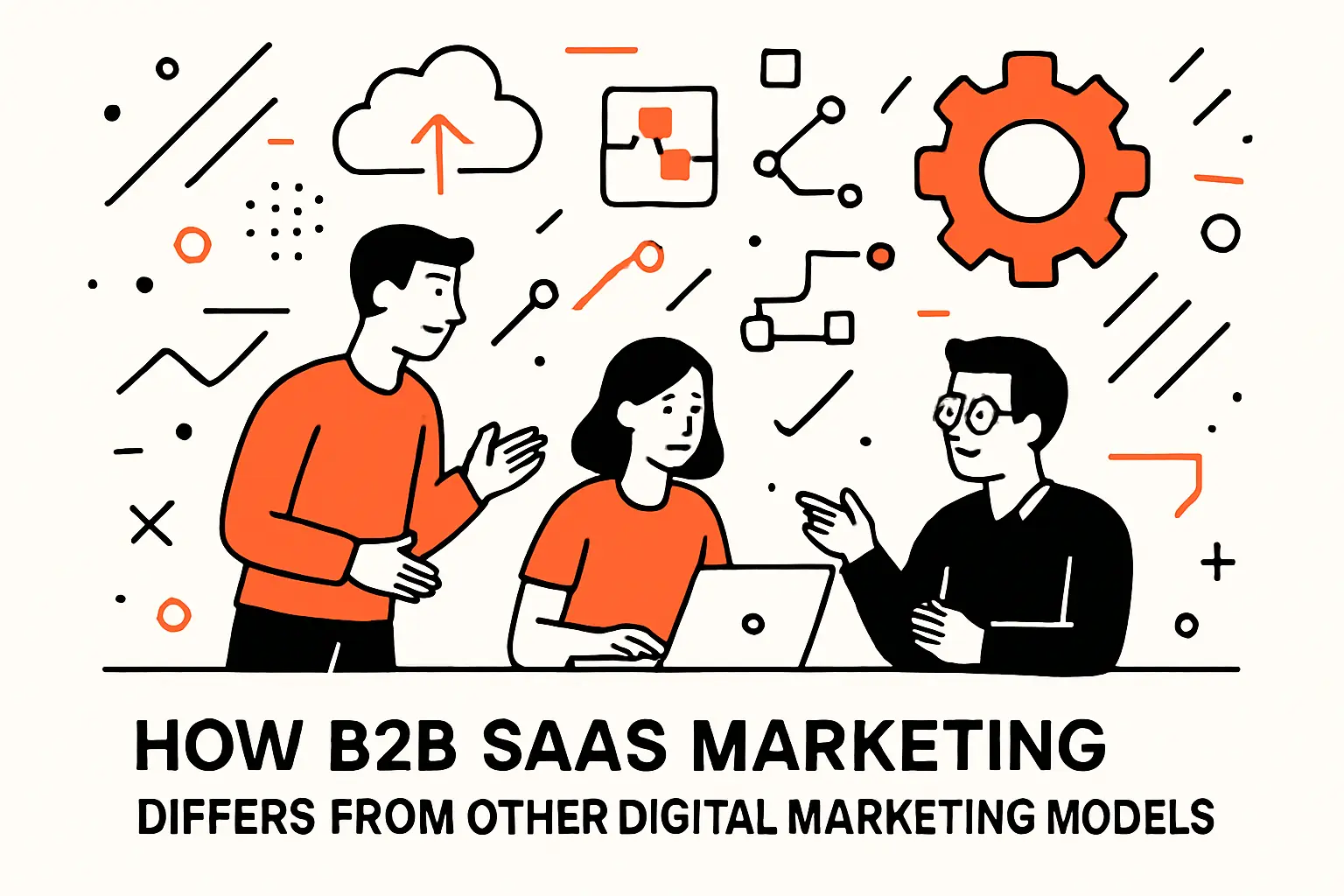
How B2B SaaS marketing differs from other digital marketing models
1. Relationship building matters because subscriptions create repeated touchpoints
Subscriptions create repeated touchpoints, so trust is not a single hurdle—it’s a repeated requirement. Even product-led motions need relationship capital because stakeholders rotate, budgets tighten, and security reviews appear out of nowhere. Interestingly, digital preference doesn’t eliminate relationships; it changes where relationships form.
Gartner reports 61% of B2B buyers prefer an overall rep-free buying experience, so we design marketing to behave like a helpful colleague: precise documentation, clear comparisons, transparent pricing logic where possible, and strong implementation guidance. Relationship building shifts from “lunch and learn” to “make their next step obvious.”
2. Long sales cycles often require multiple demonstrations and deeper persuasion
B2B SaaS decisions are rarely about features alone; they’re about risk, coordination, and political alignment. Multiple demos happen because each stakeholder has a different definition of “done”: security wants auditability, finance wants predictability, and operators want fewer clicks. Long cycles aren’t a failure of marketing; they’re a sign that the purchase is consequential.
Forrester notes 86% of B2B purchases stall during the buying process, and we see the same pattern when internal alignment is the hidden bottleneck. Great SaaS marketing anticipates stalls with stakeholder-specific assets: a security brief, an ROI narrative, an implementation plan, and a change-management story that makes adoption feel achievable.
3. Uncertain attribution and market saturation raise the bar for strategy and creativity
Attribution is messier in B2B SaaS than most dashboards admit. A buyer might discover you via a webinar, validate via a peer review site, lurk on your pricing page, and finally convert after a referral—often across devices and weeks. Meanwhile, market saturation makes “generic best practices” blend into the background.
Creativity, in our view, is not aesthetic flair; it’s differentiated clarity. Strategy wins when the team chooses a narrow wedge, speaks in customer language, and builds a narrative that is consistent across touchpoints. When everything looks the same, the company that explains the problem best often earns the right to sell the solution.
Strategy foundation: personas, pain points, and positioning that communicates value
1. Create data-driven buyer personas based on demographics, challenges, and motivations
Personas become useful when they reflect behavior, constraints, and incentives—not when they read like fictional biographies. At TechTide Solutions, we build personas from a blend of sources: sales call transcripts, support tickets, CRM fields, product analytics, and win/loss notes. Demographics matter mainly as context; motivations and obstacles matter as decision drivers.
Practically, we capture what triggers urgency, what blocks approval, and what “success” looks like in the buyer’s world. That’s how a persona becomes an execution tool: it tells you what to say, what to show, and what proof is necessary for the next step.
2. Define the target persona by identifying who has the pain your product solves
Targeting fails when teams market to people who are adjacent to the pain rather than accountable for it. A stakeholder might feel the problem but lack budget authority; another might own budget but not feel urgency. The best target persona usually sits at the intersection of pain ownership, workflow proximity, and political ability to drive change.
In our engagements, we often map “pain gravity” across roles. When the buyer is the person who bleeds time every day, messaging can be practical and specific. When the buyer is a leader, the story has to connect operational pain to business outcomes like risk reduction, throughput, or predictability.
3. Clarify jobs to be done and express product value succinctly for the right audience
“Jobs to be done” helps SaaS teams escape feature-speak. Buyers don’t wake up wanting a dashboard; they want to close the month faster, stop incidents, prevent compliance surprises, or coordinate work across teams. A clear job statement makes positioning sharper because it ties your product to a concrete progress goal.
Succinct value expression is a discipline. We push for one primary sentence that explains the job, the outcome, and the differentiation, and then we support it with a proof ladder: demos, case studies, and technical details that earn credibility without overwhelming the reader.
4. Build messaging that leads with customer value and reflects real customer language
Messaging works best when it sounds like the customer—not like the vendor. Real customer language is often blunt and unglamorous: “We can’t see what’s going on,” “handoffs break,” “approvals are chaos,” or “the spreadsheet is lying again.” Those phrases are gold because they reveal the mental model the buyer already has.
From our side, we treat language as a product surface. We align ad copy, landing pages, onboarding screens, and in-app prompts around the same vocabulary so the experience feels consistent. When the words match from first click to first success, buyers feel less cognitive friction and more confidence.
Full-funnel saas marketing lifecycle from lead generation to customer retention
1. Stage 1 find monthly subscribers with lead generation strategies for distinct prospect groups
Lead generation in SaaS is really about acquiring “qualified curiosity.” Different prospect groups require different entry points: some respond to high-intent keywords, others to community trust, and others to integration-driven discovery. One funnel is rarely enough; we prefer portfolio thinking where each segment has an appropriate first offer.
In practice, we separate “learners” from “evaluators.” Learners want education and templates, while evaluators want comparisons and proof. Mixing the two creates wasted spend and confused analytics, so we build distinct pathways with separate landing pages, nurture sequences, and conversion events.
2. Stage 2 combine off-site awareness with on-site conversion to close informed buyers
Off-site awareness—podcasts, social, review platforms, partnerships—creates familiarity, but on-site conversion turns that familiarity into action. The handoff is where many teams stumble: the ad promises speed, the landing page is generic, and the CTA is ambiguous. That mismatch makes the buyer feel tricked.
We treat the website as a product. Pages should answer the buyer’s next question in sequence: what it is, who it’s for, what it replaces, how it works, and what happens after signup. Conversion improves when the site behaves like a guided evaluation rather than a brochure.
3. Stage 3 retain customers with engagement, customer success, and upgrade paths
Retention is marketing, even when it sits under a different org chart. Customers stay when they repeatedly reach meaningful outcomes, and that requires proactive engagement: onboarding that adapts to role, success milestones, and a support experience that resolves issues without blame. Expansion becomes natural when the customer already trusts the system.
Upgrade paths should feel like capability unlocks, not penalties. In our experience, the cleanest expansions are attached to a new job the customer is ready to do, such as adding teams, automating a new workflow, or hardening governance as usage grows.
4. Nurture leads through the funnel with email sequences, retargeting, and helpful resources
Nurture works when it reduces uncertainty at the buyer’s pace. Email sequences should function like a structured curriculum, not a drip of sales pressure. Retargeting can reinforce memory, but only if the creative matches the buyer’s stage; otherwise it becomes expensive noise.
We recommend building nurture around “micro-commitments.” A buyer who downloads a template may be ready for a workshop, while a buyer who reads a pricing page may be ready for a guided demo. Helpful resources—migration checklists, security FAQs, implementation playbooks—turn nurture into a service.
5. Promote customer success with case studies, testimonials, and referral programs
Customer success stories are most persuasive when they teach, not when they brag. A great case study explains the initial situation, the constraints, the implementation approach, and the measurable outcome in terms the buyer cares about. Testimonials can be short, but they should be specific: vague praise rarely changes minds.
Referral programs work when they align with professional reputation. Buyers refer tools that make them look competent, so the referral “reward” can be as simple as making it easy to share a credible one-pager or a short internal pitch deck that helps the advocate sell the tool inside their own company.
Content marketing and SEO that build trust and discoverability at scale
1. Create content, tools, and resources that help the audience do their job better
Content scales when it is genuinely useful. Blogs are fine, but tools often outperform articles because they create hands-on value: ROI calculators, maturity assessments, request-for-proposal templates, and onboarding checklists. The trick is to build resources that match real tasks your buyer already performs.
From our perspective, the best content strategy is a product strategy. When you publish something that saves a buyer time today, you earn the right to be considered tomorrow. Over time, your brand becomes associated with competence, and competence is the quiet driver of trust in B2B.
2. Build FAQ-driven content clusters around real SaaS buyer needs and use cases
FAQ clusters work because buyers search in questions, not slogans. Questions reveal intent: “How do we migrate?” “How does SSO work?” “What permissions exist?” “Can this integrate with our CRM?” Each question is a page, and each page is a chance to prove you understand the buyer’s world.
We design clusters around use cases and objections, then connect them with internal links and consistent terminology. A cluster becomes more than SEO; it becomes sales enablement and onboarding support. When content answers the same questions that demos answer, sales cycles shorten and confidence rises.
3. SEO fundamentals: sitemaps, metadata, backlinks, and ranking monitoring
SEO fundamentals are not glamorous, but they keep your discoverability from collapsing under technical debt. Clean sitemaps help crawlers understand your site structure. Metadata should reflect search intent rather than internal naming. Backlinks still matter, especially when they come from credible industry sites and partners.
Monitoring closes the loop. We track rankings, but we also track what those rankings do: do they drive qualified traffic, engagement, and conversions? When a page ranks but converts poorly, the issue is often mismatched intent, not bad writing, so the fix is repositioning the page rather than stuffing it with keywords.
4. Optimize for mobile search behavior and emerging voice search patterns
Mobile optimization is no longer about squeezing desktop pages onto a smaller screen. Buyers research between meetings, in transit, and while multitasking, so the experience must be fast, legible, and easy to navigate with a thumb. Voice search adds another layer: queries become more conversational and more specific.
In practice, we keep critical answers above the fold, reduce layout shifts, and avoid burying key details behind heavy interactions. Short, direct sentences help voice-like queries, while structured headings help both humans and machines skim. A buyer who can find a clear answer quickly is more likely to trust you later.
5. SEO and AI optimization aligned with evolving search and generative discovery
Search is evolving toward generative summaries and “answer-first” experiences, and that shifts what it means to optimize. Ranking still matters, yet being quotable matters too: clear definitions, explicit comparisons, and well-structured explanations are more likely to be used in AI-driven results. In other words, content needs to be both discoverable and extractable.
We focus on semantic clarity: consistent terms, transparent claims, and evidence-oriented writing. Structured data can help, but the core is editorial discipline—say what the product does, for whom, under what constraints, and with what assumptions. When you remove ambiguity, you remove buyer anxiety.
6. Use product experts to fuel thought leadership through blogs, videos, and webinars
Thought leadership becomes credible when it comes from practitioners, not only from marketing. Product managers, solution engineers, and customer success leaders sit closest to the real problems, so their insights tend to be sharper and more useful. Videos and webinars also let buyers “meet” the team’s thinking style, which matters in trust-heavy categories.
We like to turn internal expertise into repeatable formats: teardown sessions, implementation walkthroughs, architecture explainers, and live Q&A. Over time, that cadence becomes a compounding asset. Buyers often choose the vendor that taught them the most before the first sales call.
Channel mix for saas marketing campaigns across acquisition and demand generation

1. Paid search and pay per click campaigns focused on intent-heavy SaaS keywords
Paid search is the closest thing to “buying intent,” but it is also where undifferentiated SaaS gets punished. Broad keywords attract expensive clicks from curious researchers, while intent-heavy keywords capture buyers who are already evaluating solutions. The goal is not traffic volume; it’s profitable evaluation.
We structure campaigns around intent tiers: problem queries, solution queries, competitor comparisons, and integration-specific searches. Landing pages must match the query’s mental model, or the click is wasted. When alignment is right, paid search becomes a controlled pipeline rather than a budget leak.
2. Paid social ads paired with retargeting to re-engage prospects and drive conversions
Paid social is strongest for shaping category perception and reaching specific roles, especially when the product is new or the buyer doesn’t yet know what to search for. Retargeting then reinforces memory and guides the next step, but only when it’s sequenced thoughtfully. Showing the same ad repeatedly is not a strategy.
In our campaigns, we treat social as narrative and retargeting as navigation. Social introduces the problem framing, while retargeting offers a deeper asset: a webinar, a comparison page, or a demo walkthrough. Sequencing builds momentum without becoming intrusive.
3. Treat email as a personalized buyer journey rather than a sales pitch
Email still works because it’s direct, asynchronous, and easy to personalize by behavior. The mistake is treating email as a megaphone. A good email program feels like guidance: “Here’s what to do next,” “Here’s what to watch out for,” and “Here’s how teams like yours approached implementation.”
We recommend segmenting by lifecycle and intent. A new lead should receive education and category clarity, while an active trial user should receive activation help and use-case recipes. When email is tied to product events, it becomes a bridge between marketing and adoption.
4. Partnerships, integrations, and co-marketing with complementary tools to expand reach
Partnerships are a distribution strategy disguised as marketing. Integrations place your product where work already happens, which reduces switching cost and makes adoption feel natural. Co-marketing then turns the integration into a story: “together, we solve a larger workflow.”
From our vantage point, the best partnerships have mutual technical investment. A shallow integration may generate a blog post, but a deep integration generates sustained leads because it changes the customer’s daily experience. Clear documentation, shared onboarding paths, and joint support expectations turn partner leads into retained customers.
5. Influencer and affiliate marketing powered by trusted third-party recommendations
Influencers in B2B are rarely celebrities; they are practitioners with credibility: consultants, operators, niche creators, and community leaders. Affiliate programs work when they reward honest recommendation rather than hype. Trust is the currency here, and once it’s spent recklessly, it’s hard to earn back.
We prefer “demonstration-first” influencer content. A creator who shows a real workflow—what they clicked, what changed, what broke, and what surprised them—does more for conversion than generic praise. Affiliates become a channel when you support them with assets that keep the message accurate.
6. SaaS comparison websites and peer reviews that influence shortlist and purchase decisions
Peer reviews are not just reputation; they are decision infrastructure. Buyers use review sites to validate claims, surface hidden tradeoffs, and build internal consensus: “Other teams like ours chose this.” Gartner found 66% of software buyers say reviews significantly impact their purchase decision, so ignoring reviews is like ignoring a major sales conversation happening in public.
Our approach is to operationalize reviews: respond thoughtfully, route product feedback internally, and encourage satisfied customers to share specific outcomes. Review content also becomes messaging input; recurring themes in positive reviews often outperform internal positioning statements.
7. Event marketing across conferences, webinars, and meetups to create high-touch connections
Events create compressed trust because they allow real-time interaction. Conferences can be expensive, yet they can also accelerate deals when the category is complex and buyers want to “feel” the team. Webinars scale better and work well for education, especially when they focus on implementation rather than promotion.
We encourage teams to treat events as content factories. A strong talk can become a blog series, a demo script, a sales deck, and a nurture sequence. Meetups and smaller gatherings often produce higher-quality conversations, particularly when the agenda is built around shared problems rather than vendor pitches.
8. Account-based marketing for high-value accounts with layered targeting and outreach
ABM works when the product has a clear ideal customer profile and the upside per account justifies the effort. Layered targeting means coordinating ads, outbound, content, and product experiences around the same account list. The goal is not to “stalk” accounts; it’s to remove friction for a buying committee.
In our work, ABM gets sharper when it is hypothesis-driven. Teams should articulate why a specific account is a fit, what trigger suggests urgency, and what internal stakeholder map is likely. When those hypotheses are explicit, outreach becomes relevant and respectful rather than noisy.
9. Founder-led marketing as a low-cost credibility lever when it fits the founder profile
Founder-led marketing can be powerful because founders can speak with conviction about why the product exists and what tradeoffs it embraces. Not every founder should be public, and not every category benefits from a strong personality. When it does fit, the founder becomes a credibility shortcut.
We advise founders to lead with learning rather than ego. Sharing mistakes, system design decisions, and customer-driven pivots creates a narrative buyers trust. Over time, founder content can reduce paid spend by creating direct demand, especially in categories where buyers value transparency and technical depth.
Metrics, experimentation, and optimization for sustainable SaaS growth
1. Set clear goals and review cadence using KPIs tied to business outcomes
Metrics become meaningful when they are attached to decisions. A KPI dashboard that no one uses is just visual clutter. We recommend a review cadence that matches your sales cycle and your product release rhythm, with a short weekly view for leading indicators and a deeper monthly view for cohort outcomes.
Goal setting should tie directly to business outcomes: pipeline quality, activation depth, retention stability, and expansion readiness. When KPIs are framed as levers rather than scores, teams stop arguing about vanity metrics and start improving the system.
2. Core saas marketing metrics: CAC, CLV, CLV to CAC ratio, MRR, churn, and sign-up-to-paid conversion
Core SaaS metrics form a language for growth, but they only work when definitions are consistent. CAC must include the real cost of acquisition, not just ad spend. CLV must reflect actual retention behavior, not optimistic assumptions. Churn must be segmented, because a small-business churn story and an enterprise churn story are different problems.
Instrumentation matters more than spreadsheets
From the engineering side, we focus on event schemas and identity resolution: who did what, in what workspace, tied to what account. Clean data makes CLV-to-CAC analysis credible, and credibility is what earns budget confidence. When metrics are trustworthy, marketers can negotiate for time and investment without hand-waving.
3. Conversion rate optimization supported by clear CTAs, navigation, and landing page clarity
CRO is often framed as button colors, but the real gains usually come from clarity. Buyers convert when the page reduces ambiguity: who the product is for, what happens after clicking, and how risk is handled. Navigation should support the evaluation journey instead of forcing a scavenger hunt.
We treat each landing page like a mini-sales conversation. The CTA should match intent: a high-intent visitor might want pricing or a demo, while a learning visitor might want a guide. When CTAs are aligned, conversion rises without gimmicks.
4. Continuous experimentation with A/B testing to avoid set and forget campaigns
Experimentation is an operating system, not a project. Campaigns decay because competitors adapt, audiences fatigue, and buyer expectations evolve. A/B testing keeps the team honest by letting reality settle arguments quickly.
Design experiments around a causal hypothesis
Instead of “test headlines,” we propose “test why the buyer should care.” A hypothesis might be that emphasizing implementation speed reduces perceived risk, or that showing integration depth increases confidence. When experiments are framed causally, the learnings transfer across channels and into product onboarding.
5. Churn reduction as a bottom-line growth strategy supported by feedback loops and iteration
Churn reduction often produces cleaner growth than chasing new acquisition, because it improves the revenue base you already paid for. Feedback loops should include quantitative signals—feature adoption, time-to-value, support volume—and qualitative signals like exit surveys and renewal notes. The goal is to discover which “moments of disappointment” predict churn.
Iteration then becomes a shared effort. Product fixes reduce friction, customer success builds habits, and marketing sets expectations accurately. When those three functions align, churn becomes less mysterious and more manageable.
6. Measure channel impact on conversions and retention to improve attribution and resource allocation
Attribution improves when teams accept that the buyer journey is multi-touch and then design measurement accordingly. First-touch and last-touch models are easy, but they lie by omission. A better approach is to track meaningful milestones: first engaged session, activation event, sales-qualified moment, and renewal health signals.
We often recommend a warehouse-centric setup where marketing, product, and revenue data can be queried together. Once channels are evaluated by downstream retention and expansion, budgets shift toward quality. That shift is where SaaS growth becomes sustainable rather than performative.
TechTide Solutions custom software development for teams executing saas marketing
1. Build custom web apps and customer portals that support trials, onboarding, and self-serve conversion
Many SaaS teams outgrow off-the-shelf marketing sites because the evaluation experience becomes the differentiator. A custom portal can guide trials, personalize onboarding by role, and surface the right proof at the right time. Done well, self-serve becomes less of a gamble and more of a guided journey.
At TechTide Solutions, we build portals that behave like product: fast, secure, and measurable. The goal is to move beyond “sign up and hope” into “sign up and succeed,” with clear milestones, contextual help, and frictionless handoffs to sales when assistance is actually valuable.
2. Develop integrations and automated workflows that connect product, CRM, marketing, and analytics data
Growth teams are only as effective as their data flow. When product events don’t reach the CRM, sales works blind. When campaign metadata doesn’t reach the warehouse, attribution becomes a guessing game. Integrations turn disconnected tools into a coherent system.
We typically implement event pipelines, identity stitching, and workflow automation that routes signals to the right place: PQL alerts to sales, activation nudges to lifecycle email, and churn risk flags to customer success. Once those loops are automated, teams spend less time exporting CSVs and more time improving the experience.
3. Implement experimentation-ready architectures to ship iterative improvements tied to growth goals
Experimentation requires architecture that can change safely. Feature flags, modular front-ends, and clean analytics hooks let teams test messaging, onboarding flows, and paywall logic without shipping chaos. Without that foundation, A/B testing becomes risky, slow, and politically contentious.
Our approach is to make iteration boring—in the best way. Stable environments, clear rollback plans, and consistent tracking events allow growth teams to move quickly while keeping trust with engineering and security. When shipping is reliable, optimization becomes a habit rather than a heroic effort.
Conclusion: turning saas marketing tactics into an integrated growth system
1. Unify tactics into a coordinated full-funnel strategy with consistent omnichannel messaging
Tactics succeed when they are orchestrated. Paid search, content, partnerships, and ABM should not each tell a different story; they should express the same positioning through different lenses. Consistent omnichannel messaging reduces cognitive load for buyers and makes your brand feel “real” rather than fragmented.
From our experience, unification starts with a shared source of truth: one persona model, one value proposition, and one definition of activation. Once those are stable, channels stop competing for credit and start compounding each other’s impact.
2. Lead with value and education to earn trust before asking for the conversion
Education is the most underpriced advantage in B2B SaaS. Buyers want to feel competent, and they reward vendors who help them make good decisions—even if the decision is “not now.” Value-first marketing builds trust, and trust is what makes trials, demos, and sales conversations productive.
We encourage teams to treat every asset as a small act of customer success. A strong guide, a clear comparison, or a transparent security explanation can do more than a clever ad. Over time, that posture creates inbound momentum that competitors struggle to copy.
3. Align marketing and product priorities so insights drive iteration, retention, and recurring revenue
Alignment is where SaaS growth becomes durable. Marketing learns why buyers hesitate, product learns what blocks activation, and customer success learns which outcomes predict long-term health. When those insights flow across teams, recurring revenue stops being a hope and becomes a designed outcome.
Next steps tend to be simple but not easy: pick one funnel stage to improve, instrument it cleanly, and iterate with discipline. If we at TechTide Solutions could ask one question to guide your next quarter, it would be this: what single change would make your buyers feel more confident—before they ever talk to your team?