
India’s digital build‑out is accelerating, and enterprise buyers are investing accordingly; industry spending is forecast to reach $160 billion in 2025, creating fertile ground for React Native partners that can turn strategy into durable, secure mobile products. At Techtide Solutions, we view this not as a procurement trend but as a mandate for craftsmanship, governance, and long‑term maintainability.
Top 20 React Native App Development Companies in India and Services

React Native remains our go to for native quality with one codebase and faster release cycles. Teams also benefit from a hiring pool that mirrors the web ecosystem. In India, we have watched the craft mature beyond build once hope for parity. It now balances new architecture like TurboModules and Fabric with TypeScript first conventions. Release hygiene improved through robust CI and CD with Expo Application Services or fastlane.
Partner Fit: Builders Over Decks
When we evaluate partners, we look far beyond glossy portfolios. We study state management choices like Redux Toolkit, Zustand, and Recoil. We check whether design tokens are standardized across web and mobile. Testing depth matters, including Detox and Playwright on mobile web shells. We confirm they have solved background tasks, offline queues, memory leaks, and flaky push payloads. Fluency with Hermes and React 19 ready code is expected. We look for native bridges on performance critical paths like camera, media, and BLE. Finally, we require observability with Flipper, Sentry, and Datadog. All of that shows up in delivery velocity as well as MTTR when something misbehaves in production.
We’re writing this as Techtide Solutions—builders first, buyers second. We’ve shipped React Native for fintech, retail, mobility, healthcare, and field operations teams; we’ve also been the cleanup crew on projects that faltered due to weak state isolation, non‑deterministic renders, or tangled navigation stacks. What follows is our on‑the‑ground view of twenty India‑based (or India‑delivering) teams that can help you win in 2025. For each, we outline who they are, what external recognition we can verify, the kinds of React Native services we see them deliver, and when they tend to be an ideal fit. Where public third‑party awards aren’t visible, we note that rather than speculating. Our lens is practical: team composition, platform choices, and engagement models matter as much as pixel polish.
1. GeekyAnts

GeekyAnts is a product engineering studio with a deep JavaScript pedigree and long‑standing React Native open‑source contributions. Headquartered in Bengaluru, they’ve operated since 2006 (~19 years) with an estimated 250–999 people across India, the US, and the UK. Their industry mix leans toward fintech, e‑commerce, SaaS, and enterprise modernization, and their design systems work is above average for the category.
External recognition worth noting: GoodFirms highlighted the company as the Best Company to Work With, a nod that mirrors what we’ve seen in the developer community’s regard for their NativeBase and gluestack ecosystem.
On React Native, we’ve seen GeekyAnts excel when the brief demands component libraries, theming at scale, and handoffs that keep parity with web apps. Their teams tend to be strong in TypeScript, React Query, and the new architecture (Fabric/TurboModules). When teams need real‑world resilience—background sync, offline-first queues, and encryption‑at‑rest—we’ve seen them lean on well‑tested patterns instead of novelty.
Ideal fit: venture‑backed startups and digital product teams at mid‑market companies that want a system‑driven UI, strict design tokenization, and speed to MVP without sacrificing maintainability. Expect collaborative discovery and a bias toward open‑source building blocks, which suits buyers who want to own their stack.
2. SPEC INDIA

SPEC INDIA is a longstanding enterprise software and analytics firm founded in 1987. Based in Ahmedabad, it employs an estimated 250 to 999 professionals. Additionally, its portfolio spans custom software, mobile, data platforms, and AI augmentation. Finally, the company has delivered offshore development for about 38 years, longer than most pure play mobile boutiques.
We found no recent independent award for SPEC INDIA meeting our verification threshold as of October 28, 2025. If organizers or major outlets publish fresh, verifiable recognition, we will update these notes.
On React Native, SPEC is a steady option for field‑force and utility apps: barcode/BLE peripherals, route optimization surfaces, and dashboards. Their enterprise background shows up in SSO/MDM readiness, role‑based access, and audit trails. We’ve seen their teams prioritize predictable release trains, CI hardening, and governance, which matters once you pass a few thousand daily active sessions.
Ideal fit: enterprises and upper mid‑market firms that need RN inside broader programmes (data warehousing, integration, analytics). If you want a partner comfortable with vendor reviews, long‑cycle roadmaps, and strong documentation standards, SPEC tends to align.
3. TechTide Solutions

We build cross platform products where React Native sits alongside modern web stacks and a reliable cloud pipeline. Moreover, we operate as a distributed team and keep exact headcount private. Meanwhile, our India delivery hub anchors projects across fintech, logistics, healthcare, and marketplaces. Our stance: minimal tech debt, predictable releases, and observability from day one.
We prefer to let shipped work speak for itself; as of October 28, 2025, we’re not submitting to award programs and have no third‑party awards to cite here. Our energy goes into referenceable outcomes and OSS contributions rather than trophies; if that changes, we’ll disclose it.
Our React Native playbook is opinionated: TypeScript + React Query + Zustand (where Redux Toolkit’s ceremony isn’t warranted), UI libraries kept thin, and performance‑critical paths in native modules. We standardize Hermes, crash analytics with Sentry, and end‑to‑end tests with Detox. CI/CD is either EAS or fastlane on self‑hosted runners, with release channels and feature flags to derisk rollouts.
Ideal fit: founders and product leaders who want a hands‑on partner across product strategy, design systems, and “boring” reliability work. We’re a match when you value unit economics and lifecycle cost as much as greenfield velocity, and you want a team that will push back when shortcuts compromise maintainability.
4. Sphinx Solutions

Sphinx Solutions is a Pune‑headquartered digital product company operating since 2010 (~15 years) with an estimated 50–249 employees. They mix custom software, AI, and mobile for B2C and B2B brands, and maintain a secondary presence in the UAE. Their portfolio skews toward consumer products, logistics, and retail, and they’re comfortable with end‑to‑end delivery.
We did not find verifiable, off‑domain awards specific to Sphinx Solutions that we consider credible enough to cite as of October 28, 2025; if a reputable organizer publishes recognitions tied to them, we’ll revisit.
In React Native, Sphinx is solid for greenfield consumer apps that require polished onboarding flows, analytics pipelines, and retention mechanics. We’ve seen them handle SKU‑heavy catalogues with client‑side caching and fast image handling, and they’re pragmatic about where native code should take over—media capture, secure key storage, or intensive animation.
Ideal fit: funded startups and growth‑stage brands that want a single partner for UX, engineering, and iterations driven by event analytics. If you’re aiming for millions of monthly sessions, ask them up front about their plan for performance budgets and autoscaling backends.
5. Hidden Brains Infotech

Hidden Brains is a custom software firm based in Ahmedabad, active since the early 2000s. Additionally, it has over twenty years of operations and a large delivery footprint, commonly estimated in the several hundreds. Meanwhile, their scope spans enterprise systems, mobile, and AI enablement across healthcare, manufacturing, and BFSI. Finally, they are versatile and comfortable working within multi vendor environments.
As of October 28, 2025, we haven’t found recent, off‑domain awards we can responsibly cite for Hidden Brains. Given their breadth, we wouldn’t be surprised to see new recognitions surface; we simply won’t speculate.
React Native work here tends to sit inside larger programmes: mobile extensions for ERP/CRM, partner portals, or compliance‑heavy forms. Expect a process tuned to change control and stakeholder governance. Their teams understand EMM/MDM constraints, which matters for enterprise rollouts in regulated sectors.
Ideal fit: enterprises consolidating vendors who want a single throat to choke for web, mobile, and integrations—and who value a predictable SDLC over edge‑case experimentation.
6. Expert App Devs
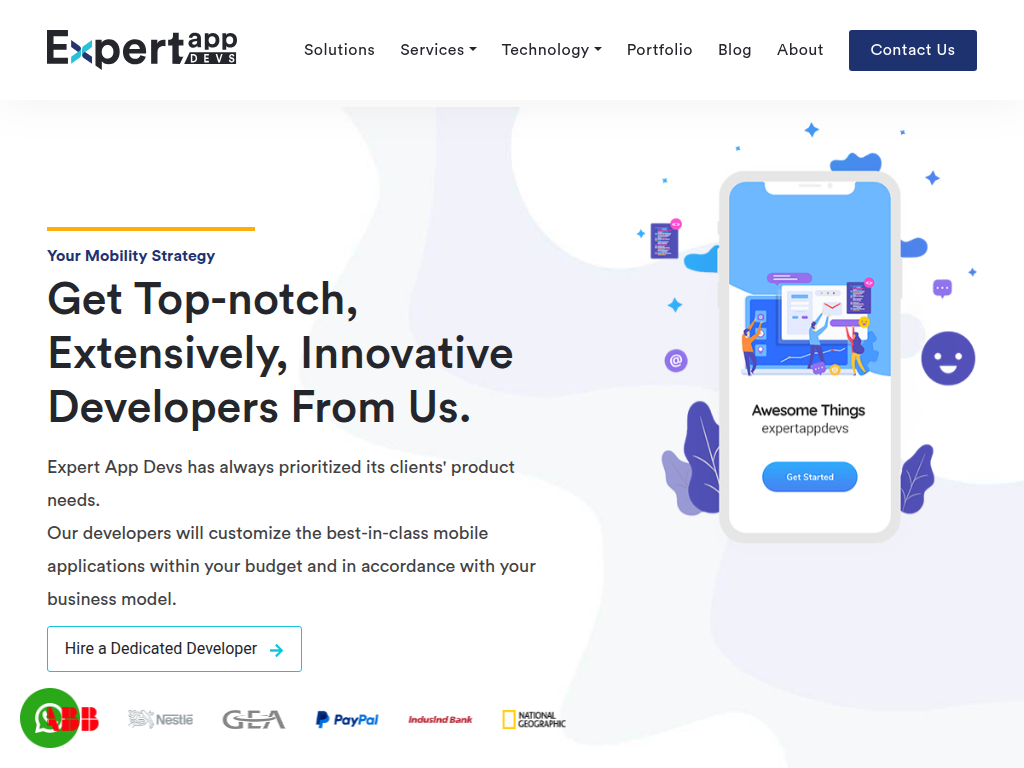
Expert App Devs operates from Ahmedabad with satellite presence in the US and UAE, positioned as a cross‑platform and native mobile specialist. We estimate 50–249 employees and ~10–14 years in the market. They emphasize dedicated‑team engagement and staff augmentation alongside full‑cycle builds.
We didn’t locate independent, off‑domain awards that meet our verification bar as of October 28, 2025. If recognized by organizers with public listings, we’ll add them in a future refresh.
In React Native, they’re pragmatic: ship features at a steady clip, keep the bundle lean, and avoid unnecessary native modules. We’ve seen them pick Expo for rapid discovery, then gradually add custom native modules where performance or device APIs demand it. Their managed services cover post‑launch hygiene (crash budgets, ANR tracking, OTA cadence).
Ideal fit: SMEs and funded startups that want predictable throughput under a team‑extension model, with time‑and‑materials flexibility and clear sprint accounting.
7. Concetto Labs

Concetto Labs is an Ahmedabad‑based engineering firm founded in the mid‑2010s (~9+ years) with an estimated 50–199 employees. They’re known for Microsoft‑first stacks (Power Platform, Azure) along with JavaScript and mobile, and they maintain a catalog of white‑label solutions for common app archetypes.
We didn’t find third‑party awards attributable to Concetto Labs on independent domains that we’re comfortable citing at this time. We’ll update when organizers publish public rosters that include them.
React Native delivery here is brisk and template friendly. It starts fast with Expo and EAS. Form heavy interfaces get reliable validation. CI stays tidy and easy to hand off. When device capabilities get complex, they use native where needed. They also document the bridge well for maintainers.
Ideal fit: product owners who benefit from accelerators—admin templates, common integrations, and pre‑baked CI/CD—without committing to a massive long‑term retainer. Works well for internal tools and mid‑complexity B2C apps.
8. eSparkBiz

eSparkBiz is headquartered in Ahmedabad with US presence, operating for ~15 years and an estimated team size in the low‑hundreds. They position around Talent‑as‑a‑Service and cross‑functional delivery pods that mix mobile, web, QA, and DevOps under one umbrella.
We do not have an independently verifiable, off‑domain award to cite for eSparkBiz at the moment. Should a well‑known program list them publicly, we’ll consider it for a future revision.
On React Native, their pitch is “full‑stack squads.” We’ve seen that translate to solid pipeline work: CI with caching, code‑owners in monorepos, and contracts between mobile and backend that prevent drift. The result is faster cycle time for features that touch multiple surfaces (mobile, web, and admin).
Ideal fit: buyers who don’t want to assemble their own cross‑functional team and prefer a single vendor for API, RN, and QA with feature‑flag discipline and canary releases.
9. Space‑O Technologies

Space‑O Technologies operates from Ahmedabad with North American offices, active since ~2010 (~15 years), and an estimated 100–199 people. Their industry spread includes retail, healthcare, logistics, and fintech, and they take on both MVPs and modernization projects.
We haven’t found recent, organizer‑published awards for Space‑O on third‑party domains we consider authoritative as of October 28, 2025. If that changes, we’ll reflect it here.
React Native strengths: cost‑aware delivery, good at trimming scope to a valuable core, and sensible defaults for authentication, analytics, and in‑app messaging. When apps graduate beyond MVP, we’ve seen them handle migration from managed Expo to bare workflows without derailing releases.
Ideal fit: founders seeking to validate a proposition quickly, or enterprises that need a mobile companion app tethered to existing systems without wholesale backend re‑platforming.
10. Konstant Infosolutions

Konstant Infosolutions is a Jaipur‑origin firm with US presence and a track record dating back to the early 2000s (~20+ years). Headcount is commonly reported in the 250–999 range. They cover mobile, web, and integrations for retail, travel, education, and services marketplaces.
We did not identify a current, off‑domain award listing attributable to Konstant Infosolutions that we can verify today. If a reputable program publishes an explicit roster entry, we’ll add it in an update.
On React Native, Konstant tends to be reliable on multi‑tenant, role‑aware builds (guest, merchant, admin) with clean navigation stacks and coherent state boundaries. Expect attention to release management—versioning, OTA planning, and app store choreography—especially helpful when non‑technical stakeholders drive deadlines.
Ideal fit: buyers who want breadth—mobile today, web tomorrow—without changing vendors, and who value long‑cycle support arrangements once the app finds its market.
11. Kellton

Kellton is a Hyderabad‑headquartered, publicly listed digital engineering and consulting company with ~1,800 employees, active for over a decade in global markets. They’re not a boutique; they’re a systems partner that can blend RN builds with data, integration, and security programs under enterprise governance.
We haven’t identified third‑party awards we’re comfortable citing for Kellton specific to mobile/react native as of today; public listings tend to highlight corporate milestones rather than niche practice awards.
For React Native, Kellton’s value is scale: security reviews, compliance alignment (PII, consent, audit), and mobile delivery inside multi‑team programs. If you need native bridges vetted by architecture boards or integrations into legacy stacks, their enterprise DNA becomes an asset.
Ideal fit: large enterprises and regulated industries where procurement, InfoSec, and architecture councils shape how the work is done as much as what is delivered.
12. Dotsquares

Dotsquares runs a globally distributed model with major delivery strength in Jaipur and a commercial base in the UK. Operating since the early 2000s (~20+ years) with 1,000+ personnel, they’re a broad‑spectrum vendor—mobile, web, CRM, and cloud—with RN as one of several competencies.
We did not find an organizer‑published, off‑domain award for Dotsquares specific to React Native in the last year that meets our verification standard; their recognition tends to be for broader software delivery.
On React Native, they’re useful when you want to co‑source: some in‑house, some vendor, and want the ability to scale up or down. They’re consistent on documentation and handover, and they have enough depth to swap seniority levels without losing delivery rhythm.
Ideal fit: agencies and enterprises that need a bench to flex on demand, where governance and time zone coverage matter more than boutique specialization.
13. Apptunix

Apptunix is a Chandigarh/Mohali‑area mobile and product firm with global offices, ~12 years in business, and an estimated few‑hundred employees. They service on‑demand, mobility, and marketplace domains with AI‑assisted product engineering, plus staff augmentation for spikes.
We haven’t seen independent, organizer‑side awards we can cleanly cite for Apptunix specific to React Native in the last year. Their marketing references multiple listings, but we avoid vendor‑hosted claims when not mirrored off‑domain.
React Native strengths: shipping consumer‑facing apps with robust growth loops—referrals, notifications, and A/B tests—alongside sensible analytics (events, cohorts, funnels). We’ve seen them be practical on payment integrations, deep links, and store compliance.
Ideal fit: operators who equate “win” with user growth and unit economics, and who want a partner comfortable blending product growth tactics with engineering cadence.
14. Binmile

Headquartered in Noida with a global footprint, Binmile is a product and platform engineering firm founded in the late 2010s (~6–8 years) and an estimated 200–500 employees. They blend custom software, QA, and DevOps with mobile, and emphasize digital transformation outcomes over one‑off builds.
We’re aware of claims around fast‑growth listings and awards, but we’re holding off citing until we can reference organizer‑side listings on independent domains for specific years and rankings. As of October 28, 2025, we’re not placing a linked award here.
React Native at Binmile looks like: cross‑functional squads with embedded QA, decent test coverage, and a preference for modularization that eases long‑term maintenance. On performance‑sensitive screens, they’re comfortable dropping into native and keeping bridges tidy.
Ideal fit: mid‑market firms that want a results‑oriented vendor willing to share KPIs—release frequency, crash‑free users, time‑to‑restore—rather than only outputs.
15. Brainium Information Technologies
Brainium is a Kolkata‑based firm operating since ~2009 (~16 years) with an estimated 200–500 employees. They mix mobile, web, and digital marketing, which sometimes makes them a one‑stop shop for SMBs that need both app delivery and customer acquisition playbooks.
We found no organizer published awards on independent domains for Brainium’s React Native practice that we can confidently link today. When citing ratings or lists, we prefer primary sources with explicit rosters.
React Native projects here tend to emphasize cost‑effective delivery and support: predictable triage, store submission cycles, and release calendars synced to marketing beats. For SMBs stepping into mobile, that predictability sometimes trumps esoteric optimizations.
Ideal fit: small to mid‑sized businesses that want a vendor who can bundle engineering with growth support and operate within strict budgets without chaos.
16. TechAhead

TechAhead is a Noida/Los Angeles hybrid with ~15+ years of operation and an estimated few‑hundred staff. They deliver mobile, web, and cloud for enterprises and well‑funded startups, and they’re comfortable being a primary vendor for complex, multi‑platform programs.
Press coverage notes a #1 global ranking in ‘Spring 2025 App Development Awards’ on Clutch. We treat that as a signal of broad client satisfaction and delivery maturity in a competitive peer set.
React Native here tends to be paired with IoT, AI/ML integrations, and platform work (design systems, microfrontends across mobile and web). The delivery cadence is program‑friendly—release trains, quality gates, and service‑level monitoring—so stakeholder groups can align on outcomes.
Ideal fit: enterprises and scaleups that want a flagship app with demanding UX requirements, complex integrations, and a predictable path from MVP to tens of thousands of daily active users.
17. DianApps

DianApps is a Jaipur‑ and Gurugram‑present product engineering company active since the late 2010s (~6–7 years), with an estimated 100–300 employees. They operate globally but rely on India delivery, tackling mobility, web, and adjunct services like digital marketing.
As of today, we haven’t found organizer‑side awards on independent domains to cite for DianApps in the React Native category. We’ll revisit if that changes.
In RN, they’re execution‑focused: clean UI kits, pragmatic state management, and careful use of OTA updates to avoid app store bottlenecks. For location‑aware apps (delivery, mobility), they’re mindful of battery budgets and background behaviors—critical for retention.
Ideal fit: founders and product managers who want fast feedback loops—weekly demos, strapped backlog—and transparent burndown on a fixed‑scope MVP.
18. Simform

Simform is a large digital engineering company with major India delivery, founded in 2010 (~15 years), and a team size typically reported in the 1,000+ range. They deliver across cloud, data, AI/ML, and product engineering, with React Native as one part of broader platform initiatives.
Independent coverage recorded Simform as #1 on the ‘Top 1000 Global Service Providers 2022’ by Clutch, a noteworthy signal in a crowded market.
React Native at Simform usually sits within larger modernization efforts—data platforms, microservices, and cloud infra—so the mobile app isn’t an island. They’re strong on reliability engineering and production telemetry, which makes a difference when RN apps become revenue‑bearing channels.
Ideal fit: enterprises and scaleups that want mobile aligned with cloud/data roadmaps, not treated as a sidecar. If you need org‑scale standards, they have the muscle and process depth.
19. Rootquotient

Rootquotient is a product engineering partner with India delivery (notably Chennai) and global presence, founded in the late 2010s (~6–7 years) with an estimated 50–199 people. They emphasize strategy, purposeful design, and engineering excellence over staffing models.
We have not identified organizer‑published awards on independent domains for Rootquotient that we can cite as of today. When credible recognitions appear, we’ll amend this section.
For React Native, Rootquotient’s strength is upfront product framing and tight UX loops. They work well where user research, behavioral insights, and design tokens lead the way, and RN becomes a vehicle for consistent multi‑surface experiences.
Ideal fit: teams that value discovery as much as delivery—early MVPs where wrong turns are expensive and an outcome‑driven approach keeps scope honest.
20. Upwork React Native Developers in India
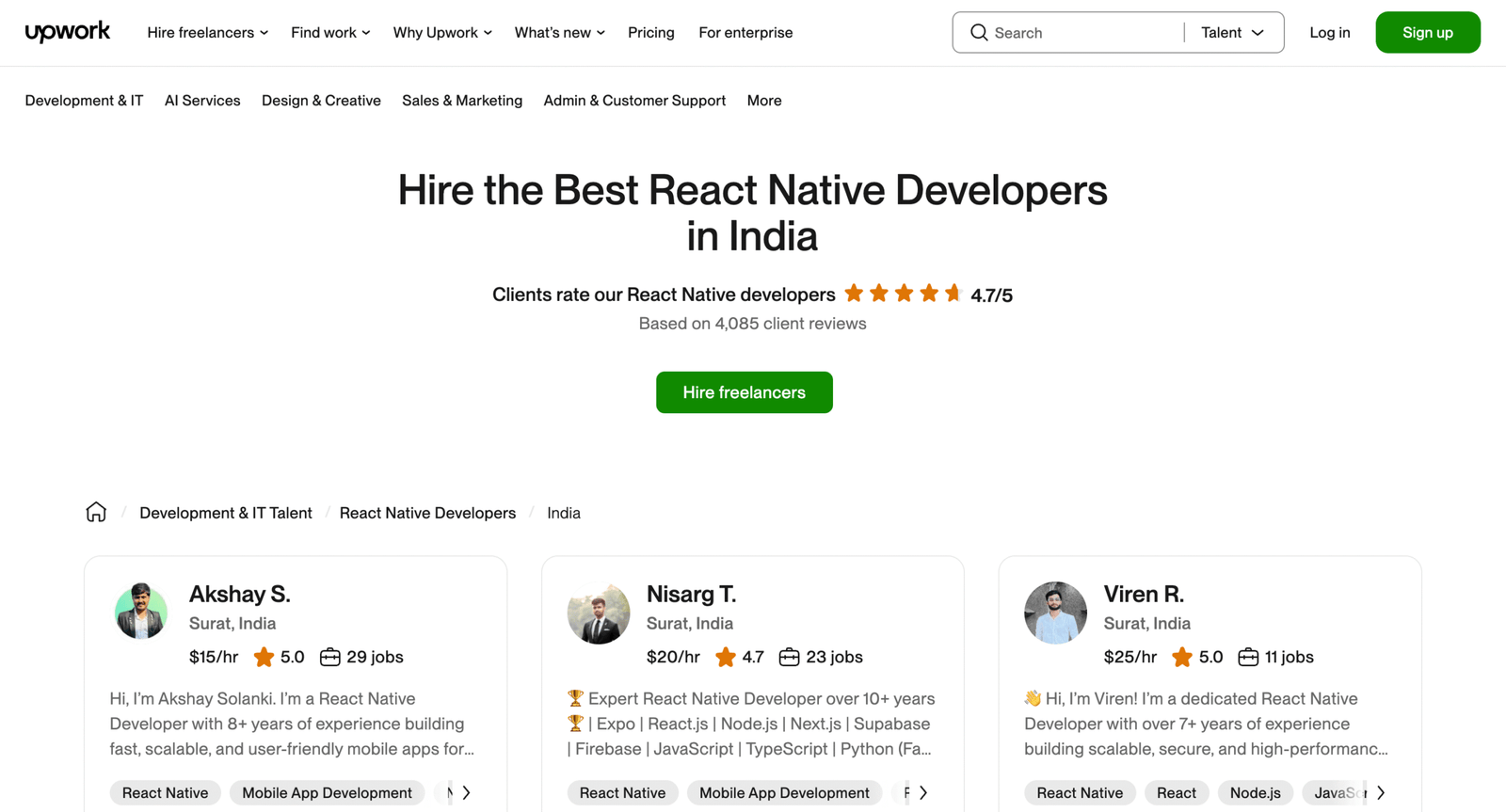
Upwork isn’t a company; it’s a marketplace with deep React Native talent concentrated in India. You’ll find solo seniors and boutique teams reporting years of RN practice, often with TypeScript portfolios and domain experience in fintech, logistics, or consumer marketplaces. Engagements range from hourly sprints to long‑term retainers.
This isn’t an award entry; marketplace ratings aren’t awards. We therefore aren’t citing any awards here. What matters is vetting—code samples, take‑home tasks, and past production apps—more than badges.
If you go the Upwork route, treat your project like a product: define acceptance criteria, enforce code owners in your repo, and make CI the source of truth. For React Native, test for new architecture readiness (Fabric/TurboModules), Expo/CLI flexibility, and comfort with Hermes and OTA strategies.
Ideal fit: budget‑sensitive teams with strong internal product leadership who can manage contractors, write crisp tickets, and own the risk of team assembly and knowledge retention.
If you’re weighing two or three contenders and want a second opinion on scope, architecture, or engagement model, we’re happy to sanity‑check your brief. Would you like us to review your must‑have features and suggest a build plan—complete with state management, CI/CD, and a performance budget tailored to your target devices?
Recommended reading: Top 20 Web Design Companies in Singapore: How to Choose and Custom Solutions
Why React Native matters and how react native app development companies in india deliver value

Cross‑platform development is firmly mainstream; a recent developer study shows Flutter usage at 46 percent, a useful proxy for the maturity of multi‑platform tooling that React Native competes within and complements. In our practice, that maturity translates into predictable delivery, a deep library ecosystem, and a hiring pool steeped in modern JavaScript.
1. What is React Native
React Native is a UI framework that lets us compose native interfaces using JavaScript and React’s declarative model. Under the hood, the modern architecture (Fabric + TurboModules + JSI) speaks directly to platform components, avoiding the heavy, chatty bridges of old. In plain terms: we write idiomatic React, and the runtime renders true native views without forcing us into web wrappers.
How we explain it to non‑engineers
Think of React Native as a bilingual interpreter: it understands the language of product teams (React components) and speaks fluently to iOS and Android UI toolkits. That dual fluency is why it fits well in cross‑functional teams where web and mobile talent blend.
2. Single codebase for iOS and Android
We centralize domain logic while isolating platform‑specific seams—permissions, navigation idioms, and OS integrations—behind thin adapters. When a design calls for a platform‑native affordance (say, a share sheet or home‑screen widget), we expose a typed module and keep the rest of the app blissfully ignorant. This keeps delivery predictable without flattening platform personality.
Engineering tip
Use Platform.select and per‑platform file suffixes to keep “if‑else” clutter out of shared components. Pair with a monorepo to share primitives across web and mobile while compiling to platform‑correct outputs.
3. Native components and near‑native performance
Fabric’s concurrent rendering, Hermes as the default JS engine, and TurboModules for fast native calls mean complex screens remain responsive. Where latency truly matters—camera, Bluetooth, low‑level crypto—we ship slim native modules and keep the bulk of product logic in React Native. The result: native feel without duplicating entire codebases.
Real‑world pattern
For a subscription commerce client, we pushed image decoding and gesture handling into native helpers while keeping the cart, promotions, and account areas in shared React Native views. Users noticed the polish; finance noticed the maintainability.
4. Hot reloading for faster iteration
Fast Refresh keeps feedback loops tight. Designers can watch micro‑interactions evolve while engineers tweak props, styles, and transitions in real time. The caveat: we checkpoint state thoughtfully so hot swaps don’t mask initialization bugs. That discipline pays back during handoffs and regression hunts.
5. Strong open‑source community and ecosystem
React Navigation, Reanimated, Tamagui, React Native Paper, Expo, and Microsoft’s native modules form a living toolkit. We contribute fixes and docs when gaps appear; doing so is selfish in the best way—our future maintenance windows shrink as the ecosystem improves.
6. Works well with Node.js Express Firebase GraphQL Django
React Native slots neatly into modern backends. We use Node/Express for a “backend‑for‑frontend” layer that shapes payloads to screens, GraphQL for declarative data fetching and cache coherency, Firebase for realtime and push orchestration, and Django/DRF when teams want Python’s batteries‑included pragmatism. The mobile app stays lean while the server absorbs policy, orchestration, and audit.
Integration heuristics
Prefer GraphQL for chatty detail pages, REST for append‑only events and webhooks, and edge caching for list screens. On mobile, wire storage through a repository pattern so switching providers (say, from Firebase to a custom socket) doesn’t ripple across components.
7. Code reusability and faster time to market
Shared components, typography tokens, and validation logic travel across iOS and Android without drama. We lean on design tokens and theming systems so accessibility, brand color ramps, and spacing scale coherently as products evolve.
8. Cost and time savings with cross‑platform development
Cross‑platform isn’t about choosing the cheapest path; it’s about paying once for product knowledge—domain models, error states, analytics discipline—and applying that investment on multiple platforms. When features demand deep native work, we isolate and optimize rather than forking entire journeys.
9. Attractive UIs with ready‑to‑use components
Design systems thrive in React Native. Libraries like Tamagui or NativeBase let us compose accessible surfaces, while Skia‑backed animations bring delight without forcing heavy custom natives. The net effect: expressive UIs with predictable effort.
10. Why India for React Native cost‑effective talent and a large developer pool
India’s product engineering culture is increasingly “product‑led + platform‑savvy.” Teams are comfortable with TypeScript, CI/CD, and observability on day one, and they understand how to wire into India Stack rails such as UPI and e‑KYC. For global buyers, that means a pragmatic blend of velocity, security sensibility, and domain literacy.
Recommended reading: Top 30 App Development Companies In Spain 2026
How to choose among react native app development companies in india

Outsourcing models are evolving from cost‑only deals to value partnerships; a recent global survey shows 80% of executives intend to maintain or increase third‑party outsourcing, with value metrics and AI governance increasingly explicit in contracts. We see that shift reflected in RFPs asking for product outcomes, not just body counts.
1. Experience and expertise in React Native
Probe for the new architecture (Fabric/TurboModules) in real projects, not just slideware. Ask how the team decided between Expo and a bare workflow, where they drew the line for native modules, and how they measured perceived performance. The best answers include tradeoffs, not absolutes.
2. Portfolio depth and domain fit
Your problem space matters. Regulated fintech, social marketplaces, field operations, and media all place different constraints on caching, offline behavior, and security controls. Favor partners who can narrate those constraints and show how they shaped the architecture.
3. Client reviews and testimonials
Look beyond star‑ratings. Seek specifics: tricky edge cases that were discovered late, analytics events that changed a funnel decision, or a refactor that simplified a growth experiment. Substance beats superlatives.
4. Transparent and value‑aligned pricing
Outcome‑based engagements work when metrics are observable and within the vendor’s span of control. We recommend a hybrid: a predictable base team plus incentives tied to milestones like app store readiness, accessibility compliance, or design‑system adoption.
5. Post‑launch support and maintenance commitment
Mobile is a living organism. Confirm plans for OS upgrades, device coverage, dependency updates, and security patches. A reliable partner treats release trains, crash‑free sessions, and observability as part of everyday hygiene, not expensive change requests.
6. Clear communication and on‑time delivery
Ask who writes the weekly risk log, how decisions are captured, and where design and engineering discuss tradeoffs. In our teams, asynchronous updates, lightweight RFCs, and demo‑centric sprint reviews keep everyone aligned without ceremony bloat.
7. UI UX design approach and capabilities
Designers should think in tokens, not pixels. The handoff improves when components map directly to code, motion guidance is documented, and accessibility is considered as a first‑class constraint. React Native thrives when design systems are real products.
8. Testing and quality assurance maturity
Great mobile QA blends unit tests, component snapshots, E2E flows, and contract tests against your APIs. We also advocate “chaos‑lite” drills—airplane‑mode, throttled networks, and background/foreground stress—to reflect real‑world usage patterns.
9. Transparent project management and reporting
Insist on dashboards that show work‑in‑progress, upcoming releases, open risks, and dependency health. Clear visibility makes it easier to de‑scope gracefully, not desperately.
Recommended reading: Top 20 Software Consulting Companies: 2026 Guide and Key Trends
How TechTide Solutions helps you build custom React Native solutions

Agile done well moves the business, not just the burndown; research finds operational performance can improve by 30 to 50 percent with enterprise agility, which mirrors our experience when teams align architecture, product, and design around measurable outcomes. We bake that alignment into every engagement.
1. Discovery and requirements workshops tailored to your business goals
We start with collaborative workshops to map outcomes, not feature lists—service blueprints, event storming, and architecture sketches that reveal constraints early. This yields a living backlog tied to user journeys and business levers, so prioritization stays rational when realities shift.
Beyond the happy path
We codify failure states and operational guardrails up front: offline behavior, rollback strategy, feature flags, and alerting. That forethought shrinks surprises later.
2. Custom feature development with modular scalable architecture
Our default is a modular monorepo—shared primitives for typography, spacing, analytics, and auth; vertical feature packages for cart, checkout, content, or messaging. We isolate native modules where hardware or OS features warrant it, and we keep API integrations behind repositories so backends can evolve without churn in the UI.
Security and compliance baked in
We treat secrets, transport, and data at rest as first‑class concerns, wire secure storage correctly, and document data flows for reviews. Compliance becomes a by‑product of good engineering, not an afterthought.
3. Agile sprints transparent communication and ongoing support
Each sprint culminates in a working demo and a risk review everyone can read in minutes. Post‑launch, we run release trains, analytics‑driven experiments, and steady dependency upgrades, so momentum persists after the first app store splash.
Recommended reading: Top 30 Mobile App Development Companies in France to Consider
Conclusion choosing your React Native partner in India

Security expectations are rising in lockstep with investment; end‑user spending on information security in India is projected to hit $3.3 billion in 2025, which is why we advocate choosing partners who instrument privacy and security by design, not by audit. If you want a candid assessment, we’re happy to run a lightweight workshop to map risks, opportunities, and a pragmatic React Native roadmap—shall we schedule a discovery session and align on outcomes that matter to you?