


As product people at Techtide Solutions, we study Nike’s transformation not as distant observers but as peers building D2C, data, and supply chain software for global brands. Two market currents frame Nike’s choices. First, digital commerce has become the default growth engine, with global retail e-commerce reaching an estimated $6 trillion in 2024, and second, enterprise IT budgets keep expanding to support that shift, with worldwide IT spending forecast at $5.06 trillion in 2024. Against that backdrop, Nike’s arc from Consumer Direct Offense to immersive virtual goods offers a masterclass in where to double down—and where to pivot—when digital meets brand.
Inside Nike Digital Transformation At A Glance
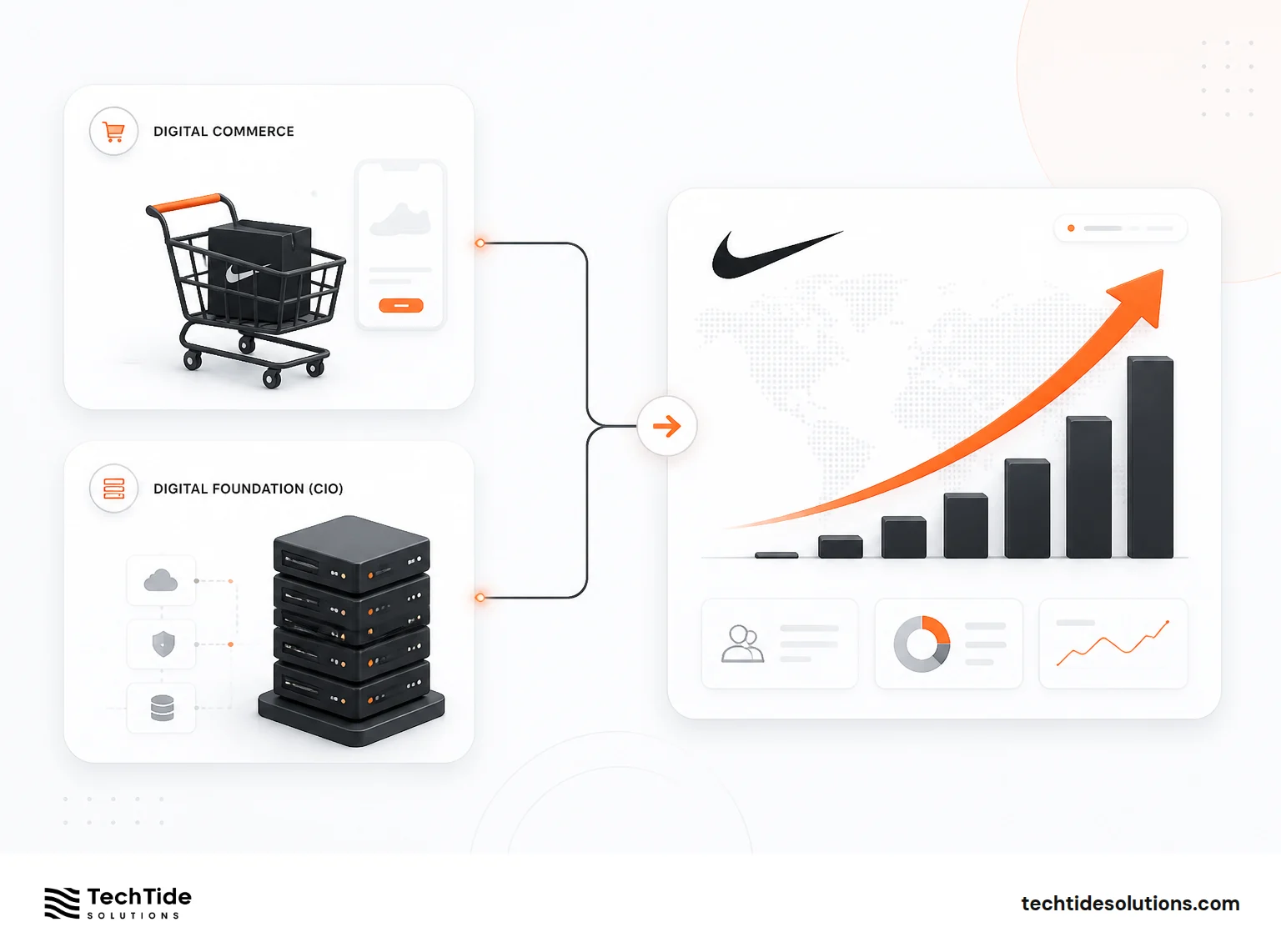
Before the playbook, one market fact matters. Digital retail is already huge and still growing, with ecommerce reaching about 6 trillion dollars in 2024. Meanwhile, CIOs kept funding the stack, with projected spending of 5.06 trillion dollars in 2024. Together, those numbers show digital first is now an operating condition, not a slogan.
1. From Consumer Direct Offense To Consumer Direct Acceleration
Nike’s transformation began with the Consumer Direct Offense (CDO), announced on June 15, 2017, to “serve the consumer personally, at scale.” Just three years later, leadership formalized the next phase—Consumer Direct Acceleration (CDA)—with a company-wide operating model shift on July 22, 2020. Practically, CDA sharpened the portfolio into Men’s, Women’s, and Kids; unified technology foundations; and set explicit targets for digital penetration. On the Q4 FY2020 call, Nike reiterated its acceleration plan—including beating its 30% digital-penetration goal ahead of schedule and aiming toward 50% over time, stating it would reach the earlier goal “more than two years ahead.”
As builders, we read both CDO and CDA as governance decisions: reorganize around consumer-funnel outcomes and invest in data as an asset. The hard part? Not the statements of intent, but editing distribution, incentives, and operating rhythms to back them. Nike did that—sometimes messily—in public.
2. Shift From Wholesale To A D2C-Led Marketplace
From 2017 onward, Nike reduced exposure to undifferentiated wholesale and invested in owned stores, apps, and a tighter set of strategic partners. After years of deprioritizing Amazon, Nike confirmed a return to the platform on May 21, 2025, signaling a recalibrated “marketplace of the future” that blends D2C with selective wholesale reach. Foot Locker, for example, trumpeted a “renewed” relationship in March 2023. We view this as the pragmatic middle path: keep the data-rich first-party pipe while reenlisting scaled partners to move inventory and sustain breadth. In our client work, this is usually the inflection where governance and data sharing agreements, not just channel maps, decide success.
3. Digital Channels Accounted For About 26% Of Revenue By 2022
By FY2023, Nike Digital represented 26% of total sales, up from roughly 10% pre-pandemic. The arc wasn’t linear—digital traffic and promo intensity later fluctuated—but the structural shift is real. This kind of mix change forces enterprises to solve two hard problems simultaneously: the experience problem (full-funnel personalization at scale) and the economics problem (margin mix after customer acquisition and returns). Nike’s next moves—membership, sizing, demand sensing, and supply-chain automation—were all aimed at those two problems.
4. COVID-19 Accelerated The Digital Playbook
Pandemic lockdowns didn’t create Nike’s strategy; they compressed the timeline. Across sectors, companies accelerated digitization of customer and supply-chain interactions by three to four years, and Nike’s Q4 FY2020 results showed digital as about 30% of revenue at the time. We felt that same compression with our own clients: projects scoped for 18 months demanded delivery in 12 weeks. The lesson holds—response speed matters, but the scaffolding (clean data, flexible architecture, and disciplined ops) is what makes speed repeatable.
Recommended reading: Starbucks Digital Transformation: How Tech Rebuilt the Coffeehouse
Direct-To-Consumer Marketplace And Membership
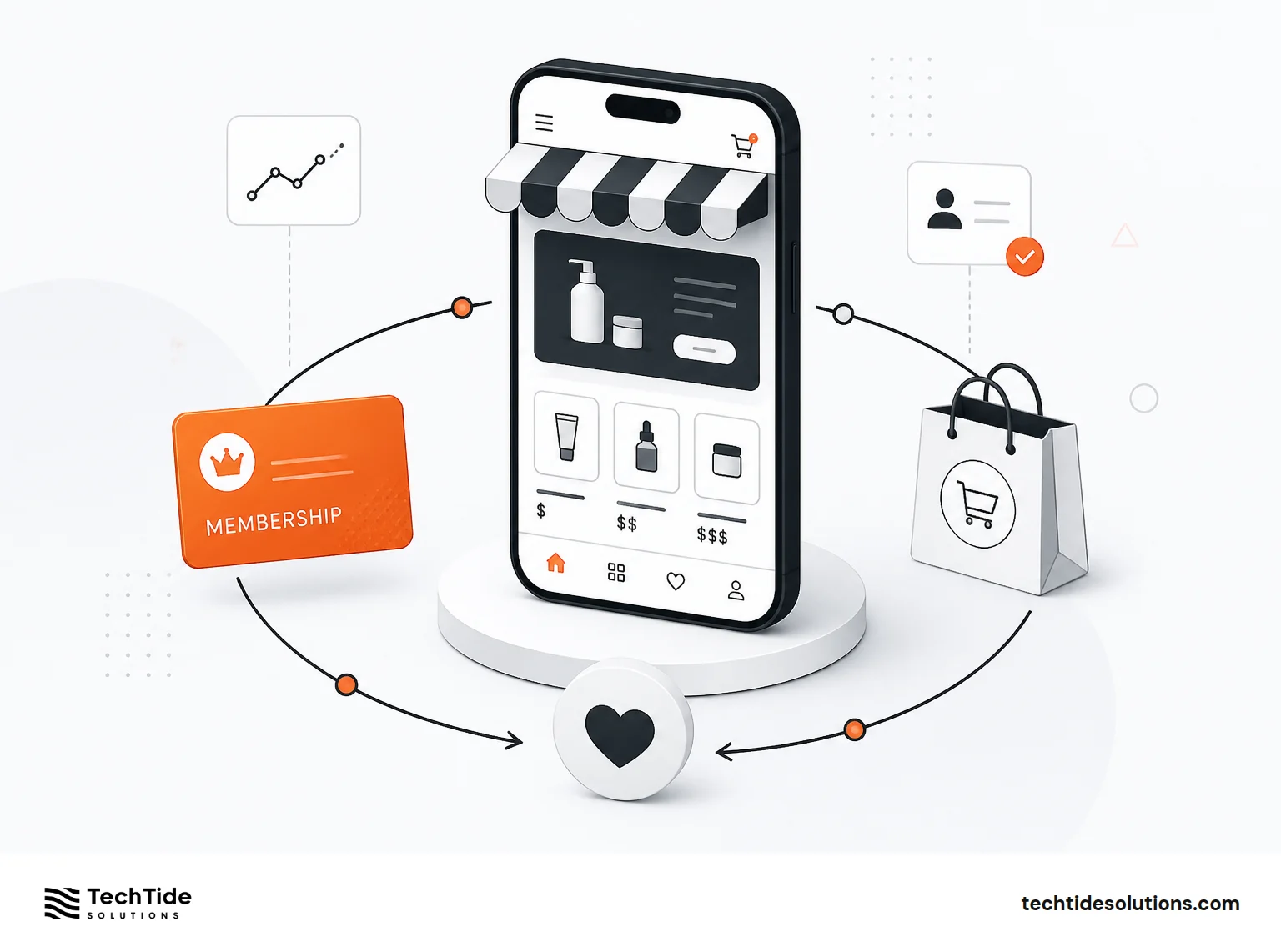
The economics of D2C hinge on retention and frequency. Data shows loyalty drives spend: members in paid programs are 60% more likely to spend more, while free programs lift the likelihood by 30%; and in retail, 67% spend more with retailers when members. Nike’s D2C system leans into that reality with membership embedded across commerce, content, and community.
1. Nike.com And The Nike App As A Unified Storefront
The Nike App is the membership control room. It personalizes storefronts, pulls in training/running context, and ties to store visits via “App at Retail.” The idea is not new. Make the app a daily companion. Nike executes it with unusual specificity. For example, member unlocks at the door, Scan to Try, and instant checkout connect online identity to in store browsing. These features are not gimmicks. Instead, they shrink the gap between intent and purchase. As a result, Nike also gains opt in first party data that reduces guesswork in merchandising and lifecycle marketing.
2. SNKRS Drops Access And Sneaker Community
SNKRS formalized scarcity, storytelling, and fairness in a playground tailored for sneakerheads. Tools like Exclusive Access and Shock Drops reward engagement signals. In our testing, the best results come from balanced eligibility rules. Participation should matter. Purchase history should matter too. That mix helps avoid overconcentration. Meanwhile, Nike made SNKRS a separate experience for a reason. It keeps drop culture from cannibalizing mainstream commerce. As a result, grail hunting and everyday replenishment stay distinct product jobs.
3. Nike Training Club And Nike Run Club For Retention And Data
NTC and NRC weren’t built as revenue lines; they are durable habit engines. Minutes logged, streaks, and program completion become membership signals, which in turn inform recommendations and lifecycle nudges. Nike has publicly shared membership milestones—more than 300 million members by FY2021 and roughly 160 million active members by late 2022—underscoring the distinction between total and active bases. Our view: fitness utility inside the same identity as commerce is a moat; it raises the “switching cost” to other brands that only transact.
4. House Of Innovation Flagships Blend Store And App Experiences
House of Innovation 000 (New York) is a thesis in steel and glass: “Shop the Look” by scanning mannequins, “Scan to Try” for fitting room delivery, and “Instant Checkout” from the app—introduced at launch on November 14, 2018 and detailed by Nike here 68,000 square feet. The store is effectively an R&D lab for phygital journeys. We’ve implemented similar flows for clients (QR-to-fulfillment, reserve-and-try, self-checkout) and the operational constraint is rarely the UI—it’s inventory accuracy, pick/pack choreography, and loss prevention. Nike’s investments downstream (RFID, OMS changes) make those front-end promises credible.
5. Chatbots And Assisted Selling With Laiye
Conversational AI supports scale. In Greater China, Nike used Laiye to stand up chat-based assisted selling and support, with reported outcomes such as 75% of inquiries resolved without manual intervention and 50% productivity gains. We treat chat not as a “contact deflection” tool but as a discovery and conversion surface: size advice, bundle curation, and service-to-sales transitions. The design nuance is disclosure and handoff—clear escalation to humans when confidence drops and continuity of context across channels.
Recommended reading: Adidas Market Share: Current Position, Growth Drivers, and Competitive Outlook
Data AI And Personalization
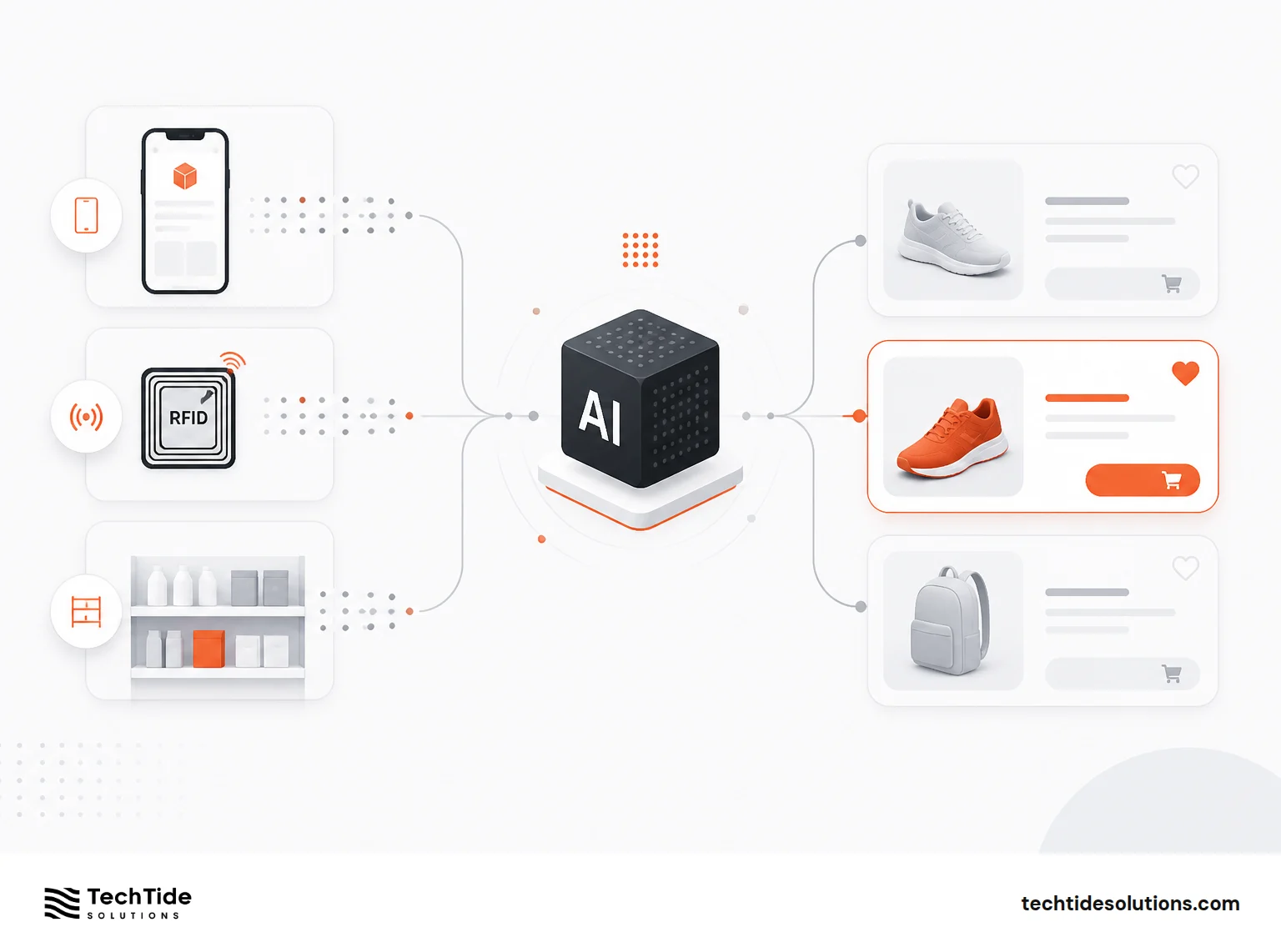
Personalization, done well, lifts revenue by 10–15% on average, and retail AI software outlays are rising toward $12.5 billion by 2027 from $7.8 billion in 2024. Nike’s data strategy—apps for identity, RFID for inventory truth, and targeted acquisitions—was built to make those gains repeatable rather than one-off.
1. First-Party Data From Apps Stores And Wearables
NTC, NRC, SNKRS, Nike App, and .SWOOSH all funnel consented data into a single view of the member: goals, sizes, engagement rhythms, and spend. That makes segmentation more granular (e.g., “new runners returning post-injury” or “members who train 3x/week and buy tights quarterly”). Combined with RFID-enabled inventory data—rolled out to “nearly all footwear and apparel,” described as hundreds of millions of products—you can promise not just relevance but availability. Our experience: identity plus availability is the unlock that turns recommendations into revenue.
2. AI For Recommendations Demand Forecasting And Pricing
On the demand side, Nike invested in predictive capabilities to place the right assortment by geo and partner. Celect—acquired on August 6, 2019—brought hyperlocal demand sensing; Datalogue—acquired on February 9, 2021—focused on unifying data pipelines so models and marketers work from clean inputs. The operational payoffs aren’t abstract: fewer stockouts, saner markdowns, and “right-first-time” allocations. We routinely see clients recapture basis points of margin simply by marrying model outputs to human merchant workflow—the last mile of analytics adoption.
3. Acquisitions To Build Capabilities Zodiac 2018 Select 2019 Datalogue 2021
Nike bought Zodiac (customer lifetime value modeling) in March 2018 to get closer to true CLV-driven decisions (who to acquire and how much to spend), Celect in August 2019 for predictive inventory optimization, and Datalogue in February 2021 to accelerate data integration. In our playbooks, these “capability tuck-ins” work when you immediately dock them to funded use cases with executive owners—e.g., “cut stockouts by 20% in EMEA women’s running” or “reduce size-related returns by 15% in apparel.”
4. Nike Fit AR Sizing To Cut Returns And Boost Confidence
Nike Fit launched in 2019. It uses computer vision and machine learning to scan feet with a smartphone camera. Then it recommends sizes across different models. Nike claimed accuracy under 2 millimeters. This kind of feature removes a small but costly friction point in D2C. It reduces size anxiety, lowers return rates, and improves first pair satisfaction. At the same time, the product captures high signal data like foot shape and volume. We increasingly build that kind of fit data into apparel workflows for clients.
Immersive And Virtual Commerce Nikeland And .SWOOSH
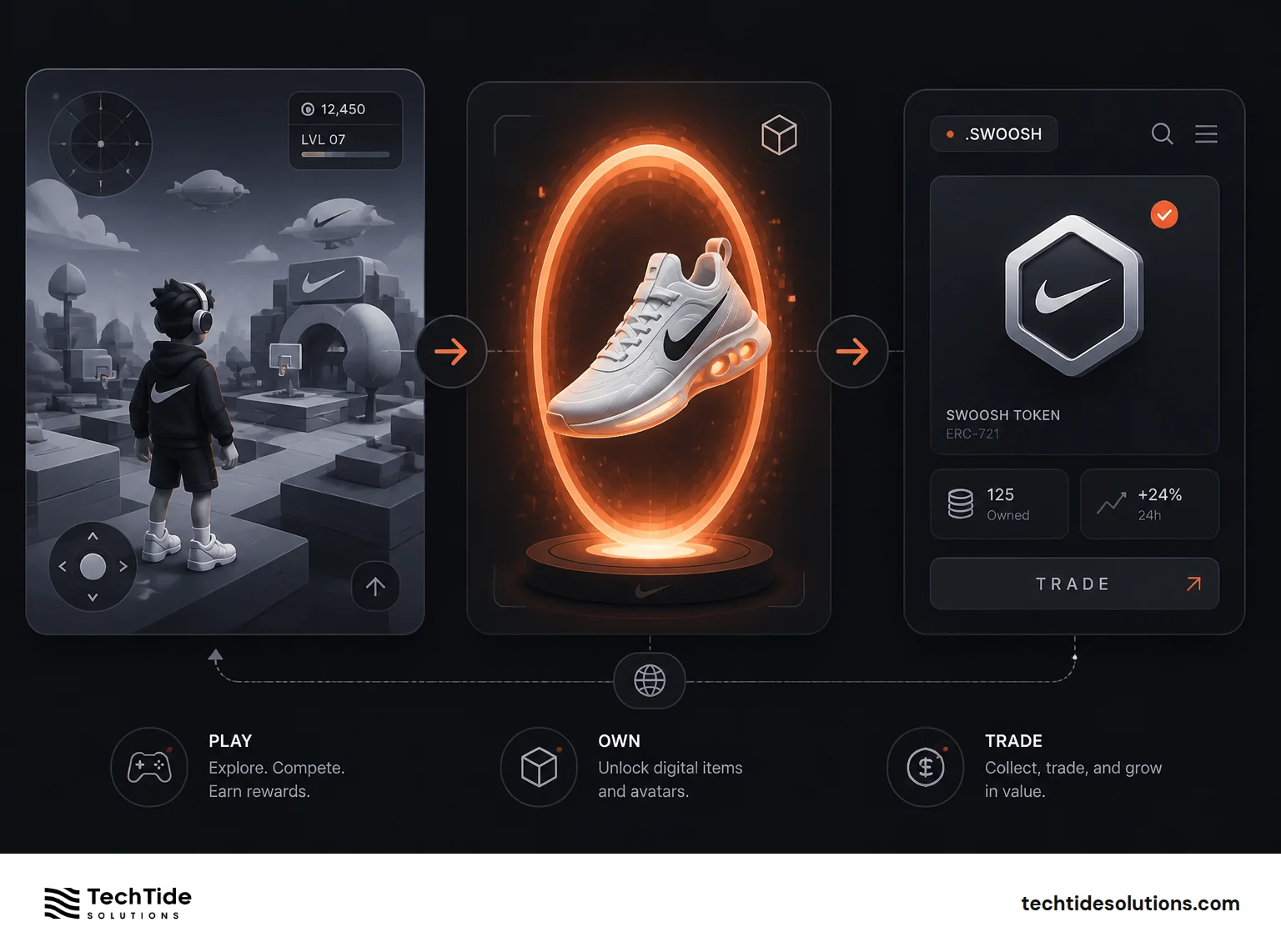
Virtual commerce isn’t a sideshow; it’s a test lab for community, scarcity, and identity. Analysts project the metaverse could generate $4–$5 trillion by 2030, and Nike has been among the most active global brands in live experiments across gaming, NFTs, and digital twins.
1. Nikeland On Roblox As A Branded Playground
Nikeland launched on Roblox in late 2021 as a sports-themed world with mini-games and a digital showroom. Early signals were strong—Nike cited 6.7 million visitors from 224 countries within months, and subsequent coverage pegged total visits in the tens of millions. We’ve helped brands build similar “playgrounds,” and the key is retention loops: user-generated games, seasonal drops, and physical-virtual crossover (e.g., AR moments at flagship stores) rather than static showrooms.
2. RTFKT And NFTs Including CryptoKicks Dunk Genesis
Nike acquired RTFKT in December 2021 and launched the Nike Dunk Genesis “CryptoKicks” in April 2022, introducing “Skin Vials” that could transform digital sneakers’ appearance—some resales hit eye-popping marks, with reports of a single pair selling for 45 ETH. It hasn’t been linear; Nike later moved to wind down RTFKT operations, prompting litigation in April 2025. Still, the experiment produced playbooks for token-gated access, co-creation, and digital-physical tie-ins that informed .SWOOSH.
3. .SWOOSH Our Force 1 Virtual Boxes Priced At 19.82 USD With Future Utilities
In April 2023, Nike’s .SWOOSH launched “Our Force 1,” co-curated with the community. Each box cost 19.82 USD, a nod to the Air Force 1 birth year. The offer also promised future utility, including access to special products and experiences. From a practitioner’s view, the pricing logic is smart. Entry stays low friction. The utility roadmap feels concrete. More importantly, the concept creates a clear bridge back to physical experiences. It’s what moves NFTs from speculation to loyalty and R&D.
4. Digital Assets That Unlock Physical Products And Exclusive Experiences
Both RTFKT and .SWOOSH framed digital assets as access keys—early product access, event admission, or special-edition physicals. In our own builds, we treat digital ownership primarily as identity and permissions management, not a standalone P&L. The mechanics—claim windows, transferability rules, and anti-bot controls—matter as much as the artistry. Nike’s .SWOOSH messaging emphasized “future utilities” tied to real-world drops, which is where we see brands get durable returns.
Digitizing Operations And The Supply Chain
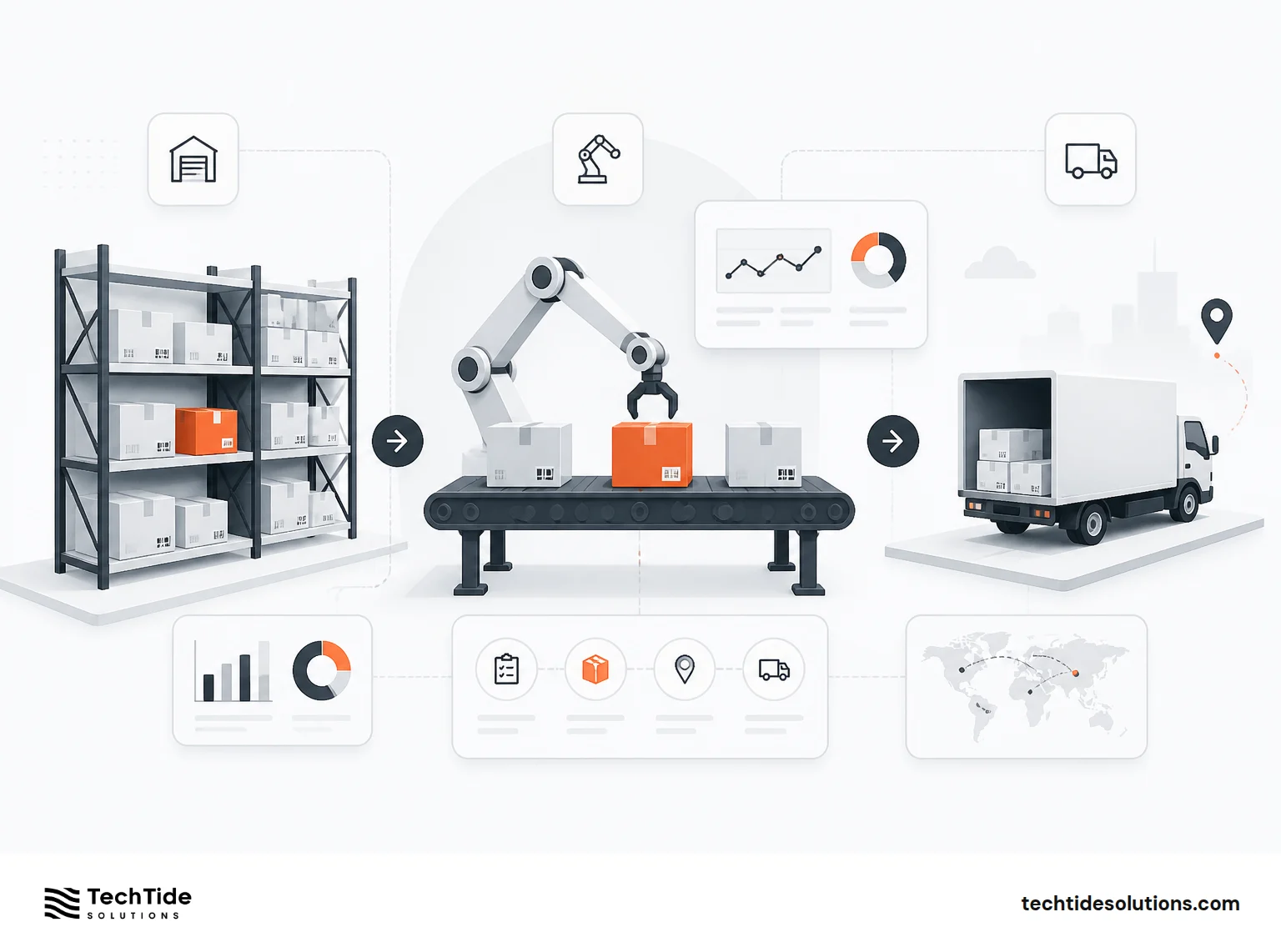
Consumers don’t feel the back end—until they do. Retailers have pushed technology deeper into ops: retail AI software spend is projected to reach $12.5 billion by 2027, and total IT spend is on a trajectory of $5.06 trillion in 2024. Nike’s operational modernization blends network redesign, automation, ERP overhaul, and item-level visibility—each a lever for speed, precision, and sustainability.
1. Regional Service Centers And Omnichannel Fulfillment
Nike shifted from a near-single-node model (Memphis) to a multi-node network, adding regional facilities (e.g., Los Angeles, Bethlehem, Dallas) and a center in Madrid to complement Belgium’s European Logistics Campus—moves Nike described alongside the “digital-first supply chain” vision and the deployment of more than 1,000 collaborative robots. The impact is less distance per order, more Ship‑from‑Store and BOPIS coverage, and resilience when any single node hiccups. We’ve modeled this for clients: the crossover point where middle-mile savings and promise-keeping outweigh incremental facility fixed costs typically arrives sooner than expected when digital tops 20–25% of mix.
2. Robotics Cobots And Automation In Distribution
To meet holiday spikes and labor constraints, Nike added over 1,000 cobots for sorting and packing. Automation here is not about replacing people; it’s about increasing throughput and safety while enabling service-level agreements (SLAs) that marketing can actually promise. When we deploy automation layers, we map them to order profiles (size, cube, velocity) and service classes; getting slotting and orchestration right creates outsized gains.
3. Demand Sensing And Inventory Optimization
Acquiring Celect in 2019 added a mature demand-sensing stack. Combined with RFID’s item-level truth, it yields connected inventory across owned and partner channels. For one client, we saw a multi-point increase in full-price sell-through by simply using demand-sensing outputs to adjust replenishment cadences for the 200 most volatile SKUs—a small number of items drove most stockouts. Nike’s “Express Lane” merchandising cadence thrives on exactly this feedback.
4. The Los Angeles To Memphis Dedicated Train
In 2021, Nike secured a dedicated LA-to-Memphis rail service—the “Sole Train”—to cut dwell time between West Coast ports and Tennessee DCs, pairing it with committed drayage for 24-hour offloading. This is operations as strategy: if ocean congestion is the constraint, own a faster rail artery. We’ve seen the same logic in client charter flights or dedicated intermodal blocks during peak; the math is compelling when demand is price-inelastic for core franchises.
5. ERP Modernization Rolled Out In Greater China And Planned For North America
ERP is the quiet backbone. Nike called its new ERP its “biggest investment” in digital transformation, with go-live in Greater China slated for July 2022 and North America planned for FY2024 per CFO commentary. The goals: unify inventory and financial views, shorten cash conversion cycles, and standardize processes across D2C and wholesale. We’ve led similar rollouts and the pattern is universal—value accelerators are not just system go-lives but the adjacent changes: ATP logic that respects reservation windows, OMS rules that arbitrate between ship‑from‑store and DCs, and clean product data for speed-to-site.
6. BOPIS And Faster Last Mile
Omnichannel fulfillment—BOPIS, ship-from-store, curbside—graduated from pandemic stopgaps to table stakes. Nike’s “App at Retail” underwrites these flows with identity, while the network redesign supplies the physical muscle. Across retail, BOPIS and curbside usage took off in 2020 and remained sticky thereafter, with reported surges like 443% growth in early December 2020 vs. pre-pandemic baselines. Our guidance: design last-mile options not as a menu but as an optimizer—nudge customers to the best option dynamically, given inventory location, carrier time-in-transit, and basket economics.
7. Blockchain And NFC For Authenticity And Traceability
Beyond logistics, Nike leaned into item-level authenticity. With RFID rolled out to “nearly all footwear and apparel,” inventory accuracy and returns validation improved. RTFKT experiments introduced on-chain ownership for digital goods and NFC tie-ins for authenticated physicals. We’ve implemented NFC and serialization for luxury clients, and the key is interoperability: make the identity scheme common across distribution partners and customer touchpoints so customer service, resale partnerships, and warranties share a truth source.
How TechTide Solutions Helps You Build Custom D2C Data And Commerce Solutions Aligned To Your Needs
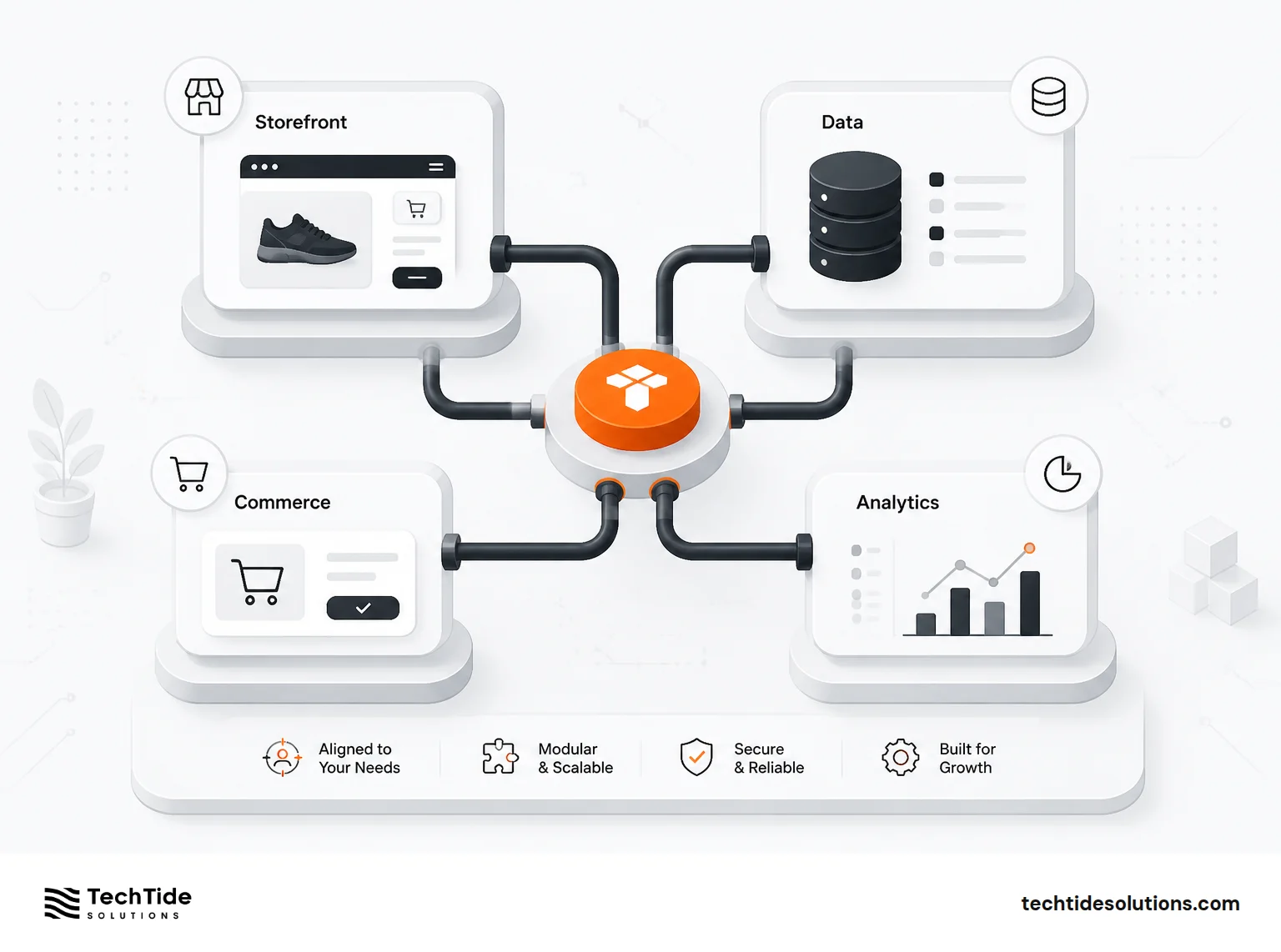
We build the ductwork that lets brand strategies breathe. Investment is flowing into this stack—global GenAI outlays alone are forecast to hit $644 billion in 2025, and retail AI software is heading toward $12.5 billion by 2027. Our job is to turn that spend into measurable value for your D2C P&L.
1. Discovery And Roadmapping Focused On Business Outcomes
We start with the scoreboard: contribution margin, return rate, inventory turns, and lifetime value. Then we map a 12–18 month roadmap where every workstream has a KPI, a data dependency, and an operational owner. For a footwear client, that meant prioritizing “size-confidence” and “ship‑from‑store” ahead of loyalty tiers—because the value pool was bigger and faster. We bring Nike-like discipline to the sequence: nail the plumbing before pouring more into the funnel.
2. Custom Applications Membership And Commerce Platforms
We deliver apps and web experiences that embed membership into every flow (NTC/NRC taught us the power of utility). Personalization modules, drop mechanics (for your version of SNKRS), and guided selling experiences are configurable. We obsess over latency, state management between web/app/store, and caching strategies so you can support “shock” events without falling over.
3. ERP And Logistics Integrations For Real-Time Operations
We’ve integrated OMS/ERP stacks through to WMS and TMS, with rules engines that arbitrate among DCs, dark stores, and retail locations. We help teams define SFS/BOPIS eligibility, split-shipment logic, and SLA promises tied to inventory health. If a “Sole Train” equivalent makes sense for your network, we quantify the threshold where dedicated capacity beats spot buys.
4. AI-Powered Personalization Demand Forecasting And Sizing Tools
Recommendation engines, demand sensing, and sizing guidance are where AI moves the needle. We build foot and body sizing via computer vision (Nike Fit-style), demand models that feed allocation rules, and real-time ranking services that respect inventory. Our rubric is practical: if the model can’t hit production SLAs, we shorten the loop and shift inference to the edge.
5. Security Compliance And Scalable Cloud Foundations
Commerce and membership data are crown jewels. Our architectures encrypt at rest/in transit, enforce least privilege, and implement privacy-by-design for consent and data retention. We also design for observability—because you can’t fix what you can’t see—and for graceful degradation under load.
Conclusion Lessons From Nike Digital Transformation
Every transformation looks clean in retrospectives and messy in motion. Statistically, about 70% of transformations fail to meet their objectives, which is why Nike’s willingness to pivot—rebalancing wholesale vs. D2C, investing end-to-end, and experimenting in virtual worlds—offers practical takeaways for any brand.
1. Reinforce Core Category Expertise While Going Digital
Digital can’t replace category craft. The biggest wins happen when product, performance narratives, and community are sharp—and digital amplifies them. Nike’s best launches tied deep sport credibility to data-backed targeting and engaging formats. Our advice: anchor on your “earned” stories first; then let algorithms find the audience efficiently.
2. Balance D2C And Wholesale To Protect Profitability And Reach
Owning the consumer relationship is gold, but strategic wholesale extends reach and smooths inventory cycles. Nike’s return to Amazon in 2025 reflects that balance. The real work is in data-sharing norms, assortment discipline, and promo coordination so channels don’t undercut each other.
3. Build Clear Governance Skills And Change Management
Organization design matters. CDO/CDA weren’t just slogans; they came with leadership changes and operating model rewires in 2020. Given that 70% of transformations falter, naming explicit accountabilities (and what is de‑scoped) is a feature, not a footnote.
4. Invest End To End From Consumer Experience To Supply Chain
Every point of friction has an upstream cause. Nike’s phygital features “Scan to Try” and “Instant Checkout” work because RFID, OMS/ERP updates, and multi-node networks speed accurate inventory and fulfillment. The Sole Train shows logistics is a weapon, not back-office, and 24-hour drayage rivals the value of ads.
5. Track Value Beyond Clicks To Safeguard Long-Term Brand Equity
Short-term digital wins (traffic spikes, promo-driven conversion) can erode brand if overused. Durable value came from membership, fit confidence, and connected inventory. These capabilities cut returns, raise full-price sell-through, and increase lifetime value. That’s where we like to put clients’ chips: moats, not moments.
If you’re planning your next D2C and data leap, where will the first 90 days show measurable impact without mortgaging your brand story? Let’s find the answer together.

