
Tourism websites don’t fail because the code is “bad”; they fail because the intent is fuzzy. At TechTide Solutions, we treat the earliest planning phase like product strategy, not like “website brainstorming.” A travel site is simultaneously a storefront, a trust machine, a customer-support surface, and—if you do it well—an operations hub that reduces manual work instead of creating more of it. As a market reality check, Statista estimates the online travel market size worldwide at 654 billion U.S. dollars in 2024, which is why the bar for experience, performance, and credibility keeps rising even for small local operators.
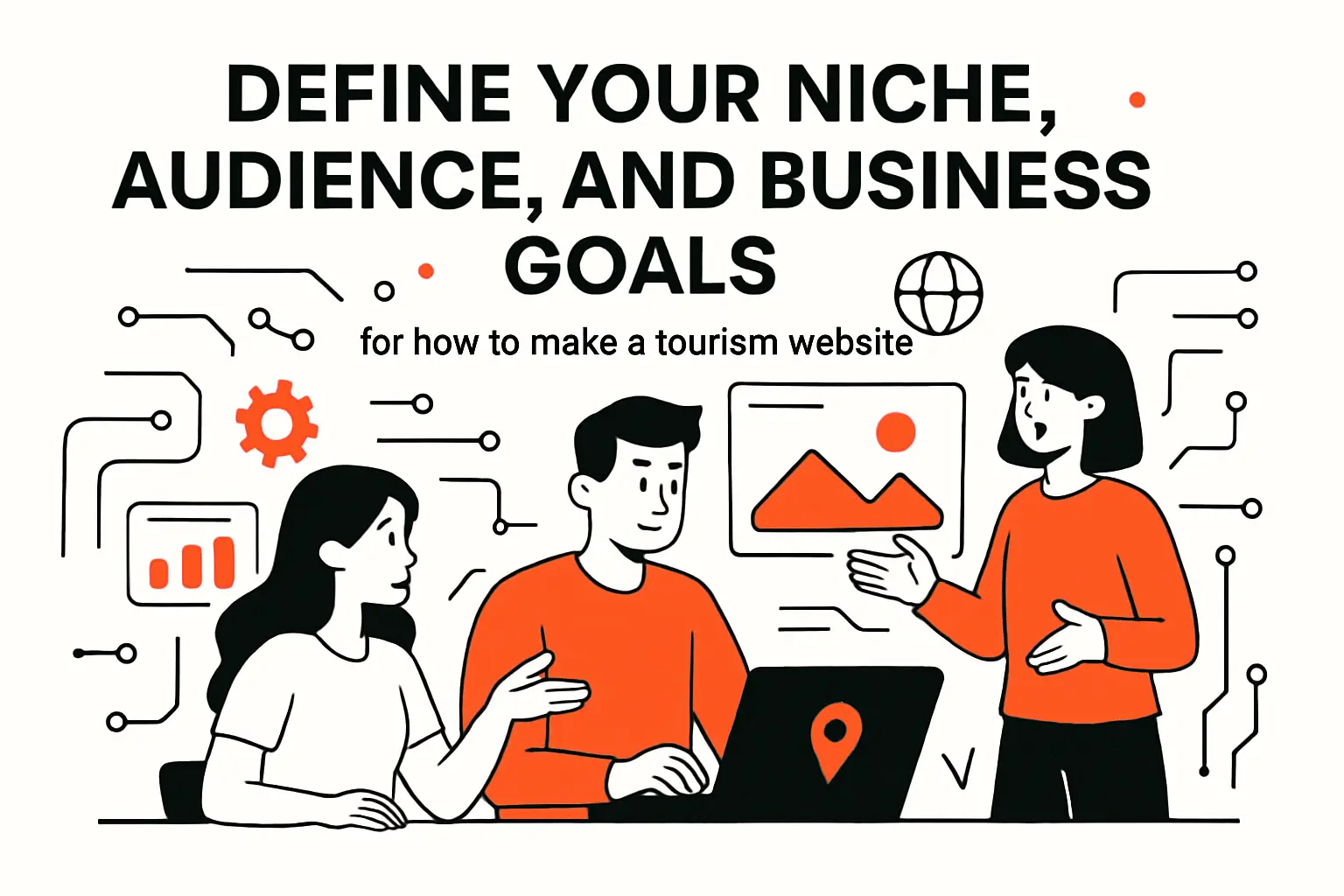
Define your niche, audience, and business goals for how to make a tourism website
1. Choose a niche and clarify your unique selling proposition
Picking a niche is not about narrowing your ambition; it’s about sharpening the promise you can actually fulfill. In practice, “tours in Italy” is a category, while “small-group truffle hunting with a chef in Piedmont” is a proposition customers can picture and pay for. From a positioning standpoint, we like to define a niche across three dimensions: audience (who), context (where/when), and outcome (what changes for them). Consider how Airbnb Experiences or GetYourGuide listings succeed: the best ones sell a transformation—mastering pasta, seeing hidden neighborhoods, learning a craft—rather than a generic itinerary. Once the promise is specific, everything downstream gets easier: photography style, booking rules, cancellation policy, and even the language your guides use on-site.
2. Research competitors, traveler expectations, and current travel trends
Competitor research should not be a gallery walk of pretty homepages; it should be a teardown of the full customer journey. Instead of asking “Who ranks on Google?”, we ask “Who wins trust at the moment of hesitation?” and “Who removes friction at the moment of payment?” Looking at OTAs like Viator and Booking.com can teach you how travelers compare options (filters, availability calendars, social proof), while looking at destination marketing sites can teach you how travelers dream (storytelling, imagery, seasonal hooks). A useful habit is capturing screenshots of critical moments—pricing disclosure, pickup details, accessibility notes, and refund terms—because that is where differentiation often hides. When patterns repeat across competitors, that is rarely coincidence; it’s usually a signal of baseline traveler expectations you must meet before you can innovate.
3. Select a business model: direct bookings, affiliate referrals, or agency commissions
Business model is architecture. Direct bookings demand strong conversion UX, robust payments, and operational workflows that handle changes; affiliate referrals demand content depth, SEO discipline, and analytics that can attribute value; agency commissions demand partner management, rate sheets, and lead qualification. For many tour operators, the most pragmatic path is a hybrid: core products sold direct, long-tail products referred to partners, and seasonal overflow routed through agencies. That blend can reduce risk while you build brand gravity. Operationally, we encourage founders to map who “owns” the customer relationship at each point, because a referral model might monetize traffic while leaving you with little control over service recovery if something goes wrong during the trip.
4. Map the visitor journey from inspiration to inquiry to booking
A tourism website is a sequence of decisions, not a set of pages. Most travelers start in inspiration mode (vague intent, high emotion), shift into evaluation mode (options, constraints), and finally enter booking mode (details, certainty). Designing for that progression means you should intentionally place “dreaming” content (visuals, stories, itineraries) upstream, and “risk-reduction” content (FAQs, policies, logistics, reviews) near the point of conversion. From a systems angle, we like to model the journey as states: anonymous visitor, returning visitor, lead, booker, confirmed traveler, and post-trip advocate. Once the states are explicit, you can align tooling—email automation, CRM tagging, review requests—so that the site does more than collect payments; it nurtures relationships.
Choose the right tourism website type, platform, and site map
Format choices are rarely neutral. A blog-centric site can dominate search and nurture trust, but it can bury conversion if booking is an afterthought; a booking-first site can convert demand, but it can struggle to generate it without content and distribution. At TechTide Solutions, we treat the “type” of tourism website as a product strategy decision tied to how you acquire customers, how you deliver service, and how quickly you need to adapt inventory.
1. Match your website format to your offering: local guides, tour operators, blogs, or booking-focused sites
Local guides often win by personality and credibility, so their websites should foreground people: guide bios, principles, and story-rich itineraries. Tour operators, on the other hand, win by reliability and scale; they need structured inventories, availability management, and consistent policies across products. Blogs are powerful when your edge is expertise (think: national park trip planning, food tourism, niche heritage routes), because content compounding can become your primary acquisition channel. Booking-focused sites are best when demand is already warm—returning travelers, referral-driven traffic, or strong social discovery—because the site’s job is to convert, not to educate. The wrong format creates a mismatch: high-intent visitors forced to hunt for availability, or early-stage dreamers pressured into booking before they understand what they are buying.
2. Decide between a one-page tourism site vs a multi-page website
One-page sites can work for a single flagship experience with a narrow audience, especially if your traffic is mostly paid or social and you need a focused narrative. Multi-page sites become essential when you have multiple destinations, multiple tour types, complex policies, or content that must be discoverable via search. From a technical perspective, multi-page also gives you cleaner information architecture: each page can target a distinct intent, and each page can become a landing page for a specific query. From a conversion standpoint, the hidden risk of one-page sites is cognitive overload—too many concepts in one scroll—while the hidden risk of multi-page sites is fragmentation—too many clicks without a clear “next action.”
3. Outline essential pages: Home, About, Destinations or Services, Contact, FAQs
We think of “essential pages” as essential questions. Home answers “What is this and why should I care?”; About answers “Who are you and why should I trust you?”; Destinations or Services answer “What can I do, and what does it cost?”; Contact answers “Can I reach you when something changes?”; FAQs answer “What are the gotchas?” For tourism, FAQs are not filler—they are a conversion lever because travel buyers anticipate uncertainty: weather, meeting points, language, accessibility, refunds, and safety. Well-structured pages also reduce support load; fewer repetitive emails means your team has more time to deliver excellent on-the-ground experiences, which is the real engine of repeat business.
4. Evaluate build options: no-code builders, WordPress setups, or custom development
No-code builders shine when speed matters and your requirements are conventional; they can be surprisingly effective for brochure sites that route bookings to an external platform. WordPress works well when content marketing is central and you want a large plugin ecosystem, though governance becomes critical to avoid a “plugin museum” that slows the site and complicates updates. Custom development makes sense when bookings, pricing rules, availability syncing, or integrations become your differentiator—especially if operations need automation beyond what plugins can safely provide. In our experience, the smartest evaluation criterion is not “How fast can we launch?” but “How expensive will change become?” because tourism businesses evolve constantly: seasons shift, suppliers change, and distribution channels come and go.
Set up the technical foundation: domain, hosting, and launch essentials
A tourism website is an operational system wearing a marketing suit. Under the surface, you need a foundation that handles traffic spikes from social posts, protects customer data, and stays stable when you add content, new tours, and integrations. The goal is not technical perfection; the goal is predictable outcomes: fast pages, reliable booking flows, and safe handling of identity and payment data.
1. Pick a memorable domain name that supports branding and search visibility
A good domain is easy to say over a phone call and hard to misspell when typed quickly. Brandability matters more than keyword stuffing, yet clarity still counts—travelers should be able to infer what you offer without squinting. From an SEO standpoint, we focus less on exact-match domains and more on consistent naming across the domain, page titles, business profiles, and citation listings. Operationally, ownership hygiene is non-negotiable: register with an account controlled by the business (not a former contractor), enable registrar security features, and document renewal and DNS access so that growth doesn’t turn into a scramble at the worst possible time.
2. Choose hosting that supports performance, scalability, and reliable uptime
Hosting is not just where files live; it is the environment that shapes speed, stability, and your ability to ship improvements safely. For content-heavy tourism sites, caching strategy and a CDN often matter as much as raw server horsepower. For booking-heavy sites, database performance and request latency become the heartbeat, especially when availability checks, pricing rules, and payment sessions must feel instant. From an engineering perspective, we prefer infrastructure that supports staged deployments and rollbacks, because tourism businesses cannot “pause bookings” while a fix is tested. When infrastructure is chosen well, marketing can run campaigns confidently and operations can trust the calendar rather than double-checking everything by hand.
3. Prepare launch essentials for search engines: XML sitemap and robots.txt
Search visibility is partly content, partly hygiene. XML sitemaps help search engines discover your pages efficiently, particularly when you have many tours, seasonal landing pages, or destination guides. Robots directives matter because staging environments and thin pages can accidentally leak into indexing, creating brand confusion and diluting relevance. In our delivery process, we treat launch readiness as a checklist with ownership: generate the sitemap automatically, verify canonical URLs, confirm that core pages are indexable, and ensure that redirects are clean when older URLs change. A disciplined launch setup prevents the common tourism problem where a rebrand or platform migration quietly erases years of earned visibility.
4. Cover security basics: SSL and protecting user and payment data
Trust is the currency of travel commerce, and security is how trust becomes rational rather than emotional. HTTPS is table stakes, yet “secure” also means safe form handling, hardened admin access, and careful data minimization—collect only what you actually need to deliver the trip. Payment security becomes simpler when you use reputable processors and tokenize card data so that your servers never store sensitive payment details. From a business-risk lens, we push clients to plan for operational security as well: staff access policies, audit logs, and incident response playbooks. Even without dramatic breaches, small lapses—like exposed admin dashboards or poorly protected booking exports—can become reputational damage that costs more than any technical fix.
Design and UX best practices for tourism websites

Tourism UX is about helping a person commit to a future self. Travelers buy anticipation, but they pay with certainty; design has to bridge that gap. At TechTide Solutions, we judge UX not by aesthetics alone but by whether a visitor can confidently answer: “What am I getting, how do I book it, and what happens if plans change?”
1. Build user-friendly navigation with clear categories and a prominent menu
Navigation should reflect how travelers think, not how your internal team is organized. Categories like “Day Tours,” “Multi-Day,” “Private,” “Family-Friendly,” or “Accessible Options” map to real decision filters, while vague labels like “Experiences” or “Offerings” often hide the path forward. On content-rich sites, we like dual navigation: inspirational categories for browsing and utility paths for action (book, contact, FAQs). From a usability standpoint, consistent menus across pages reduce the mental tax of exploring. When the menu becomes predictable, visitors spend their attention on your story and your product instead of spending it on orientation.
2. Use high-quality visuals and showcase sections to sell experiences
Tourism is one of the few industries where visuals are not decoration; they are product definition. Great photos do more than look pretty—they show group size, terrain, pace, accessibility realities, and the emotional tone of the experience. For example, a kayaking tour page should show water conditions and posture, not just sunsets, because buyers are silently asking, “Can I do this?” On the technical side, we implement responsive images and modern formats so beauty doesn’t sabotage performance. A well-built gallery also supports storytelling: progression shots, context shots, and proof shots create a narrative arc that makes the experience feel tangible.
3. Prioritize mobile responsiveness and touch-friendly interactions
Travel planning happens everywhere: in rideshares, in airport lounges, and on couches while someone watches TV in the background. Mobile-first design is less about squeezing a desktop layout into a smaller rectangle and more about rethinking the order of information. Thumb-friendly controls, readable type, and simplified forms reduce abandonment in the moments when attention is scarce. Performance is part of mobile UX, too, because slow pages create distrust; Axios reported that 53% of users abandon pages if they take more than three seconds to load, which aligns with what we observe in analytics when tourism pages are overloaded with unoptimized media.
4. Use clear calls to action that guide visitors toward booking or inquiries
Calls to action should match intent. Early-stage visitors need low-commitment options—save to favorites, sign up for updates, ask a question—while high-intent visitors need a direct booking path that feels safe. Placing CTAs is also about timing: “Check availability” becomes meaningful only after dates and meeting points are clear. From a copywriting angle, generic buttons like “Submit” miss an opportunity to reduce uncertainty; action-oriented labels like “Request a private quote” or “Reserve your spot” set expectations. In implementation, we treat CTAs as measurable hypotheses, then iterate based on user behavior rather than internal opinion.
Core features that help visitors plan and book trips
Features are not a checklist; they are a strategy for reducing friction and increasing confidence. Tourism buyers worry about logistics, legitimacy, and fit. Strong features answer those concerns with clarity, speed, and consistency, while also reducing the behind-the-scenes administrative burden that can quietly drain profitability.
1. Add search and discovery tools that help users compare options quickly
Discovery is where many tourism sites lose customers, especially when inventory grows. Filters for duration, difficulty, price range, and availability help visitors narrow choices without feeling trapped. Search matters even for small catalogs because travelers often arrive with a specific mental model: “sunrise hike,” “kid-friendly museum tour,” or “airport transfer.” On the engineering side, we pay attention to relevance ranking and typo tolerance, because travel terms vary by region and language. When discovery is done well, the website behaves like a good concierge: it listens, it narrows, and it suggests—not randomly, but with intent.
2. Implement booking workflows: integrated booking systems or third-party booking services
Booking workflows are where marketing becomes operations. Third-party booking platforms can accelerate launch, but they often introduce brand discontinuity and limit customization of rules like deposits, blackout dates, or add-ons. Integrated booking systems give you control, but they demand careful engineering around inventory, cancellations, and communication. From a product lens, we design booking as a set of decisions: choose date, choose party details, choose options, confirm policy, pay, and receive confirmation. That sequence should feel calm and inevitable, not like a maze, because the moment someone decides to book is also the moment anxiety spikes.
Integrated vs. Embedded: What We Look For
Embedded widgets are fine when you need speed, yet full integration wins when your website must behave like a unified product. In our builds, we prioritize consistent styling, fast availability checks, and resilient error handling so that users never feel punished for a minor mistake like picking the wrong date. Operational integrations—like syncing guide schedules or capacity limits—matter just as much as the payment screen, because a “successful checkout” is still a failure if it creates a double booking.
3. Set up payment processing and secure checkout options
Payments should feel boring, because boredom is trust. Travelers expect familiar methods, clear currency display, and transparent fee disclosure before the final step. A strong checkout also supports real travel realities: partial payments for high-ticket trips, deposits, gift cards, and rescheduling rules that don’t require manual intervention. From an engineering standpoint, we treat payments as an event-driven flow: authorize, capture, confirm, notify, reconcile. When that model is explicit, finance reporting becomes cleaner and customer support becomes faster, because staff can see exactly what happened without guessing.
4. Build trust with reviews, testimonials, and ratings
Tourism is experiential, so trust is social. Reviews reduce the perceived risk of buying something intangible, especially for first-time visitors who don’t know your destination or your brand. Instead of sprinkling testimonials randomly, we map them to objections: safety, punctuality, guide knowledge, language support, and value. Third-party review platforms can add credibility because they feel independent, but first-party testimonials can tell richer stories—particularly for niche trips where the “right fit” matters more than mass appeal. In our experience, the most effective trust signals are specific and situational, not generic praise.
5. Support trip planning with interactive maps, event calendars, and attraction or dining guides
Planning features turn your website into a companion rather than a brochure. Interactive maps help travelers understand meeting points, neighborhoods, terrain, and proximity to landmarks; they also reduce “Where exactly is this?” support messages. Event calendars can drive seasonal urgency without hype, especially for festivals, migrations, or weather-dependent experiences. Destination guides and dining suggestions can be a strategic wedge: even if a visitor doesn’t book today, helpful planning content invites them to return, and repeat visits are often a precursor to conversion. When we build planning tools, we also design for maintainability, because stale calendars and outdated tips erode trust faster than having no guide at all.
Content and SEO strategy that attracts travelers year-round

Tourism demand is seasonal, but traffic growth doesn’t have to be. Content and SEO are how you earn attention repeatedly without paying for every click. At TechTide Solutions, we treat content as a product: it needs a roadmap, quality control, and performance monitoring, not just occasional inspiration.
1. Publish destination guides, tour pages, itineraries, and practical travel information
Tour pages are transactional, yet guides are relational—and you need both. A strong destination guide answers practical questions (getting around, weather patterns, etiquette), while also offering narrative structure (where to stay, how to spend a day, what to skip). Itineraries are particularly effective because they package complexity into a story travelers can borrow. From a search perspective, practical content tends to capture long-tail intent, while tour pages capture commercial intent; together, they create a funnel that feels natural rather than manipulative. Done well, content also becomes staff training material: guides and operators can align on the same descriptions, meeting points, and expectations.
2. Use engaging formats such as list posts, photo galleries, and video content
Format is not superficial; it’s a cognitive tool. List posts work because they reduce planning overwhelm, photo galleries work because they communicate “vibe” fast, and short videos work because they demonstrate pace, sound, and context that images can’t convey. For tourism brands, video can also function as a trust mechanism: seeing a real guide speak calmly on camera often reassures customers more than polished copy. On the build side, we implement media with performance safeguards—lazy loading, responsive delivery, and accessibility support—so engagement doesn’t turn into a slow, frustrating page. Variety in format also helps you repurpose content for social, email, and partner sites without rewriting everything from scratch.
3. Plan keywords by traveler intent and strengthen visibility with local SEO
Keyword planning starts with intent, not with volume. Travelers search differently at different moments: “best neighborhoods” is exploratory, “private tour near me” is transactional, and “is it safe” is reassurance-seeking. Local SEO then anchors those intents to real-world signals: accurate business listings, consistent contact details, embedded maps, and location-specific pages that genuinely help. For operators who serve multiple pickup zones or nearby towns, location pages can be effective when they add real value—meeting logistics, transit tips, and realistic travel times—rather than thinly swapping city names. The goal is to become the obvious answer for a specific type of traveler in a specific place.
4. Apply technical SEO for travel websites: structured content and schema markup
Technical SEO is how you make your content legible to machines without making it less human. Structured content—clear headings, consistent sections, and predictable templates—helps search engines interpret pages and helps users scan quickly. Schema markup can add context for tours, organizations, and reviews, which may improve how your listings appear in search results. From an implementation angle, we focus on correctness and maintainability: schema should be generated from the same data model that powers your page, not copy-pasted and forgotten. When SEO is engineered into the system, launching new tours becomes less risky because every new page inherits best practices automatically.
5. Expand reach with multilingual content plus accessibility and inclusivity considerations
Multilingual content isn’t only about translation; it’s about cultural clarity and reduced friction for international visitors. Currency display, measurement conventions, and tone can all affect comprehension, even when the words are technically correct. Accessibility is equally strategic because travel planning often involves complex forms and high anxiety, and barriers can quietly exclude paying customers. W3C notes that WCAG guidance adds 9 requirements, and while we don’t treat compliance as a box-checking exercise, we do treat inclusive UX as a conversion advantage that also reduces support costs. Inclusive content also improves brand perception; travelers increasingly notice whether a company respects different bodies, abilities, and backgrounds.
Launch, promote, and maintain your tourism website
A launch is a beginning, not a finish line. Tourism sites live in a world of changing seasons, changing suppliers, and changing traveler expectations. Our approach is to launch with discipline, promote with consistency, and maintain with the same seriousness you bring to safety checks on an actual tour.
1. Run pre-launch checks: device testing, booking flow testing, and performance tests
Pre-launch is where reputations are protected. Device testing should mirror real behavior. Test thumb-based menu taps, autofill forms, app switching during checkout, and delayed booking returns. Booking flows must also cover edge cases. Include sold-out dates, discounts, reschedules, refunds, and failed payments with clean recovery paths. Performance tests should reflect expected spikes, such as influencer traffic or seasonal promotions, because travel demand can arrive in waves. When teams skip these checks, the failure mode is rarely subtle—it’s a broken checkout during your most valuable traffic window.
2. Promote with social media, email newsletters, and backlink-building tactics
Promotion works best when it matches the natural rhythm of travel planning. Social content can spark desire and reach new audiences, while email is better at nurturing people who are still deciding. Backlinks matter because they act like trust transfers. Partnerships with hotels, local blogs, tourism boards, and event sites can create durable referral traffic. Instead of chasing generic link building, we encourage clients to earn links with useful assets. Think printable maps, itinerary planners, event roundups, or accessibility guides that local partners actually want to share. Over time, that approach builds authority without relying entirely on ads.
3. Automate operations: confirmations, reminders, availability updates, and support workflows
Automation is where a tourism website pays for itself. Confirmation emails and SMS reminders reduce no-shows, while structured pre-trip messages reduce repetitive questions about meeting points and what to bring. Availability updates become crucial when you sell across multiple channels; syncing inventory prevents the nightmare of apologizing after accepting money. Support workflows—ticketing, templated replies, and internal alerts—help teams respond quickly without losing context. In our builds, we treat automation as a set of reliable triggers tied to booking events, so that staff can focus on guest experience instead of constantly copy-pasting information.
4. Keep the site fresh: ongoing content updates, plugin maintenance, and performance monitoring
Maintenance is a growth strategy disguised as housekeeping. Content freshness matters because travel information decays: restaurants close, pickup rules change, and seasonal advice becomes misleading. Plugin and dependency maintenance matters because security risks often arrive through outdated components, not through exotic attacks. Performance monitoring matters because tourism sites gain weight over time. More photos, scripts, and tracking tags slowly pile up. That creep can quietly reduce conversions. Sustainable maintenance needs clear ownership, practical checklists, and scheduled reviews. Then the site stays healthy even when the team is busy running tours.
How TechTide Solutions helps tourism businesses build custom solutions
Building a tourism website is not just assembling pages. It is designing a system where marketing, bookings, and operations reinforce each other. At TechTide Solutions, we bring a product mindset to travel. We clarify success, engineer for reliability, and iterate from real behavior instead of guesswork.
1. Requirements discovery to align your website with customer needs and booking goals
Discovery is where we earn leverage. Our team runs structured workshops to clarify tours, pricing rules, seasonality, cancellation constraints, guide staffing, and pickup zones. Rather than assuming every brand needs the same features, we map where customers hesitate and where staff time leaks. Then we turn business goals into measurable outcomes. That means fewer abandoned inquiries, faster confirmations, fewer schedule conflicts, and more trust at payment. Clear requirements also prevent a common travel tech trap. The website looks finished, but the business still runs on spreadsheets and apologetic emails.
2. Custom web app development for booking, payments, maps, and third-party integrations
Custom development becomes valuable when your workflow is your differentiation. Our engineers build booking and checkout flows around your real business rules. They integrate payments, maps, and external systems without awkward compromises. Depending on how you sell and deliver, integrations can include calendars, CRM platforms, email systems, analytics, review tools, and channel managers. The goal is simple: a smoother experience for both customers and operations. We also design data models that support growth: new tour variants, private upgrades, add-ons, multilingual content, and supplier relationships. When the web app is built as a coherent system, new products become easier to launch and easier to manage, which is how travel brands scale without losing quality.
3. Ongoing optimization and support for scalable performance, security, and long-term growth
Support is not just bug fixes; it’s a partnership with your revenue engine. Our team monitors performance, hardens security, and improves conversion paths based on analytics and user feedback. We also help clients adapt to change. That includes new distribution partners, revised policies, updated content strategy, and seasonal landing pages shaped by real demand. Over time, we turn the website into a stable platform that evolves without drama, because tourism businesses rarely stand still. Sustainable growth comes from small, consistent improvements rather than occasional redesigns that reset learning.
Conclusion: a practical roadmap for building a tourism website that converts
A tourism website is a promise made in public and fulfilled in the real world. Planning creates the foundation, UX builds confidence, booking functionality turns intent into revenue, and trust features protect your brand when a traveler hesitates. When those layers reinforce each other, the site becomes more than a brochure—it becomes an operating system for your travel business.
1. Prioritize planning, UX, booking functionality, and trust-building features
Great tourism sites feel effortless because the hard work stays hidden. Clear positioning, coherent navigation, transparent policies, and a booking flow without surprises make that possible. Then trust signals do their quiet work. They reduce anxiety at the exact moment someone considers paying for an experience not yet lived. From our perspective, the best roadmap is sequential. First, define the promise. Next, design the journey. Then engineer the booking flow. Finally, polish the proof. When the order is reversed—starting with design trends or plugin shopping—the result often looks modern but converts poorly.
2. Combine SEO and content publishing to create sustainable traffic and bookings
Content attracts; booking pages convert. SEO becomes powerful when content reflects traveler intent and rests on a technical foundation search engines can understand. Over time, guides and itineraries can make your brand the trusted local voice. Then tour pages provide a clear next step when visitors are ready to act. For most travel brands, sustainable acquisition is a portfolio: search, social, partners, and email. When you build that portfolio intentionally, seasonality becomes manageable rather than existential.
3. Launch confidently, then iterate with ongoing updates and improvements
Launching is the moment you start learning at scale. Feedback from real travelers will reveal what your team cannot see internally: confusing meeting point language, missing photos that show difficulty, or policies that feel unclear at checkout. Iteration should be continuous and calm, supported by monitoring and a maintenance rhythm that keeps performance and security from degrading. If your next step is to turn this blueprint into a scoped plan—pages, integrations, booking rules, and a launch checklist—what would you rather optimize first: conversion rate, operational time savings, or the quality of leads coming in through the site?