
At Techtide Solutions, we build software for organizations that cannot afford drama—systems that touch revenue, compliance, customer trust, and day-to-day operations. Over time, we’ve learned a humbling truth: most “software problems” are really project-management problems wearing a technical disguise. Good code cannot rescue unclear goals, shifting scope, or silent stakeholders; likewise, disciplined delivery cannot compensate for brittle engineering. Our framework below is how we keep both sides honest—business intent and technical execution—so delivery becomes repeatable rather than heroic.
1. Why software projects succeed or fail: the case for disciplined project management
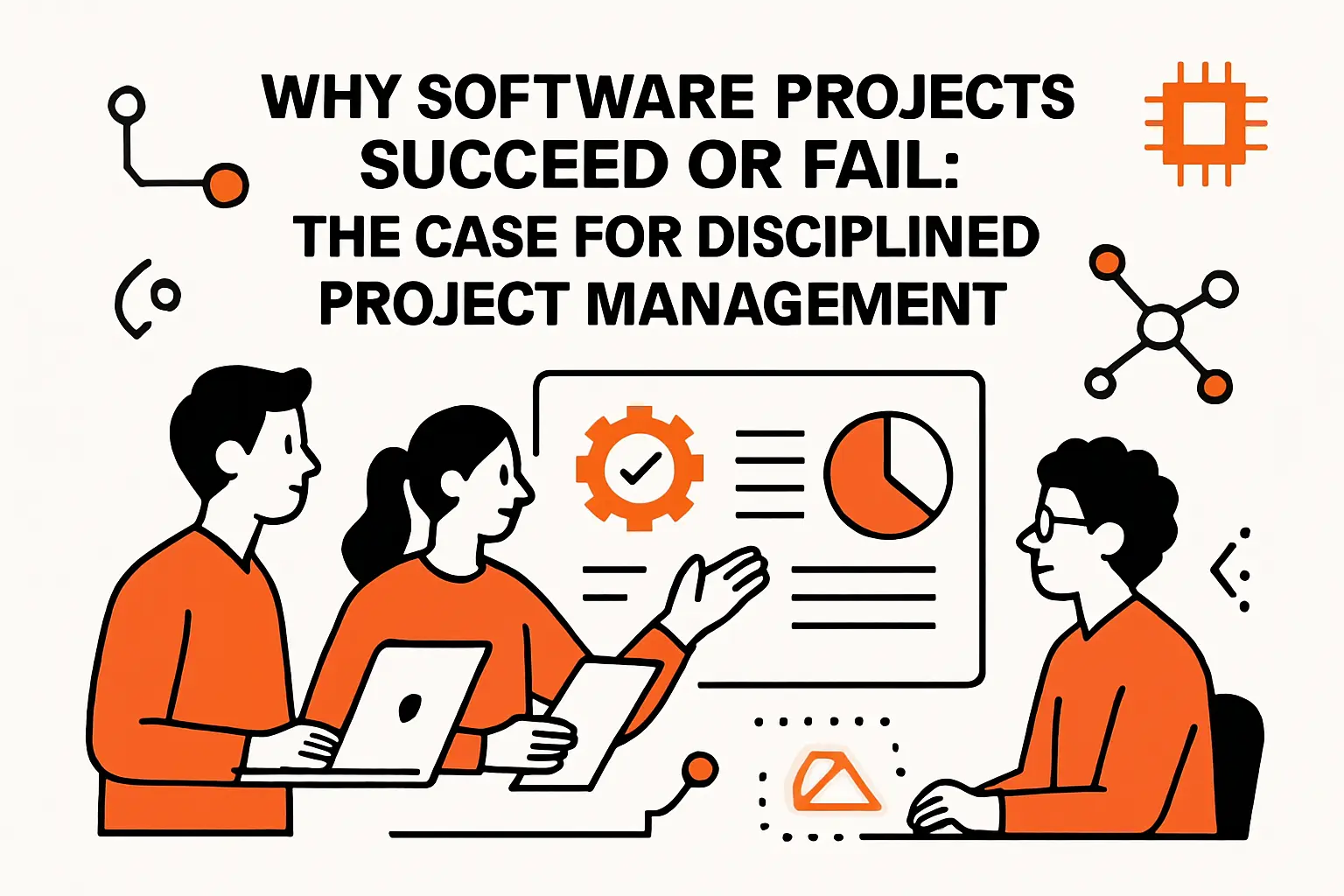
1. Common failure drivers: unclear goals, unrealistic expectations, weak communication, and limited leadership involvement
Market reality provides the backdrop: enterprise IT budgets are enormous, and scrutiny is rising because the stakes keep climbing; Gartner projects worldwide IT spending will reach $6.08 trillion in 2026, which means every avoidable failure becomes an executive-level story. Inside that pressure cooker, teams tend to fail in predictable ways. Vague goals invite rework, optimism bias turns estimates into promises, and weak communication causes “unknown unknowns” to pile up until a late-stage surprise breaks the plan.
In our delivery retrospectives, the biggest red flags rarely come from the codebase; they show up earlier as misaligned mental models. A product leader imagines a workflow tool; a finance stakeholder imagines an audit trail; an engineer imagines a service boundary; the organization never forces these visions into a single, testable definition. Without leadership involvement, that mismatch persists until the project is too expensive to change—so teams ship something that functions but disappoints. At Techtide Solutions, we treat early clarity and ongoing stakeholder contact as risk controls, not “nice-to-have” ceremonies.
Practical Signal Check
- Listen for “we’ll know it when we see it,” because that phrase usually means the team hasn’t defined acceptance criteria yet.
- Watch for timelines framed as immovable dates without a tradeoff discussion, because that often hides a scope bomb.
- Ask who owns the final call on priorities, since consensus-by-exhaustion is a slow path to failure.
- Confirm how the team will document decisions, because undocumented decisions tend to get reversed later.
2. The IT project lifecycle: initiation, planning, execution, monitoring and control, and closure
Projects succeed when the lifecycle is explicit, not improvised. Initiation is where we validate why the work matters, who benefits, and what constraints are non-negotiable; in practice, this is the stage where we insist on a business sponsor who can answer “why now?” with more than a slogan. Planning converts intent into a map: scope boundaries, delivery approach, dependency discovery, budget guardrails, and a risk-first view of what could derail outcomes.
Execution is where teams build and integrate, but monitoring and control is where they stay grounded. In mature delivery, status is not a weekly performance; it is a continuous comparison between plan and reality, with active corrections. Closure is not just a celebration—it’s a transfer of ownership, operational readiness, documentation, and a hard look at what the organization should do differently next time. Skip closure and the project may “finish,” but the business keeps paying interest—support chaos, muddy ownership, and value that arrives late (if it arrives at all).
How We Keep the Lifecycle Honest
- Define gates as learning checkpoints, not bureaucratic hurdles, so each phase forces a real decision: continue, change direction, or stop.
- Surface dependencies early, because the calendar cost of a late integration surprise is usually higher than any coding effort.
- Use closure to create a stable operating rhythm, since post-launch uncertainty is where trust erodes fastest.
3. Why IT projects need specialized management: technical complexity, integrations, and cybersecurity considerations
Software projects behave differently than many other business initiatives because the “product” is a living system, not a static deliverable. Integrations turn a simple feature into a distributed negotiation across teams, vendors, APIs, data schemas, and uptime expectations. Meanwhile, cybersecurity is not a department—it is a property of the design, the implementation, the delivery pipeline, and the operating model.
That security dimension is not theoretical: IBM’s breach research found the global average cost of a data breach reached $4.88 million in 2024, so treating security and privacy as “phase-two enhancements” is economically irrational. From our perspective, specialized project management for IT means managing technical risk like a first-class citizen: architecture decisions, data flows, third-party dependencies, and release practices must be visible in governance. Put bluntly, if the plan cannot describe how the system will be safely built and safely changed, it is not a plan yet.
2. Define scope, goals, and completion criteria: core best practices in software project management
1. Clarify objectives early with deliverables, acceptance criteria, and what the system will not do
Scope clarity is not about writing a longer requirements document; it is about creating boundaries that protect focus. In our discovery workshops, we push for concrete deliverables that can be validated, plus acceptance criteria that can be tested by people who did not write them. Just as importantly, we insist on explicit non-goals—what the system will not do—because non-goals are how teams defend the roadmap when stakeholders understandably ask for “just one more thing.”
A useful pattern is to define scope in terms of user journeys and data responsibilities. For example, “users can submit an application” is incomplete until the team agrees on identity requirements, audit expectations, validation rules, and what happens when downstream systems are unavailable. By forcing those details into acceptance criteria, we reduce ambiguity and prevent late-stage debates that destroy momentum. The goal is not rigidity; the goal is to make change a conscious choice instead of an accidental side effect.
Definition Artifacts We Rely On
- Write acceptance criteria in plain language tied to observable behavior, so business stakeholders can actually confirm intent.
- Capture non-goals as guardrails, because “not now” is often the difference between a deliverable release and an endless build.
- Record integration assumptions, since external systems rarely behave like the happy-path diagrams suggest.
2. Align stakeholder priorities with a shared definition of completion and clear success outcomes
Alignment is a design task. Different stakeholders optimize for different outcomes: sales teams want speed, operations teams want stability, finance teams want predictability, and security teams want control. Rather than pretending those objectives naturally converge, we make tradeoffs visible and negotiate a shared definition of completion that the organization can defend when pressure arrives.
In practice, that definition of completion must include more than features. A release that works in a demo but fails in production is not “done” in any meaningful business sense. Likewise, a system that meets today’s requirements but cannot be changed safely is a deferred failure. We aim for a completion definition that includes operational readiness, training needs, data migration completeness, and a realistic support posture—because that is what turns a build into a business capability.
Stakeholder Alignment That Actually Holds
- Agree on who signs off on “done,” because diffuse responsibility creates late-stage conflict.
- Specify what gets measured after launch, since outcomes that are never measured tend to be quietly abandoned.
- Normalize tradeoff language, so scope and quality are discussed as levers rather than moral judgments.
3. Set realistic goals and expectations that can be measured and revisited throughout delivery
Realism is not pessimism; it is a form of respect for everyone’s time. When timelines are fantasy, teams compensate through overtime, shortcuts, and fragile decisions that increase long-term costs. Instead, we prefer goals that can be measured and revisited: measurable performance expectations, clear adoption milestones, and defined quality thresholds that guide decisions when time pressure appears.
At Techtide Solutions, we also treat estimates as hypotheses that should improve with information. Early in a project, uncertainty is high, so estimates must include explicit assumptions. As discovery reduces ambiguity, estimates should tighten; when they do not, it is often a sign that hidden complexity remains unresolved. That feedback loop—estimate, learn, refine—keeps goals grounded while preserving flexibility.
3. Build the delivery team, roles, and governance that keep work moving
1. Define roles and responsibilities clearly using RACI to reduce confusion and handoff friction
Role clarity is one of the cheapest forms of risk reduction we know. RACI works because it forces a conversation teams often avoid: who is responsible for doing the work, who is accountable for outcomes, who must be consulted for correctness, and who should be informed to avoid surprises. Without this clarity, teams over-consult and under-decide, or worse, they decide in isolation and trigger stakeholder backlash later.
In software delivery, handoff friction is a silent killer. Requirements bounce between business analysts and engineers; security reviews arrive late; operations teams discover needs during deployment rather than during design. A practical RACI matrix makes those transitions explicit and gives teams a shared map for collaboration. When responsibilities are clear, accountability becomes easier to carry—and easier to enforce with kindness rather than conflict.
RACI Done the Useful Way
- Start with decisions, not job titles, because ownership matters most when tradeoffs must be made.
- Keep accountability singular, since shared accountability often means no accountability in practice.
- Clarify approval boundaries for security and compliance work, because late vetoes are expensive.
2. Create strong sponsor and stakeholder alignment with consistent check-ins and clear connection points
Sponsorship is the difference between a project that can make decisions and one that can only request them. We look for a sponsor who can remove organizational blockers, align priorities across departments, and defend the project’s value when competing initiatives emerge. Without that sponsor, teams may build steadily yet still fail because the organization never fully commits to adoption and change.
Consistency matters more than intensity. A predictable rhythm of check-ins creates a shared heartbeat for decision-making, risk review, and scope control. From our perspective, the check-in is not merely a status ritual; it is a governance mechanism that keeps leadership involved at the moments when their involvement can actually change outcomes. Clear connection points—who attends what, when decisions are required, and how escalations work—prevent delivery from becoming an endless Slack thread with no resolution.
3. Plan resources across people, budget, technology, and time constraints for both small and large organizations
Resource planning is not just staffing; it is capacity design. A small organization may have limited people but faster decision paths, while a large enterprise may have deep expertise alongside heavy coordination costs. Either way, delivery needs explicit planning across roles, budgets, toolchains, and time constraints—especially when key contributors split their attention across operational responsibilities.
We also plan for the hidden work: environments, access provisioning, vendor coordination, and data readiness. Those tasks rarely show up in feature lists, yet they routinely dictate schedule reality. When resource planning includes these operational dependencies, teams can create a feasible roadmap rather than a hopeful one.
4. Choose a methodology and working rhythm that fits the work

1. Select the right approach for the project type: waterfall, agile, scrum, kanban, or hybrid
Methodology is a means, not an identity. Some work benefits from sequential planning because requirements are stable and the delivery path is well understood; other work demands iteration because uncertainty is the central constraint. In our experience, most real projects land in hybrid territory: enough uncertainty to require learning cycles, plus enough dependencies and governance needs to require disciplined planning.
Rather than forcing a single method, we focus on the underlying question: what kind of risk dominates this project? If the primary risk is misunderstanding, short cycles with frequent demos expose issues early. If the primary risk is integration complexity, a plan that sequences dependencies and validates architecture early becomes essential. When teams choose a methodology based on risk, the process stops being dogma and starts being a tool.
How We Decide in Practice
- Match the method to the uncertainty level, because iteration is expensive when requirements are already settled.
- Prioritize integration sequencing when external systems dominate the risk, since late integration is the classic schedule trap.
- Use hybrid patterns to satisfy governance while keeping delivery flexible, especially in regulated environments.
2. Operationalize the cadence: kickoffs, sprint or flow rituals, and regular reviews
Cadence is where methodology becomes real. A kickoff sets shared context, but the real work happens in recurring rituals: backlog refinement, planning, demos, retrospectives, and risk reviews. Each ritual exists to answer a question that otherwise becomes fuzzy: what are we building next, why does it matter, what changed, and what do we need to adjust?
In flow-based work, the emphasis shifts toward limiting work in progress and maintaining a steady throughput. In sprint-based work, the emphasis is on timeboxed commitments and learning at sprint boundaries. Either way, we insist on regular reviews that include stakeholders, because isolated delivery teams can move fast in the wrong direction. A predictable rhythm reduces anxiety, and reduced anxiety is a surprisingly strong productivity multiplier.
3. Standardize viable processes for initiation, risk management, quality management, and ongoing improvement
Standardization is not bureaucracy when it protects focus. Teams need shared processes for initiation, risk management, quality management, and continuous improvement so that delivery does not depend on individual heroics. The goal is “viable consistency”: enough structure to keep work coherent, but not so much paperwork that teams spend more time reporting than building.
At Techtide Solutions, we standardize artifacts that accelerate alignment: lightweight charters, decision logs, risk registers, and quality gates integrated into the development workflow. Improvement then becomes measurable because teams can compare outcomes across projects using comparable signals. When a process cannot be explained as a risk reducer or a speed enabler, we treat it as a candidate for removal.
5. Communication, transparency, and documentation that prevent surprises
1. Build a communication plan that clarifies tools, channels, cadence, and stakeholder expectations
Communication plans sound formal until a project collapses under miscommunication, and then they look like common sense. A plan clarifies where decisions are made, where updates live, and which channel is authoritative. Without that clarity, teams duplicate work, stakeholders miss context, and urgent issues get buried in the wrong thread.
We also calibrate the communication style to the audience. Executives want outcome-focused narratives: risks, decisions needed, and expected impact. Delivery teams need detailed context: dependencies, acceptance criteria, and technical constraints. When a project communicates the same way to everyone, it usually communicates effectively to no one.
Communication That Reduces Friction
- Declare a single source of truth for scope and status, because competing dashboards create competing realities.
- Separate decision meetings from status meetings, since mixing them often means neither gets done well.
- Define escalation paths upfront, so risks move quickly to the people who can act on them.
2. Report status transparently and proactively to protect timelines, budgets, and stakeholder trust
Status reporting becomes valuable when it is honest about uncertainty. Teams often fear transparency because it can feel like admitting weakness, yet the opposite is true: proactive risk disclosure builds trust, and trust buys time to solve problems properly. When status reports hide issues, stakeholders discover them later through missed milestones, which is the worst possible moment to rebuild credibility.
We structure status around outcomes and constraints: what changed since the last update, what decisions are pending, and what risks threaten delivery. Clear language matters here. “On track” is meaningless without context, while “we are blocked by access provisioning” is actionable. Transparency also supports smarter tradeoffs because leaders can decide whether to adjust scope, timeline, or resourcing before the project enters crisis mode.
3. Document decisions, dependencies, and changes so teams can move faster with fewer misunderstandings
Documentation is not a pile of pages; it is a memory system. Projects move faster when teams can revisit why a decision was made without reopening the debate. Decision logs, dependency maps, and change histories prevent the same conversations from repeating, and they reduce the risk of quiet reversals that sabotage delivery.
In our experience, the most expensive misunderstandings stem from undocumented assumptions. A team assumes a vendor will support a capability; a stakeholder assumes a feature includes reporting; an engineer assumes the organization has an identity provider ready. When those assumptions are captured early, they become testable. When they are not captured, they become landmines.
6. Risk, change management, and compliance safeguards for IT delivery
1. Run collaborative risk management using risk registers and structured logs for issues and decisions
Risk management fails when it becomes a solo activity. A collaborative risk register invites engineers, product owners, security leaders, and operations teams to surface concerns early, before they harden into outages or delays. The value is not the spreadsheet; the value is the shared habit of naming uncertainty and assigning ownership for mitigation.
We also differentiate between risks, issues, and decisions. Risks are future possibilities that need mitigation plans; issues are current blockers that need resolution paths; decisions are forks that must be documented and owned. When teams lump these together, the project loses clarity. When teams separate them, escalation becomes easier and progress becomes visible.
Risk Conversations We Encourage
- Ask what would make the project fail, because that question often surfaces uncomfortable truths worth addressing early.
- Identify single points of knowledge, since “only one person knows how that works” is operational risk in disguise.
- Review external dependencies regularly, because vendor timelines and internal platform teams rarely align by accident.
2. Handle change management with a controlled process to evaluate, schedule, or reject changes
Change is inevitable; chaos is optional. Controlled change management means every request is evaluated for impact on scope, timeline, cost, and risk. That evaluation should be fast enough to keep momentum, yet rigorous enough to prevent scope creep from quietly hollowing out the plan.
At Techtide Solutions, we treat change as a backlog conversation with guardrails. Some changes are urgent because they correct misunderstanding or reduce risk; other changes are valuable but can be scheduled; some changes should be rejected because they dilute outcomes. The key is to make the decision explicit and to document it, so the organization understands the tradeoff rather than imagining the team is simply being “difficult.”
3. Address security, privacy, accessibility, and data planning early to reduce rework and delivery risk
Compliance work is easiest when it starts early. Security, privacy, accessibility, and data planning all introduce constraints that shape architecture and user experience. When teams postpone these concerns, they often rebuild features later under time pressure, which is how quality and trust erode.
Our approach is to integrate these considerations into discovery and design. Data classification influences storage choices and logging policies. Privacy expectations influence analytics and retention. Accessibility affects component selection and testing strategy. By threading these concerns into normal delivery work, teams avoid the “audit scramble” pattern where compliance becomes a frantic, last-minute retrofit.
7. Engineering practices that strengthen delivery quality and reliability
1. Quality fundamentals: automated testing, test coverage, reduced complexity, and consistent code reviews
Quality is a system of habits, not a phase. Automated testing, sensible coverage goals, complexity control, and consistent code reviews work together to reduce defect rates and increase confidence during change. When these practices are absent, teams compensate with manual verification and tribal knowledge, which scales poorly and fails under deadline pressure.
We also emphasize “design for testability” because it forces good architecture. Clear boundaries, dependency injection, and predictable data flows make systems easier to validate. Code reviews add a second set of eyes, but their deeper value is shared learning: teams converge on standards, uncover hidden assumptions, and prevent brittle patterns from spreading. A disciplined engineering culture turns project management promises into credible delivery.
Quality Practices We Consider Non-Negotiable
- Automate critical-path tests, because fragile manual testing creates fear of release.
- Review code for clarity as well as correctness, since unreadable systems become unmaintainable systems.
- Reduce complexity intentionally, because accidental complexity is the tax that never stops charging interest.
2. Safe delivery practices: small batch deploys, feature flags, CI/CD, and version control
Delivery safety is how teams release without panic. Small batch deployments reduce blast radius, feature flags allow controlled rollout, and continuous integration enforces discipline at the point where change enters the system. Version control is the backbone that enables traceability and collaboration, yet many organizations still underinvest in release engineering compared to feature work.
From a project-management lens, safe delivery practices convert uncertainty into manageable increments. Instead of betting the project on a “big bang” release, teams ship in slices, learn from real usage, and correct course quickly. That rhythm reduces stakeholder anxiety because progress is visible and risk is distributed. In business terms, safe delivery practices protect revenue by reducing downtime risk and shortening feedback loops.
3. Operational readiness: software ownership, observability, and support for critical business applications
Operational readiness is where many otherwise-successful projects stumble. A system can be feature-complete and still fail the business if no one owns it, if monitoring is weak, or if support processes are unclear. Observability—useful logs, actionable metrics, and traceable requests—turns outages into solvable problems rather than mysteries.
Ownership is equally important. A product team that ships and disappears creates operational debt for the organization. We prefer clear ownership models, runbooks that match reality, and support pathways that include both technical and business stakeholders. When operational readiness is planned from the start, launch becomes a controlled transition instead of a cliff.
8. TechTide Solutions: custom solutions tailored to customer needs
1. From discovery to delivery: translating goals and constraints into practical software roadmaps
At Techtide Solutions, we treat discovery as a risk-reduction investment, not an abstract exercise. The work begins by translating business goals into system responsibilities: what data must exist, what workflows must be supported, and what operational constraints must hold. From there, we map dependencies, identify the thorniest unknowns, and design a roadmap that front-loads learning before heavy build commitments.
Roadmaps fail when they are just timelines. A practical roadmap includes decision points, integration milestones, and explicit assumptions that can be validated. It also includes options: paths the organization can take if priorities shift or constraints change. By making those options visible, leadership can steer delivery without destabilizing the team.
Discovery Outputs We Aim to Deliver
- Clarified outcomes and non-goals, so stakeholders know what success means and what is out of scope.
- Architecture direction tied to constraints, so technical decisions serve business needs rather than personal preferences.
- Risk-driven sequencing, so the hardest questions are answered early instead of becoming late-stage emergencies.
2. Building custom web apps, mobile experiences, and software systems with scalable architectures and clean SDLC workflows
Custom software is rarely about novelty; it is about fit. Organizations come to us when off-the-shelf tools cannot match their workflows, compliance obligations, or integration landscape. Our build approach emphasizes scalable architecture patterns, clean SDLC workflows, and an engineering discipline that supports change—because change is the only constant once a system becomes valuable.
Across web apps, mobile experiences, and internal platforms, we focus on clarity of boundaries. Data contracts, service responsibilities, and integration patterns get defined early so teams can build independently without constant friction. Meanwhile, the SDLC workflow—branching strategy, review process, test automation, and release pipeline—gets designed to protect both speed and stability. That combination is how teams ship confidently while keeping long-term costs under control.
3. Continuous improvement after launch: KPIs, iteration cycles, maintenance, and long-term product optimization
Launch is not the finish line; it is the start of learning at full fidelity. After release, we help clients define KPIs that reflect business outcomes rather than vanity metrics. Iteration cycles then become a disciplined loop: observe real usage, prioritize improvements, deliver changes safely, and measure again.
Maintenance is where organizations either protect their investment or slowly lose it. Predictable patching, dependency management, and security hygiene keep systems healthy. Optimization work—performance tuning, workflow refinement, usability improvements, and operational automation—extends product life and reduces support burden. When continuous improvement is planned as part of governance, the software stays aligned with the business as the business evolves.
9. Conclusion: applying best practices in software project management for repeatable success
1. Start with clarity: scope, objectives, roles, and a methodology that fits the work
Clarity is the foundation that keeps delivery from drifting. A project with explicit scope boundaries, crisp objectives, clear roles, and a method chosen for the project’s dominant risks is far more likely to reach a meaningful outcome. In our view, the best plans are not rigid; they are testable. When assumptions are visible, teams can adapt without losing coherence.
2. Make transparency the default: proactive status reporting, documentation, and measurable KPIs
Transparency is the antidote to surprise. Proactive status reporting, lightweight documentation, and outcome-oriented KPIs allow teams and leaders to steer continuously instead of reacting late. Trust grows when risks are surfaced early and decisions are recorded clearly. Over time, that trust becomes a strategic advantage because delivery stops being a gamble and starts being a capability.
3. Close the loop: post-project reviews, lessons learned, and continuous improvement practices
Improvement requires closure with intent. Post-project reviews should not be blame sessions; they should be learning sessions that identify root causes, process gaps, and engineering constraints that shaped outcomes. Continuous improvement then becomes practical: adjust templates, strengthen quality gates, refine governance, and train teams on what actually mattered.
So here’s our challenge question at Techtide Solutions: if your next software project had to be delivered without heroics—no overtime marathons, no last-minute scope miracles—what would you change in your project management and engineering practices before you start?