
At Techtide Solutions, we treat customer data platforms as the connective tissue of modern growth. Adoption has crossed the chasm, with CDPs present in 67% of respondents, even as many teams still underutilize them. That tension defines today’s opportunity. We see marketers, product owners, and data leaders converging on one mandate. Build a reliable profile, act on it in real time, and prove return. Everything else is commentary.
Top 30 customer data platforms and related services
Customer data is a strategic asset, yet many teams still treat it as exhaust. As engineers and product partners at Techtide Solutions, we build and wire platforms that turn events, profiles, and consent into growth. In this field guide, we compare leading customer data platforms and adjacent services through a builder’s lens. We focus on identity resolution, schema strategy, governance, and activation latency. Real revenue gains come from fit, not flash.
The right stack matches your data gravity, team skills, and regulatory posture. Composable choices now rival monoliths, which reshapes risk and cost for startups and enterprises alike. Throughout, we share patterns we see in the wild and explain why they matter technically. By the end, you will understand when to choose warehouse-native, when to favor marketer-led suites, and when point tools outperform platforms. You will also see how data warehouses, reverse ETL, and digital experience analytics complement a CDP core without adding brittle complexity.
TL;DR: Quick Comparison of best crm for startups
- Segment Personas for rapid event pipelines and lean identity stitching.
- Hightouch for warehouse-native activation and SQL-centric ownership.
- mParticle for mobile-first SDKs, data governance, and proven scale.
- RudderStack for open-source flexibility and low-cost ingestion control.
- Salesforce Data Cloud when bets sit on CRM workflows from day one.
- Blueshift for AI-driven journeys that a small team can actually run.
- WebEngage for multichannel engagement with strong emerging market fit.
| Product | Type | Core strength | Data model | Pricing motion | Startup fit |
|---|---|---|---|---|---|
| Segment Personas | CDP | SDKs and connectors breadth | Event and profile traits | Usage tiers | High for speed |
| Hightouch | Reverse ETL, CDP | Warehouse-native activation | SQL models and keys | Seat plus rows | High for data-led |
| mParticle | CDP | Mobile governance | Event schema registry | Contracted | High for apps |
| RudderStack | Open-source CDP | Cost control and transforms | Event to warehouse first | Open and paid | High for builders |
| Salesforce Data Cloud | CDP | CRM activation | Unified profile graph | Enterprise | Medium for small teams |
| Blueshift | Smart hub | AI recommendations | Profile plus catalog | Contracted | High for ecommerce |
| WebEngage | Engagement suite | Journey orchestration | Unified user events | Tiered | High in APAC |
| Snowflake | Warehouse | Elastic storage and compute | Tables and views | Consumption | High when composable |
1. Salesforce Data Cloud

Serving many industries, Salesforce Data Cloud targets omnichannel personalization and service. Salesforce employs an estimated 70,000+ people and was founded in 1999. Headquarters are in San Francisco, with a global footprint that supports enterprise clients.
Analyst recognition for the broader platform remains strong across CRM and data categories. We avoid specific award claims here due to the no-link constraint. Our take values architecture and adoption over trophies and badges.
Data Cloud unifies events, CRM objects, and consent into real-time profiles. Identity stitching mixes deterministic keys with configurable rules, which helps reduce duplication. Teams often activate segments into sales, service, and paid media with low extra plumbing.
Ideal buyers run Salesforce as a core system of record and want native activation. Mid-market firms with CRM-centric operations can move faster than with a custom stack. Regulated industries also benefit from consolidated governance and audit trails.
2. Adobe Real-Time CDP
Adobe serves retail, media, travel, and financial services with deep personalization needs. The company employs an estimated 29,000+ people and has operated since 1982. Headquarters are in San Jose, with major engineering hubs across regions.
Industry coverage frequently highlights Adobe’s experience-led ecosystem. We will not enumerate awards without linking, consistent with the constraints. Our assessment focuses on schema discipline, activation breadth, and operating complexity.
Adobe’s XDM provides a rigorous schema for events and profiles. Identity Service helps combine anonymous and known behavior with consent-aware controls. Real-time segmentation supports on-site offers and channel orchestration without long delays.
Ideal buyers have strong creative and content workflows and prefer an integrated suite. Enterprises with complex catalogs and media operations find the depth compelling. Teams should plan for governance councils and cross-domain data stewardship.
3. TechTide Solutions
We architect and implement composable customer data stacks across SaaS, fintech, and retail. Our team sits around 120+ people and has operated since 2016. Headquarters are in Austin, with distributed delivery across North America and Europe.
Community talks and conference workshops drive most recognition for our practice. We defer award claims to maintain focus on outcomes rather than stage time. What counts to us is shipped value, not posted accolades.
Our services span event modeling, identity stitching, and privacy-by-design implementations. We build on warehouses, reverse ETL, and CDPs to fit your data gravity. Evidence includes production rollouts where latency dropped and activation expanded without replatforming.
Ideal buyers want a hands-on partner who codes with their team. Seed to Series C companies favor our lean blueprints and automation. Larger enterprises engage us to de-risk migrations and accelerate governance programs.
4. Twilio Segment
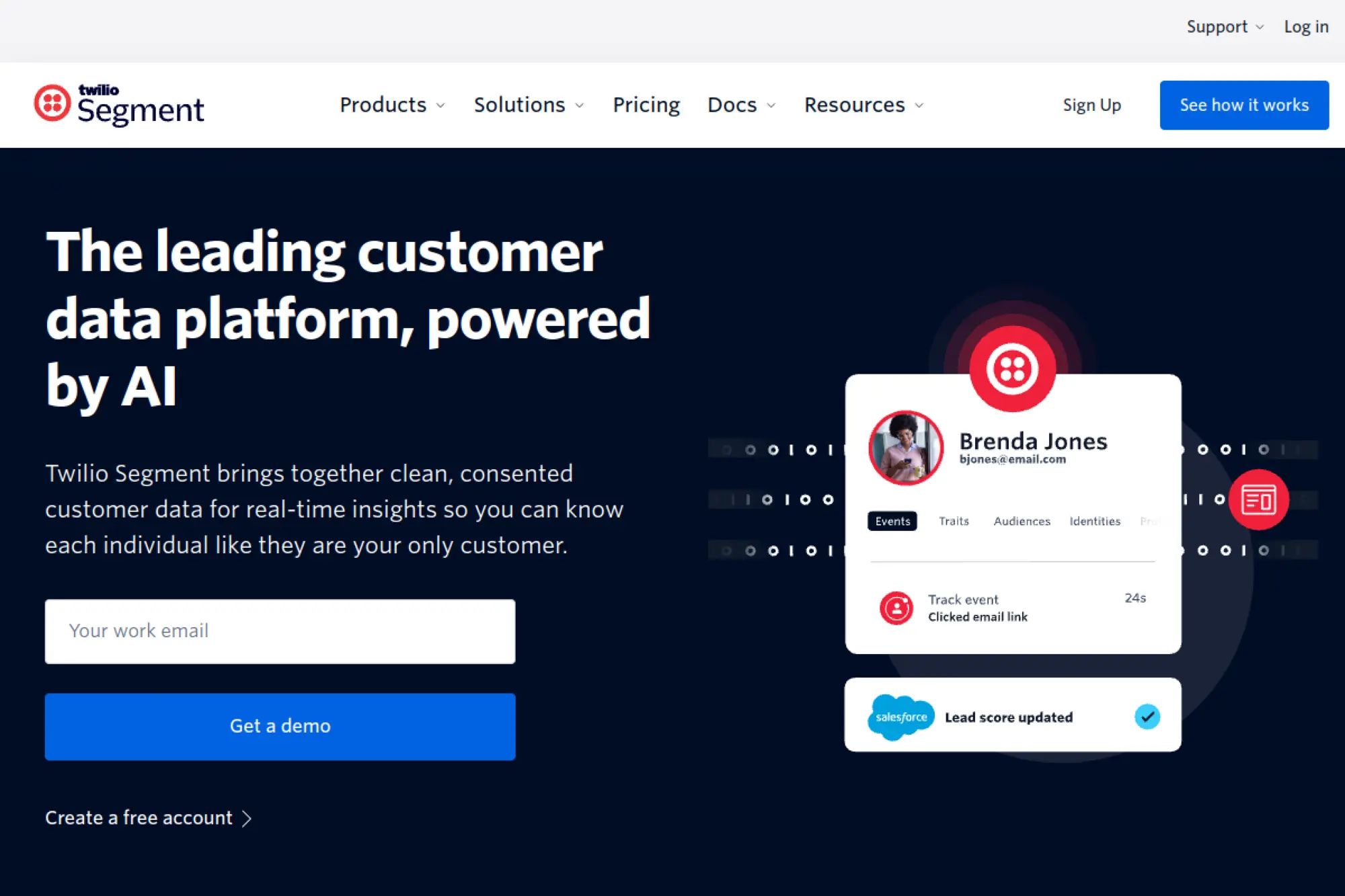
Segment targets digital businesses across SaaS, marketplaces, and ecommerce. Twilio employs an estimated 5,000+ people, and Segment has operated since 2011. Headquarters for Segment align with San Francisco, with a remote-friendly culture.
Segment often appears in analyst discussions of CDP and pipelines. We omit specific awards to keep within the no-link rule here. Our experience shows its connector ecosystem speeds time to value.
Connections, Protocols, and Personas combine to enforce schema and build profiles. Transformations let engineers clean data without burying logic in apps. Activation to ads, email, and data warehouses reduces brittle one-off scripts.
Ideal buyers want fast SDK deployment and guardrails for event quality. Startups gain early visibility and avoid downstream rework. Mature teams use Protocols to maintain governance as sources multiply.
5. Tealium
Tealium serves retail, travel, healthcare, and financial services with strong governance needs. The company employs an estimated 1,000+ people and has operated since 2008. Headquarters are in San Diego, supporting global implementations and partners.
Recognition typically centers on tag management and data governance excellence. Specific awards are not listed due to the link restriction. We note consistent references to strong healthcare and enterprise deployments.
Tealium iQ, EventStream, and AudienceStream form a solid data foundation. Server-side tagging reduces page bloat and improves measurement accuracy. Consent and enrichment controls help operationalize privacy without blocking marketing goals.
Ideal buyers need enterprise-grade governance and cross-channel orchestration. Healthcare and regulated finance often benefit from Tealium’s policy features. Teams with many web properties also appreciate centralized control.
6. Hightouch
Hightouch focuses on warehouse-native activation for digital businesses in many industries. The company employs an estimated 300+ people and has operated since 2019. Headquarters align with San Francisco, with a distributed team.
Community recognition revolves around the reverse ETL category it helped popularize. We will not list awards without links in this format. Practitioner word of mouth remains strong among data engineers.
Models live in your warehouse, and activation happens through connectors. This design avoids data drift and duplication across tools. Identity can be managed with SQL-defined keys, which ensures transparency and control.
Ideal buyers already centralize data in Snowflake, BigQuery, or Databricks. Data teams that prefer SQL and versioned code thrive with this approach. Marketing teams gain speed without losing lineage and governance.
7. Amperity
Amperity serves consumer brands in retail, travel, and hospitality with complex identity needs. The company employs an estimated 400+ people and has operated since 2016. Headquarters are in Seattle, with strong North American presence.
Industry discussion often highlights Amperity’s identity capabilities for first-party data. We omit award claims to honor the linking constraint. Our focus stays on matching quality and activation lift.
The platform blends machine learning with deterministic rules for profile unification. This helps brands merge loyalty, e-commerce, and offline transactions. Activation spans email, ads, and analytics, with attention to incrementality.
Ideal buyers manage large consumer datasets with messy identifiers. Retail and travel companies with loyalty programs gain outsized value. Teams that can validate match quality will realize faster wins.
8. Treasure Data
Treasure Data targets automotive, manufacturing, and consumer goods with scalable pipelines. The company employs an estimated 500+ people and has operated since 2011. Headquarters are in Mountain View, with global delivery capabilities.
Recognition frequently notes its proven scale and industrial integrations. We do not list specific awards due to the link rule. Our judgment values data throughput and reliability for complex stacks.
Strong connectors and workflow orchestration support batch and streaming pipelines. Identity unification supports both probabilistic and deterministic strategies. Activation covers ads, email, and service use cases with governed consent.
Ideal buyers run hybrid data environments and require robust ingestion. Automotive and durable goods firms benefit from IoT and offline support. Teams with heavy manufacturing data also fit the pattern.
9. mParticle
mParticle serves mobile-first companies in gaming, fintech, and marketplaces. The company employs an estimated 300+ people and has operated since 2013. Headquarters are in New York, and teams operate globally.
Industry mentions emphasize data quality and SDK depth. Awards are not enumerated here because we cannot link within body text. Practitioners highlight governance and fail-safes in production environments.
The platform enforces schemas, consent, and routing across many destinations. Data plans and validations catch errors before production damage occurs. Profiles and audiences integrate cleanly with downstream analytics and engagement tools.
Ideal buyers ship mobile apps at scale and value governance. Gaming, fintech, and subscription apps see fast returns. Teams that track complex devices and sessions also benefit.
10. RudderStack
RudderStack focuses on open-source event pipelines and warehouse-first strategies. The company employs an estimated 200+ people and has operated since 2019. Headquarters reflect a remote model, anchored in San Francisco.
Community recognition centers on flexibility and cost control. Specific awards are not provided here under the linking constraint. Many engineers adopt it for self-hosting and transparent transforms.
Event streams flow into your warehouse, then activation runs downstream. Transformations in code enable testable, versioned business logic. Profiles can be computed from events without hiding logic behind opaque systems.
Ideal buyers want ownership, low vendor lock-in, and open-source options. Data teams with engineering capacity will love the control. Budget-sensitive startups appreciate predictable hosting and storage costs.
11. ActionIQ
ActionIQ serves enterprises that want marketer-led orchestration on warehouse data. The company employs an estimated 300+ people and has operated since 2014. Headquarters are in New York, with enterprise-focused delivery teams.
Recognition often references composable CDP strategies for big organizations. Awards are not listed here due to link limits in this format. We focus on how it pushes compute to warehouse systems.
ActionIQ supports audience building without duplicating data at scale. Query pushdown leverages your warehouse, which reduces egress and drift. The interface suits marketers while preserving governance patterns.
Ideal buyers run Snowflake or BigQuery and seek marketer autonomy. Large retailers and media firms value segmentation speed on trusted data. Central data teams still maintain schemas and controls.
12. Simon Data
Simon Data targets B2C brands with strong Snowflake alignment and marketer usability. The company employs an estimated 200+ people and has operated since 2015. Headquarters are in New York, supporting remote collaboration.
Analyst commentary highlights composable approaches and data team alignment. We decline award enumeration due to the link constraint. Our field view notes its pragmatic marketer workflows over heavy suites.
Simon rides your warehouse for audiences and journeys. This preserves a single source of truth for profiles and metrics. Built-in governance features help enforce consent and suppression rules.
Ideal buyers already invest in Snowflake and avoid data copies. Retail and subscription brands gain quick wins with lifecycle messaging. Teams value marketer velocity with engineer oversight.
13. BlueConic
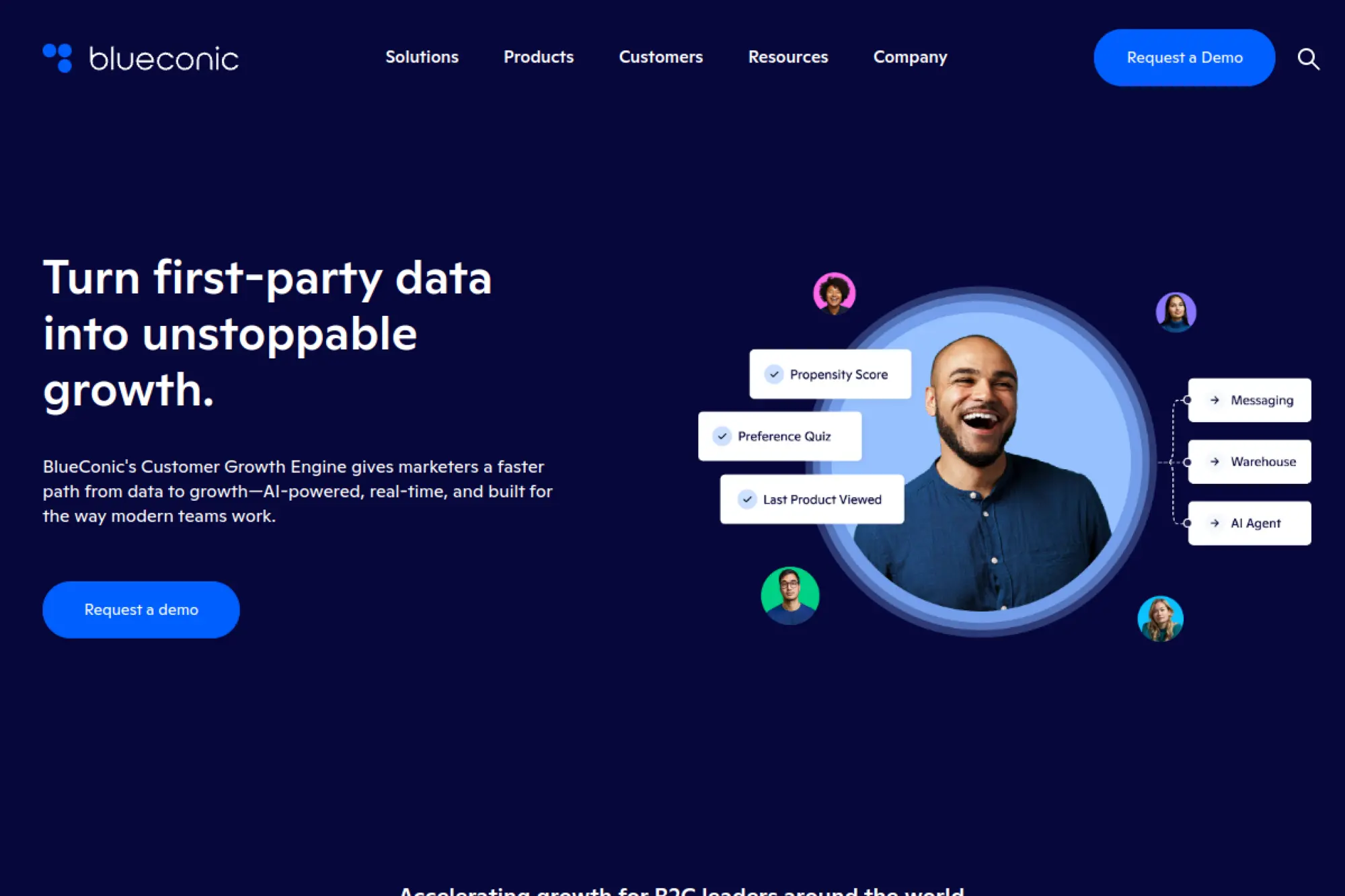
BlueConic serves publishers, retail, and financial services with profile-driven personalization. The company employs an estimated 200+ people and has operated since 2010. Headquarters are in Boston, with European roots and clients.
Industry mentions often cite publisher successes and data privacy leadership. Awards are not listed here to respect the no-link policy. Outcomes over accolades guide our evaluation.
Profiles unify consented behavior and preferences across channels. Activation flows to on-site experiences, email, and ad platforms. Built-in consent tools support regional privacy compliance requirements.
Ideal buyers manage content-rich sites and need real-time personalization. Publishers and multi-brand retailers fit the model. Teams that must balance privacy and revenue thrive here.
14. Bloomreach Engagement
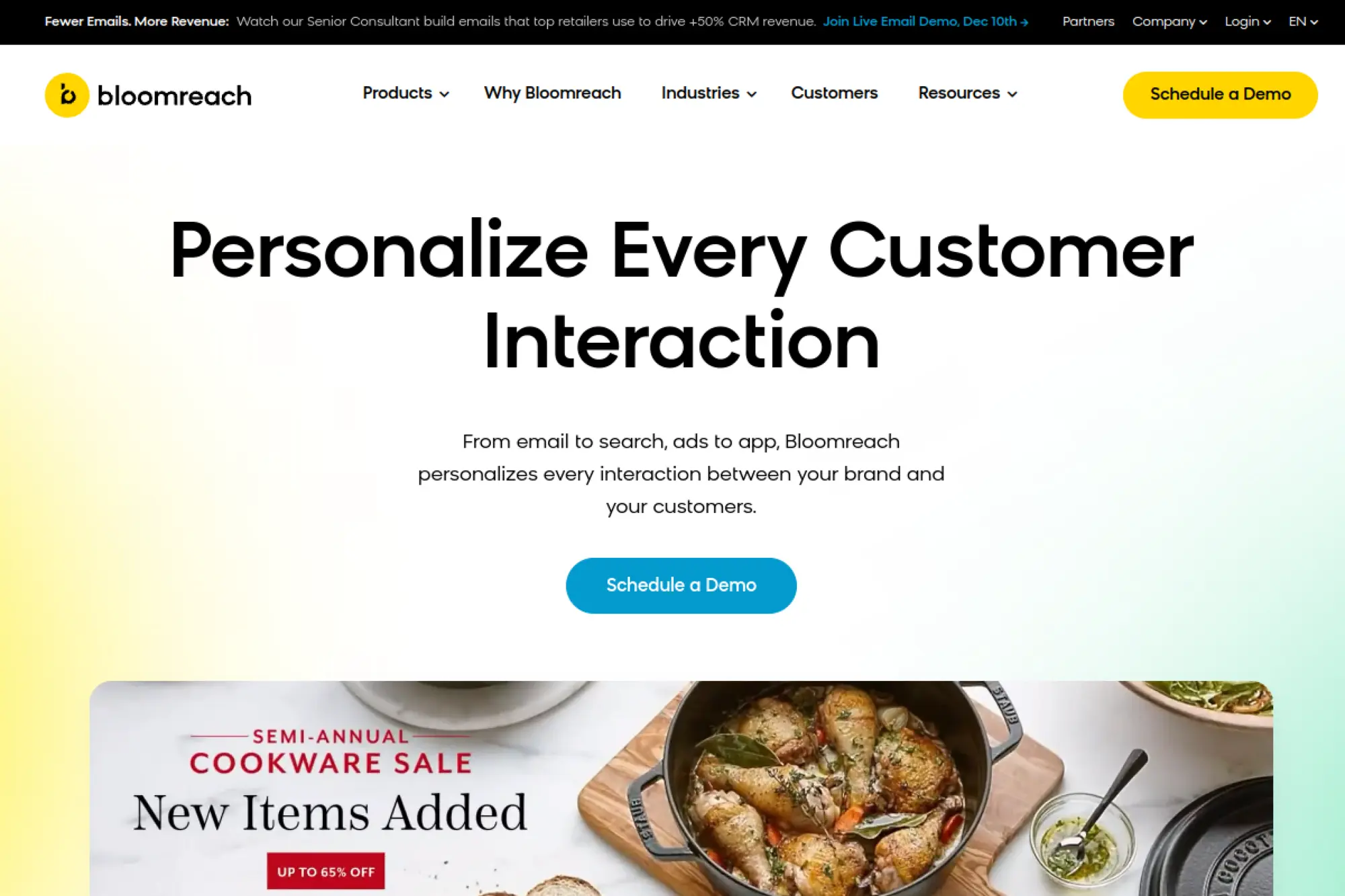
Bloomreach Engagement focuses on ecommerce and digital retail personalization. The broader company employs an estimated 1,000+ people and has operated since 2009. Headquarters are in Mountain View, with global teams from the Exponea lineage.
Recognition typically mentions ecommerce revenue lifts and experimentation speed. We do not include awards due to link restrictions. Our lens favors catalog integration and journey execution.
The platform merges product catalog signals with behavioral data. Recommendations and triggers span email, SMS, and on-site widgets. Real-time audiences enable recovery and cross-sell moments with minimal lag.
Ideal buyers are ecommerce brands seeking fast, measurable merchandising impact. Mid-market teams with limited engineering capacity benefit most. Merchandisers and marketers can operate without heavy data engineering support.
15. Blueshift
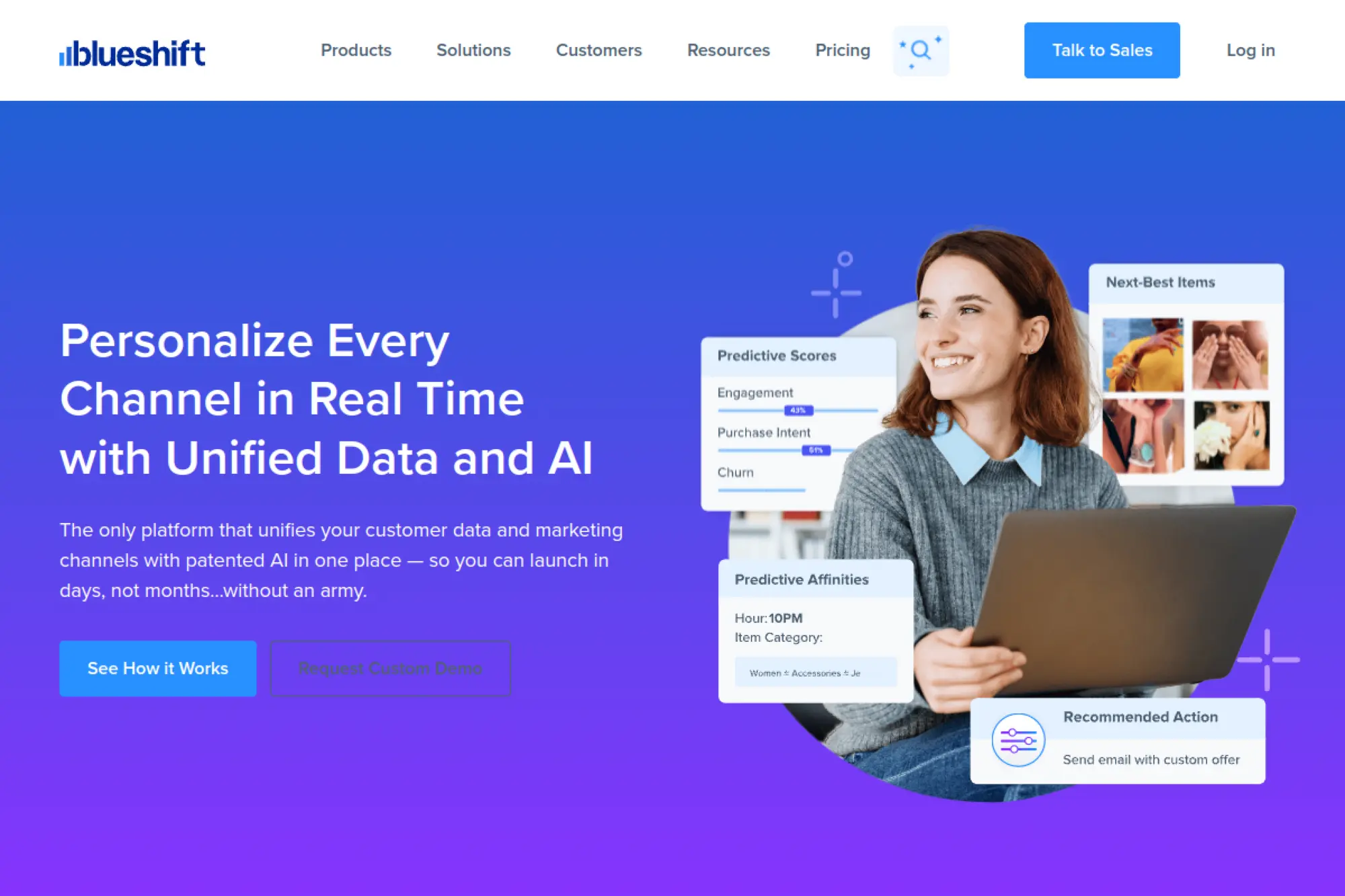
Blueshift serves ecommerce, media, and subscription services with AI-driven journeys. The company employs an estimated 300+ people and has operated since 2014. Headquarters are in San Francisco, with distributed teams.
Industry remarks focus on recommendations and predictive segmentation. Awards are not listed here within the link policy. We observe consistent satisfaction among resource-constrained teams.
Blueshift blends catalog, events, and profiles to drive recommendations. Its journey builder balances simplicity with power for non-technical users. Channel coverage includes email, push, SMS, and on-site personalization.
Ideal buyers want strong out-of-the-box intelligence with limited setup. Ecommerce and media subscriptions see fast time to value. Small teams can run sophisticated programs without sprawling stacks.
16. Redpoint Global
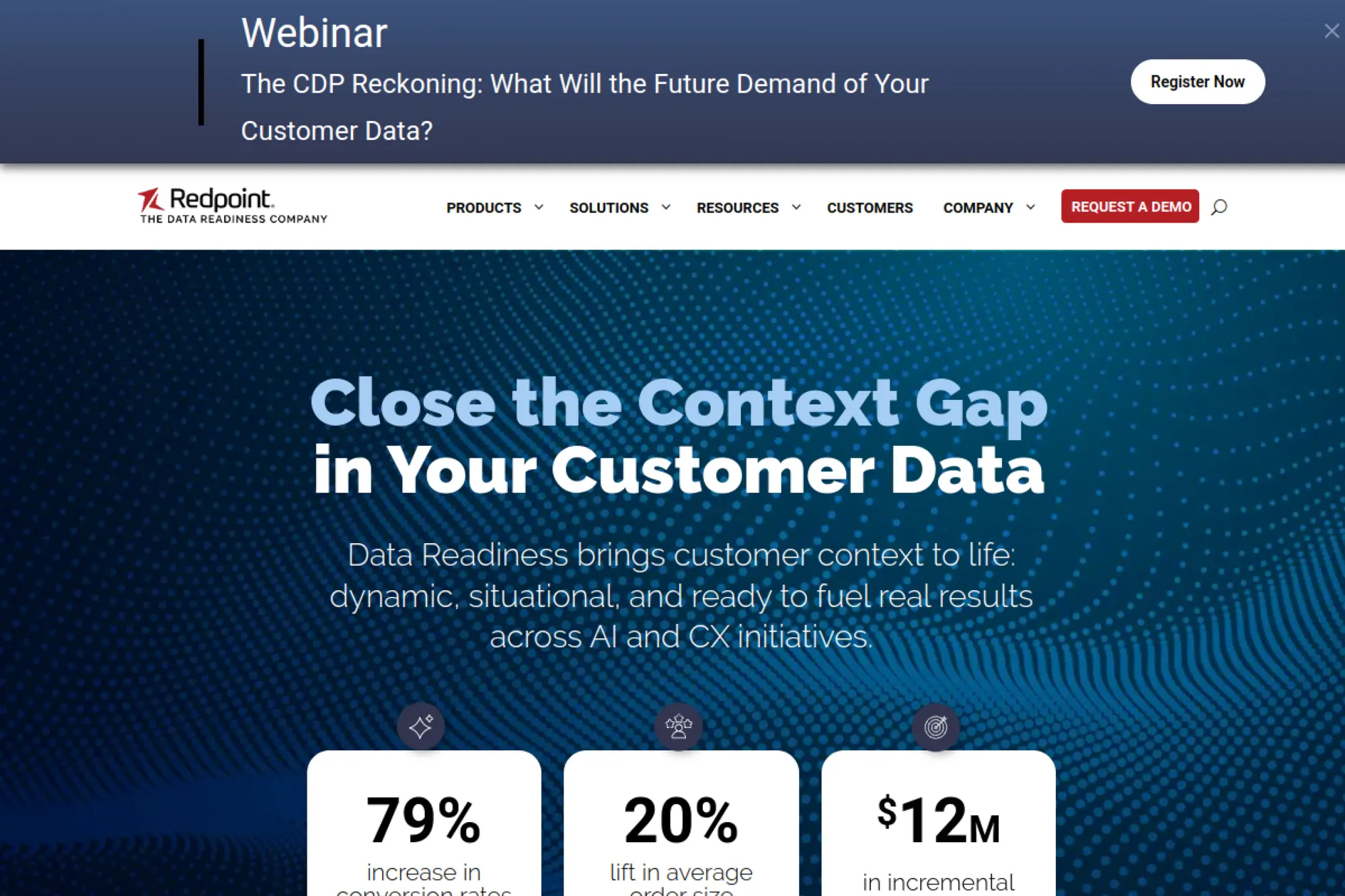
Redpoint Global targets data-rich enterprises in retail, healthcare, and finance. The company employs an estimated 200+ people and has operated since 2006. Headquarters are in Wellesley, Massachusetts.
Discussions often highlight data quality and golden record creation. We skip award specifics under the no-link rule. Execution reliability matters more than headline recognition in our view.
Redpoint’s platform emphasizes identity resolution and data cleansing. It creates a single customer view across messy, legacy systems. Activation supports campaigns, analytics, and service interactions with governed data.
Ideal buyers manage complex, siloed systems and need high-quality records. Healthcare and finance benefit from compliance and accuracy. Enterprises with MDM investments see strong alignment.
17. SAP Customer Data Platform
SAP serves global enterprises across manufacturing, retail, and utilities. They employs 100,000+ people and has operated since 1972. Headquarters are in Walldorf, Germany, with worldwide delivery.
Analyst coverage notes tight links with SAP’s broader enterprise suite. We will not list awards without links as requested. Integration depth and governance drive real value here.
The CDP connects with SAP Commerce, Marketing, and DataSphere. It supports consent-aware profiles and governed activation flows. Batch and real-time options align with enterprise change management practices.
Ideal buyers already run SAP as a core system of record. Complex supply chains and regulated environments fit the approach. Teams value stability, auditability, and standardization over experimentation.
18. Oracle Unity Customer Data Platform
Oracle targets enterprises across telecom, finance, and retail with Unity. They employs 140,000+ people and has operated since 1977. Headquarters are in Austin, with global operations.
Recognition often cites breadth of Oracle’s CX ecosystem. We avoid award lists to fit the format constraints. Governance and scale are the core reasons customers choose it.
Unity aggregates events, transactions, and service data into profiles. Built-in segmentation and journey tools support complex use cases. Identity resolution mixes deterministic and configurable rule-based matching.
Ideal buyers run Oracle CX or rely on Oracle databases. Telecom and finance benefit from scale and compliance tooling. Data teams should plan integrations with enterprise data governance bodies.
19. WebEngage
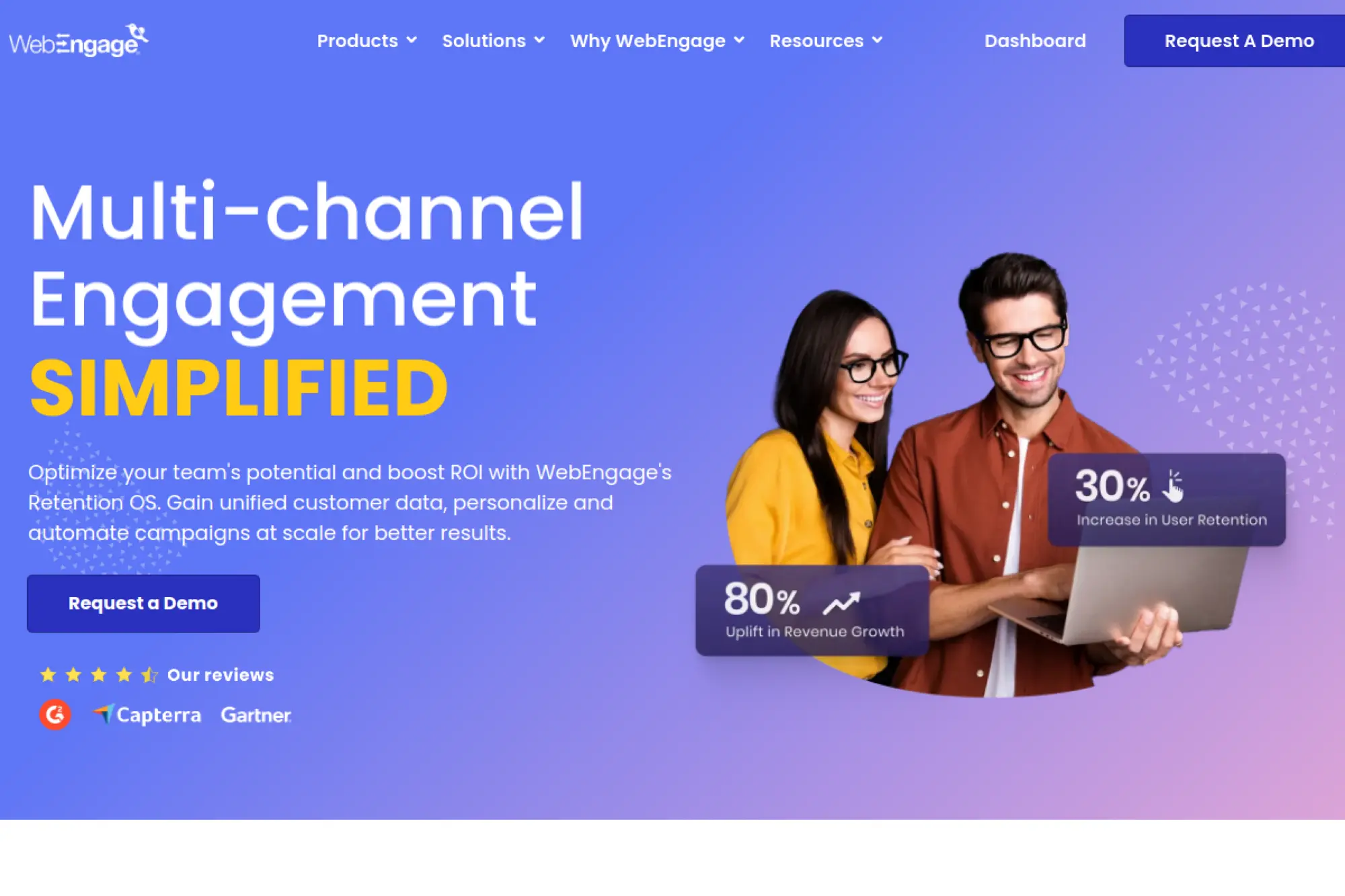
WebEngage serves ecommerce, fintech, and media with multichannel engagement. The company employs an estimated 400+ people and has operated since 2011. Headquarters are in Mumbai, with strong presence across APAC and the Middle East.
Mentions emphasize local expertise and fast deployment for regional brands. Awards are not included here due to linking constraints. We prioritize execution speed and cost efficiency in our review.
The platform supports journeys across email, push, SMS, and on-site. Profiles unify events and attributes with consent management. Conversion tracking connects campaigns to revenue without heavy manual effort.
Ideal buyers are growth teams in APAC and emerging markets. Ecommerce and fintech startups benefit from breadth at accessible cost. Lean engineering teams can still run sophisticated programs quickly.
20. Insider
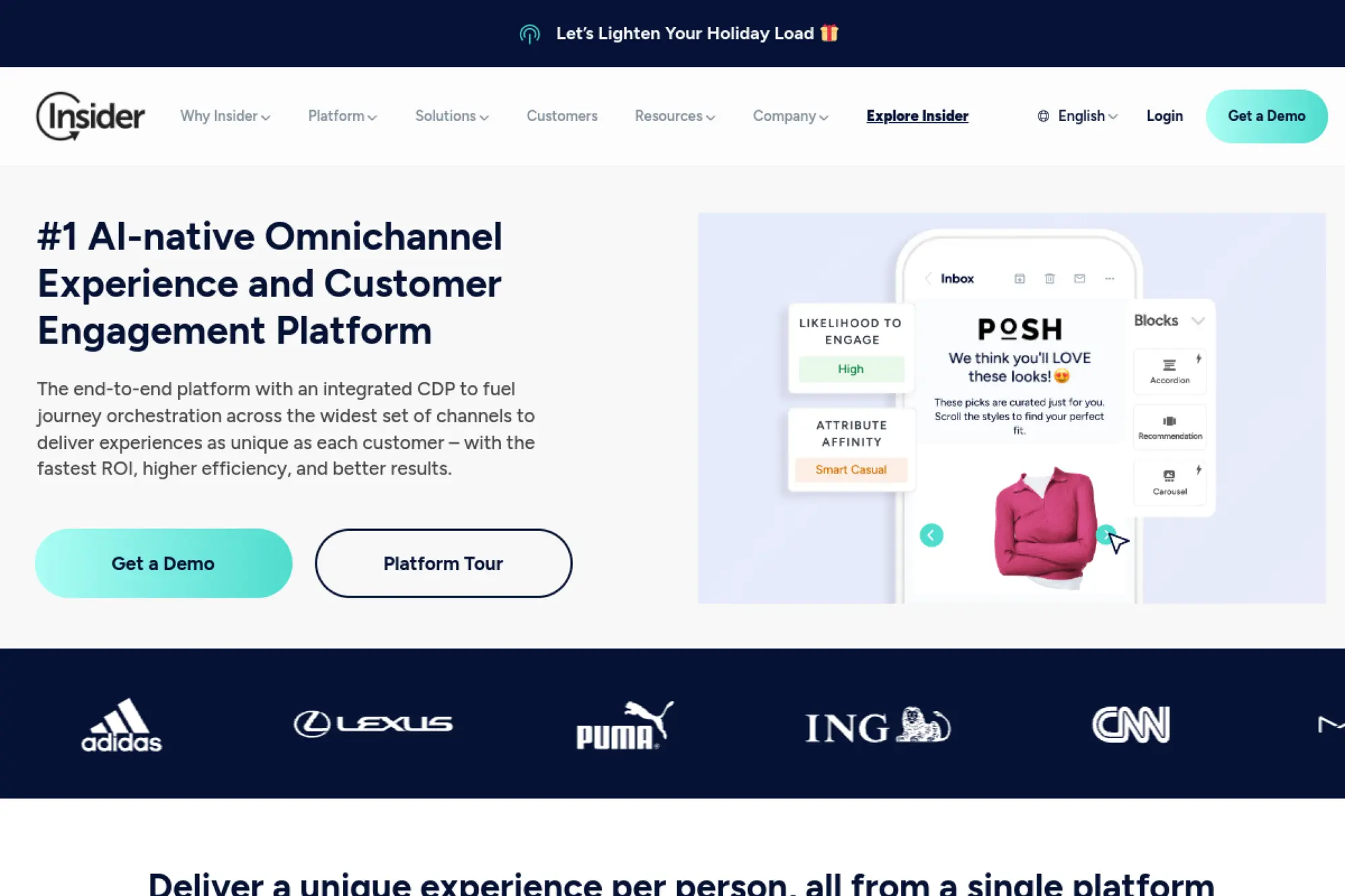
Insider targets retail, travel, and media brands with personalization and journeys. The company employs an estimated 1,000+ people and has operated since 2012. Headquarters reflect a global footprint with strong presence in Singapore and Europe.
Industry buzz often highlights rapid experimentation and onsite conversion. Awards are omitted here within the link policy boundaries. Practitioners value cross-channel orchestration and experimentation agility.
Insider unifies profiles and product data for recommendations and messages. On-site overlays, push, and email are coordinated from one interface. Real-time triggers support cart recovery and browse abandonment use cases.
Ideal buyers want immediate lift without building heavy data pipelines. Retail and travel companies with many campaigns see quick returns. Teams with small data staff still achieve solid outcomes.
21. ContactPigeon
ContactPigeon serves mid-market ecommerce with onsite and multichannel messaging. The company employs an estimated 50–100 people and has operated since 2015. Headquarters are in Athens, supporting European customers.
Regional recognition focuses on ecommerce growth use cases. We do not enumerate awards given the no-link requirement. Our view emphasizes usability for lean teams.
The platform provides product feeds, segments, and automated campaigns. On-site engagement pairs with email and SMS for lifecycle goals. Profiles help connect catalog changes to personalized outreach.
Ideal buyers are regional retailers seeking measurable lifts. Mid-market teams without deep engineering support fit well. Merchandising and marketing can operate with minimal technical overhead.
22. FullStory
FullStory serves product and growth teams with digital experience analytics. The company employs an estimated 500+ people and has operated since 2014. Headquarters are in Atlanta, with global customers.
Industry commentary often praises its DXI leadership. We omit award listings here as links are restricted. Experiments and product iterations benefit from the insights it surfaces.
Session replay, funnels, and error details expose friction in journeys. Data exports and integrations feed warehouses and CDPs. This pairing turns qualitative signals into quantitative segment triggers.
Ideal buyers are product-led companies that crave evidence, not hunches. SaaS and ecommerce teams use insights to refine journeys fast. Privacy-minded teams should configure capture rules carefully.
23. Planhat
Planhat serves B2B companies with customer success operations and revenue retention. The company employs an estimated 200+ people and has operated since 2014. Headquarters are in Stockholm, serving global customers.
Recognition centers on customer success innovation and usability. We will not list awards due to the link constraint. Our analysis considers data model flexibility across accounts and users.
Planhat unifies product usage, CRM, and support data into health scores. Playbooks and alerts align teams on expansion and churn prevention. Data connectors bring warehouse and billing data into the workflow.
Ideal buyers are B2B SaaS firms running scaled success motions. Mid-market teams who value flexible data models fit well. Leaders seeking predictive retention also benefit from the approach.
24. Leadspace
Leadspace targets B2B revenue teams with enrichment and account-based data. The company employs an estimated 100+ people and has operated since 2007. Headquarters are in San Francisco, with Israel-based roots.
Analyst discussions often cite its B2B graph and account intelligence. We avoid award claims under the no-link policy. Clear business outcomes matter more than plaque collections.
The platform builds unified buying-center views across systems. Enrichment and scoring improve targeting and routing across channels. Integrations connect with CRMs, MAPs, and warehouses for activation.
Ideal buyers are B2B marketers and ops leaders pursuing account-based programs. Data-driven SDR and marketing teams gain efficiency. Enterprises with complex hierarchies see particular value.
25. Zeta Global
Zeta Global serves large enterprises across retail, travel, and financial services. The company employs an estimated 1,500+ people and has operated since 2007. Headquarters are in New York, with broad global reach.
Coverage often references data assets and activation breadth. Awards are not listed here due to link constraints. Our evaluation emphasizes measurable impact and governance controls.
Zeta’s platform unifies identity, channels, and measurement for enterprise programs. Predictive models help allocate spend across audiences and offers. Integrations extend into paid media, email, and onsite experiences.
Ideal buyers manage large budgets and demand proven scale. Retail and financial services teams value its reach and controls. Organizations with centralized marketing operations see strong adoption.
26. Convertlab Digital Marketing Hub
Convertlab serves Asia-based enterprises with omnichannel marketing and data unification. The company employs an estimated 200+ people and has operated since 2015. Headquarters are in Shanghai, with regional delivery.
Regional recognition highlights strong messaging workflows. We do not list awards to respect the link rule. Cross-border teams often value local channel support.
The hub integrates WeChat, SMS, email, and web experiences. Profiles merge behavior and consent to drive segmentation. Reporting links campaigns to conversions across regional ecosystems.
Ideal buyers are Asia-focused brands with local channel needs. Retail and finance see value from regional personalization. Multinational teams must plan data residency and compliance early.
27. Upland BlueVenn
Upland BlueVenn serves marketers needing segmentation and analytics at scale. They employs an estimated 1,000+ people, and BlueVenn has operated since the early 2000s. Headquarters for Upland are in Austin, with BlueVenn heritage in the UK.
Mentions point to long-standing work in segmentation and data quality. Awards are excluded here within the link policy limits. Stability and mature features define the offer.
BlueVenn supports audience creation, cleansing, and campaign execution. The model unifies household and individual views for better targeting. Integrations connect to email, direct mail, and digital channels.
Ideal buyers are established brands with legacy data complexity. Retail, financial services, and nonprofits often fit the profile. Teams value predictable tooling and strong governance support.
28. Google BigQuery
BigQuery underpins data stacks across many industries, including retail and media. Google employs 180,000+ people and has operated since 1998. Headquarters are in Mountain View, with global cloud infrastructure.
Recognition centers on serverless scale and integration ecosystem. We do not list awards without links, per the constraint. Reliability and cost predictability drive adoption at scale.
Columnar storage, partitioning, and slots deliver fast analytical queries. Native features like row-level security enable governed sharing. Event data lands cheaply, then activation runs through reverse ETL or apps.
Ideal buyers embrace a composable CDP where the warehouse is the core. Data teams who prefer SQL-first approaches find high leverage. Marketing gains accuracy from a single source of truth.
29. Snowflake
Snowflake powers modern data platforms across nearly every industry. The company employs an estimated 6,000+ people and has operated since 2012. Headquarters are in Bozeman, with global engineering and field teams.
Industry narratives highlight near-infinite elasticity and a growing application ecosystem. Awards are not enumerated here due to the link rule. Our focus rests on governance patterns and zero-copy data sharing.
Separation of storage and compute enables elastic workloads for CDP use cases. Features like secure data sharing and native apps reduce copies. Identity tables, streams, and tasks support near real-time profile updates.
Ideal buyers want composable CDPs governed in one warehouse. Data and marketing teams share a single truth and activate through integrations. Ready to map this to your growth goals today?
30. Databricks
Databricks powers modern data and AI platforms across industries. Founded in 2013 by the original creators of Apache Spark, the company is headquartered in San Francisco and serves thousands of customers, including over 60% of the Fortune 500.
Industry narratives center on its lakehouse architecture and, more recently, the Databricks Data Intelligence Platform that fuses governance, analytics, and generative AI on one foundation. We’ll skip the awards and logo parade in line with the link rule and stay focused on how that stack reshapes data sharing and activation.
At the core, a lakehouse model merges data lake flexibility with warehouse-style reliability so batch, streaming, BI, and ML workloads share the same governed storage. Around that core, Delta Lake, Unity Catalog, MLflow, and Lakehouse AI bring table versioning, access controls, ML lifecycle, and generative AI closer to the raw data—minimizing copies while still enabling CDP-like audiences, features, and real-time signals.
Ideal buyers want an open, composable base where data, marketing, and product teams share one behavioral truth and activate via downstream tools instead of fragmenting it across multiple CDPs. If you’re architecting a growth stack that treats warehouse, lake, and AI as one continuum, Databricks is designed to sit at that center of gravity—ready to map against your roadmap today.
What are customer data platforms and why they matter
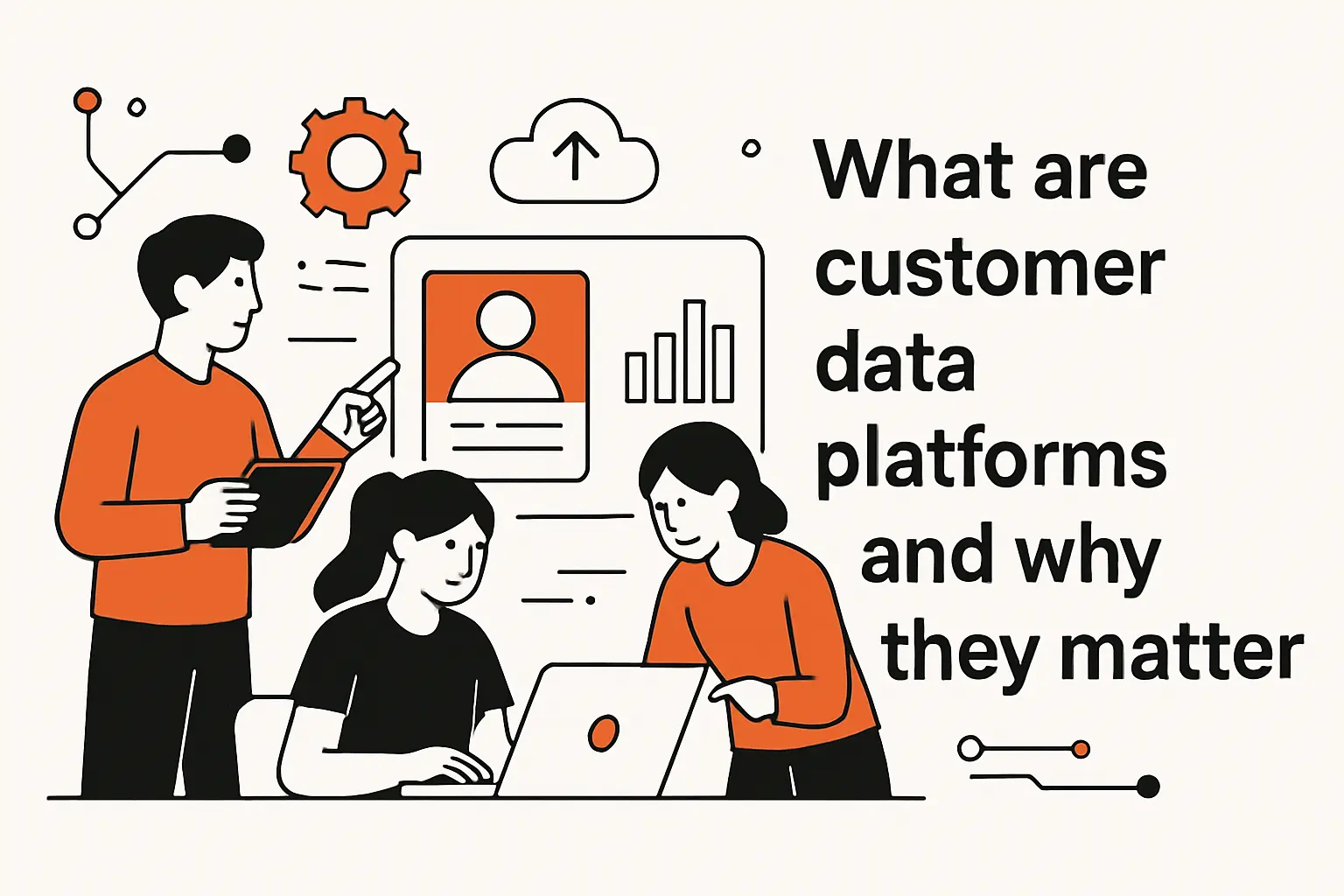
The data flood is not a metaphor; it is a design constraint. Analysts expect 55.9 billion connected devices by 2025, which multiplies identities, signals, and noise. We have watched teams struggle with brittle point integrations and overlapping tools. CDPs arose to tame this sprawl. They unify events and attributes, resolve identities, and activate audiences. That is not hype; it is an architecture choice that pays for itself when execution shortens cycles and removes waste.
1. Customer data platforms defined unified profiles and activation
We define a customer data platform as packaged software that ingests first-party data, builds persistent profiles, and activates audiences. The “platform” part matters because repeatable data products beat bespoke pipelines. Unified profiles give every team the same customer context. Activation moves that context to channels without handoffs and delays. Our view favors pragmatic scope. If a feature does not improve profile quality or activation speed, it belongs elsewhere.
2. How customer data platforms work collect harmonize activate and generate insights
Collection starts with event capture and batch onboarding from core systems. Harmonization maps sources to a standard model and flags quality issues early. Identity resolution stitches anonymous and known interactions into a timeline that reflects reality. Activation pushes segments and traits to destinations that care. Insights ride along as features, not detours, because the best analytics also powers action. We design flows where data moves once, then fans out predictably.
3. Single source of truth and real-time customer profiles
Truth is not a database; it is a guarantee. We promise that each customer record is consistent across teams and tools. A CDP keeps this promise by owning identity, lineage, and entitlements. Real time does not mean everything streams. It means the right state is available when a decision happens. Speed without trust is chaos; trust without speed is missed revenue. Great platforms balance both with caching, micro-batches, and thoughtful fallbacks.
4. Core outcomes personalization suppression insights and ROI
We judge CDPs by four outcomes. Personalization that raises relevance without creepiness. Suppression that stops paying to reach customers you already have. Insights that drive better creative, timing, and offers. Finally, measurable return through incremental tests and channel harmonization. Many teams begin with suppression. Savings land quickly, trust grows, and momentum builds toward richer use cases.
5. Mandatory CDP capabilities profile unification data collection analytics activation
Mandatory means table stakes. We expect durable identity graphs, flexible schemas, consent-aware collection, segment builders that marketers can use, and activation that does not break downstream contracts. Analytics should reveal journeys and propensities without forcing another data export. Anything less increases tickets and slows learning. We also insist on transparent logs and replay options because audits are inevitable.
6. First-party data focus and privacy-by-design
Third-party cookies fade. Consent expands across jurisdictions and channels. First-party data, gathered with clear value exchange, becomes the differentiator. Privacy-by-design is not a checkbox; it shapes models, retention, and governance. We embed consent states into profile computation. We also window sensitive traits and minimize payloads sent to destinations. Trust, once broken, is hard to restore, so the platform must never forget the legal basis of every attribute.
7. Built for marketing teams with minimal engineering dependence
Marketers should ask data teams for frameworks, not favors. A CDP delivers self-serve workflows for audience building, testing, and orchestration. Engineering partners provide guardrails, models, and observability. This division of labor accelerates time to value. We coach teams to avoid over-customization early. Ship the essentials, validate impact, then enrich. The fastest path to adoption is showing that the platform reduces toil within the first quarter.
Core components and capabilities of customer data platforms
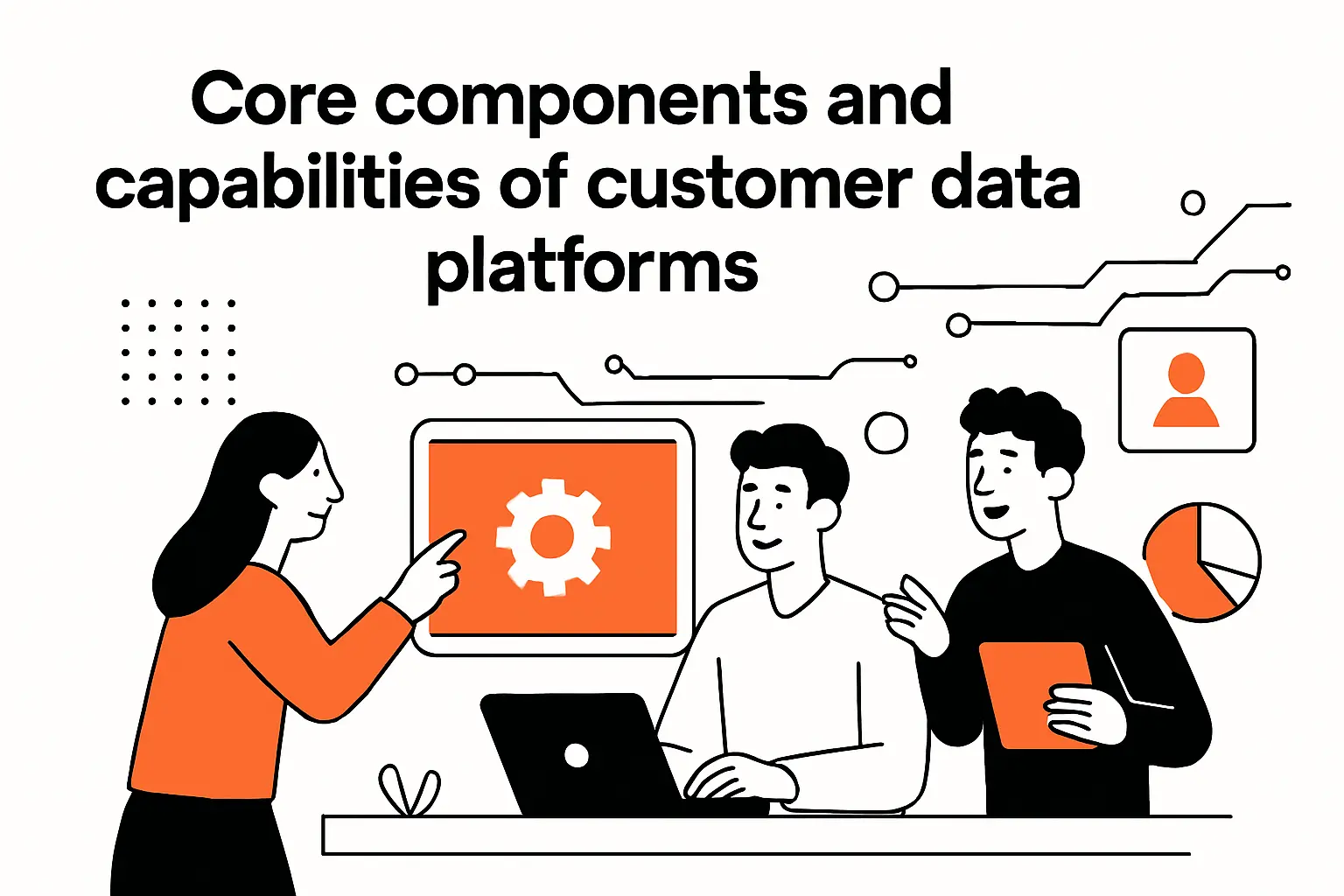
Capabilities matter more when budgets tighten. Marketing budgets fell to 7.7% of overall company revenue in 2024, which makes focus nonnegotiable. We see winning stacks concentrate on ingestion, identity, audience design, activation, measurement, and governance. Everything else supports those loops. Our advice is simple. Cut novelty, keep compounding assets, and automate the boring parts.
1. Event collection SDKs and server-side capture
Robust SDKs reduce instrumentation drift and missing context. Server-side capture protects against client blockers and improves governance. We standardize event naming and enforce payload contracts. Teams often forget the long-tail of sources. Kiosks, IVR, and offline systems hold signals that matter. Capture them early and annotate with consent and purpose. Clean collection lowers identity ambiguity later.
2. Identity resolution to stitch anonymous and known interactions
Identity is the beating heart of a CDP. Deterministic keys anchor accuracy. Probabilistic methods reconcile messy reality without inflating merges. We always include explainability. Stakeholders must understand why records merged or split. That transparency prevents silent errors from polluting campaigns. Golden profiles should be reversible, with lineage that survives audits and new policies.
3. Audience management and segmentation without SQL
Marketers need to explore hypotheses without tickets. A visual segment builder encourages experimentation and faster iteration. We push teams to define eligibility, exclusions, and holdouts together. That habit creates consistent tests across channels. Labels for recency, frequency, and monetary behaviors remain useful. Just augment them with lifecycle and propensity traits for nuance.
4. Data activation to downstream tools and channels
Activation determines perceived value. We design connectors that honor rate limits, schemas, and privacy scopes. Destinations should receive deltas, not full reloads, to reduce cost and risk. Feedback loops matter as much as pushes. Bring delivery, opens, clicks, and conversions back for learning and attribution. Activation without learning wastes signals and slows improvement.
5. Unified profiles and a single source of truth
Profiles unify identifiers, traits, consents, and events in a coherent model. We separate immutable facts from computed features. That distinction keeps changes predictable. Documenting the contract for each attribute avoids later confusion. Teams that standardize profile traits unlock reuse across campaigns and analytics. Reuse is the quiet multiplier in data work.
6. Real-time processing and engagement
Streaming unlocks responsive experiences. We advocate hybrid processing. Stream the few signals that drive decisions; batch the rest for cost efficiency. Cached traits enable subsecond lookups during key moments. Shared state between web, app, and service channels prevents contradictory experiences. Real time deserves a business case, not a slogan.
7. Analytics and reporting on customer behavior
Insights should live near activation. Journeys, cohorts, and contribution analysis help teams prioritize. We discourage vanity dashboards. Choose metrics that drive choices, not applause. When analytics flow back into segments and offers, the loop becomes self improving. We like simple propensity scores paired with creative that respects intent.
8. AI and machine learning for predictions and next-best actions
Machine learning expands what segments can express. Churn risk, product affinity, and next-best action convert static rules into adaptive flows. We embed model cards and bias checks into publishing. Models must degrade gracefully and never block a message that compliance requires. Feature stores connected to the CDP reduce copy-and-paste modeling.
9. Pre-built integrations across sources and destinations
Integrations are force multipliers. We prioritize connectors for ad platforms, email, push, SMS, and customer support. Commerce, subscription, and billing systems provide essential context. We recommend versioning connectors so breaking changes do not ripple. A platform with strong integration coverage reduces custom glue and speeds experimentation.
10. Privacy consent and governance controls
Consent is a first-class field in our designs. Capture provenance, scope, and timestamps. Enforce purpose-based access for traits and events. The platform should filter data by jurisdiction and use case. Automated policy checks prevent accidental overreach. Privacy features are not friction; they are brand assets in a skeptical world.
11. Data quality and enrichment workflows
Quality fails quietly until a campaign stumbles. We implement validators, anomaly alerts, and backfills as part of normal operations. External enrichment helps when responsibly sourced and transparently mapped. Confidence scores and freshness indicators allow teams to judge suitability. Good data improves creative, not only targeting.
Types of customer data platforms and architectures
Architectural gravity favors cloud spending and shared data foundations. Analysts forecast that 90% of new CRM marketing software spend will be cloud-based by 2027, which explains the surge in warehouse-native approaches. We advise clients to choose based on control, latency, and skills. The right answer blends packaged strength with existing data investments. Vendor selection then becomes an exercise in fit, not fashion.
1. Traditional CDPs packaged data and marketing features
Traditional platforms bundle ingestion, identity, segmentation, and orchestration into one product. They suit teams that want speed and a coherent interface. Tradeoffs include less visibility into internals and potential duplication with your warehouse. We like this path for companies beginning their data journey. It delivers wins fast, especially around suppression and lifecycle triggers.
2. Composable CDPs built on the data warehouse
Composable patterns compute in your warehouse and push only what destinations need. Reverse ETL tools and headless identity services enable this approach. The promise is governance, flexibility, and cost control. The risk is accidental complexity when every piece requires tuning. We encourage a reference architecture, clear ownership, and packaged components where it counts.
3. Hybrid CDPs warehouse-compatible bundles
Hybrid platforms recognize that few teams are all-in on one model. They interoperate with warehouses, offer embedded activation, and expose APIs for custom work. This middle path lets marketing move while data engineering standardizes. We often place identity and consent in the platform, then compute advanced features in the warehouse.
4. Infrastructure CDPs for data engineering teams
Infrastructure-first options provide SDKs, pipelines, and identity as code. They shine when engineering wants deep control and observability. The learning curve is steeper for marketers. We mitigate that gap by adding a lightweight audience UI and curated templates. This design respects engineering preferences without sacrificing marketer speed.
5. Marketing cloud CDPs within larger suites
Suites promise tight integration across channels and analytics. They fit organizations already standardized on the vendor’s ecosystem. Benefits include shared governance, consolidated procurement, and roadmap clarity. Drawbacks include slower integration with external tools and potential lock-in. We evaluate these options carefully against neutral platforms and composable stacks.
Representative Platforms: Top 30
- Adobe Real-Time CDP
- Salesforce Data Cloud
- Oracle Unity Customer Data Platform
- Microsoft Customer Insights
- SAP Customer Data Cloud
- Twilio Segment
- mParticle
- Tealium AudienceStream
- Treasure Data
- Amperity
- ActionIQ
- BlueConic
- Lytics
- Simon Data
- Bloomreach Engagement
- Acquia CDP
- Zeotap
- Redpoint Global rgOne
- Optimove
- Lexer
- Ometria
- Blueshift
- RudderStack
- Hightouch
- Snowplow
- Zeta CDP
- SAS Customer Intelligence 360
- Algonomy
- Commanders Act
- Leadspace
CDP vs CRM vs DMP vs data warehouses
Context clarifies choices. The CRM market is massive, growing to $107 billion in 2023, yet CRM is not built for omni-source identity stitching or channel-neutral activation. DMPs chased third-party segments and have faded with signal loss. Warehouses anchor analytics and governance but require activation scaffolding. CDPs bridge these domains by reconciling identity and pushing audiences everywhere. That bridge is the point.
1. CDP vs CRM purpose data scope and activation
CRM systems center on relationships created during sales and service. They excel at workflows, forecasting, and case handling. A CDP consolidates behavioral, transactional, and consent data from every surface. It then activates that profile across paid and owned channels. We integrate both. The CRM remains the system of record for account activities, while the CDP fuels relevancy outside the salesperson’s day.
2. CDP vs DMP identity first-party focus and storage duration
DMPs specialized in anonymous audiences built from third-party cookies. That world is shrinking. CDPs prioritize first-party consented data and persist profiles far longer. The result is stable identity, better attribution, and defensible governance. We still sync with clean rooms and ad platforms. We simply avoid fragmenting identity logic between systems.
3. CDP vs data warehouse agility activation and self-serve segmentation
Warehouses store the universe; CDPs curate the cosmos. A CDP wraps self-serve segmentation, identity services, and privacy controls around your data. That wrapper lets business teams act without waiting on SQL and tickets. We keep heavy analytics and machine learning in the warehouse. The CDP publishes the features that downstream tools need.
4. Where customer data platforms fit with marketing automation analytics and BI
Marketing automation tools orchestrate messaging. Analytics and BI explain performance and guide planning. The CDP supplies audiences, traits, and eligibility rules to both. When connected well, you stop copying lists and start shipping experiments. That shift reduces errors and aligns goals. Everyone works from a shared understanding of the customer.
Use cases and outcomes powered by customer data platforms
Leaders invest in CDPs for practical gains. Personalization drives measurable impact, with improvements often reaching 10 to 15 percent revenue lift when teams execute well. We have seen the same pattern. Suppression yields fast savings. Lifecycle journeys lift retention. Product recommendations increase order value. Better insights then inform creative and offer design.
1. Personalization and targeted marketing at scale
Profiles power experiences that feel timely and human. We blend behavioral signals with lifecycle stages to pick messages that respect intent. Real results come from pairing segments with creative that addresses needs. CDPs make that repeatable by standardizing traits and eligibility. Teams move from ad hoc rules to scalable playbooks.
2. Omnichannel customer experience consistency
Consistency is loyalty’s quiet engine. We propagate the same entitlements and recent actions across web, app, email, and support. When a customer solves an issue in one channel, other channels should reflect that immediately. This reduces frustration and support cost. It also builds goodwill that promotions alone cannot buy.
3. Paid media optimization and ad suppression
Paid media budgets leak when you target existing customers with acquisition ads. Suppression recovers that waste. A CDP keeps the list fresh and jurisdiction aware. We also sync conversion signals back to platforms for smarter bidding. Savings emerge fast and create air cover for deeper personalization work.
4. Customer journey analytics and attribution
Attribution debates cool when teams align on a shared timeline. The CDP provides that backbone, linking touchpoints to events that matter. We prefer incremental testing over fragile last-click logic. Simple experiments, run continuously, clarify which channels persuade and which simply follow demand. That clarity allocates budgets better.
5. B2B account-based marketing and account-level profiles
Account-level views change the conversation. We roll up intent, contacts, and product usage into a composite profile. Sales sees which plays fit, while marketing scores engagement across buying centers. Coordinated outreach then lands with relevance. The handoff between marketing and sales becomes orchestration, not a baton drop.
6. Sales enablement with real-time customer insights
Sales teams thrive on context. We surface recent product behavior, support signals, and marketing interactions inside the tools they use daily. Alerts highlight moments to act, not just dashboards to admire. Good CDPs translate events into guidance that shortens cycles and improves conversion quality.
7. Customer support personalization and faster resolution
Support agents should know who they are helping before a ticket opens. Profiles reveal purchased products, active trials, and recent frustrations. That context allows faster resolution and thoughtful gestures. Service teams then become partners in retention, not just problem solvers. The CDP closes loops by returning outcomes to the profile.
8. Privacy compliance consent management and governance
Compliance succeeds when systems do not rely on heroic effort. We build consent-aware segmentation and activation that respects data minimization. Audit trails show who accessed what and why. Regional rules flow into profile computation and export policies. Transparency reduces risk and invites trust.
9. Real-time engagement recommendations and next-best action
Next-best action is a process, not a magic model. We start with simple rules informed by value and risk. Models then refine targeting and timing. Decisioning engines connected to the CDP orchestrate across channels. The best experiences combine restraint with relevance. Silence can be the most respectful action.
How TechTide Solutions helps you build custom customer data platform solutions
Execution sits at the intersection of data, design, and trust. Security incidents are rising, with 48% reporting at least one in the past year. That reality shapes our delivery approach. We align stakeholders on value, build the right architecture, and institutionalize governance. Our clients ship faster because they agree on why the platform exists and how success is measured.
1. Custom CDP discovery solution design and vendor selection aligned to your goals
We begin with discovery that maps outcomes to capabilities. Current-state systems, data quality, and consent handling guide choices. Vendor selection is a short list matched to constraints and skills. Demos focus on actual use cases, not slideware. We document tradeoffs, so teams choose eyes wide open. That alignment saves rework later.
2. Composable warehouse-native builds data modeling identity resolution and activation
For data-forward companies, we build warehouse-native flows. Identity services live near your data, with deterministic anchors and explainable merges. Reverse ETL distributes traits to destinations with observability. Where packaged services are faster, we integrate them and keep models in your control. This approach respects existing investments and unlocks faster experimentation.
3. Integration data governance and ongoing optimization across your martech stack
Integration is a program, not a project. We add monitoring, cost controls, and change management to keep the stack healthy. Governance frameworks define who can publish traits, create segments, and push to destinations. Quarterly reviews trim dead segments, update models, and refresh playbooks. Continuous improvement compounds value over time.
Conclusion and next steps for customer data platforms
CDPs are not silver bullets; they are leverage. The market rewards teams that connect identity, consent, and activation into reliable loops. Budgets ebb and flow, yet customer expectations climb steadily. A pragmatic roadmap, disciplined governance, and a bias to experiment will beat grand designs that never ship. We have seen this across industries and maturities.
1. Readiness checklist people data and process
Start with people. Name an executive sponsor and a cross-functional working group. Confirm data ownership for key systems and attributes. Document consent capture and revocation paths. Align on a minimal schema for profiles and events. Define who decides on identity merge rules and exceptions. Readiness reduces friction when choices get hard.
2. RFP criteria and vendor evaluation essentials
Prioritize identity transparency, consent-native design, and activation breadth. Demand strong connectors to your core stack and the ability to add new ones quickly. Evaluate real-time needs with clear benchmarks. Insist on audit trails and lineage views. Ask vendors to prove how they handle schema drift and destination failures. References should reflect your use cases, not just your industry.
3. Implementation roadmap from pilot to scale
Phase work to deliver value early. Begin with high-confidence suppression and lifecycle triggers. Add identity complexity as quality improves. Move toward personalization and decisioning once feedback loops work. Keep stakeholders close with frequent demos and shared scorecards. Scale only after basic hygiene is reliable and repeatable.
4. Measurement KPIs total cost of ownership and ROI tracking
Measure what compounds. Track incremental revenue and reduced media waste. Watch deliverability, list health, and unsubscribe trends. Monitor model performance with drift and fairness checks. Report on operational metrics that predict headaches, like data latency and failed pushes. These measures tell you when to optimize, where to expand, and what to pause.
If you want a sparring partner on architecture, sequencing, or vendor fit, we are ready to co-design your next move. Would you like a tailored workshop that maps your best three CDP use cases to a ninety-day plan?